 Add to Chrome
 Add to Firefox
 Add to Edge
Dual Modality Prompted Diffusion Priors for Zero Shot Hyperspectral Pansharpening
Aug 12, 2026
Hyperspectral pansharpening aims to reconstruct a high resolution hyperspectral (HRHS) image from a panchromatic (PAN) image and a low resolution hyperspectral (LRHS) image while preserving both spatial details and spectral fidelity. Recent diffusion based methods exploit pretrained image priors by generating a low dimensional representation and subsequently mapping it to the hyperspectral domain. However, the observed panchromatic and hyperspectral images are typically imposed only through external reconstruction objectives, limiting their direct interaction with the diffusion prior. To address this issue, we propose dual-modality image-prompted diffusion model (DIDM) for zero shot hyperspectral pansharpening. DIDM encodes the low resolution hyperspectral and panchromatic observations into spectral and spatial prompt tokens, respectively, and injects them into intermediate features of a frozen remote sensing diffusion model through cross attention, allowing complementary spectral and spatial information to directly guide diffusion feature evolution. In addition, we introduce a panchromatic guided weighted pixel aware total variation regularizer that combines low resolution hyperspectral degradation fidelity and panchromatic response fidelity with gradient adaptive structural regularization, thereby preserving structural discontinuities while suppressing spurious variations in homogeneous regions. Extensive experiments on Pavia, Chikusei, and Houston under reduced resolution protocols show that DIDM achieves the best performance across all evaluated metrics, while full resolution evaluation on FR1 yields the highest HQNR among the compared methods. These results demonstrate that internal dual modality prompting and panchromatic guided structural regularization provide an effective balance between spatial detail enhancement and spectral preservation.

GSPan: A Continuous Gaussian Primitive Representation for Arbitrary-Scale Pansharpening
Jun 16, 2026Pansharpening aims to generate high-resolution multispectral (HRMS) images by fusing low-resolution multispectral (LRMS) and panchromatic (PAN) observations. Most existing deep learning methods treat pansharpening as fixed-grid prediction, which limits scale adaptation. To address this, we propose GSPan, a framework that introduces 2D Gaussian Splatting (GS) into pansharpening. Instead of directly predicting pixels, GSPan represents band-wise residual details as continuous and learnable 2D Gaussian primitives. We design a Dual-Stream Hierarchical Interaction (DSHI) architecture with a Spatial-Spectral Interactive Attention (SSIA) module to estimate these primitives from complementary PAN and MS observations. The predicted primitives are rendered as a residual detail field and injected into the upsampled MS image. This continuous representation allows GSPan to render fused images on arbitrary target sampling grids without scale-specific retraining. It further enables a Scale-Decoupled Asymmetric Inference (SDAI) strategy, which estimates primitives at a reduced resolution and renders the fused image at the target resolution for efficient large-scene pansharpening. Experiments on QuickBird, GaoFen-2, WorldView-3, and WorldView-3-4K datasets show that GSPan delivers state-of-the-art fusion performance. Moreover, SDAI markedly accelerates inference, achieving a favorable trade-off between computational efficiency and fusion quality. Our results demonstrate the potential of continuous Gaussian residual representations as a flexible and scale-decoupled alternative to fixed-grid prediction.
Bridging the RGB-IR Gap: Consensus and Discrepancy Modeling for Text-Guided Multispectral Detection
Apr 13, 2026Text-guided multispectral object detection uses text semantics to guide semantic-aware cross-modal interaction between RGB and IR for more robust perception. However, notable limitations remain: (1) existing methods often use text only as an auxiliary semantic enhancement signal, without exploiting its guiding role to bridge the inherent granularity asymmetry between RGB and IR; and (2) conventional data-driven attention-based fusion tends to emphasize stable consensus while overlooking potentially valuable cross-modal discrepancies. To address these issues, we propose a semantic bridge fusion framework with bi-support modeling for multispectral object detection. Specifically, text is used as a shared semantic bridge to align RGB and IR responses under a unified category condition, while the recalibrated thermal semantic prior is projected onto the RGB branch for semantic-level mapping fusion. We further formulate RGB-IR interaction evidence into the regular consensus support and the complementary discrepancy support that contains potentially discriminative cues, and introduce them into fusion via dynamic recalibration as a structured inductive bias. In addition, we design a bidirectional semantic alignment module for closed-loop vision-text guidance enhancement. Extensive experiments demonstrate the effectiveness of the proposed fusion framework and its superior detection performance on multispectral benchmarks. Code is available at https://github.com/zhenwang5372/Bridging-RGB-IR-Gap.
A Benchmarking Protocol for SAR Colorization: From Regression to Deep Learning Approaches
Oct 12, 2023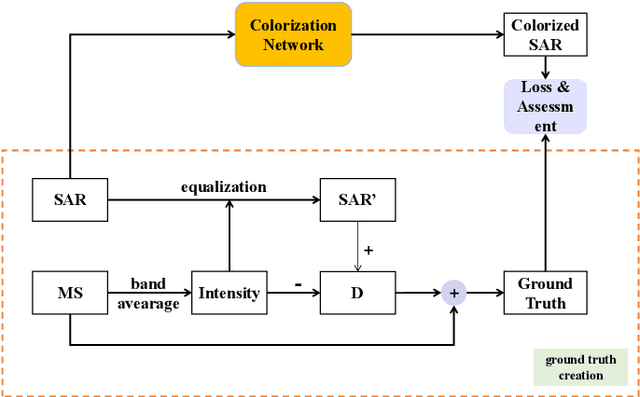
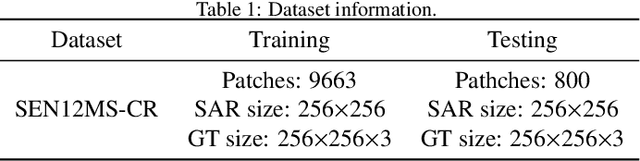
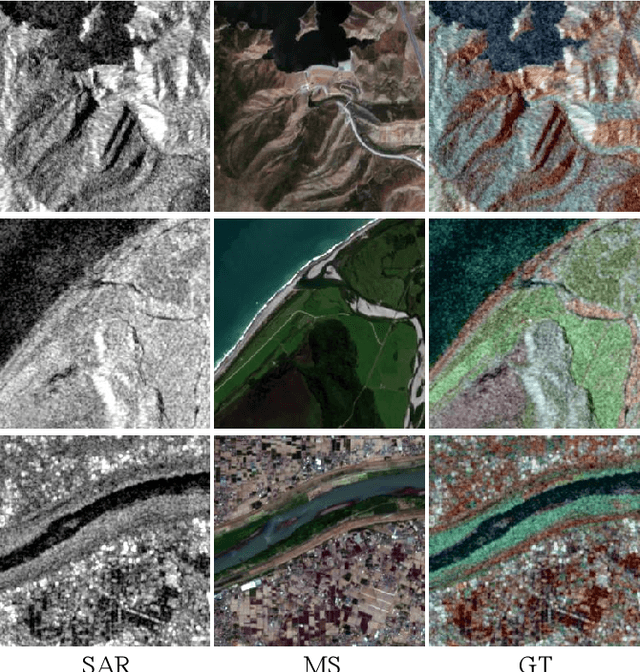
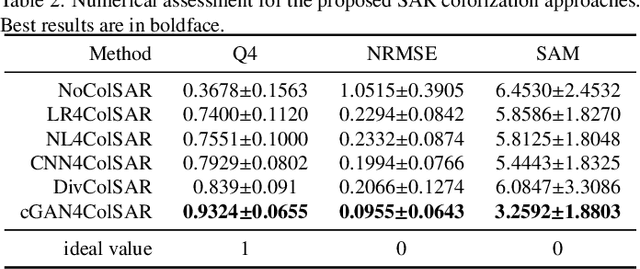
Synthetic aperture radar (SAR) images are widely used in remote sensing. Interpreting SAR images can be challenging due to their intrinsic speckle noise and grayscale nature. To address this issue, SAR colorization has emerged as a research direction to colorize gray scale SAR images while preserving the original spatial information and radiometric information. However, this research field is still in its early stages, and many limitations can be highlighted. In this paper, we propose a full research line for supervised learning-based approaches to SAR colorization. Our approach includes a protocol for generating synthetic color SAR images, several baselines, and an effective method based on the conditional generative adversarial network (cGAN) for SAR colorization. We also propose numerical assessment metrics for the problem at hand. To our knowledge, this is the first attempt to propose a research line for SAR colorization that includes a protocol, a benchmark, and a complete performance evaluation. Our extensive tests demonstrate the effectiveness of our proposed cGAN-based network for SAR colorization. The code will be made publicly available.