 Add to Chrome
 Add to Firefox
 Add to Edge
FlowPilot: Real-Time World-Action Modeling for Agile UAV Navigation
Aug 01, 2026
We present FlowPilot, a compact world-action model for real-time onboard UAV navigation from depth. Unlike map-then-optimize pipelines that require local reconstruction or end-to-end policies that lack explicit scene prediction, FlowPilot jointly denoises future depth observations and executable trajectories with flow matching. A dual-stream mixture-of-transformers couples video and action experts through shared attention, allowing future-scene prediction and trajectory generation to inform each other. At deployment, the model runs action-centrically and outputs only a trajectory. To ensure trackability, actions are parameterized as degree-7 Bernstein polynomials: the current state constrains the initial control points, and the network predicts five free control points, yielding C^2-continuous references with closed-form velocity, acceleration and jerk. FlowPilot is trained on a three-level depth pyramid spanning high-throughput simulation, photorealistic simulation, and real onboard data. In closed-loop simulation, it outperforms learning- and optimization-based baselines under increasing clutter and commanded speeds up to 8m/s. On a physical quadrotor, the full perception-to-action pipeline runs in under 18ms on a Jetson Orin NX and reaches 5.5m/s in cluttered indoor and forest environments using only onboard sensing and computation.

Fast Numbers, Slow Language: Bridging Quantitative and Qualitative Earnings Signals
Jun 29, 2026Earnings announcements release two types of information sequentially: quantitative surprise (numeric earnings-per-share (EPS)/revenue versus analyst estimate) arrives first in press releases and financial news, processed by algorithmic traders within minutes; qualitative language (management tone, guidance, question-and-answer (Q&A) credibility) arrives 30-90 min later in the earnings conference call transcript (ECT), requiring human interpretation overnight. Financial economists have studied quantitative surprise for 50 years; natural language processing (NLP) researchers have studied qualitative ECT signals for a decade. Despite studying the same event, the two communities used incompatible frameworks: different targets (return vs. volatility), trading setups (long top-decile and short bottom-decile vs. trade-all), and metrics (return spread between top and bottom 20% (Q5-Q1) vs. mean squared error (MSE)), making direct comparison and connection challenging. We bridge these communities with EarningsInOne, the first corpus aligning earnings news, ECTs, and intraday and next-day prices across SP 1500 (broad U.S. equity universe, 2022-2025). Applying unified trading and evaluation tools to both signal types, we confirm a clean speed separation, fast numbers, slow language: quantitative surprise peaks at announcement and is largely eliminated by the next market open; qualitative ECT sentiment peaks on the next trading day, real and tradeable, but hidden under prior transcript-based evaluation that optimised sign-agnostic volatility with pointwise MSE.
MAD: Mapping-Aware World Models for Agile Quadrotor Flight
Jun 03, 2026Agile quadrotor flight in cluttered scenes requires more than a reactive mapping from a depth image to a control command: the vehicle must remember which regions have been observed, infer nearby occupied space, and act under partial visibility and tight latency. In this paper, we present Mapping-Aware Dreamer (MAD), a geometry-aware world model for vision-based quadrotor flight. Instead of using raw-image reconstruction as the main self-supervised objective, MAD learns recurrent latent dynamics that reconstruct robocentric occupancy and visibility grid maps together with proprioceptive states. This design forces the latent state to encode local geometry, visibility history, and ego-motion in a form that is directly relevant to collision avoidance. MAD is trained in DiffAero using a GPU-parallel map-construction module that provides high-throughput supervision for occupancy and visibility. The learned representation is used in three policy-learning modes: imagination-based MAD-Dreamer and feature-extractor variants based on PPO and SHAC. Across visual navigation and racing tasks, MAD-based agents achieve higher success rates, faster flight, and better cross-task transfer than corresponding vision-only baselines. The model also produces interpretable map predictions and accurate ego-motion estimates from depth observations. We further deploy the learned policy on a physical quadrotor with an Intel RealSense D435i and demonstrate safe indoor and outdoor flight under limited sensing, reaching 9.66 m/s in simulation and 5.05 m/s in real-world forest experiments. These results show that mapping-aware world models provide a practical middle ground between modular aerial navigation and end-to-end learning.
Double-Edged Sword or Sharp Tool? Designing and Evaluating Triadic LLM-Teacher Collaboration for K-12 Writing at Scale
May 28, 2026The double-edged sword of integrating Large Language Models (LLMs) requires an effective triadic collaboration mechanism among LLMs, teachers and students, especially for K-12 education. By developing a triadic collaboration system to support K-12 writing learning, a multidimensional evaluation framework grounded in Systemic Functional Linguistics and the suggestion trajectory tracing pipeline, this paper contributes a large-scale empirical dataset involving $57,954$ essays from $10,195$ students across $120$ schools over two years. Our findings confirm the efficacy of this system in improving writing quality through a strategic labor division: the LLM serves as a generative engine to mitigate teacher burnout, and the teacher acts as a pedagogical gatekeeper and bridge to guarantee feedback quality. While both LLM and teacher are critical for skill improvement, we uncover a ceiling effect where excessive linguistic expansion yields diminishing marginal utility. These suggest a dynamically adaptive LLM-teacher collaboration as student proficiency increases.
Same Company, Same Signal: The Role of Identity in Earnings Call Transcripts
Dec 23, 2024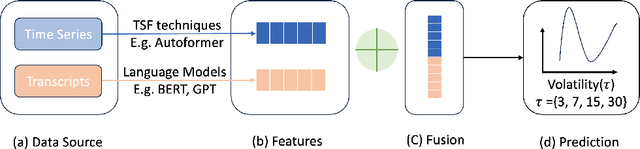



Post-earnings volatility prediction is critical for investors, with previous works often leveraging earnings call transcripts under the assumption that their rich semantics contribute significantly. To further investigate how transcripts impact volatility, we introduce DEC, a dataset featuring accurate volatility calculations enabled by the previously overlooked beforeAfterMarket attribute and dense ticker coverage. Unlike established benchmarks, where each ticker has only around two earnings, DEC provides 20 earnings records per ticker. Using DEC, we reveal that post-earnings volatility undergoes significant shifts, with each ticker displaying a distinct volatility distribution. To leverage historical post-earnings volatility and capture ticker-specific patterns, we propose two training-free baselines: Post-earnings Volatility (PEV) and Same-ticker Post-earnings Volatility (STPEV). These baselines surpass all transcripts-based models on DEC as well as on established benchmarks. Additionally, we demonstrate that current transcript representations predominantly capture ticker identity rather than offering financially meaningful insights specific to each earnings. This is evidenced by two key observations: earnings representations from the same ticker exhibit significantly higher similarity compared to those from different tickers, and predictions from transcript-based models show strong correlations with prior post-earnings volatility.
On the Role of Model Prior in Real-World Inductive Reasoning
Dec 18, 2024
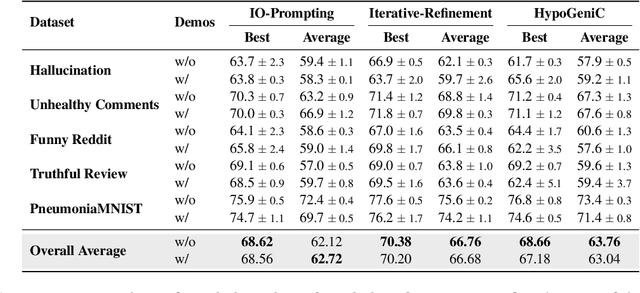


Large Language Models (LLMs) show impressive inductive reasoning capabilities, enabling them to generate hypotheses that could generalize effectively to new instances when guided by in-context demonstrations. However, in real-world applications, LLMs' hypothesis generation is not solely determined by these demonstrations but is significantly shaped by task-specific model priors. Despite their critical influence, the distinct contributions of model priors versus demonstrations to hypothesis generation have been underexplored. This study bridges this gap by systematically evaluating three inductive reasoning strategies across five real-world tasks with three LLMs. Our empirical findings reveal that, hypothesis generation is primarily driven by the model's inherent priors; removing demonstrations results in minimal loss of hypothesis quality and downstream usage. Further analysis shows the result is consistent across various label formats with different label configurations, and prior is hard to override, even under flipped labeling. These insights advance our understanding of the dynamics of hypothesis generation in LLMs and highlight the potential for better utilizing model priors in real-world inductive reasoning tasks.