 Add to Chrome
 Add to Firefox
 Add to Edge
METRO: Towards Strategy Induction from Expert Dialogue Transcripts for Non-collaborative Dialogues
Apr 14, 2026
Developing non-collaborative dialogue agents traditionally requires the manual, unscalable codification of expert strategies. We propose \ours, a method that leverages large language models to autonomously induce both strategy actions and planning logic directly from raw transcripts. METRO formalizes expert knowledge into a Strategy Forest, a hierarchical structure that captures both short-term responses (nodes) and long-term strategic foresight (branches). Experimental results across two benchmarks show that METRO demonstrates promising performance, outperforming existing methods by an average of 9%-10%. Our further analysis not only reveals the success behind METRO (strategic behavioral diversity and foresight), but also demonstrates its robust cross-task transferability. This offers new insights into building non-collaborative agents in a cost-effective and scalable way. Our code is available at https://github.com/Humphrey-0125/METRO.

Self-Supervised Contrastive Graph Clustering Network via Structural Information Fusion
Aug 08, 2024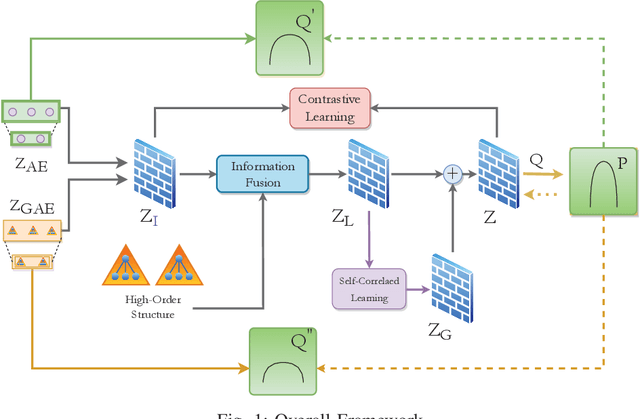
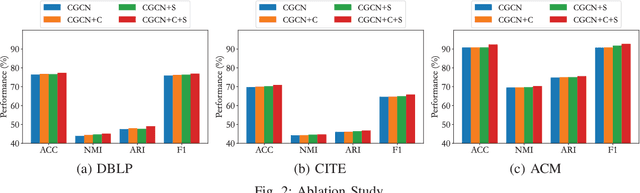
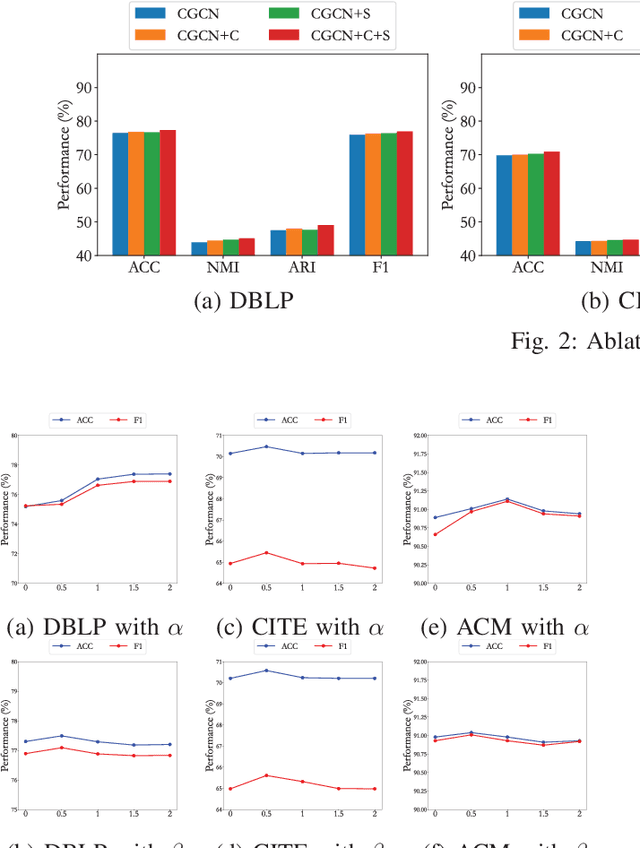
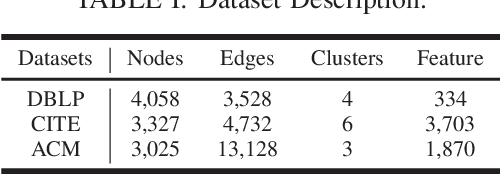
Graph clustering, a classical task in graph learning, involves partitioning the nodes of a graph into distinct clusters. This task has applications in various real-world scenarios, such as anomaly detection, social network analysis, and community discovery. Current graph clustering methods commonly rely on module pre-training to obtain a reliable prior distribution for the model, which is then used as the optimization objective. However, these methods often overlook deeper supervised signals, leading to sub-optimal reliability of the prior distribution. To address this issue, we propose a novel deep graph clustering method called CGCN. Our approach introduces contrastive signals and deep structural information into the pre-training process. Specifically, CGCN utilizes a contrastive learning mechanism to foster information interoperability among multiple modules and allows the model to adaptively adjust the degree of information aggregation for different order structures. Our CGCN method has been experimentally validated on multiple real-world graph datasets, showcasing its ability to boost the dependability of prior clustering distributions acquired through pre-training. As a result, we observed notable enhancements in the performance of the model.
* 6 pages, 3 figures