 Add to Chrome
 Add to Firefox
 Add to Edge
Limitations of Synthetic Data Generation in Specialized Data-Scarce Domains
Aug 13, 2026
Advances in diffusion-based generative models have motivated the use of synthetic image generation to alleviate data scarcity in vision tasks. While this strategy has shown promise in natural image benchmarks such as ImageNet, its effectiveness in sparse, high-variance real-world domains remains unclear. In this work, we focus on domains where images differ substantially from common image datasets and additional data are expensive to obtain. Against non-generative data augmentation baselines, we evaluate the downstream classifier performance improvements yielded by two schools of generative sparse data extension: distribution modeling and sample perturbation. Across five trauma classification tasks using subject-wise train--validation splits, no generative approach consistently outperforms a strong non-generative baseline. Feature-space analysis reveals recurring failure modes: memorization or collapse, distributional drift, and generation of visually plausible but simplified canonical instances that are easier to classify than real data.

Reward Bias Substitution: Single-Axis Bias Mitigations Redirect Optimization Pressure
May 27, 2026Single-axis mitigations of reward-model biases (e.g., reducing proxy reliance on length, sycophancy, or style) can rotate optimization pressure onto correlated proxies rather than eliminate it, a failure mode we call reward bias substitution. The failure is enabled by a measurement-versus-optimization gap between audit and policy-induced distributions during mitigation evaluation and policy training. We formalize mitigation outcomes into a regime taxonomy and prove that successful mitigation, bias substitution, and overcorrection produce identical observables under any audit-distribution scoring, including ranking accuracy and win-rate, even when granted oracle access to the true reward. Across published preference-learning mitigation work, no method we survey reports the evidence needed to certify successful mitigation. Augmenting evaluation with policy-induced distributions while tracking multiple biases provably closes the gap, and we translate this into actionable prescriptions for mitigation methods and benchmarks. We demonstrate bias substitution in language model RLHF, where a length penalty during GRPO training compresses responses as intended yet redirects optimization pressure onto confidence calibration, driving the policy into overconfidence while factual free-form accuracy falls. We also show a published length-debiasing operator that zeroes reward-length correlation on the audit distribution but reintroduces bias under best-of-N selection on three of four SOTA reward models, and a length-sycophancy coupling whose direction reverses under human-LLM judge disagreement.
Behavior-Consistent Deep Reinforcement Learning
May 21, 2026Reinforcement learning (RL) often exhibits high variance across training runs, leading to unreliable performance and posing a major challenge to deployment in real-world domains. In this work, we address the challenge of cross-run policy divergence by formalizing the problem of behavior-consistent RL, where the objective is to obtain policies that are both high-performing and distributionally similar across training runs. Our key observation is that maximum-entropy RL provides a direct mechanism for controlling behavioral divergence by anchoring runs to a common (uniform) prior. We prove that, for Boltzmann policies, choosing the temperature proportional to $Q$-function disagreement bounds the pairwise KL divergence between the induced policies. However, we also show that naïvely increasing entropy might impair policy optimization while amplifying off-policy error. Building upon these observations, we propose $Q$-value Expectile Disagreement (QED), a state-dependent temperature schedule that uses double-critic disagreement as a single-run proxy for cross-run disagreement. Empirically, we demonstrate that across 18 continuous-control tasks, QED reduces across-run divergence by two orders of magnitude without sacrificing performance, resulting in a considerable reduction in return variance at modest sample-efficiency costs.
Model Agreement via Anchoring
Feb 26, 2026Numerous lines of aim to control $\textit{model disagreement}$ -- the extent to which two machine learning models disagree in their predictions. We adopt a simple and standard notion of model disagreement in real-valued prediction problems, namely the expected squared difference in predictions between two models trained on independent samples, without any coordination of the training processes. We would like to be able to drive disagreement to zero with some natural parameter(s) of the training procedure using analyses that can be applied to existing training methodologies. We develop a simple general technique for proving bounds on independent model disagreement based on $\textit{anchoring}$ to the average of two models within the analysis. We then apply this technique to prove disagreement bounds for four commonly used machine learning algorithms: (1) stacked aggregation over an arbitrary model class (where disagreement is driven to 0 with the number of models $k$ being stacked) (2) gradient boosting (where disagreement is driven to 0 with the number of iterations $k$) (3) neural network training with architecture search (where disagreement is driven to 0 with the size $n$ of the architecture being optimized over) and (4) regression tree training over all regression trees of fixed depth (where disagreement is driven to 0 with the depth $d$ of the tree architecture). For clarity, we work out our initial bounds in the setting of one-dimensional regression with squared error loss -- but then show that all of our results generalize to multi-dimensional regression with any strongly convex loss.
Iterative Compositional Data Generation for Robot Control
Dec 20, 2025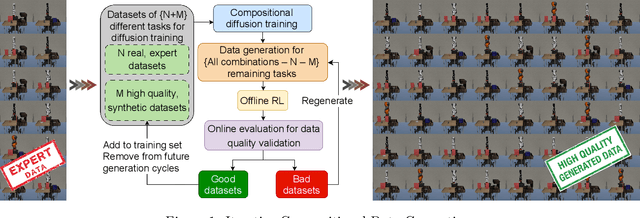
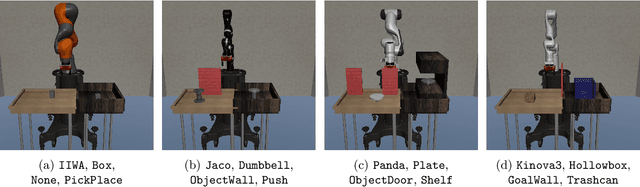

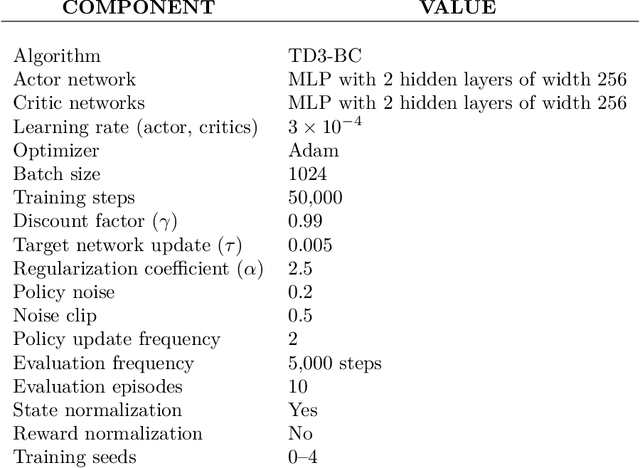
Collecting robotic manipulation data is expensive, making it impractical to acquire demonstrations for the combinatorially large space of tasks that arise in multi-object, multi-robot, and multi-environment settings. While recent generative models can synthesize useful data for individual tasks, they do not exploit the compositional structure of robotic domains and struggle to generalize to unseen task combinations. We propose a semantic compositional diffusion transformer that factorizes transitions into robot-, object-, obstacle-, and objective-specific components and learns their interactions through attention. Once trained on a limited subset of tasks, we show that our model can zero-shot generate high-quality transitions from which we can learn control policies for unseen task combinations. Then, we introduce an iterative self-improvement procedure in which synthetic data is validated via offline reinforcement learning and incorporated into subsequent training rounds. Our approach substantially improves zero-shot performance over monolithic and hard-coded compositional baselines, ultimately solving nearly all held-out tasks and demonstrating the emergence of meaningful compositional structure in the learned representations.
A Multi-Robot Platform for Robotic Triage Combining Onboard Sensing and Foundation Models
Dec 09, 2025
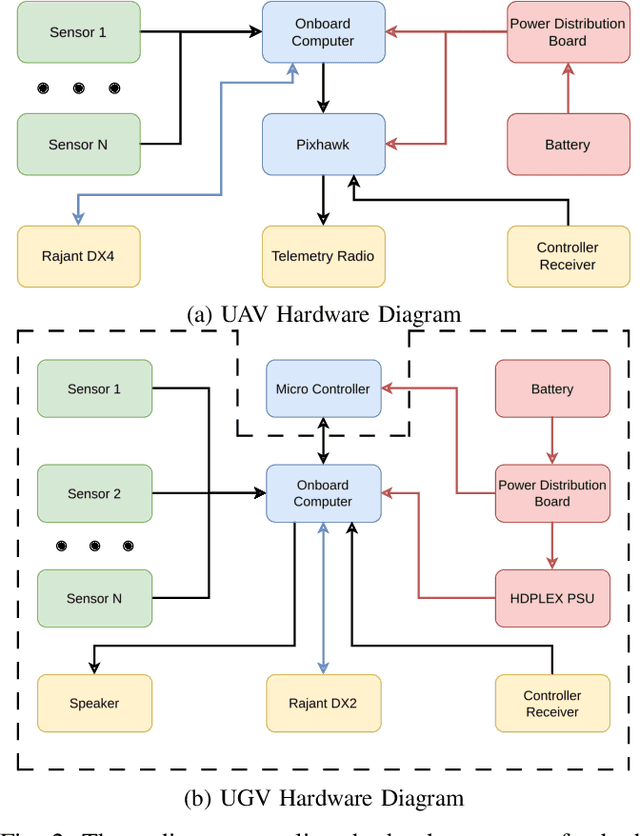
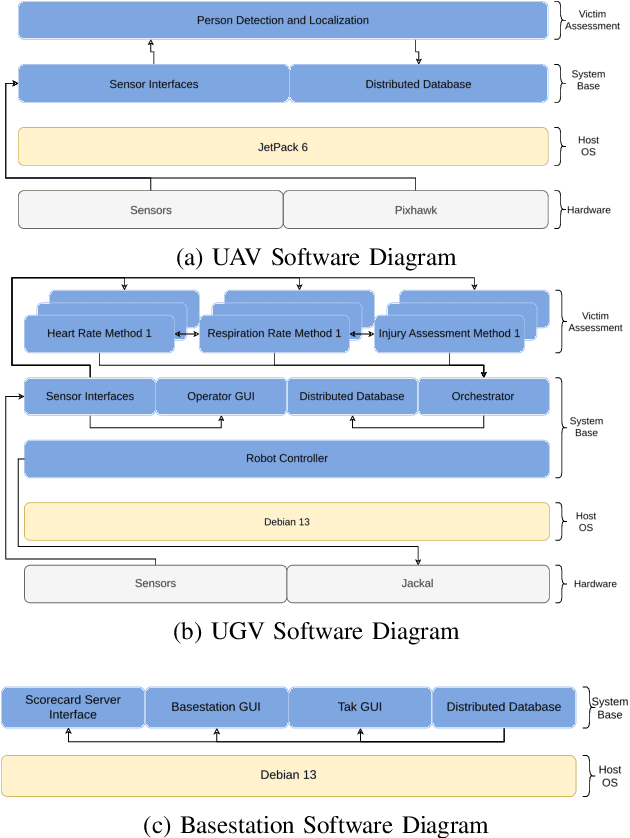
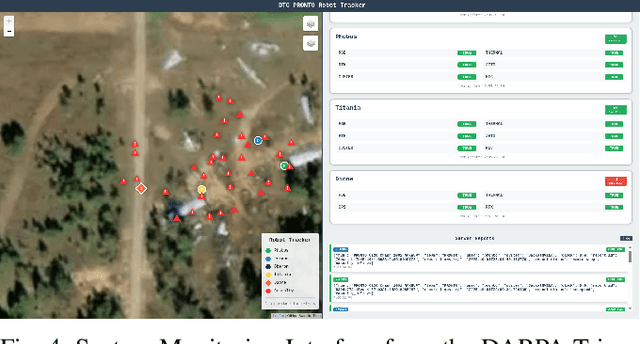
This report presents a heterogeneous robotic system designed for remote primary triage in mass-casualty incidents (MCIs). The system employs a coordinated air-ground team of unmanned aerial vehicles (UAVs) and unmanned ground vehicles (UGVs) to locate victims, assess their injuries, and prioritize medical assistance without risking the lives of first responders. The UAV identify and provide overhead views of casualties, while UGVs equipped with specialized sensors measure vital signs and detect and localize physical injuries. Unlike previous work that focused on exploration or limited medical evaluation, this system addresses the complete triage process: victim localization, vital sign measurement, injury severity classification, mental status assessment, and data consolidation for first responders. Developed as part of the DARPA Triage Challenge, this approach demonstrates how multi-robot systems can augment human capabilities in disaster response scenarios to maximize lives saved.
Replicable Reinforcement Learning with Linear Function Approximation
Sep 10, 2025Replication of experimental results has been a challenge faced by many scientific disciplines, including the field of machine learning. Recent work on the theory of machine learning has formalized replicability as the demand that an algorithm produce identical outcomes when executed twice on different samples from the same distribution. Provably replicable algorithms are especially interesting for reinforcement learning (RL), where algorithms are known to be unstable in practice. While replicable algorithms exist for tabular RL settings, extending these guarantees to more practical function approximation settings has remained an open problem. In this work, we make progress by developing replicable methods for linear function approximation in RL. We first introduce two efficient algorithms for replicable random design regression and uncentered covariance estimation, each of independent interest. We then leverage these tools to provide the first provably efficient replicable RL algorithms for linear Markov decision processes in both the generative model and episodic settings. Finally, we evaluate our algorithms experimentally and show how they can inspire more consistent neural policies.
Future Slot Prediction for Unsupervised Object Discovery in Surgical Video
Jul 02, 2025Object-centric slot attention is an emerging paradigm for unsupervised learning of structured, interpretable object-centric representations (slots). This enables effective reasoning about objects and events at a low computational cost and is thus applicable to critical healthcare applications, such as real-time interpretation of surgical video. The heterogeneous scenes in real-world applications like surgery are, however, difficult to parse into a meaningful set of slots. Current approaches with an adaptive slot count perform well on images, but their performance on surgical videos is low. To address this challenge, we propose a dynamic temporal slot transformer (DTST) module that is trained both for temporal reasoning and for predicting the optimal future slot initialization. The model achieves state-of-the-art performance on multiple surgical databases, demonstrating that unsupervised object-centric methods can be applied to real-world data and become part of the common arsenal in healthcare applications.
Intersectional Fairness in Reinforcement Learning with Large State and Constraint Spaces
Feb 17, 2025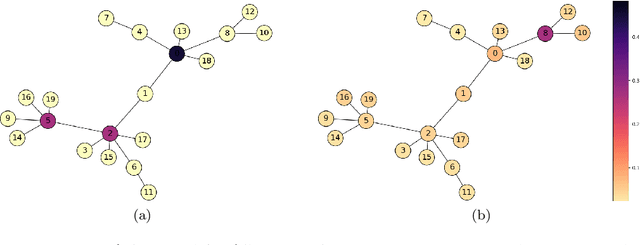
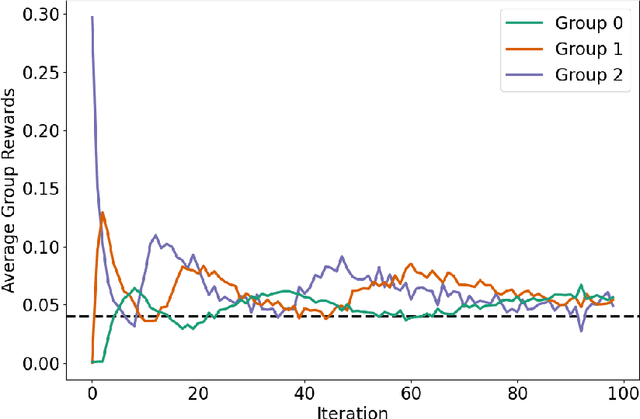
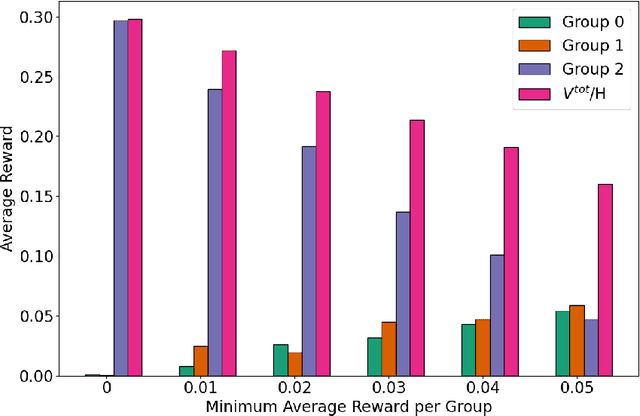
In traditional reinforcement learning (RL), the learner aims to solve a single objective optimization problem: find the policy that maximizes expected reward. However, in many real-world settings, it is important to optimize over multiple objectives simultaneously. For example, when we are interested in fairness, states might have feature annotations corresponding to multiple (intersecting) demographic groups to whom reward accrues, and our goal might be to maximize the reward of the group receiving the minimal reward. In this work, we consider a multi-objective optimization problem in which each objective is defined by a state-based reweighting of a single scalar reward function. This generalizes the problem of maximizing the reward of the minimum reward group. We provide oracle-efficient algorithms to solve these multi-objective RL problems even when the number of objectives is exponentially large-for tabular MDPs, as well as for large MDPs when the group functions have additional structure. Finally, we experimentally validate our theoretical results and demonstrate applications on a preferential attachment graph MDP.
Can we hop in general? A discussion of benchmark selection and design using the Hopper environment
Oct 11, 2024Empirical, benchmark-driven testing is a fundamental paradigm in the current RL community. While using off-the-shelf benchmarks in reinforcement learning (RL) research is a common practice, this choice is rarely discussed. Benchmark choices are often done based on intuitive ideas like "legged robots" or "visual observations". In this paper, we argue that benchmarking in RL needs to be treated as a scientific discipline itself. To illustrate our point, we present a case study on different variants of the Hopper environment to show that the selection of standard benchmarking suites can drastically change how we judge performance of algorithms. The field does not have a cohesive notion of what the different Hopper environments are representative - they do not even seem to be representative of each other. Our experimental results suggests a larger issue in the deep RL literature: benchmark choices are neither commonly justified, nor does there exist a language that could be used to justify the selection of certain environments. This paper concludes with a discussion of the requirements for proper discussion and evaluations of benchmarks and recommends steps to start a dialogue towards this goal.