 Add to Chrome
 Add to Firefox
 Add to Edge
OmniGuide: Universal Guidance Fields for Enhancing Generalist Robot Policies
Mar 09, 2026
Vision-language-action(VLA) models have shown great promise as generalist policies for a large range of relatively simple tasks. However, they demonstrate limited performance on more complex tasks, such as those requiring complex spatial or semantic understanding, manipulation in clutter, or precise manipulation. We propose OMNIGUIDE, a flexible framework that improves VLA performance on such tasks by leveraging arbitrary sources of guidance, such as 3D foundation models, semantic-reasoning VLMs, and human pose models. We show how many kinds of guidance can be naturally expressed as differentiable energy functions with task-specific attractors and repellers located in 3D space, that influence the sampling of VLA actions. In this way, OMNIGUIDE enables guidance sources with complementary task-relevant strengths to improve a VLA model's performance on challenging tasks. Extensive experiments in both simulation and real-world environments, across diverse sources of guidance, demonstrate that OMNIGUIDE enhances the performance of state-of-the-art generalist policies (e.g., $π_{0.5}$, GR00T N1.6) significantly across success and safety rates. Critically, our unified framework matches or surpasses the performance of prior methods designed to incorporate specific sources of guidance into VLA policies. Project Page: $\href{https://omniguide.github.io/}{this \; url}$

HDGS: Textured 2D Gaussian Splatting for Enhanced Scene Rendering
Dec 02, 2024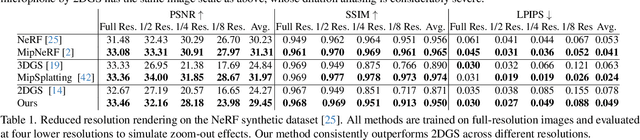
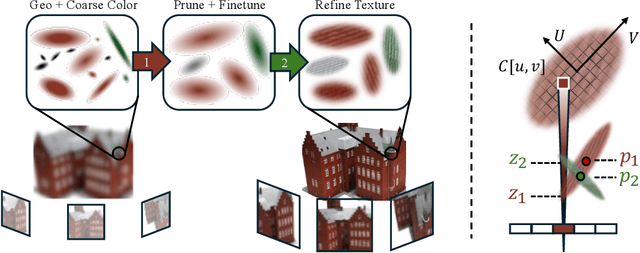
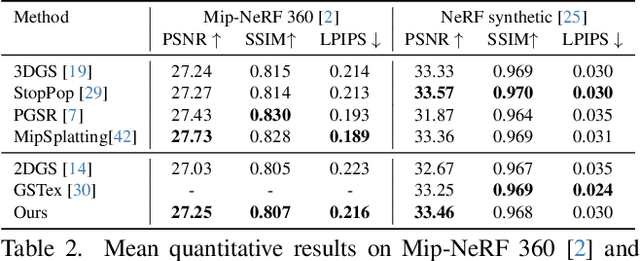
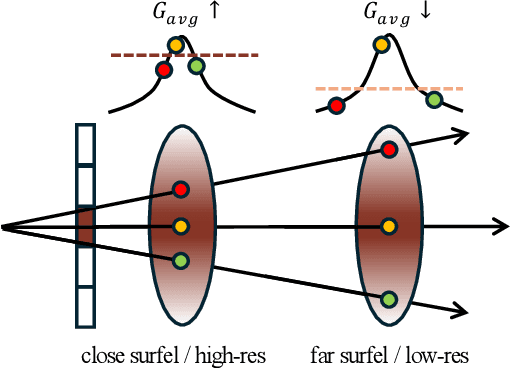
Recent advancements in neural rendering, particularly 2D Gaussian Splatting (2DGS), have shown promising results for jointly reconstructing fine appearance and geometry by leveraging 2D Gaussian surfels. However, current methods face significant challenges when rendering at arbitrary viewpoints, such as anti-aliasing for down-sampled rendering, and texture detail preservation for high-resolution rendering. We proposed a novel method to align the 2D surfels with texture maps and augment it with per-ray depth sorting and fisher-based pruning for rendering consistency and efficiency. With correct order, per-surfel texture maps significantly improve the capabilities to capture fine details. Additionally, to render high-fidelity details in varying viewpoints, we designed a frustum-based sampling method to mitigate the aliasing artifacts. Experimental results on benchmarks and our custom texture-rich dataset demonstrate that our method surpasses existing techniques, particularly in detail preservation and anti-aliasing.
Track Everything Everywhere Fast and Robustly
Mar 26, 2024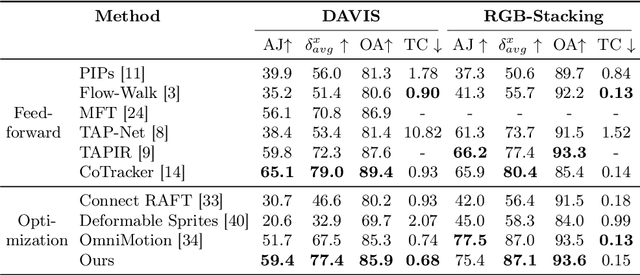
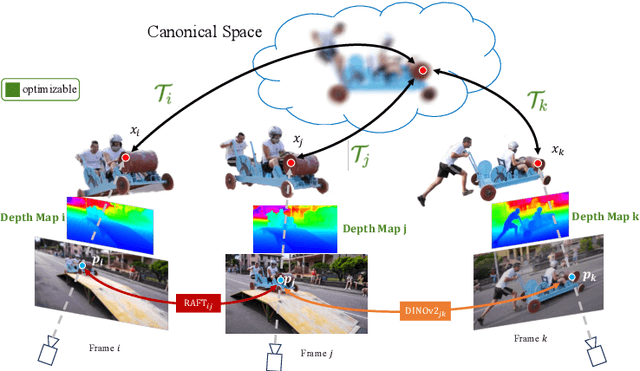
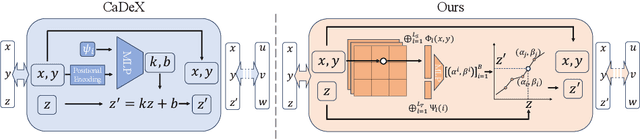
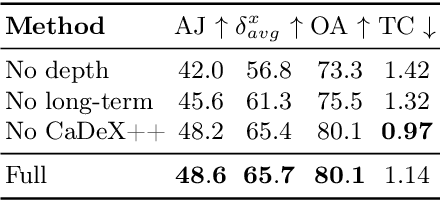
We propose a novel test-time optimization approach for efficiently and robustly tracking any pixel at any time in a video. The latest state-of-the-art optimization-based tracking technique, OmniMotion, requires a prohibitively long optimization time, rendering it impractical for downstream applications. OmniMotion is sensitive to the choice of random seeds, leading to unstable convergence. To improve efficiency and robustness, we introduce a novel invertible deformation network, CaDeX++, which factorizes the function representation into a local spatial-temporal feature grid and enhances the expressivity of the coupling blocks with non-linear functions. While CaDeX++ incorporates a stronger geometric bias within its architectural design, it also takes advantage of the inductive bias provided by the vision foundation models. Our system utilizes monocular depth estimation to represent scene geometry and enhances the objective by incorporating DINOv2 long-term semantics to regulate the optimization process. Our experiments demonstrate a substantial improvement in training speed (more than \textbf{10 times} faster), robustness, and accuracy in tracking over the SoTA optimization-based method OmniMotion.
Perceiving Unseen 3D Objects by Poking the Objects
Feb 26, 2023We present a novel approach to interactive 3D object perception for robots. Unlike previous perception algorithms that rely on known object models or a large amount of annotated training data, we propose a poking-based approach that automatically discovers and reconstructs 3D objects. The poking process not only enables the robot to discover unseen 3D objects but also produces multi-view observations for 3D reconstruction of the objects. The reconstructed objects are then memorized by neural networks with regular supervised learning and can be recognized in new test images. The experiments on real-world data show that our approach could unsupervisedly discover and reconstruct unseen 3D objects with high quality, and facilitate real-world applications such as robotic grasping. The code and supplementary materials are available at the project page: https://zju3dv.github.io/poking_perception.