 Add to Chrome
 Add to Firefox
 Add to Edge
Automatically Improving Simulation Physics for Articulated Objects
May 18, 2026
Simulation is a central tool for scalable robot learning, but its effectiveness depends on the quality of object assets. While modern 3D datasets provide rich geometric and kinematic representations, they typically lack the physical properties required for stable and realistic interaction, requiring significant manual effort to construct simulation-ready articulated objects. In this thesis, we introduce interaction-readiness, which characterizes whether an object can be reliably simulated under manipulation. We propose a quantitative evaluation framework that decomposes interaction-readiness into measurable components, enabling systematic analysis of object quality and revealing failure modes not captured by conventional evaluation. We further present a multi-modal, simulator-in-the-loop approach for generating interaction-ready articulated objects from incomplete 3D assets. The method integrates geometric, visual, and semantic information to infer physical properties and refines them through iterative simulator feedback to improve physical consistency. Experiments across diverse articulated objects and manipulation tasks show that object quality directly impacts simulation stability, interaction behavior, and policy performance. Objects refined by our method exhibit more stable and realistic dynamics, enabling more reliable downstream learning and evaluation. Overall, this thesis demonstrates the importance of physical realism for articulated objects in simulation and introduces a practical multi-modal refinement approach, guided by simulator feedback, for constructing such objects at scale.

Iterative Compositional Data Generation for Robot Control
Dec 20, 2025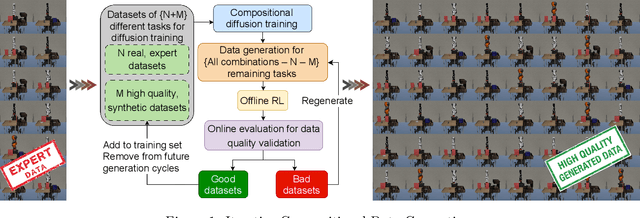
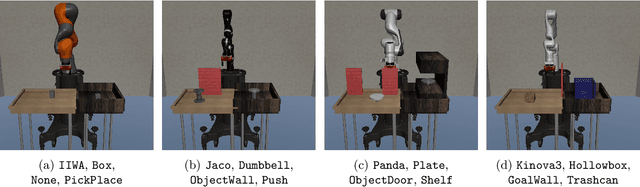

Collecting robotic manipulation data is expensive, making it impractical to acquire demonstrations for the combinatorially large space of tasks that arise in multi-object, multi-robot, and multi-environment settings. While recent generative models can synthesize useful data for individual tasks, they do not exploit the compositional structure of robotic domains and struggle to generalize to unseen task combinations. We propose a semantic compositional diffusion transformer that factorizes transitions into robot-, object-, obstacle-, and objective-specific components and learns their interactions through attention. Once trained on a limited subset of tasks, we show that our model can zero-shot generate high-quality transitions from which we can learn control policies for unseen task combinations. Then, we introduce an iterative self-improvement procedure in which synthetic data is validated via offline reinforcement learning and incorporated into subsequent training rounds. Our approach substantially improves zero-shot performance over monolithic and hard-coded compositional baselines, ultimately solving nearly all held-out tasks and demonstrating the emergence of meaningful compositional structure in the learned representations.
SBAMP: Sampling Based Adaptive Motion Planning
Nov 15, 2025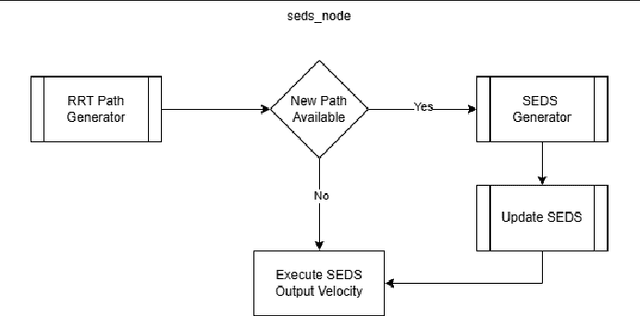
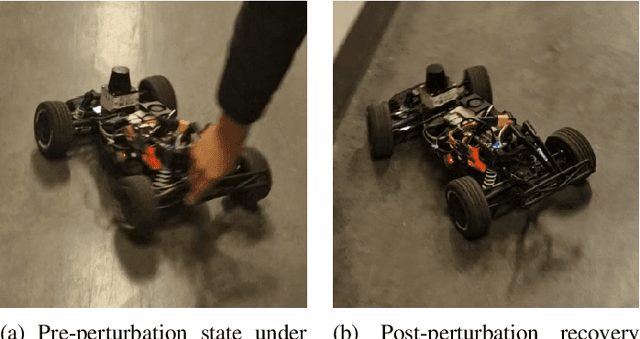
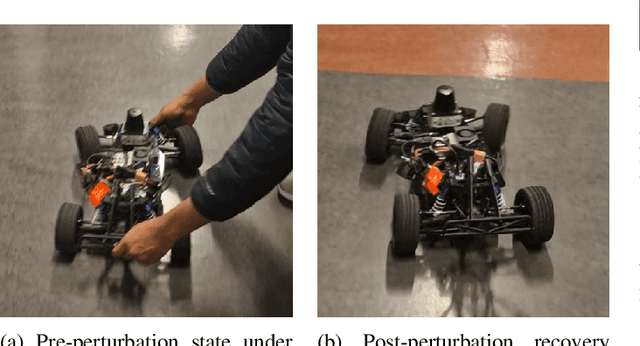
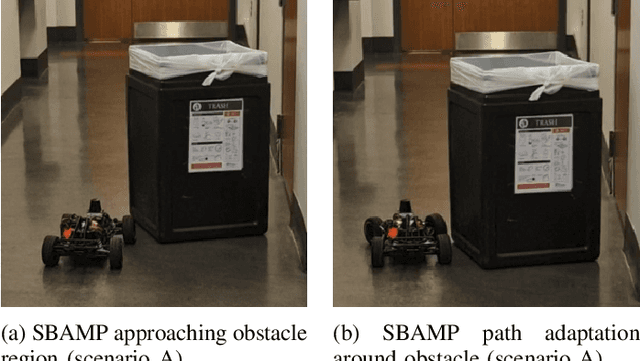
Autonomous robotic systems must navigate complex, dynamic environments in real time, often facing unpredictable obstacles and rapidly changing conditions. Traditional sampling-based methods, such as RRT*, excel at generating collision-free paths but struggle to adapt to sudden changes without extensive replanning. Conversely, learning-based dynamical systems, such as the Stable Estimator of Dynamical Systems (SEDS), offer smooth, adaptive trajectory tracking but typically rely on pre-collected demonstration data, limiting their generalization to novel scenarios. This paper introduces Sampling-Based Adaptive Motion Planning (SBAMP), a novel framework that overcomes these limitations by integrating RRT* for global path planning with a SEDS-based local controller for continuous, adaptive trajectory adjustment. Our approach requires no pre-trained datasets and ensures smooth transitions between planned waypoints, maintaining stability through Lyapunov-based guarantees. We validate SBAMP in both simulated environments and real hardware using the RoboRacer platform, demonstrating superior performance in dynamic obstacle scenarios, rapid recovery from perturbations, and robust handling of sharp turns. Experimental results highlight SBAMP's ability to adapt in real time without sacrificing global path optimality, providing a scalable solution for dynamic, unstructured environments.