 Add to Chrome
 Add to Firefox
 Add to Edge
Iterative Compositional Data Generation for Robot Control
Dec 20, 2025
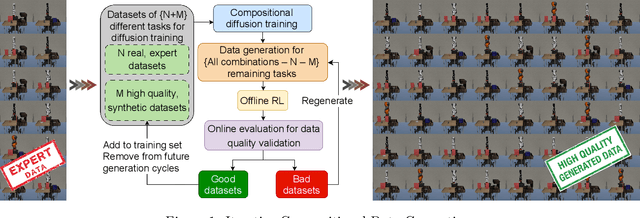
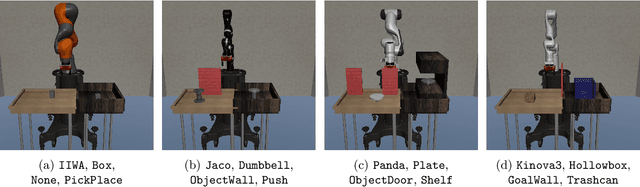

Collecting robotic manipulation data is expensive, making it impractical to acquire demonstrations for the combinatorially large space of tasks that arise in multi-object, multi-robot, and multi-environment settings. While recent generative models can synthesize useful data for individual tasks, they do not exploit the compositional structure of robotic domains and struggle to generalize to unseen task combinations. We propose a semantic compositional diffusion transformer that factorizes transitions into robot-, object-, obstacle-, and objective-specific components and learns their interactions through attention. Once trained on a limited subset of tasks, we show that our model can zero-shot generate high-quality transitions from which we can learn control policies for unseen task combinations. Then, we introduce an iterative self-improvement procedure in which synthetic data is validated via offline reinforcement learning and incorporated into subsequent training rounds. Our approach substantially improves zero-shot performance over monolithic and hard-coded compositional baselines, ultimately solving nearly all held-out tasks and demonstrating the emergence of meaningful compositional structure in the learned representations.

Intrinsically motivated graph exploration using network theories of human curiosity
Jul 13, 2023


Intrinsically motivated exploration has proven useful for reinforcement learning, even without additional extrinsic rewards. When the environment is naturally represented as a graph, how to guide exploration best remains an open question. In this work, we propose a novel approach for exploring graph-structured data motivated by two theories of human curiosity: the information gap theory and the compression progress theory. The theories view curiosity as an intrinsic motivation to optimize for topological features of subgraphs induced by the visited nodes in the environment. We use these proposed features as rewards for graph neural-network-based reinforcement learning. On multiple classes of synthetically generated graphs, we find that trained agents generalize to larger environments and to longer exploratory walks than are seen during training. Our method computes more efficiently than the greedy evaluation of the relevant topological properties. The proposed intrinsic motivations bear particular relevance for recommender systems. We demonstrate that curiosity-based recommendations are more predictive of human behavior than PageRank centrality for several real-world graph datasets, including MovieLens, Amazon Books, and Wikispeedia.