 Add to Chrome
 Add to Firefox
 Add to Edge
CXR-Retrieve: Compositional Text-to-Image Retrieval in Chest Radiography
Jul 30, 2026
Large chest radiography archives are difficult to search because most studies are paired only with free-text reports rather than structured clinical annotations. Vision-language models offer a natural interface for text-to-image retrieval, but current biomedical models are primarily optimized for report-to-image matching rather than for satisfying short clinical search queries. This creates an objective mismatch: a model may retrieve images related to words in the query while failing to satisfy the full clinical constraint, especially for conjunctions and negations such as ``atelectasis and no pneumonia.'' We introduce CXR-Retrieve, a structured benchmark for compositional chest X-ray text-to-image retrieval. The benchmark contains 5,159 test images from the official test-split of MIMIC-CXR-JPG and 145 textual queries spanning single and conjunction findings, both positive and negative. Relevance is defined by whether a retrieved image satisfies all asserted pathology constraints, rather than by whether it matches a paired report. We further propose a label-aware contrastive fine-tuning objective for clinical retrieval. Our method attracts image-text pairs with compatible asserted pathology constraints, including shared confirmed absences, while explicitly repelling contradictory pairs. Starting from the in-domain CXR-CLIP checkpoint, our method improves Precision@5 over CXR-CLIP by 8.5 percentage points on two-pathology conjunctions and by 22.0 percentage points on negation queries. These results show that reliable chest X-ray retrieval requires training objectives that model not only which findings are mentioned, but also how they are clinically asserted.

Person Identification from Contextual Motion
Jun 11, 2026We consider the problem of identifying people based on their motion styles. We present a generative model describing the action instance creation process and derive a probabilistic identity inference scheme for two common person identification scenarios motivated by the surveillance and authentication applications. We introduce a novel, \emph{interactive}, scenario for person identification from motion patterns. To this end, we formalize the identification process in the context of a sequential message exchange session between the subject and the system. The subject's behavior is modeled using a probabilistic generative model inspired by the Human Information Processing (HIP) paradigm. At each stage, the system presents a visual stimulus (a cue) to the subject and records their motion response. The cue is selected so as to maximize the mutual information of the expected response and the subject's identity. Once recorded, the response is used to update the a posteriori probability over possible subjects' identities. The process terminates once a sufficient classification confidence level is reached. To the best of our knowledge, this is the first time person identification is addressed in such interactive setting. We report high recognition rates on five publicly available datasets and our own novel dataset consisting of 4,476 recordings of 22 test subjects responding to 15 cues.
Look Where It Matters: High-Resolution Crops Retrieval for Efficient VLMs
Mar 14, 2026Vision-language models (VLMs) typically process images at a native high-resolution, forcing a trade-off between accuracy and computational efficiency: high-resolution inputs capture fine details but incur significant computational costs, while low-resolution inputs advocate for efficiency, they potentially miss critical visual information, like small text. We present AwaRes, a spatial-on-demand framework that resolves this accuracy-efficiency trade-off by operating on a low-resolution global view and using tool-calling to retrieve only high-resolution segments needed for a given query. We construct supervised data automatically: a judge compares low- vs.\ high-resolution answers to label whether cropping is needed, and an oracle grounding model localizes the evidence for the correct answer, which we map to a discrete crop set to form multi-turn tool-use trajectories. We train our framework with cold-start SFT followed by multi-turn GRPO with a composite reward that combines semantic answer correctness with explicit crop-cost penalties. Project page: https://nimrodshabtay.github.io/AwaRes
MESSI: A Multi-Elevation Semantic Segmentation Image Dataset of an Urban Environment
May 13, 2025This paper presents a Multi-Elevation Semantic Segmentation Image (MESSI) dataset comprising 2525 images taken by a drone flying over dense urban environments. MESSI is unique in two main features. First, it contains images from various altitudes, allowing us to investigate the effect of depth on semantic segmentation. Second, it includes images taken from several different urban regions (at different altitudes). This is important since the variety covers the visual richness captured by a drone's 3D flight, performing horizontal and vertical maneuvers. MESSI contains images annotated with location, orientation, and the camera's intrinsic parameters and can be used to train a deep neural network for semantic segmentation or other applications of interest (e.g., localization, navigation, and tracking). This paper describes the dataset and provides annotation details. It also explains how semantic segmentation was performed using several neural network models and shows several relevant statistics. MESSI will be published in the public domain to serve as an evaluation benchmark for semantic segmentation using images captured by a drone or similar vehicle flying over a dense urban environment.
Neural Descriptors: Self-Supervised Learning of Robust Local Surface Descriptors Using Polynomial Patches
Mar 05, 2025Classical shape descriptors such as Heat Kernel Signature (HKS), Wave Kernel Signature (WKS), and Signature of Histograms of OrienTations (SHOT), while widely used in shape analysis, exhibit sensitivity to mesh connectivity, sampling patterns, and topological noise. While differential geometry offers a promising alternative through its theory of differential invariants, which are theoretically guaranteed to be robust shape descriptors, the computation of these invariants on discrete meshes often leads to unstable numerical approximations, limiting their practical utility. We present a self-supervised learning approach for extracting geometric features from 3D surfaces. Our method combines synthetic data generation with a neural architecture designed to learn sampling-invariant features. By integrating our features into existing shape correspondence frameworks, we demonstrate improved performance on standard benchmarks including FAUST, SCAPE, TOPKIDS, and SHREC'16, showing particular robustness to topological noise and partial shapes.
Streamlining Conformal Information Retrieval via Score Refinement
Oct 03, 2024

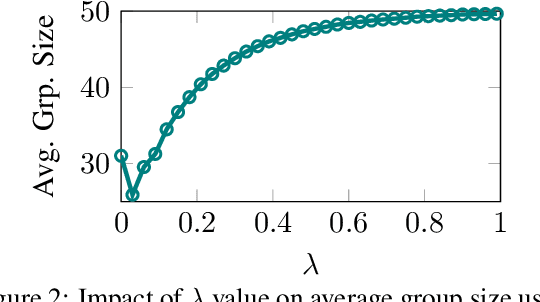
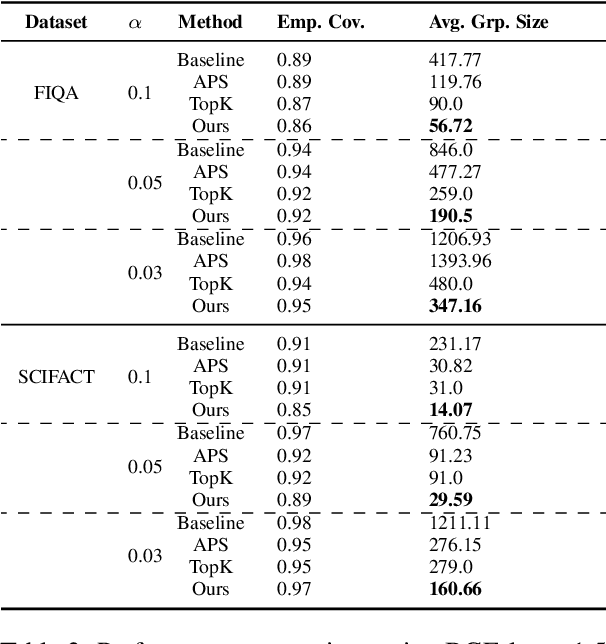
Information retrieval (IR) methods, like retrieval augmented generation, are fundamental to modern applications but often lack statistical guarantees. Conformal prediction addresses this by retrieving sets guaranteed to include relevant information, yet existing approaches produce large-sized sets, incurring high computational costs and slow response times. In this work, we introduce a score refinement method that applies a simple monotone transformation to retrieval scores, leading to significantly smaller conformal sets while maintaining their statistical guarantees. Experiments on various BEIR benchmarks validate the effectiveness of our approach in producing compact sets containing relevant information.
Anchored Diffusion for Video Face Reenactment
Jul 21, 2024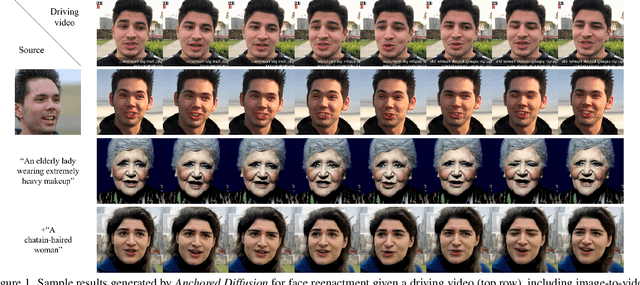
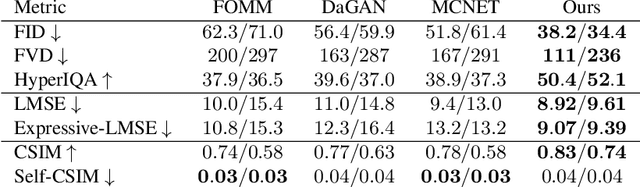
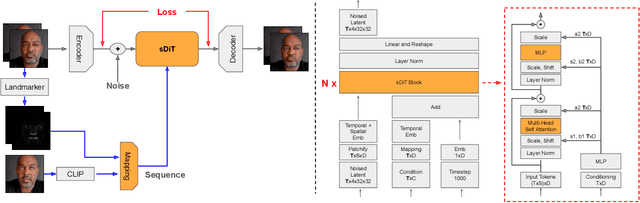

Video generation has drawn significant interest recently, pushing the development of large-scale models capable of producing realistic videos with coherent motion. Due to memory constraints, these models typically generate short video segments that are then combined into long videos. The merging process poses a significant challenge, as it requires ensuring smooth transitions and overall consistency. In this paper, we introduce Anchored Diffusion, a novel method for synthesizing relatively long and seamless videos. We extend Diffusion Transformers (DiTs) to incorporate temporal information, creating our sequence-DiT (sDiT) model for generating short video segments. Unlike previous works, we train our model on video sequences with random non-uniform temporal spacing and incorporate temporal information via external guidance, increasing flexibility and allowing it to capture both short and long-term relationships. Furthermore, during inference, we leverage the transformer architecture to modify the diffusion process, generating a batch of non-uniform sequences anchored to a common frame, ensuring consistency regardless of temporal distance. To demonstrate our method, we focus on face reenactment, the task of creating a video from a source image that replicates the facial expressions and movements from a driving video. Through comprehensive experiments, we show our approach outperforms current techniques in producing longer consistent high-quality videos while offering editing capabilities.
Molecular Diffusion Models with Virtual Receptors
Jun 26, 2024
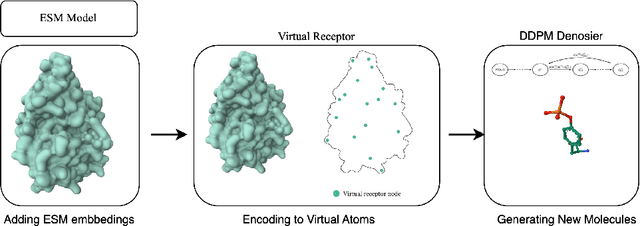

Machine learning approaches to Structure-Based Drug Design (SBDD) have proven quite fertile over the last few years. In particular, diffusion-based approaches to SBDD have shown great promise. We present a technique which expands on this diffusion approach in two crucial ways. First, we address the size disparity between the drug molecule and the target/receptor, which makes learning more challenging and inference slower. We do so through the notion of a Virtual Receptor, which is a compressed version of the receptor; it is learned so as to preserve key aspects of the structural information of the original receptor, while respecting the relevant group equivariance. Second, we incorporate a protein language embedding used originally in the context of protein folding. We experimentally demonstrate the contributions of both the virtual receptors and the protein embeddings: in practice, they lead to both better performance, as well as significantly faster computations.
Looks Too Good To Be True: An Information-Theoretic Analysis of Hallucinations in Generative Restoration Models
May 26, 2024
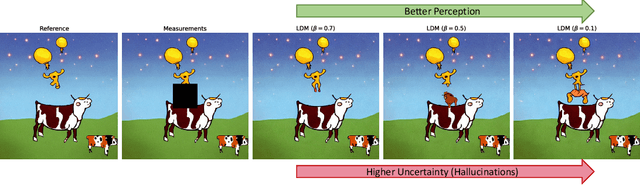
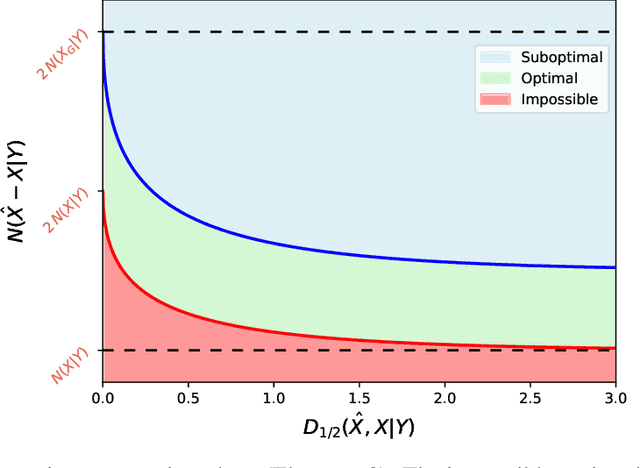
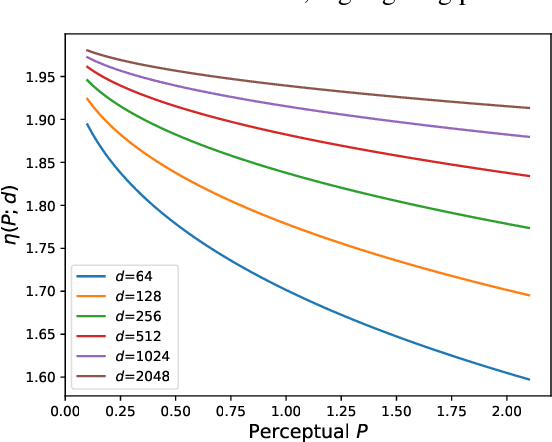
The pursuit of high perceptual quality in image restoration has driven the development of revolutionary generative models, capable of producing results often visually indistinguishable from real data. However, as their perceptual quality continues to improve, these models also exhibit a growing tendency to generate hallucinations - realistic-looking details that do not exist in the ground truth images. The presence of hallucinations introduces uncertainty regarding the reliability of the models' predictions, raising major concerns about their practical application. In this paper, we employ information-theory tools to investigate this phenomenon, revealing a fundamental tradeoff between uncertainty and perception. We rigorously analyze the relationship between these two factors, proving that the global minimal uncertainty in generative models grows in tandem with perception. In particular, we define the inherent uncertainty of the restoration problem and show that attaining perfect perceptual quality entails at least twice this uncertainty. Additionally, we establish a relation between mean squared-error distortion, uncertainty and perception, through which we prove the aforementioned uncertainly-perception tradeoff induces the well-known perception-distortion tradeoff. This work uncovers fundamental limitations of generative models in achieving both high perceptual quality and reliable predictions for image restoration. We demonstrate our theoretical findings through an analysis of single image super-resolution algorithms. Our work aims to raise awareness among practitioners about this inherent tradeoff, empowering them to make informed decisions and potentially prioritize safety over perceptual performance.
Uncertainty-Aware PPG-2-ECG for Enhanced Cardiovascular Diagnosis using Diffusion Models
May 19, 2024Analyzing the cardiovascular system condition via Electrocardiography (ECG) is a common and highly effective approach, and it has been practiced and perfected over many decades. ECG sensing is non-invasive and relatively easy to acquire, and yet it is still cumbersome for holter monitoring tests that may span over hours and even days. A possible alternative in this context is Photoplethysmography (PPG): An optically-based signal that measures blood volume fluctuations, as typically sensed by conventional ``wearable devices''. While PPG presents clear advantages in acquisition, convenience, and cost-effectiveness, ECG provides more comprehensive information, allowing for a more precise detection of heart conditions. This implies that a conversion from PPG to ECG, as recently discussed in the literature, inherently involves an unavoidable level of uncertainty. In this paper we introduce a novel methodology for addressing the PPG-2-ECG conversion, and offer an enhanced classification of cardiovascular conditions using the given PPG, all while taking into account the uncertainties arising from the conversion process. We provide a mathematical justification for our proposed computational approach, and present empirical studies demonstrating its superior performance compared to state-of-the-art baseline methods.