 Add to Chrome
 Add to Firefox
 Add to Edge
Benchmarking Video Foundation Models for Remote Parkinson's Disease Screening
Feb 13, 2026
Remote, video-based assessments offer a scalable pathway for Parkinson's disease (PD) screening. While traditional approaches rely on handcrafted features mimicking clinical scales, recent advances in video foundation models (VFMs) enable representation learning without task-specific customization. However, the comparative effectiveness of different VFM architectures across diverse clinical tasks remains poorly understood. We present a large-scale systematic study using a novel video dataset from 1,888 participants (727 with PD), comprising 32,847 videos across 16 standardized clinical tasks. We evaluate seven state-of-the-art VFMs -- including VideoPrism, V-JEPA, ViViT, and VideoMAE -- to determine their robustness in clinical screening. By evaluating frozen embeddings with a linear classification head, we demonstrate that task saliency is highly model-dependent: VideoPrism excels in capturing visual speech kinematics (no audio) and facial expressivity, while V-JEPA proves superior for upper-limb motor tasks. Notably, TimeSformer remains highly competitive for rhythmic tasks like finger tapping. Our experiments yield AUCs of 76.4-85.3% and accuracies of 71.5-80.6%. While high specificity (up to 90.3%) suggests strong potential for ruling out healthy individuals, the lower sensitivity (43.2-57.3%) highlights the need for task-aware calibration and integration of multiple tasks and modalities. Overall, this work establishes a rigorous baseline for VFM-based PD screening and provides a roadmap for selecting suitable tasks and architectures in remote neurological monitoring. Code and anonymized structured data are publicly available: https://anonymous.4open.science/r/parkinson\_video\_benchmarking-A2C5

OmniSapiens: A Foundation Model for Social Behavior Processing via Heterogeneity-Aware Relative Policy Optimization
Feb 11, 2026To develop socially intelligent AI, existing approaches typically model human behavioral dimensions (e.g., affective, cognitive, or social attributes) in isolation. Although useful, task-specific modeling often increases training costs and limits generalization across behavioral settings. Recent reasoning RL methods facilitate training a single unified model across multiple behavioral tasks, but do not explicitly address learning across different heterogeneous behavioral data. To address this gap, we introduce Heterogeneity-Aware Relative Policy Optimization (HARPO), an RL method that balances leaning across heterogeneous tasks and samples. This is achieved by modulating advantages to ensure that no single task or sample carries disproportionate influence during policy optimization. Using HARPO, we develop and release Omnisapiens-7B 2.0, a foundation model for social behavior processing. Relative to existing behavioral foundation models, Omnisapiens-7B 2.0 achieves the strongest performance across behavioral tasks, with gains of up to +16.85% and +9.37% on multitask and held-out settings respectively, while producing more explicit and robust reasoning traces. We also validate HARPO against recent RL methods, where it achieves the most consistently strong performance across behavioral tasks.
Replicating Human Motivated Reasoning Studies with LLMs
Jan 22, 2026Motivated reasoning -- the idea that individuals processing information may be motivated to reach a certain conclusion, whether it be accurate or predetermined -- has been well-explored as a human phenomenon. However, it is unclear whether base LLMs mimic these motivational changes. Replicating 4 prior political motivated reasoning studies, we find that base LLM behavior does not align with expected human behavior. Furthermore, base LLM behavior across models shares some similarities, such as smaller standard deviations and inaccurate argument strength assessments. We emphasize the importance of these findings for researchers using LLMs to automate tasks such as survey data collection and argument assessment.
HAL: Inducing Human-likeness in LLMs with Alignment
Jan 07, 2026Conversational human-likeness plays a central role in human-AI interaction, yet it has remained difficult to define, measure, and optimize. As a result, improvements in human-like behavior are largely driven by scale or broad supervised training, rather than targeted alignment. We introduce Human Aligning LLMs (HAL), a framework for aligning language models to conversational human-likeness using an interpretable, data-driven reward. HAL derives explicit conversational traits from contrastive dialogue data, combines them into a compact scalar score, and uses this score as a transparent reward signal for alignment with standard preference optimization methods. Using this approach, we align models of varying sizes without affecting their overall performance. In large-scale human evaluations, models aligned with HAL are more frequently perceived as human-like in conversation. Because HAL operates over explicit, interpretable traits, it enables inspection of alignment behavior and diagnosis of unintended effects. More broadly, HAL demonstrates how soft, qualitative properties of language--previously outside the scope for alignment--can be made measurable and aligned in an interpretable and explainable way.
VisualActBench: Can VLMs See and Act like a Human?
Dec 10, 2025Vision-Language Models (VLMs) have achieved impressive progress in perceiving and describing visual environments. However, their ability to proactively reason and act based solely on visual inputs, without explicit textual prompts, remains underexplored. We introduce a new task, Visual Action Reasoning, and propose VisualActBench, a large-scale benchmark comprising 1,074 videos and 3,733 human-annotated actions across four real-world scenarios. Each action is labeled with an Action Prioritization Level (APL) and a proactive-reactive type to assess models' human-aligned reasoning and value sensitivity. We evaluate 29 VLMs on VisualActBench and find that while frontier models like GPT4o demonstrate relatively strong performance, a significant gap remains compared to human-level reasoning, particularly in generating proactive, high-priority actions. Our results highlight limitations in current VLMs' ability to interpret complex context, anticipate outcomes, and align with human decision-making frameworks. VisualActBench establishes a comprehensive foundation for assessing and improving the real-world readiness of proactive, vision-centric AI agents.
AI Standardized Patient Improves Human Conversations in Advanced Cancer Care
May 05, 2025Serious illness communication (SIC) in end-of-life care faces challenges such as emotional stress, cultural barriers, and balancing hope with honesty. Despite its importance, one of the few available ways for clinicians to practice SIC is with standardized patients, which is expensive, time-consuming, and inflexible. In this paper, we present SOPHIE, an AI-powered standardized patient simulation and automated feedback system. SOPHIE combines large language models (LLMs), a lifelike virtual avatar, and automated, personalized feedback based on clinical literature to provide remote, on-demand SIC training. In a randomized control study with healthcare students and professionals, SOPHIE users demonstrated significant improvement across three critical SIC domains: Empathize, Be Explicit, and Empower. These results suggest that AI-driven tools can enhance complex interpersonal communication skills, offering scalable, accessible solutions to address a critical gap in clinician education.
AI Can Enhance Creativity in Social Networks
Oct 20, 2024


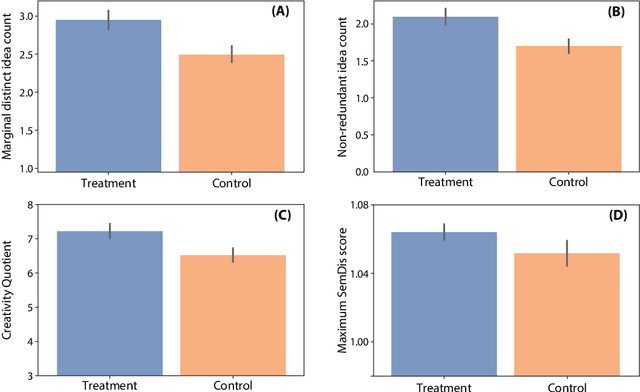
Can peer recommendation engines elevate people's creative performances in self-organizing social networks? Answering this question requires resolving challenges in data collection (e.g., tracing inspiration links and psycho-social attributes of nodes) and intervention design (e.g., balancing idea stimulation and redundancy in evolving information environments). We trained a model that predicts people's ideation performances using semantic and network-structural features in an online platform. Using this model, we built SocialMuse, which maximizes people's predicted performances to generate peer recommendations for them. We found treatment networks leveraging SocialMuse outperforming AI-agnostic control networks in several creativity measures. The treatment networks were more decentralized than the control, as SocialMuse increasingly emphasized network-structural features at large network sizes. This decentralization spreads people's inspiration sources, helping inspired ideas stand out better. Our study provides actionable insights into building intelligent systems for elevating creativity.
Accessible, At-Home Detection of Parkinson's Disease via Multi-task Video Analysis
Jun 21, 2024Limited access to neurological care leads to missed diagnoses of Parkinson's disease (PD), leaving many individuals unidentified and untreated. We trained a novel neural network-based fusion architecture to detect Parkinson's disease (PD) by analyzing features extracted from webcam recordings of three tasks: finger tapping, facial expression (smiling), and speech (uttering a sentence containing all letters of the alphabet). Additionally, the model incorporated Monte Carlo Dropout to improve prediction accuracy by considering uncertainties. The study participants (n = 845, 272 with PD) were randomly split into three sets: 60% for training, 20% for model selection (hyper-parameter tuning), and 20% for final performance evaluation. The dataset consists of 1102 sessions, each session containing videos of all three tasks. Our proposed model achieved significantly better accuracy, area under the ROC curve (AUROC), and sensitivity at non-inferior specificity compared to any single-task model. Withholding uncertain predictions further boosted the performance, achieving 88.0% (95% CI: 87.7% - 88.4%) accuracy, 93.0% (92.8% - 93.2%) AUROC, 79.3% (78.4% - 80.2%) sensitivity, and 92.6% (92.3% - 92.8%) specificity, at the expense of not being able to predict for 2.3% (2.0% - 2.6%) data. Further analysis suggests that the trained model does not exhibit any detectable bias across sex and ethnic subgroups and is most effective for individuals aged between 50 and 80. This accessible, low-cost approach requiring only an internet-enabled device with a webcam and microphone paves the way for convenient PD screening at home, particularly in regions with limited access to clinical specialists.
Hi5: 2D Hand Pose Estimation with Zero Human Annotation
Jun 05, 2024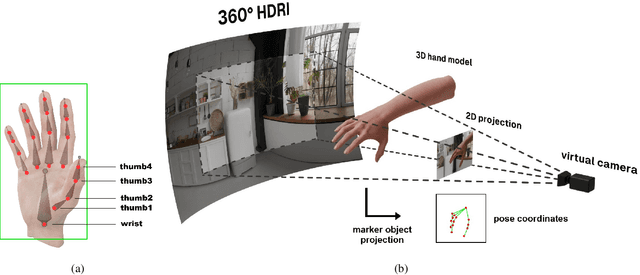



We propose a new large synthetic hand pose estimation dataset, Hi5, and a novel inexpensive method for collecting high-quality synthetic data that requires no human annotation or validation. Leveraging recent advancements in computer graphics, high-fidelity 3D hand models with diverse genders and skin colors, and dynamic environments and camera movements, our data synthesis pipeline allows precise control over data diversity and representation, ensuring robust and fair model training. We generate a dataset with 583,000 images with accurate pose annotation using a single consumer PC that closely represents real-world variability. Pose estimation models trained with Hi5 perform competitively on real-hand benchmarks while surpassing models trained with real data when tested on occlusions and perturbations. Our experiments show promising results for synthetic data as a viable solution for data representation problems in real datasets. Overall, this paper provides a promising new approach to synthetic data creation and annotation that can reduce costs and increase the diversity and quality of data for hand pose estimation.
PULSAR: Graph based Positive Unlabeled Learning with Multi Stream Adaptive Convolutions for Parkinson's Disease Recognition
Dec 10, 2023
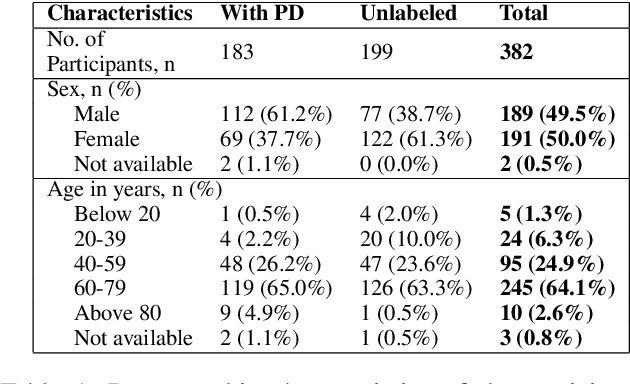
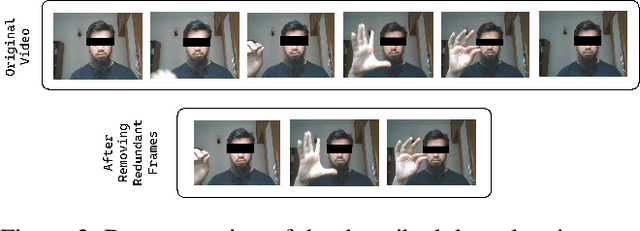
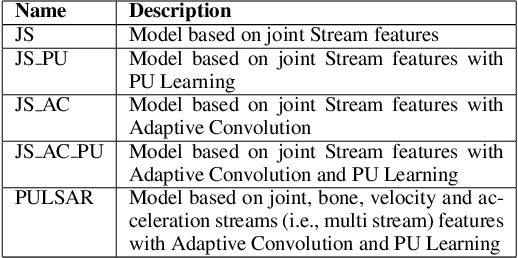
Parkinson's disease (PD) is a neuro-degenerative disorder that affects movement, speech, and coordination. Timely diagnosis and treatment can improve the quality of life for PD patients. However, access to clinical diagnosis is limited in low and middle income countries (LMICs). Therefore, development of automated screening tools for PD can have a huge social impact, particularly in the public health sector. In this paper, we present PULSAR, a novel method to screen for PD from webcam-recorded videos of the finger-tapping task from the Movement Disorder Society - Unified Parkinson's Disease Rating Scale (MDS-UPDRS). PULSAR is trained and evaluated on data collected from 382 participants (183 self-reported as PD patients). We used an adaptive graph convolutional neural network to dynamically learn the spatio temporal graph edges specific to the finger-tapping task. We enhanced this idea with a multi stream adaptive convolution model to learn features from different modalities of data critical to detect PD, such as relative location of the finger joints, velocity and acceleration of tapping. As the labels of the videos are self-reported, there could be cases of undiagnosed PD in the non-PD labeled samples. We leveraged the idea of Positive Unlabeled (PU) Learning that does not need labeled negative data. Our experiments show clear benefit of modeling the problem in this way. PULSAR achieved 80.95% accuracy in validation set and a mean accuracy of 71.29% (2.49% standard deviation) in independent test, despite being trained with limited amount of data. This is specially promising as labeled data is scarce in health care sector. We hope PULSAR will make PD screening more accessible to everyone. The proposed techniques could be extended for assessment of other movement disorders, such as ataxia, and Huntington's disease.