 Add to Chrome
 Add to Firefox
 Add to Edge
Beyond Static Leaderboards: Predictive Validity for the Evaluation of LLM Agents
Jun 18, 2026
Agent benchmarks are growing fast, but no single benchmark touches more than four or five of the dimensions that deployment exposes. This paper aggregates the largest coordinated deep-dive of one MCP-based industrial-agent benchmark to date: fourteen parallel implementation studies covering new asset classes (including a multi-modal visual extension), alternative orchestrations, retrieval strategies, reasoning modes, infrastructure optimizations, and evaluation-methodology probes. Consolidating those studies with seven prior agent benchmarks, we argue that aggregate-score leaderboards systematically underspecify deployed-agent evaluation. Rankings derived from aggregate scores do not transfer to out-of-distribution settings; recent public-to-hidden competition retrospectives provide direct empirical evidence of this rank instability. We propose ranking configurations by predictive validity, the correlation between in-sample and out-of-sample rank, rather than in-sample mean, and report a twelve-tier measurement apparatus that exposes the deployment-relevant dimensions HELM and its agent-era successors collapse. The position is operationalized through three falsifiable out-of-distribution criteria with explicit thresholds; existing evidence partly supports it but is too thin to confirm. We close with a pre-registered pilot design and a field-level vision for what the next generation of agentic benchmarks should report.

Evaluating Temporal Semantic Caching and Workflow Optimization in Agentic Plan-Execute Pipelines
May 20, 2026Industrial asset operations workflows are latency-sensitive because a single user query may require coordination over sensor data, work orders, failure modes, forecasting tools, and domain-specific agents. We evaluate this problem on AssetOpsBench (AOB), an industrial agent benchmark whose plan-execute pipeline exposes repeated overhead from tool discovery, LLM planning, MCP tool execution, and final summarization. Existing LLM caching techniques such as KV-cache reuse and embedding-based semantic caching were designed for chatbot serving and break down when output validity depends on time, asset, or sensor parameters. We propose two complementary optimization layers for AOB plan-execute pipelines: a temporal semantic cache and a set of MCP workflow optimizations combining disk-backed tool-discovery caching and dependency-aware parallel step execution. MCP workflow optimizations corresponded to a 1.67x speedup and reduced median end-to-end latency by about 40.0% while the temporal-cache benchmark achieved a median of 30.6x speedup on cache hits. Beyond the speedup, our results expose a concrete failure mode of pure semantic caching for parameter-rich industrial queries, providing a critical analysis of how caching choices interact with evaluation correctness in MCP-backed agent benchmarks.
MuseRAG: Idea Originality Scoring At Scale
May 22, 2025An objective, face-valid way to assess the originality of creative ideas is to measure how rare each idea is within a population -- an approach long used in creativity research but difficult to automate at scale. Tabulating response frequencies via manual bucketing of idea rephrasings is labor-intensive, error-prone, and brittle under large corpora. We introduce a fully automated, psychometrically validated pipeline for frequency-based originality scoring. Our method, MuseRAG, combines large language models (LLMs) with an externally orchestrated retrieval-augmented generation (RAG) framework. Given a new idea, the system retrieves semantically similar prior idea buckets and zero-shot prompts the LLM to judge whether the new idea belongs to an existing bucket or forms a new one. The resulting buckets enable computation of frequency-based originality metrics. Across five datasets (N=1143, n_ideas=16294), MuseRAG matches human annotators in idea clustering structure and resolution (AMI = 0.59) and in participant-level scoring (r = 0.89) -- while exhibiting strong convergent and external validity. Our work enables intent-sensitive, human-aligned originality scoring at scale to aid creativity research.
AI Can Enhance Creativity in Social Networks
Oct 20, 2024


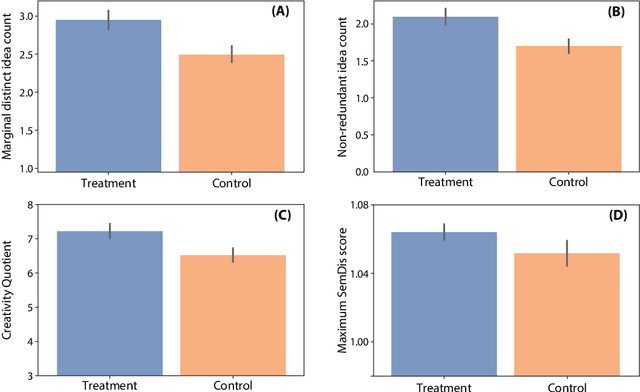
Can peer recommendation engines elevate people's creative performances in self-organizing social networks? Answering this question requires resolving challenges in data collection (e.g., tracing inspiration links and psycho-social attributes of nodes) and intervention design (e.g., balancing idea stimulation and redundancy in evolving information environments). We trained a model that predicts people's ideation performances using semantic and network-structural features in an online platform. Using this model, we built SocialMuse, which maximizes people's predicted performances to generate peer recommendations for them. We found treatment networks leveraging SocialMuse outperforming AI-agnostic control networks in several creativity measures. The treatment networks were more decentralized than the control, as SocialMuse increasingly emphasized network-structural features at large network sizes. This decentralization spreads people's inspiration sources, helping inspired ideas stand out better. Our study provides actionable insights into building intelligent systems for elevating creativity.