 Add to Chrome
 Add to Firefox
 Add to Edge
Benchmarking Video Foundation Models for Remote Parkinson's Disease Screening
Feb 13, 2026
Remote, video-based assessments offer a scalable pathway for Parkinson's disease (PD) screening. While traditional approaches rely on handcrafted features mimicking clinical scales, recent advances in video foundation models (VFMs) enable representation learning without task-specific customization. However, the comparative effectiveness of different VFM architectures across diverse clinical tasks remains poorly understood. We present a large-scale systematic study using a novel video dataset from 1,888 participants (727 with PD), comprising 32,847 videos across 16 standardized clinical tasks. We evaluate seven state-of-the-art VFMs -- including VideoPrism, V-JEPA, ViViT, and VideoMAE -- to determine their robustness in clinical screening. By evaluating frozen embeddings with a linear classification head, we demonstrate that task saliency is highly model-dependent: VideoPrism excels in capturing visual speech kinematics (no audio) and facial expressivity, while V-JEPA proves superior for upper-limb motor tasks. Notably, TimeSformer remains highly competitive for rhythmic tasks like finger tapping. Our experiments yield AUCs of 76.4-85.3% and accuracies of 71.5-80.6%. While high specificity (up to 90.3%) suggests strong potential for ruling out healthy individuals, the lower sensitivity (43.2-57.3%) highlights the need for task-aware calibration and integration of multiple tasks and modalities. Overall, this work establishes a rigorous baseline for VFM-based PD screening and provides a roadmap for selecting suitable tasks and architectures in remote neurological monitoring. Code and anonymized structured data are publicly available: https://anonymous.4open.science/r/parkinson\_video\_benchmarking-A2C5

Fibro-CoSANet: Pulmonary Fibrosis Prognosis Prediction using a Convolutional Self Attention Network
Apr 13, 2021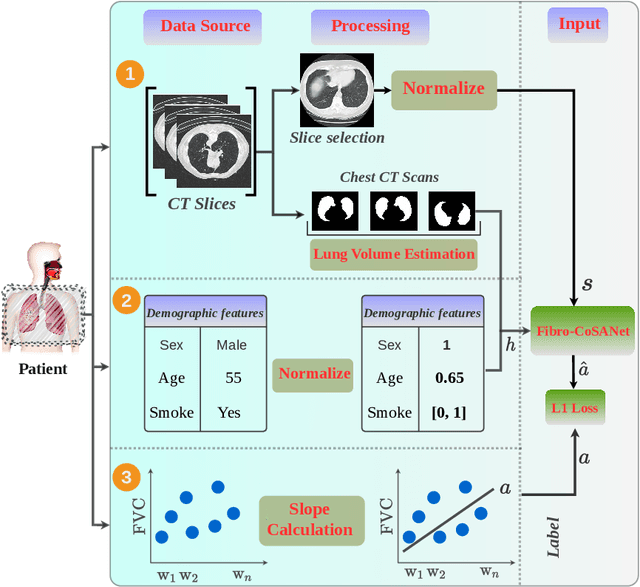
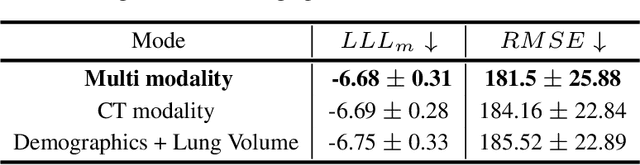
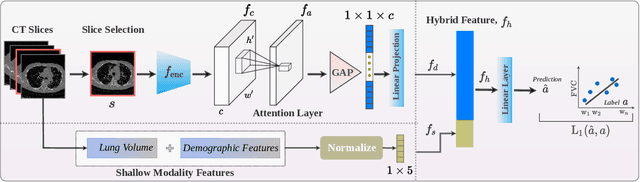
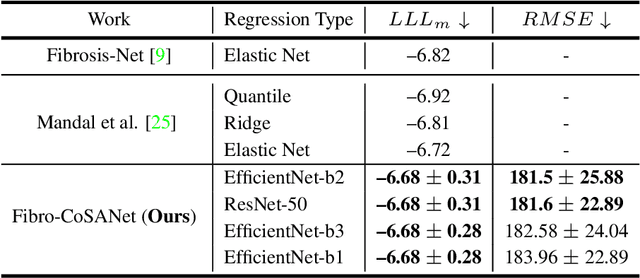
Idiopathic pulmonary fibrosis (IPF) is a restrictive interstitial lung disease that causes lung function decline by lung tissue scarring. Although lung function decline is assessed by the forced vital capacity (FVC), determining the accurate progression of IPF remains a challenge. To address this challenge, we proposed Fibro-CoSANet, a novel end-to-end multi-modal learning-based approach, to predict the FVC decline. Fibro-CoSANet utilized CT images and demographic information in convolutional neural network frameworks with a stacked attention layer. Extensive experiments on the OSIC Pulmonary Fibrosis Progression Dataset demonstrated the superiority of our proposed Fibro-CoSANet by achieving the new state-of-the-art modified Laplace Log-Likelihood score of -6.68. This network may benefit research areas concerned with designing networks to improve the prognostic accuracy of IPF. The source-code for Fibro-CoSANet is available at: \url{https://github.com/zabir-nabil/Fibro-CoSANet}.