 Add to Chrome
 Add to Firefox
 Add to Edge
Logic-Driven Context Extension and Data Augmentation for Logical Reasoning of Text
May 08, 2021
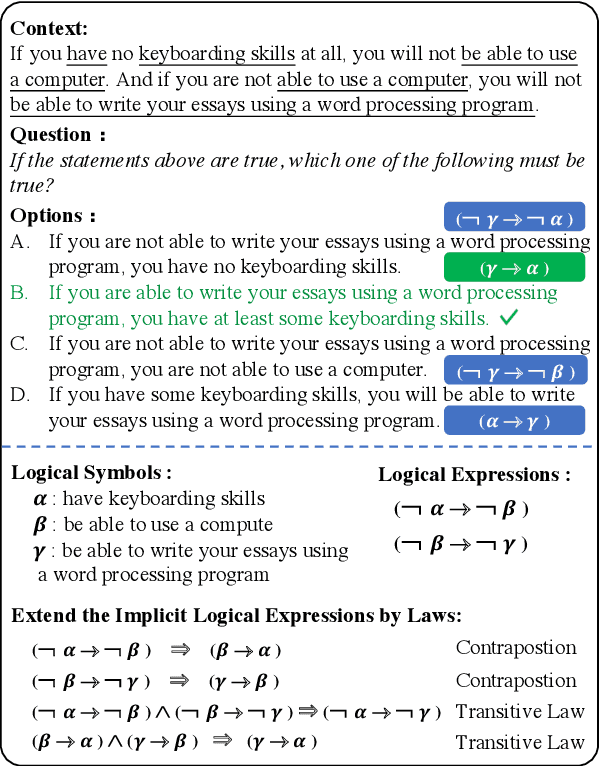
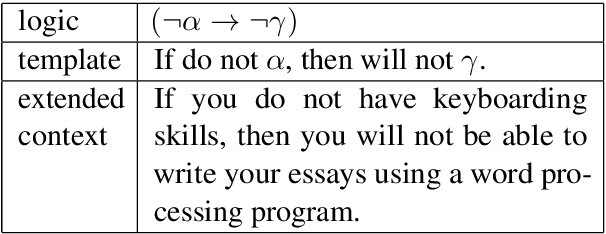
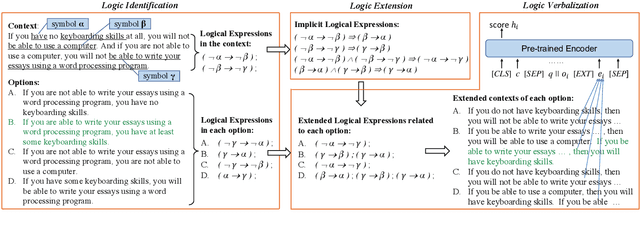
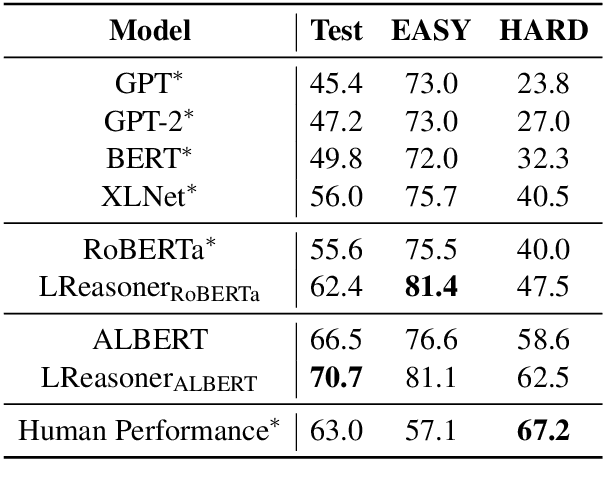
Logical reasoning of text requires understanding critical logical information in the text and performing inference over them. Large-scale pre-trained models for logical reasoning mainly focus on word-level semantics of text while struggling to capture symbolic logic. In this paper, we propose to understand logical symbols and expressions in the text to arrive at the answer. Based on such logical information, we not only put forward a context extension framework but also propose a data augmentation algorithm. The former extends the context to cover implicit logical expressions following logical equivalence laws. The latter augments literally similar but logically different instances to better capture logical information, especially logical negative and conditional relationships. We conduct experiments on ReClor dataset. The results show that our method achieves the state-of-the-art performance, and both logic-driven context extension framework and data augmentation algorithm can help improve the accuracy. And our multi-model ensemble system is the first to surpass human performance on both EASY set and HARD set of ReClor.

AR-LSAT: Investigating Analytical Reasoning of Text
Apr 15, 2021


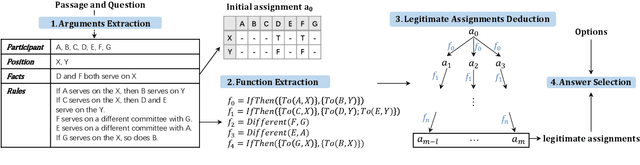
Analytical reasoning is an essential and challenging task that requires a system to analyze a scenario involving a set of particular circumstances and perform reasoning over it to make conclusions. In this paper, we study the challenge of analytical reasoning of text and introduce a new dataset consisting of questions from the Law School Admission Test from 1991 to 2016. We analyze what knowledge understanding and reasoning abilities are required to do well on this task. Furthermore, to address this reasoning challenge, we design two different baselines: (1) a Transformer-based method which leverages the state-of-the-art pre-trained language models and (2) Analytical Reasoning Machine (ARM), a logical-level reasoning framework extracting symbolic knowledge (e.g, participants, facts, logical functions) to deduce legitimate solutions. In our experiments, we find that the Transformer-based models struggle to solve this task as their performance is close to random guess and ARM achieves better performance by leveraging symbolic knowledge and interpretable reasoning steps. Results show that both methods still lag far behind human performance, which leave further space for future research.
WhiteningBERT: An Easy Unsupervised Sentence Embedding Approach
Apr 09, 2021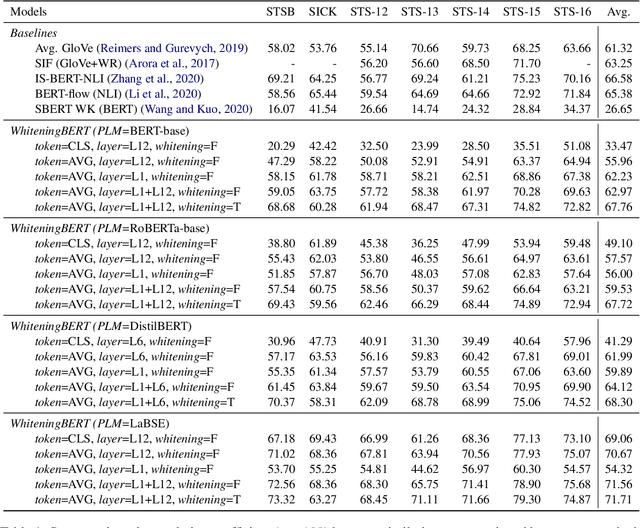
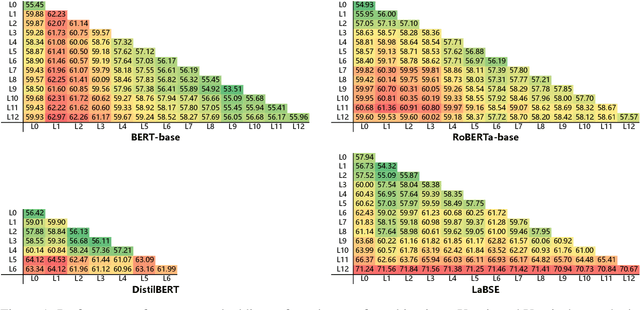
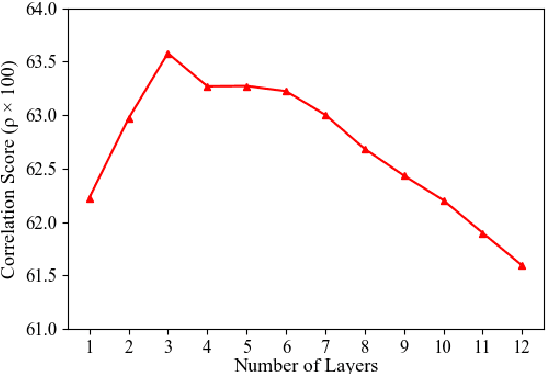
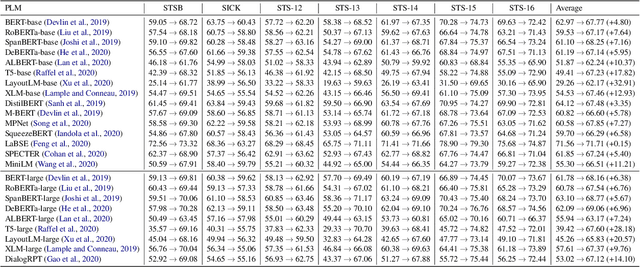
Producing the embedding of a sentence in an unsupervised way is valuable to natural language matching and retrieval problems in practice. In this work, we conduct a thorough examination of pretrained model based unsupervised sentence embeddings. We study on four pretrained models and conduct massive experiments on seven datasets regarding sentence semantics. We have there main findings. First, averaging all tokens is better than only using [CLS] vector. Second, combining both top andbottom layers is better than only using top layers. Lastly, an easy whitening-based vector normalization strategy with less than 10 lines of code consistently boosts the performance.
CodeXGLUE: A Machine Learning Benchmark Dataset for Code Understanding and Generation
Feb 09, 2021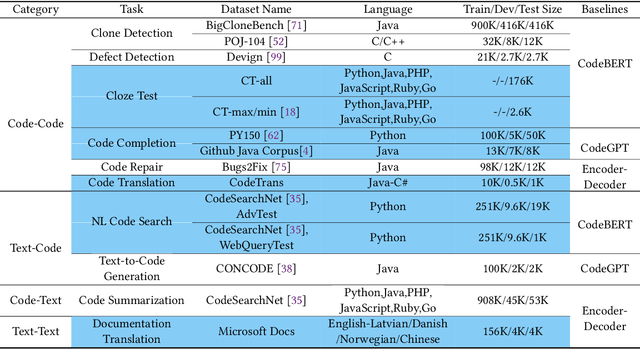
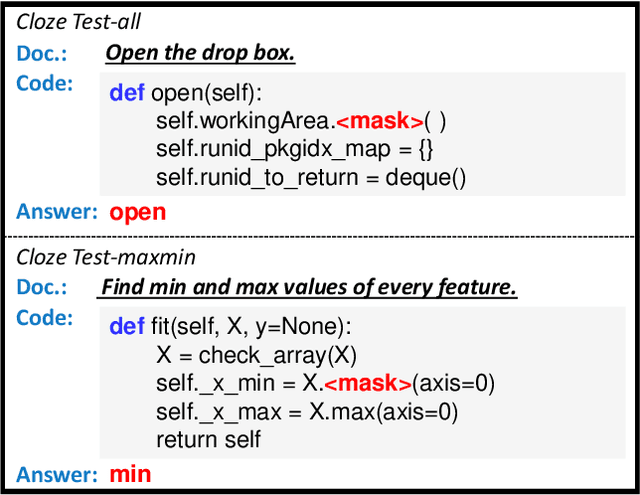
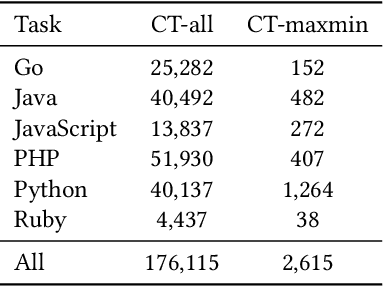
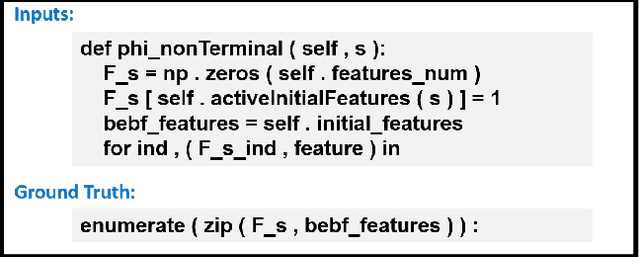
Benchmark datasets have a significant impact on accelerating research in programming language tasks. In this paper, we introduce CodeXGLUE, a benchmark dataset to foster machine learning research for program understanding and generation. CodeXGLUE includes a collection of 10 tasks across 14 datasets and a platform for model evaluation and comparison. CodeXGLUE also features three baseline systems, including the BERT-style, GPT-style, and Encoder-Decoder models, to make it easy for researchers to use the platform. The availability of such data and baselines can help the development and validation of new methods that can be applied to various program understanding and generation problems.
Syntax-Enhanced Pre-trained Model
Dec 28, 2020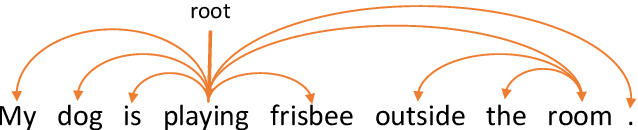
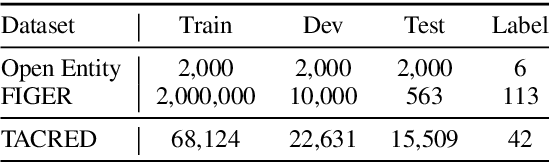
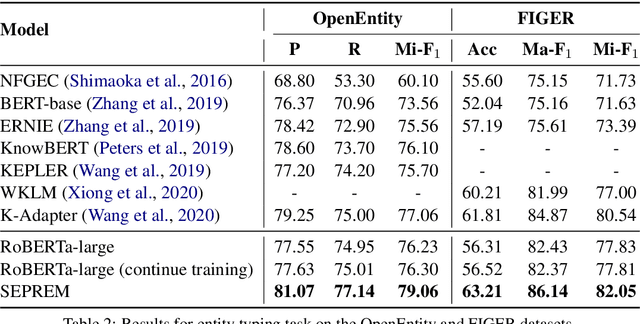
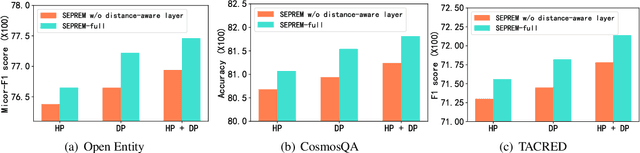
We study the problem of leveraging the syntactic structure of text to enhance pre-trained models such as BERT and RoBERTa. Existing methods utilize syntax of text either in the pre-training stage or in the fine-tuning stage, so that they suffer from discrepancy between the two stages. Such a problem would lead to the necessity of having human-annotated syntactic information, which limits the application of existing methods to broader scenarios. To address this, we present a model that utilizes the syntax of text in both pre-training and fine-tuning stages. Our model is based on Transformer with a syntax-aware attention layer that considers the dependency tree of the text. We further introduce a new pre-training task of predicting the syntactic distance among tokens in the dependency tree. We evaluate the model on three downstream tasks, including relation classification, entity typing, and question answering. Results show that our model achieves state-of-the-art performance on six public benchmark datasets. We have two major findings. First, we demonstrate that infusing automatically produced syntax of text improves pre-trained models. Second, global syntactic distances among tokens bring larger performance gains compared to local head relations between contiguous tokens.
Neural Deepfake Detection with Factual Structure of Text
Oct 15, 2020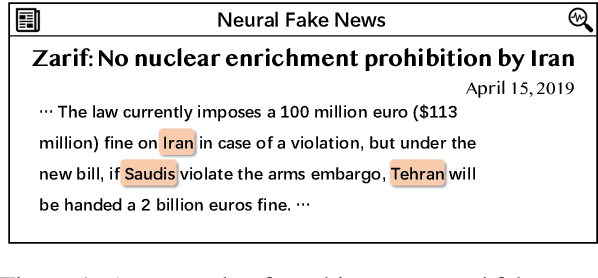
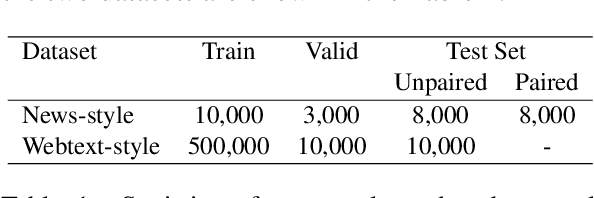
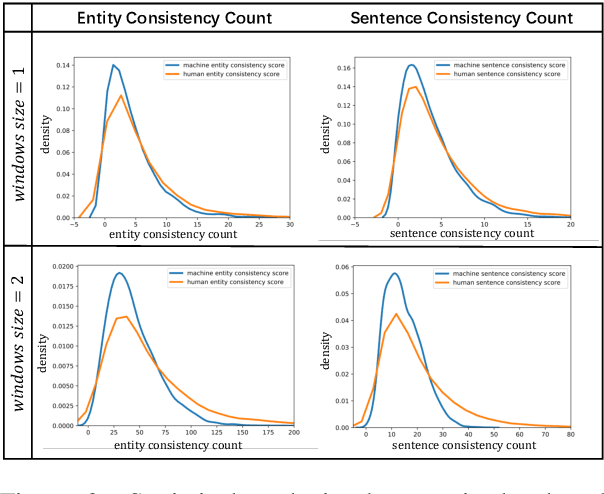
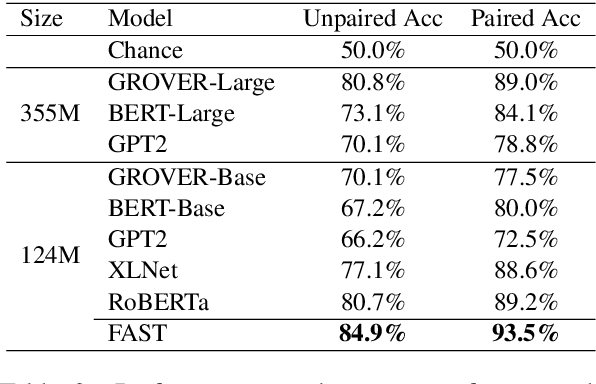
Deepfake detection, the task of automatically discriminating machine-generated text, is increasingly critical with recent advances in natural language generative models. Existing approaches to deepfake detection typically represent documents with coarse-grained representations. However, they struggle to capture factual structures of documents, which is a discriminative factor between machine-generated and human-written text according to our statistical analysis. To address this, we propose a graph-based model that utilizes the factual structure of a document for deepfake detection of text. Our approach represents the factual structure of a given document as an entity graph, which is further utilized to learn sentence representations with a graph neural network. Sentence representations are then composed to a document representation for making predictions, where consistent relations between neighboring sentences are sequentially modeled. Results of experiments on two public deepfake datasets show that our approach significantly improves strong base models built with RoBERTa. Model analysis further indicates that our model can distinguish the difference in the factual structure between machine-generated text and human-written text.
GraphCodeBERT: Pre-training Code Representations with Data Flow
Sep 29, 2020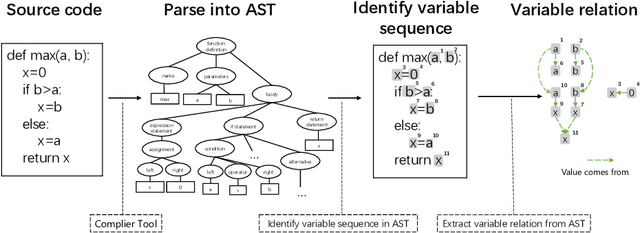
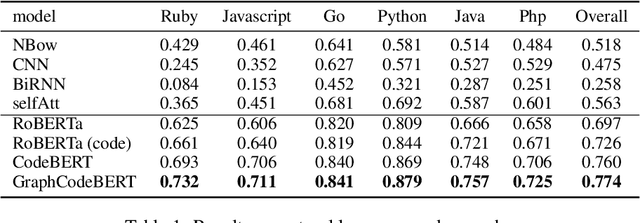
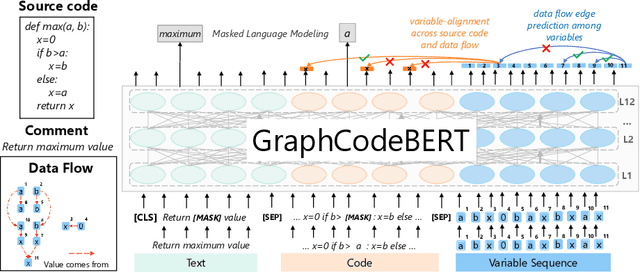
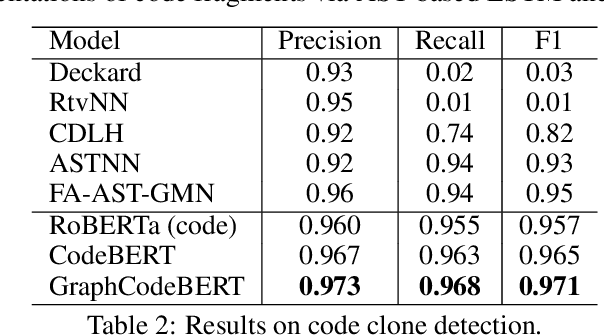
Pre-trained models for programming language have achieved dramatic empirical improvements on a variety of code-related tasks such as code search, code completion, code summarization, etc. However, existing pre-trained models regard a code snippet as a sequence of tokens, while ignoring the inherent structure of code, which provides crucial code semantics and would enhance the code understanding process. We present GraphCodeBERT, a pre-trained model for programming language that considers the inherent structure of code. Instead of taking syntactic-level structure of code like abstract syntax tree (AST), we use data flow in the pre-training stage, which is a semantic-level structure of code that encodes the relation of "where-the-value-comes-from" between variables. Such a semantic-level structure is neat and does not bring an unnecessarily deep hierarchy of AST, the property of which makes the model more efficient. We develop GraphCodeBERT based on Transformer. In addition to using the task of masked language modeling, we introduce two structure-aware pre-training tasks. One is to predict code structure edges, and the other is to align representations between source code and code structure. We implement the model in an efficient way with a graph-guided masked attention function to incorporate the code structure. We evaluate our model on four tasks, including code search, clone detection, code translation, and code refinement. Results show that code structure and newly introduced pre-training tasks can improve GraphCodeBERT and achieves state-of-the-art performance on the four downstream tasks. We further show that the model prefers structure-level attentions over token-level attentions in the task of code search.
CodeBLEU: a Method for Automatic Evaluation of Code Synthesis
Sep 27, 2020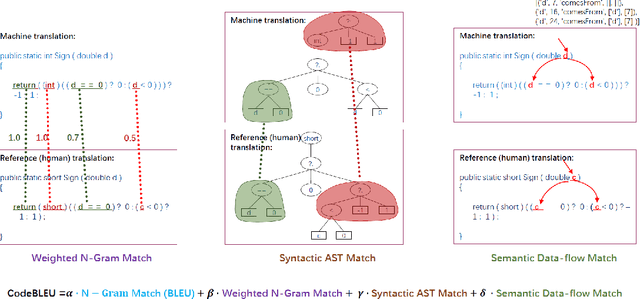

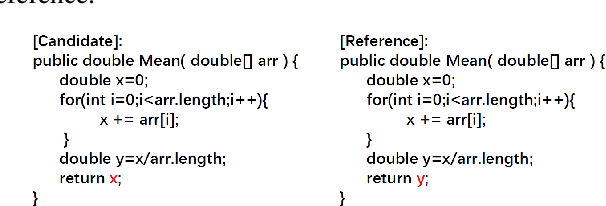
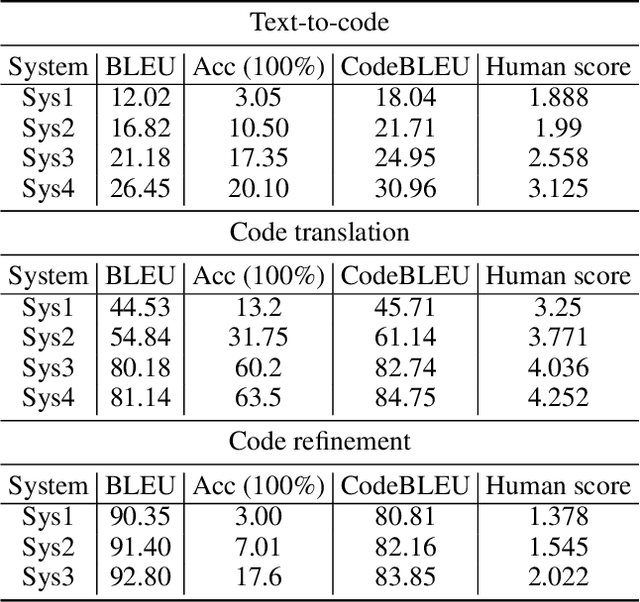
Evaluation metrics play a vital role in the growth of an area as it defines the standard of distinguishing between good and bad models. In the area of code synthesis, the commonly used evaluation metric is BLEU or perfect accuracy, but they are not suitable enough to evaluate codes, because BLEU is originally designed to evaluate the natural language, neglecting important syntactic and semantic features of codes, and perfect accuracy is too strict thus it underestimates different outputs with the same semantic logic. To remedy this, we introduce a new automatic evaluation metric, dubbed CodeBLEU. It absorbs the strength of BLEU in the n-gram match and further injects code syntax via abstract syntax trees (AST) and code semantics via data-flow. We conduct experiments by evaluating the correlation coefficient between CodeBLEU and quality scores assigned by the programmers on three code synthesis tasks, i.e., text-to-code, code translation, and code refinement. Experimental results show that our proposed CodeBLEU can achieve a better correlation with programmer assigned scores compared with BLEU and accuracy.
Evidence-Aware Inferential Text Generation with Vector Quantised Variational AutoEncoder
Jun 15, 2020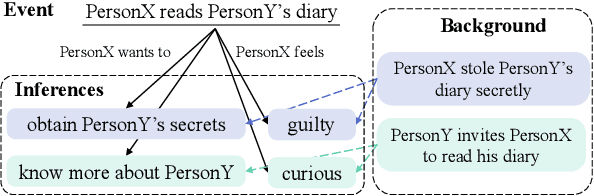
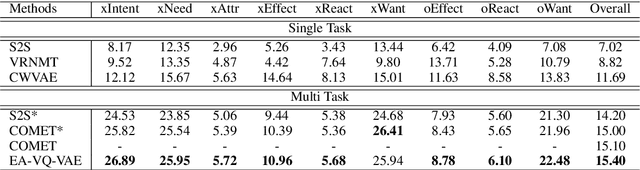
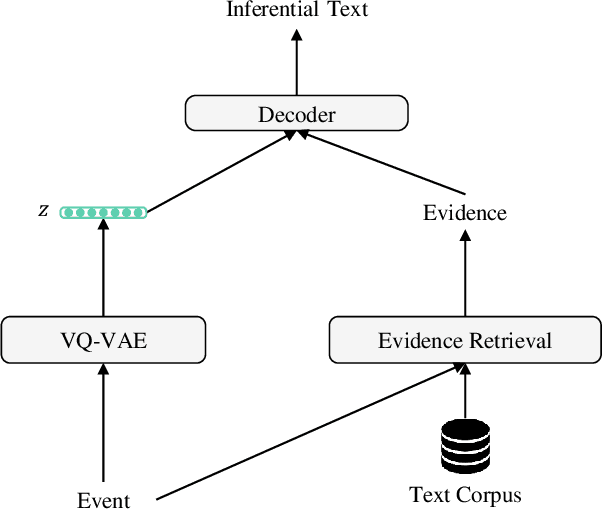
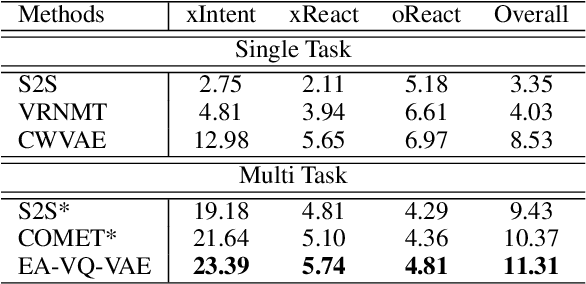
Generating inferential texts about an event in different perspectives requires reasoning over different contexts that the event occurs. Existing works usually ignore the context that is not explicitly provided, resulting in a context-independent semantic representation that struggles to support the generation. To address this, we propose an approach that automatically finds evidence for an event from a large text corpus, and leverages the evidence to guide the generation of inferential texts. Our approach works in an encoder-decoder manner and is equipped with a Vector Quantised-Variational Autoencoder, where the encoder outputs representations from a distribution over discrete variables. Such discrete representations enable automatically selecting relevant evidence, which not only facilitates evidence-aware generation, but also provides a natural way to uncover rationales behind the generation. Our approach provides state-of-the-art performance on both Event2Mind and ATOMIC datasets. More importantly, we find that with discrete representations, our model selectively uses evidence to generate different inferential texts.
Leveraging Declarative Knowledge in Text and First-Order Logic for Fine-Grained Propaganda Detection
Apr 29, 2020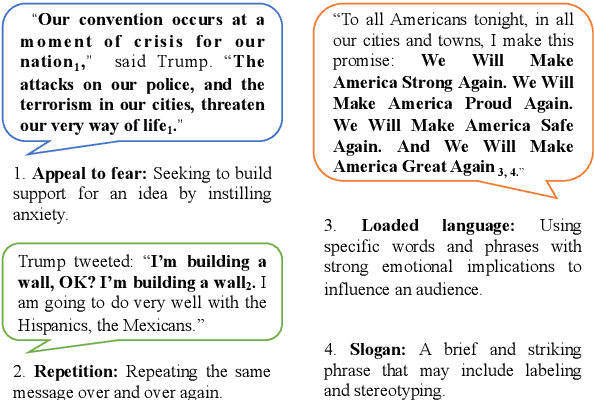
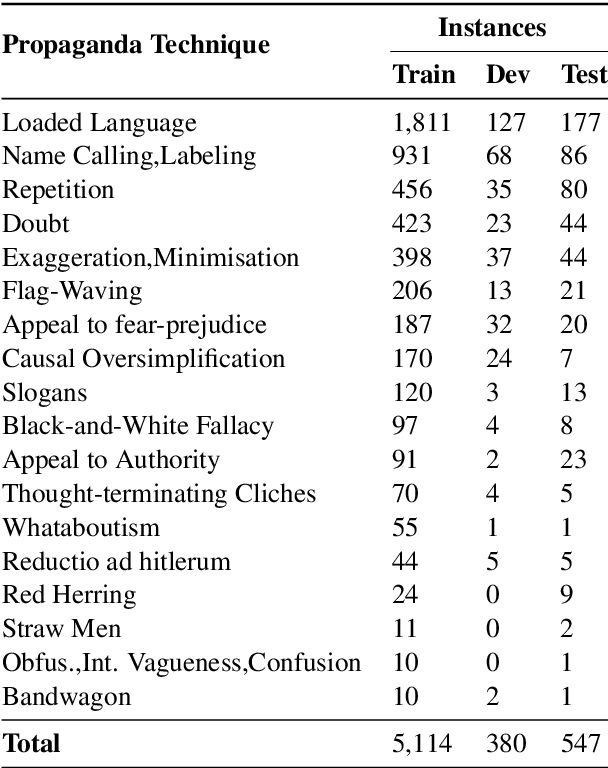
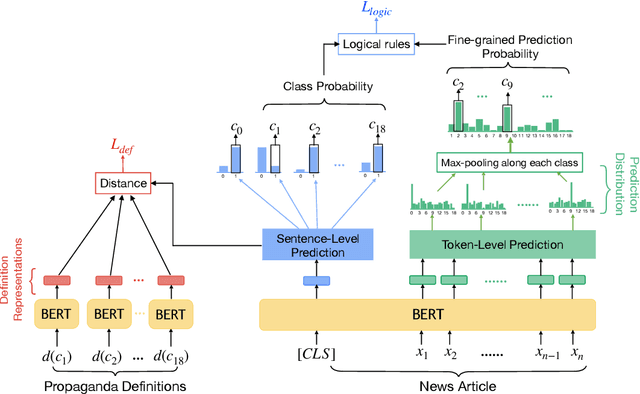

We study the detection of propagandistic text fragments in news articles. Instead of merely learning from input-output datapoints in training data, we introduce an approach to inject declarative knowledge of fine-grained propaganda techniques. We leverage declarative knowledge expressed in both natural language and first-order logic. The former refers to the literal definition of each propaganda technique, which is utilized to get class representations for regularizing the model parameters. The latter refers to logical consistency between coarse- and fine- grained predictions, which is used to regularize the training process with propositional Boolean expressions. We conduct experiments on Propaganda Techniques Corpus, a large manually annotated dataset for fine-grained propaganda detection. Experiments show that our method achieves superior performance, demonstrating that injecting declarative knowledge expressed in both natural language and first-order logic can help the model to make more accurate predictions.