 Add to Chrome
 Add to Firefox
 Add to Edge
Fine-grained Context and Multi-modal Alignment for Freehand 3D Ultrasound Reconstruction
Jul 05, 2024
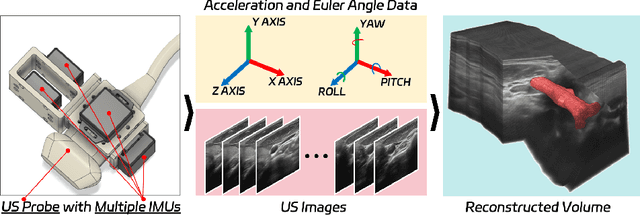
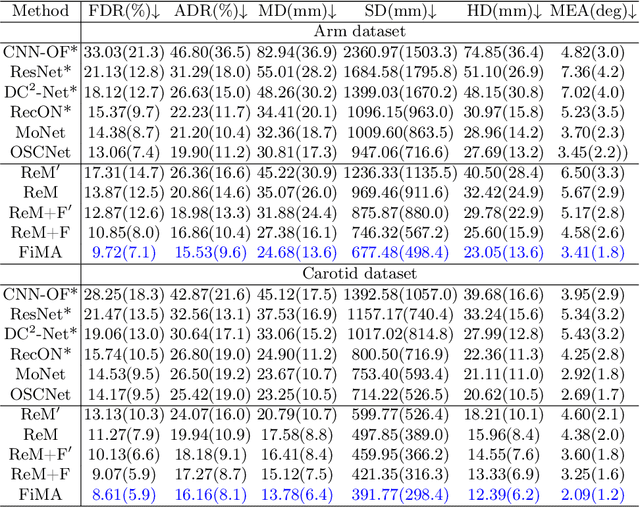
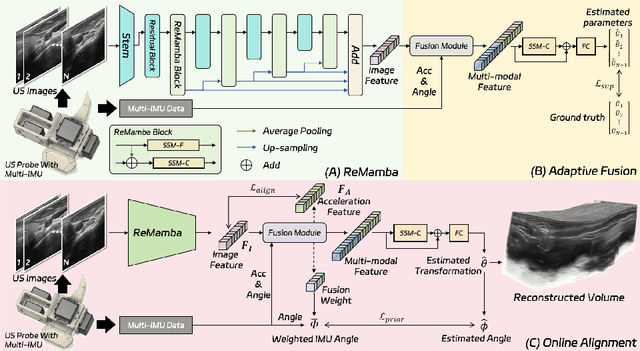
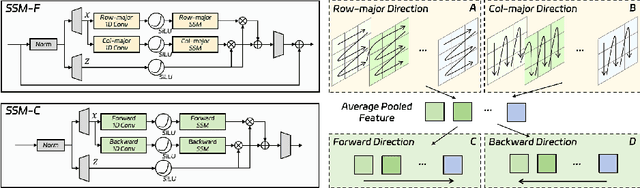
Fine-grained spatio-temporal learning is crucial for freehand 3D ultrasound reconstruction. Previous works mainly resorted to the coarse-grained spatial features and the separated temporal dependency learning and struggles for fine-grained spatio-temporal learning. Mining spatio-temporal information in fine-grained scales is extremely challenging due to learning difficulties in long-range dependencies. In this context, we propose a novel method to exploit the long-range dependency management capabilities of the state space model (SSM) to address the above challenge. Our contribution is three-fold. First, we propose ReMamba, which mines multi-scale spatio-temporal information by devising a multi-directional SSM. Second, we propose an adaptive fusion strategy that introduces multiple inertial measurement units as auxiliary temporal information to enhance spatio-temporal perception. Last, we design an online alignment strategy that encodes the temporal information as pseudo labels for multi-modal alignment to further improve reconstruction performance. Extensive experimental validations on two large-scale datasets show remarkable improvement from our method over competitors.

A Review of Image Processing Methods in Prostate Ultrasound
Jun 30, 2024Prostate cancer (PCa) poses a significant threat to men's health, with early diagnosis being crucial for improving prognosis and reducing mortality rates. Transrectal ultrasound (TRUS) plays a vital role in the diagnosis and image-guided intervention of PCa.To facilitate physicians with more accurate and efficient computer-assisted diagnosis and interventions, many image processing algorithms in TRUS have been proposed and achieved state-of-the-art performance in several tasks, including prostate gland segmentation, prostate image registration, PCa classification and detection, and interventional needle detection.The rapid development of these algorithms over the past two decades necessitates a comprehensive summary. In consequence, this survey provides a systematic analysis of this field, outlining the evolution of image processing methods in the context of TRUS image analysis and meanwhile highlighting their relevant contributions. Furthermore, this survey discusses current challenges and suggests future research directions to possibly advance this field further.
HeartBeat: Towards Controllable Echocardiography Video Synthesis with Multimodal Conditions-Guided Diffusion Models
Jun 20, 2024Echocardiography (ECHO) video is widely used for cardiac examination. In clinical, this procedure heavily relies on operator experience, which needs years of training and maybe the assistance of deep learning-based systems for enhanced accuracy and efficiency. However, it is challenging since acquiring sufficient customized data (e.g., abnormal cases) for novice training and deep model development is clinically unrealistic. Hence, controllable ECHO video synthesis is highly desirable. In this paper, we propose a novel diffusion-based framework named HeartBeat towards controllable and high-fidelity ECHO video synthesis. Our highlight is three-fold. First, HeartBeat serves as a unified framework that enables perceiving multimodal conditions simultaneously to guide controllable generation. Second, we factorize the multimodal conditions into local and global ones, with two insertion strategies separately provided fine- and coarse-grained controls in a composable and flexible manner. In this way, users can synthesize ECHO videos that conform to their mental imagery by combining multimodal control signals. Third, we propose to decouple the visual concepts and temporal dynamics learning using a two-stage training scheme for simplifying the model training. One more interesting thing is that HeartBeat can easily generalize to mask-guided cardiac MRI synthesis in a few shots, showcasing its scalability to broader applications. Extensive experiments on two public datasets show the efficacy of the proposed HeartBeat.
DeepUniUSTransformer: Towards A Universal UltraSound Model with Prompted Guidance
Jun 03, 2024Ultrasound is a widely used imaging modality in clinical practice due to its low cost, portability, and safety. Current research in general AI for healthcare focuses on large language models and general segmentation models, with insufficient attention to solutions addressing both disease prediction and tissue segmentation. In this study, we propose a novel universal framework for ultrasound, namely DeepUniUSTransformer, which is a promptable model accommodating multiple clinical task. The universality of this model is derived from its versatility across various aspects. It proficiently manages any ultrasound nature, any anatomical position, any input type and excelling not only in segmentation tasks but also in computer-aided diagnosis tasks. We introduce a novel module that incorporates this information as a prompt and seamlessly embedding it within the model's learning process. To train and validate our proposed model, we curated a comprehensive ultrasound dataset from publicly accessible sources, encompassing up to 7 distinct anatomical positions with over 9.7K annotations. Experimental results demonstrate that our model surpasses both a model trained on a single dataset and an ablated version of the network lacking prompt guidance. We will continuously expand the dataset and optimize the task specific prompting mechanism towards the universality in medical ultrasound. Model weights, datasets, and code will be open source to the public.
ModeTv2: GPU-accelerated Motion Decomposition Transformer for Pairwise Optimization in Medical Image Registration
Mar 25, 2024


Deformable image registration plays a crucial role in medical imaging, aiding in disease diagnosis and image-guided interventions. Traditional iterative methods are slow, while deep learning (DL) accelerates solutions but faces usability and precision challenges. This study introduces a pyramid network with the enhanced motion decomposition Transformer (ModeTv2) operator, showcasing superior pairwise optimization (PO) akin to traditional methods. We re-implement ModeT operator with CUDA extensions to enhance its computational efficiency. We further propose RegHead module which refines deformation fields, improves the realism of deformation and reduces parameters. By adopting the PO, the proposed network balances accuracy, efficiency, and generalizability. Extensive experiments on two public brain MRI datasets and one abdominal CT dataset demonstrate the network's suitability for PO, providing a DL model with enhanced usability and interpretability. The code is publicly available.
LUM-ViT: Learnable Under-sampling Mask Vision Transformer for Bandwidth Limited Optical Signal Acquisition
Mar 03, 2024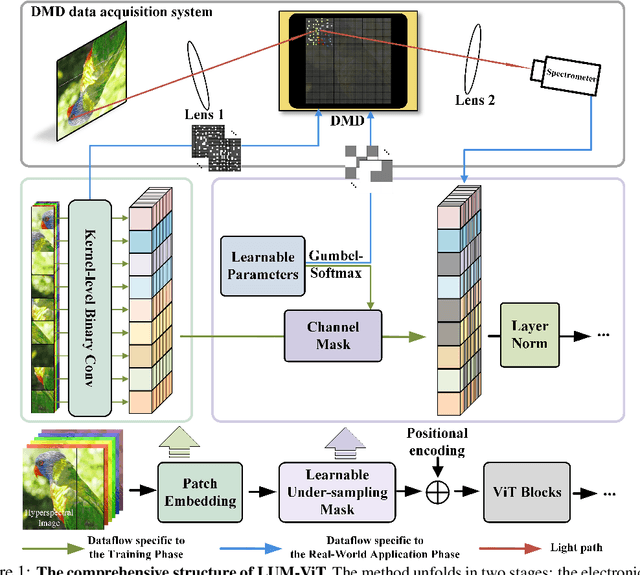
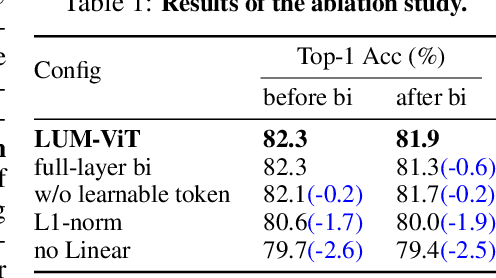
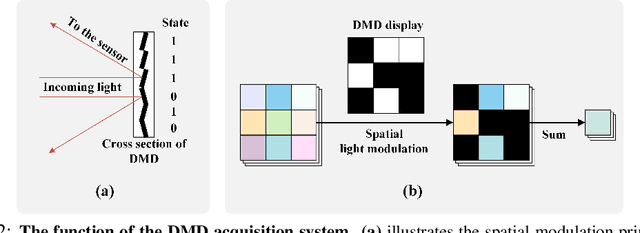
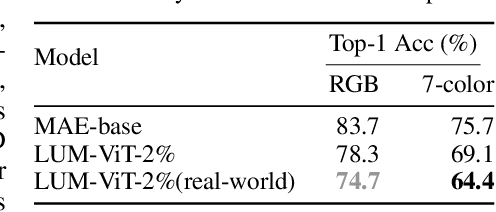
Bandwidth constraints during signal acquisition frequently impede real-time detection applications. Hyperspectral data is a notable example, whose vast volume compromises real-time hyperspectral detection. To tackle this hurdle, we introduce a novel approach leveraging pre-acquisition modulation to reduce the acquisition volume. This modulation process is governed by a deep learning model, utilizing prior information. Central to our approach is LUM-ViT, a Vision Transformer variant. Uniquely, LUM-ViT incorporates a learnable under-sampling mask tailored for pre-acquisition modulation. To further optimize for optical calculations, we propose a kernel-level weight binarization technique and a three-stage fine-tuning strategy. Our evaluations reveal that, by sampling a mere 10% of the original image pixels, LUM-ViT maintains the accuracy loss within 1.8% on the ImageNet classification task. The method sustains near-original accuracy when implemented on real-world optical hardware, demonstrating its practicality. Code will be available at https://github.com/MaxLLF/LUM-ViT.
TriAug: Out-of-Distribution Detection for Imbalanced Breast Lesion in Ultrasound
Feb 27, 2024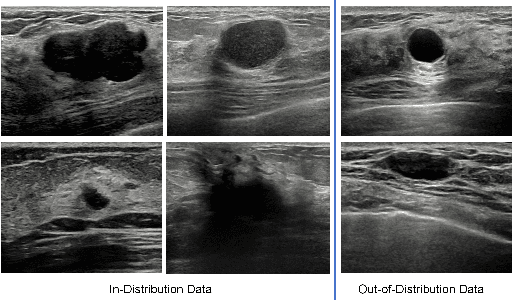
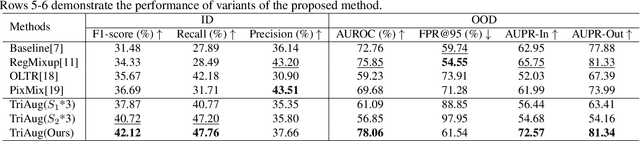
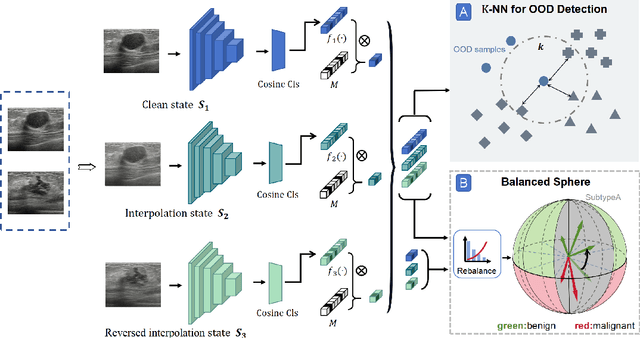
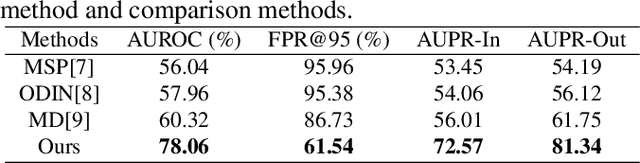
Different diseases, such as histological subtypes of breast lesions, have severely varying incidence rates. Even trained with substantial amount of in-distribution (ID) data, models often encounter out-of-distribution (OOD) samples belonging to unseen classes in clinical reality. To address this, we propose a novel framework built upon a long-tailed OOD detection task for breast ultrasound images. It is equipped with a triplet state augmentation (TriAug) which improves ID classification accuracy while maintaining a promising OOD detection performance. Meanwhile, we designed a balanced sphere loss to handle the class imbalanced problem. Experimental results show that the model outperforms state-of-art OOD approaches both in ID classification (F1-score=42.12%) and OOD detection (AUROC=78.06%).
Thyroid ultrasound diagnosis improvement via multi-view self-supervised learning and two-stage pre-training
Feb 18, 2024Thyroid nodule classification and segmentation in ultrasound images are crucial for computer-aided diagnosis; however, they face limitations owing to insufficient labeled data. In this study, we proposed a multi-view contrastive self-supervised method to improve thyroid nodule classification and segmentation performance with limited manual labels. Our method aligns the transverse and longitudinal views of the same nodule, thereby enabling the model to focus more on the nodule area. We designed an adaptive loss function that eliminates the limitations of the paired data. Additionally, we adopted a two-stage pre-training to exploit the pre-training on ImageNet and thyroid ultrasound images. Extensive experiments were conducted on a large-scale dataset collected from multiple centers. The results showed that the proposed method significantly improves nodule classification and segmentation performance with limited manual labels and outperforms state-of-the-art self-supervised methods. The two-stage pre-training also significantly exceeded ImageNet pre-training.
One-Stop Automated Diagnostic System for Carpal Tunnel Syndrome in Ultrasound Images Using Deep Learning
Feb 08, 2024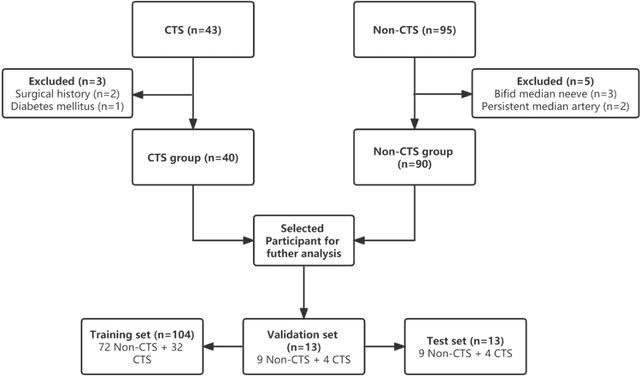
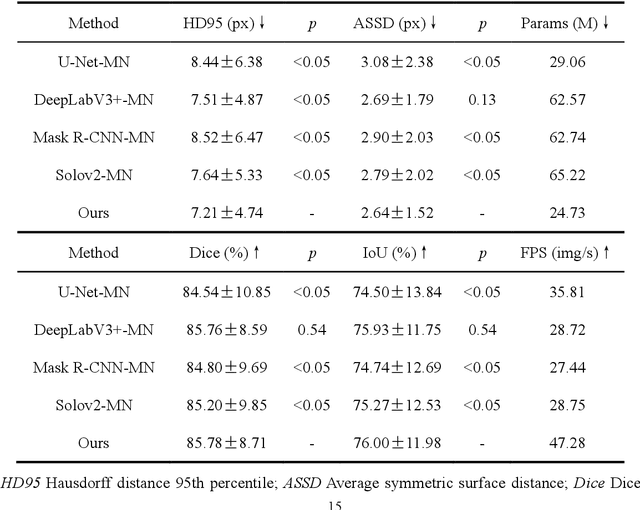
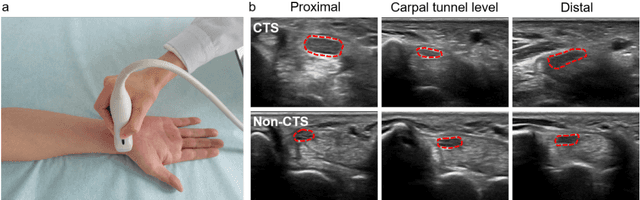
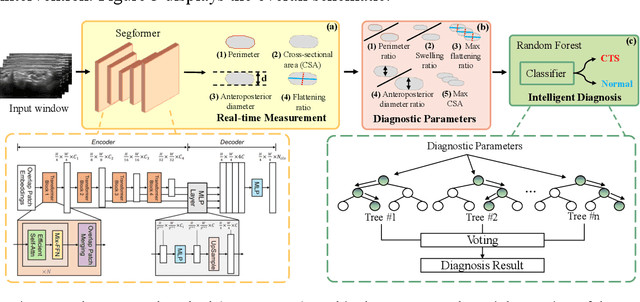
Objective: Ultrasound (US) examination has unique advantages in diagnosing carpal tunnel syndrome (CTS) while identifying the median nerve (MN) and diagnosing CTS depends heavily on the expertise of examiners. To alleviate this problem, we aimed to develop a one-stop automated CTS diagnosis system (OSA-CTSD) and evaluate its effectiveness as a computer-aided diagnostic tool. Methods: We combined real-time MN delineation, accurate biometric measurements, and explainable CTS diagnosis into a unified framework, called OSA-CTSD. We collected a total of 32,301 static images from US videos of 90 normal wrists and 40 CTS wrists for evaluation using a simplified scanning protocol. Results: The proposed model showed better segmentation and measurement performance than competing methods, reporting that HD95 score of 7.21px, ASSD score of 2.64px, Dice score of 85.78%, and IoU score of 76.00%, respectively. In the reader study, it demonstrated comparable performance with the average performance of the experienced in classifying the CTS, while outperformed that of the inexperienced radiologists in terms of classification metrics (e.g., accuracy score of 3.59% higher and F1 score of 5.85% higher). Conclusion: The OSA-CTSD demonstrated promising diagnostic performance with the advantages of real-time, automation, and clinical interpretability. The application of such a tool can not only reduce reliance on the expertise of examiners, but also can help to promote the future standardization of the CTS diagnosis process, benefiting both patients and radiologists.
* Accepted by Ultrasound in Medicine & Biology
Is Two-shot All You Need? A Label-efficient Approach for Video Segmentation in Breast Ultrasound
Feb 07, 2024Breast lesion segmentation from breast ultrasound (BUS) videos could assist in early diagnosis and treatment. Existing video object segmentation (VOS) methods usually require dense annotation, which is often inaccessible for medical datasets. Furthermore, they suffer from accumulative errors and a lack of explicit space-time awareness. In this work, we propose a novel two-shot training paradigm for BUS video segmentation. It not only is able to capture free-range space-time consistency but also utilizes a source-dependent augmentation scheme. This label-efficient learning framework is validated on a challenging in-house BUS video dataset. Results showed that it gained comparable performance to the fully annotated ones given only 1.9% training labels.