 Add to Chrome
 Add to Firefox
 Add to Edge
Empowering Polymeric Materials Discovery by Artificial Intelligence
Jun 18, 2026
Polymeric materials underpin modern technologies spanning energy storage, microelectronics, healthcare and sustainable manufacturing. Yet their rational design remains exceptionally challenging because material performance emerges from complex interactions among molecular composition, chain architecture, processing history and hierarchical structural evolution across multiple length and time scales. Consequently, polymer research has long relied on labor-intensive experimentation and fragmented modeling approaches, limiting both mechanistic understanding and innovation efficiency. Recent advances in data infrastructure, machine learning, large artificial intelligence (AI) models and laboratory automation are beginning to reshape this landscape. Rather than functioning as isolated tools, polymer databases, predictive models, AI agents and automated laboratories are increasingly converging into interconnected discovery ecosystems. As a result, the central challenge is shifting from improving predictive accuracy alone to enabling reliable decision-making, adaptive learning and seamless integration across computation, experimentation and scientific reasoning. We argue that polymer science is entering an era of autonomous discovery, in which data, simulation, reasoning and experimentation operate within self-improving feedback loops that continuously generate hypotheses, design materials, execute experiments and refine predictive models. By unifying molecular design, process optimization, experimental validation and industrial translation, such autonomous ecosystems establish a more predictive, reproducible and scalable paradigm for polymer innovation, fundamentally transforming how polymer research is conducted.

Atomistic Modeling of Chemical Disorder in Materials: Bridging Classical Methods and AI-Assisted Approaches
May 18, 2026Chemical disorder, originating from the mixed occupation of crystallographic sites by multiple elements, is widespread in alloys, ceramics, and compositionally complex materials, where short- and long-range orderings can strongly influence properties. A central obstacle is the representation gap between experiments and simulations: experiments often report disorder as partial occupancies and ensemble-averaged behaviors, whereas atomistic simulations and AI workflows usually require fully specified configurations. Tackling this gap requires computational methods that convert averaged disorder descriptions into representative configurational ensembles while balancing cost, bias, and fidelity. This challenge has become more urgent in AI-driven computational discovery, where ignoring disorder may cause AI workflows to misrank stability, misjudge novelty, and misdirect experiments with too-idealized representations. This Review highlights how classical and AI-driven methods can bridge this representation gap. We assess the strengths and limitations of approaches spanning mean-field theories, cluster expansion, quasi-random approximations, Monte Carlo, and emerging schemes powered by universal interatomic potentials and generative models. We further highlight how AI can accelerate classical computational schemes by lowering the cost of microstate evaluation, configurational exploration, and atomistic-to-thermodynamic closure. We also emphasize how AI can enable disorder-native capabilities, including workflow triage, ordering-sensitive and alchemical representations, generative models of disordered structures and distributions, and kinetics-aware disorder prediction. Together, this framework outlines a practical roadmap toward disorder-native AI, which can transform chemical disorder from a representational obstacle into a controllable variable for realistic AI-accelerated materials discovery.
Learning Ordering in Crystalline Materials with Symmetry-Aware Graph Neural Networks
Sep 20, 2024


Graph convolutional neural networks (GCNNs) have become a machine learning workhorse for screening the chemical space of crystalline materials in fields such as catalysis and energy storage, by predicting properties from structures. Multicomponent materials, however, present a unique challenge since they can exhibit chemical (dis)order, where a given lattice structure can encompass a variety of elemental arrangements ranging from highly ordered structures to fully disordered solid solutions. Critically, properties like stability, strength, and catalytic performance depend not only on structures but also on orderings. To enable rigorous materials design, it is thus critical to ensure GCNNs are capable of distinguishing among atomic orderings. However, the ordering-aware capability of GCNNs has been poorly understood. Here, we benchmark various neural network architectures for capturing the ordering-dependent energetics of multicomponent materials in a custom-made dataset generated with high-throughput atomistic simulations. Conventional symmetry-invariant GCNNs were found unable to discern the structural difference between the diverse symmetrically inequivalent atomic orderings of the same material, while symmetry-equivariant model architectures could inherently preserve and differentiate the distinct crystallographic symmetries of various orderings.
One-Stop Automated Diagnostic System for Carpal Tunnel Syndrome in Ultrasound Images Using Deep Learning
Feb 08, 2024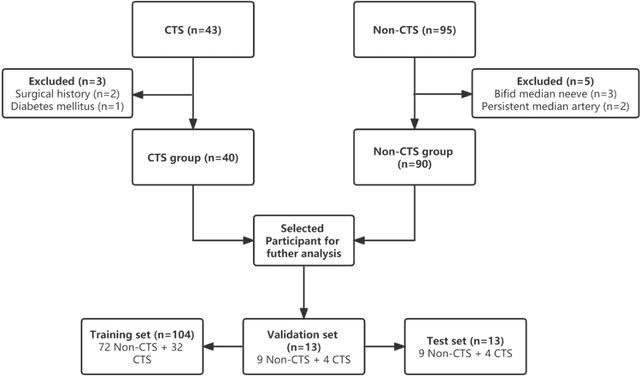
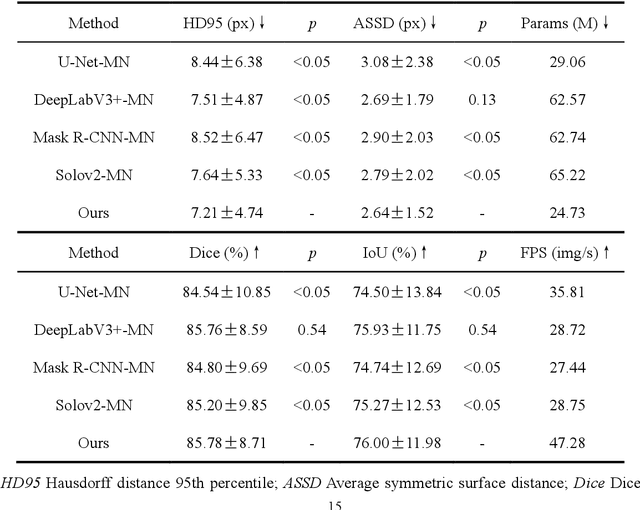
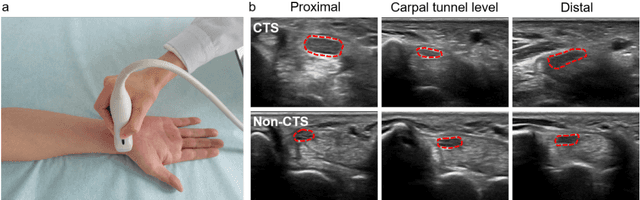
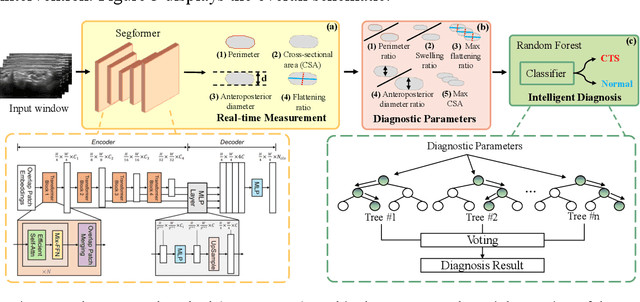
Objective: Ultrasound (US) examination has unique advantages in diagnosing carpal tunnel syndrome (CTS) while identifying the median nerve (MN) and diagnosing CTS depends heavily on the expertise of examiners. To alleviate this problem, we aimed to develop a one-stop automated CTS diagnosis system (OSA-CTSD) and evaluate its effectiveness as a computer-aided diagnostic tool. Methods: We combined real-time MN delineation, accurate biometric measurements, and explainable CTS diagnosis into a unified framework, called OSA-CTSD. We collected a total of 32,301 static images from US videos of 90 normal wrists and 40 CTS wrists for evaluation using a simplified scanning protocol. Results: The proposed model showed better segmentation and measurement performance than competing methods, reporting that HD95 score of 7.21px, ASSD score of 2.64px, Dice score of 85.78%, and IoU score of 76.00%, respectively. In the reader study, it demonstrated comparable performance with the average performance of the experienced in classifying the CTS, while outperformed that of the inexperienced radiologists in terms of classification metrics (e.g., accuracy score of 3.59% higher and F1 score of 5.85% higher). Conclusion: The OSA-CTSD demonstrated promising diagnostic performance with the advantages of real-time, automation, and clinical interpretability. The application of such a tool can not only reduce reliance on the expertise of examiners, but also can help to promote the future standardization of the CTS diagnosis process, benefiting both patients and radiologists.
* Accepted by Ultrasound in Medicine & Biology