 Add to Chrome
 Add to Firefox
 Add to Edge
TAPFormer: Robust Arbitrary Point Tracking via Transient Asynchronous Fusion of Frames and Events
Mar 05, 2026
Tracking any point (TAP) is a fundamental yet challenging task in computer vision, requiring high precision and long-term motion reasoning. Recent attempts to combine RGB frames and event streams have shown promise, yet they typically rely on synchronous or non-adaptive fusion, leading to temporal misalignment and severe degradation when one modality fails. We introduce TAPFormer, a transformer-based framework that performs asynchronous temporal-consistent fusion of frames and events for robust and high-frequency arbitrary point tracking. Our key innovation is a Transient Asynchronous Fusion (TAF) mechanism, which explicitly models the temporal evolution between discrete frames through continuous event updates, bridging the gap between low-rate frames and high-rate events. In addition, a Cross-modal Locally Weighted Fusion (CLWF) module adaptively adjusts spatial attention according to modality reliability, yielding stable and discriminative features even under blur or low light. To evaluate our approach under realistic conditions, we construct a novel real-world frame-event TAP dataset under diverse illumination and motion conditions. Our method outperforms existing point trackers, achieving a 28.2% improvement in average pixel error within threshold. Moreover, on standard point tracking benchmarks, our tracker consistently achieves the best performance. Project website: tapformer.github.io

Tracking Any Point with Frame-Event Fusion Network at High Frame Rate
Sep 18, 2024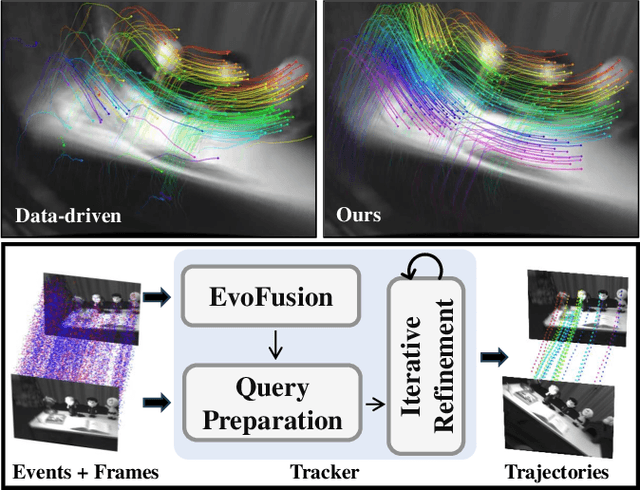
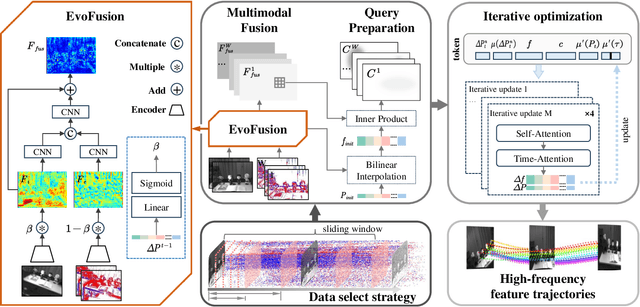
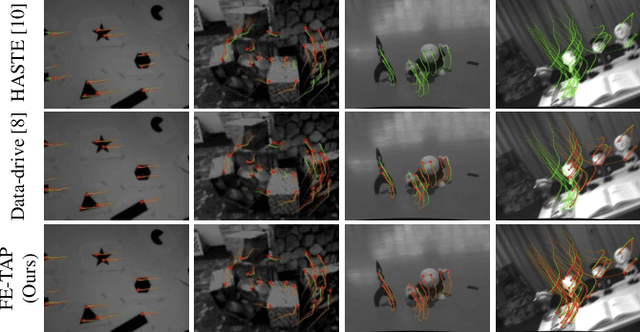
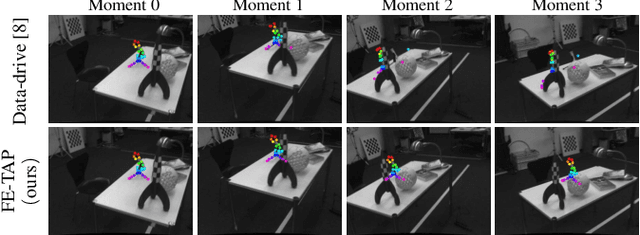
Tracking any point based on image frames is constrained by frame rates, leading to instability in high-speed scenarios and limited generalization in real-world applications. To overcome these limitations, we propose an image-event fusion point tracker, FE-TAP, which combines the contextual information from image frames with the high temporal resolution of events, achieving high frame rate and robust point tracking under various challenging conditions. Specifically, we designed an Evolution Fusion module (EvoFusion) to model the image generation process guided by events. This module can effectively integrate valuable information from both modalities operating at different frequencies. To achieve smoother point trajectories, we employed a transformer-based refinement strategy that updates the point's trajectories and features iteratively. Extensive experiments demonstrate that our method outperforms state-of-the-art approaches, particularly improving expected feature age by 24$\%$ on EDS datasets. Finally, we qualitatively validated the robustness of our algorithm in real driving scenarios using our custom-designed high-resolution image-event synchronization device. Our source code will be released at https://github.com/ljx1002/FE-TAP.