 Add to Chrome
 Add to Firefox
 Add to Edge
E-S2Feat:Semantic-Guided Spiking Local Feature Detection and Description for Event Cameras
Aug 14, 2026
Benefiting from high temporal resolution and dynamic range, event-based local feature methods have attracted increasing attention. However, event sparsity, noise, and limited texture still hinder robust local feature learning. Deploying such methods on resource-constrained platforms such as unmanned aerial vehicles also requires balancing accuracy and energy efficiency. To address these challenges, this paper proposes \textbf{E-S2Feat}, a spiking neural network framework for event-based local feature detection and description. The framework jointly optimizes local feature learning from the perspectives of feature representation and selection. First, a module-specific spiking activation mechanism preserves fine-grained structural cues and discriminative information under low-bit, energy-efficient inference, thereby improving overall representation fidelity. Furthermore, a semantic-guided feature modulation mechanism leverages semantic priors to refine keypoint response distributions and enhance local descriptor discriminability, thereby guiding the model to extract local features with greater geometric stability and stronger discriminative capability. Experiments on the ECD and EDS datasets show that the proposed method significantly outperforms baseline methods such as SuperEvent in pose estimation accuracy. It also achieves accuracy comparable to its artificial neural network counterpart while delivering an approximately 4.8-fold improvement in theoretical computational energy efficiency. Visual-inertial odometry experiments on the TUM-VIE dataset further verify the effectiveness and practical application potential of the proposed method in complete SLAM systems.

CR-Solver: GPU-Accelerated Kinematics Solver for Tendon-driven Continuum Robots
Jul 13, 2026Continuum robots provide intrinsic compliance, high dexterity, and safe physical interaction, enabling navigation and manipulation in confined and unstructured environments. Despite recent advances in sensing and control, heightening the need for precise motion generation, most widely used planning libraries are grounded in rigid-body assumptions, creating a critical gap for fast and practical tools for continuum robots. To address this, we present CR-Solver, a two-stage, optimization-based solver for the motion generation of tendon-driven continuum robots. Our method unifies inverse kinematics, path following, and trajectory planning within a single constrained nonlinear optimization framework. Leveraging GPU-accelerated parallel optimization, CR-Solver delivers fast, accurate, and constraint-aware solutions. We validate our approach on three tasks, demonstrating significant speedups over traditional CPU-based solvers while achieving a consistently high success rate above 95% and millimeter-level accuracy. The solver is implemented in pure Python, reducing the barrier to adoption and offering a practical, extensible foundation for continuum robots' high-performance motion planning.
EVA-Client: A Unified Data Collection, Inference, and Deployment Framework for Embodied Policies on Real Robots
Jul 02, 2026We present EVA-Client, an open-source framework for deployment, data collection, and evaluation of trained manipulation policies on real robots. Sitting between a policy server and the physical hardware, EVA-Client unifies the real-robot stages of the policy iteration loop within a single codebase. It makes three contributions. First, a component-decoupled architecture in which robot backends, inference strategies, and transport middlewares form an orthogonal grid: adding a robot or a strategy touches only its own layer. Second, inspectable execution through Debug, Collect, and Eval workflows, with modes ranging from open-loop simulation to continuous real-time control. Third, every evaluation run doubles as a data collection, recording full rollouts in training-ready format alongside exhaustive logs and a side-by-side comparison viewer, so each evaluation feeds the next round of training rather than ending as an unrecorded impression. EVA-Client further consolidates major real-time inference strategies, synchronous and asynchronous execution, ACT-style temporal ensembling, Real-Time Chunking, and a naive-async ablation baseline, behind a single configuration surface.
Event-based SLAM Benchmark for High-Speed Maneuvers
Apr 27, 2026Event-based cameras are bio-inspired sensors with pixels that independently and asynchronously respond to brightness changes at microsecond resolution, offering the potential to handle visual tasks in high-speed maneuvering scenarios. Existing event-based approaches, although successful in mitigating motion blur caused by high-speed maneuvers, suffer from many limitations. Some of them highlight a success of pose tracking for a fronto-parallel fast shaking camera closed to the structure, while others assume pure (optionally aggressive) three-degree-of-freedom rotations. The former requires persistent local map visibility within the field of view (FOV), whereas the latter fails to generalize to six-degree-of-freedom (6-DoF) motions where both linear and angular velocities may be large. Consequently, current successes do not fully demonstrate that event-based state estimation under arbitrary aggressive maneuvers is a fully solved problem. To quantitatively assess the extent to which the potential of event cameras has been unlocked, we conduct a thorough analysis of state-of-the-art (SOTA) event-based visual odometry (VO)/visual-inertial odometry (VIO) methods and report shortcomings in current public datasets. Furthermore, we introduce a benchmarking framework for event-based state estimation, called EvSLAM, characterized by sufficient variation in data collection platforms, diverse extreme lighting scenarios, and a wide scope of challenging motion patterns under a clear and rigorous definition of high-speed maneuvers for mobile robots, along with a novel evaluation metric designed to fairly assess the operational limits of event-based solutions. This framework benchmarks state-of-the-art methods, yielding insights into optimal architectures and persistent challenges.
Large Language Model based Interactive Decision-Making for Autonomous Driving
Apr 26, 2026In high-conflict mixed-traffic scenarios involving human-driven and autonomous vehicles, most existing autonomous driving systems default to overly conservative behaviors, lack proactive interaction, and consequently suffer from limited public acceptance. To mitigate intent misunderstandings and decision failures, we present a Large Language Model based interactive decision-making framework that augments scene understanding and intent-aware interaction to jointly improve safety and efficiency. The approach uses Object-Process Methodology to semantically model complex multi-vehicle scenes, abstracting low-level perceptual data into objects, processes, and relations, thereby streamlining reasoning over latent causal structure. Building on this representation, the Large Language Model parses both explicit and implicit intents of surrounding agents and, under jointly enforced safety and efficiency constraints, selects candidate maneuvers. We further generate perturbed trajectory candidates via Monte Carlo sampling and evaluate them to obtain an optimized executable trajectory. To foster transparency and coordination with nearby road users, the final decision is translated by the Large Language Model into concise natural-language messages and broadcast through an external Human-Machine Interface, completing a closed loop from scene understanding to action to language. Experiments in a cluster driving simulator demonstrate that the proposed method outperforms traditional baselines across safety, comfort, and efficiency metrics, while a Turing-test-style evaluation indicates a high degree of human-likeness in decision making. Besides, these results suggest that coupling semantic scene abstraction with Large Language Model mediated intent reasoning and language-based eHMI communication offers a practical pathway toward interactive, trustworthy autonomous driving in dense mixed traffic.
GESS: Multi-cue Guided Local Feature Learning via Geometric and Semantic Synergy
Apr 07, 2026Robust local feature detection and description are foundational tasks in computer vision. Existing methods primarily rely on single appearance cues for modeling, leading to unstable keypoints and insufficient descriptor discriminability. In this paper, we propose a multi-cue guided local feature learning framework that leverages semantic and geometric cues to synergistically enhance detection robustness and descriptor discriminability. Specifically, we construct a joint semantic-normal prediction head and a depth stability prediction head atop a lightweight backbone. The former leverages a shared 3D vector field to deeply couple semantic and normal cues, thereby resolving optimization interference from heterogeneous inconsistencies. The latter quantifies the reliability of local regions from a geometric consistency perspective, providing deterministic guidance for robust keypoint selection. Based on these predictions, we introduce the Semantic-Depth Aware Keypoint (SDAK) mechanism for feature detection. By coupling semantic reliability with depth stability, SDAK reweights keypoint responses to suppress spurious features in unreliable regions. For descriptor construction, we design a Unified Triple-Cue Fusion (UTCF) module, which employs a semantic-scheduled gating mechanism to adaptively inject multi-attribute features, improving descriptor discriminability. Extensive experiments on four benchmarks validate the effectiveness of the proposed framework. The source code and pre-trained model will be available at: https://github.com/yiyscut/GESS.git.
A Universal Neural Receiver that Learns at the Speed of Wireless
Feb 17, 2026Today we design wireless networks using mathematical models that govern communication in different propagation environments. We rely on measurement campaigns to deliver parametrized propagation models, and on the 3GPP standards process to optimize model-based performance, but as wireless networks become more complex this model-based approach is losing ground. Mobile Network Operators (MNOs) are counting on Artificial Intelligence (AI) to transform wireless by increasing spectral efficiency, reducing signaling overhead, and enabling continuous network innovation through software upgrades. They may also be interested in new use cases like integrated sensing and communications (ISAC). All we need is an AI-native physical layer, so why not simply tailor the offline AI algorithms that have revolutionized image and natural language processing to the wireless domain? We argue that these algorithms rely on off-line training that is precluded by the sub-millisecond speeds at which the wireless interference environment changes. We present an alternative architecture, a universal neural receiver based on convolution, which governs transmit and receive signal processing of any signal in any part of the wireless spectrum. Our neural receiver is designed to invert convolution, and we separate the question of which convolution to invert from the actual deconvolution. The neural network that performs deconvolution is very simple, and we configure this network by setting weights based on domain knowledge. By telling our neural network what we know, we avoid extensive offline training. By developing a universal receiver, we hope to simplify discussions about the proper choice of waveform for different use cases in the international standards. Since the receiver architecture is largely independent of technologies introduced at the base station, we hope to increase the rate of innovation in wireless.
TAT: Task-Adaptive Transformer for All-in-One Medical Image Restoration
Dec 16, 2025Medical image restoration (MedIR) aims to recover high-quality medical images from their low-quality counterparts. Recent advancements in MedIR have focused on All-in-One models capable of simultaneously addressing multiple different MedIR tasks. However, due to significant differences in both modality and degradation types, using a shared model for these diverse tasks requires careful consideration of two critical inter-task relationships: task interference, which occurs when conflicting gradient update directions arise across tasks on the same parameter, and task imbalance, which refers to uneven optimization caused by varying learning difficulties inherent to each task. To address these challenges, we propose a task-adaptive Transformer (TAT), a novel framework that dynamically adapts to different tasks through two key innovations. First, a task-adaptive weight generation strategy is introduced to mitigate task interference by generating task-specific weight parameters for each task, thereby eliminating potential gradient conflicts on shared weight parameters. Second, a task-adaptive loss balancing strategy is introduced to dynamically adjust loss weights based on task-specific learning difficulties, preventing task domination or undertraining. Extensive experiments demonstrate that our proposed TAT achieves state-of-the-art performance in three MedIR tasks--PET synthesis, CT denoising, and MRI super-resolution--both in task-specific and All-in-One settings. Code is available at https://github.com/Yaziwel/TAT.
STEP Planner: Constructing cross-hierarchical subgoal tree as an embodied long-horizon task planner
Jun 26, 2025The ability to perform reliable long-horizon task planning is crucial for deploying robots in real-world environments. However, directly employing Large Language Models (LLMs) as action sequence generators often results in low success rates due to their limited reasoning ability for long-horizon embodied tasks. In the STEP framework, we construct a subgoal tree through a pair of closed-loop models: a subgoal decomposition model and a leaf node termination model. Within this framework, we develop a hierarchical tree structure that spans from coarse to fine resolutions. The subgoal decomposition model leverages a foundation LLM to break down complex goals into manageable subgoals, thereby spanning the subgoal tree. The leaf node termination model provides real-time feedback based on environmental states, determining when to terminate the tree spanning and ensuring each leaf node can be directly converted into a primitive action. Experiments conducted in both the VirtualHome WAH-NL benchmark and on real robots demonstrate that STEP achieves long-horizon embodied task completion with success rates up to 34% (WAH-NL) and 25% (real robot) outperforming SOTA methods.
A Plug-and-Play Learning-based IMU Bias Factor for Robust Visual-Inertial Odometry
Mar 16, 2025
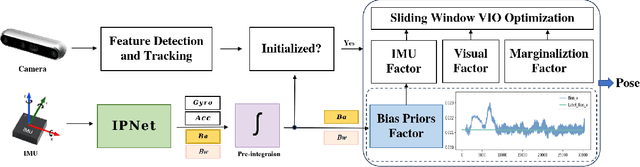
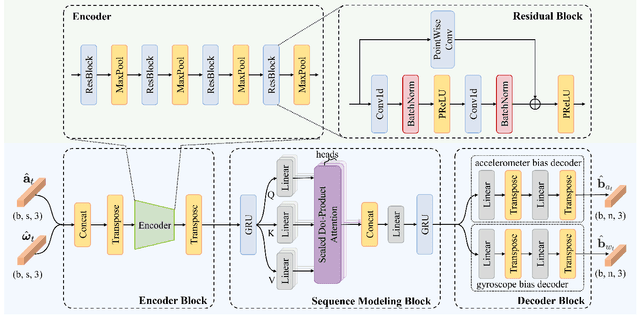
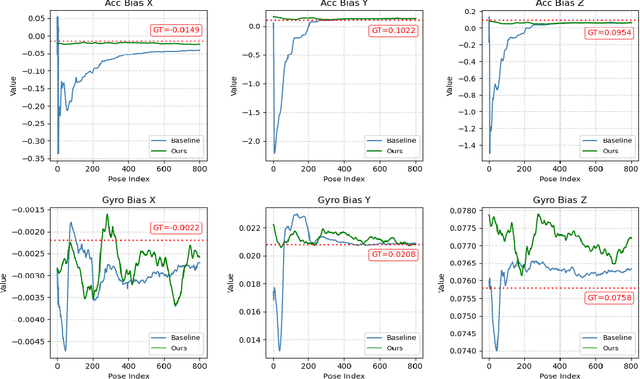
The bias of low-cost Inertial Measurement Units (IMU) is a critical factor affecting the performance of Visual-Inertial Odometry (VIO). In particular, when visual tracking encounters errors, the optimized bias results may deviate significantly from the true values, adversely impacting the system's stability and localization precision. In this paper, we propose a novel plug-and-play framework featuring the Inertial Prior Network (IPNet), which is designed to accurately estimate IMU bias. Recognizing the substantial impact of initial bias errors in low-cost inertial devices on system performance, our network directly leverages raw IMU data to estimate the mean bias, eliminating the dependency on historical estimates in traditional recursive predictions and effectively preventing error propagation. Furthermore, we introduce an iterative approach to calculate the mean value of the bias for network training, addressing the lack of bias labels in many visual-inertial datasets. The framework is evaluated on two public datasets and one self-collected dataset. Extensive experiments demonstrate that our method significantly enhances both localization precision and robustness, with the ATE-RMSE metric improving on average by 46\%. The source code and video will be available at \textcolor{red}{https://github.com/yiyscut/VIO-IPNet.git}.