 Add to Chrome
 Add to Firefox
 Add to Edge
ObjectRelator: Enabling Cross-View Object Relation Understanding in Ego-Centric and Exo-Centric Videos
Nov 28, 2024
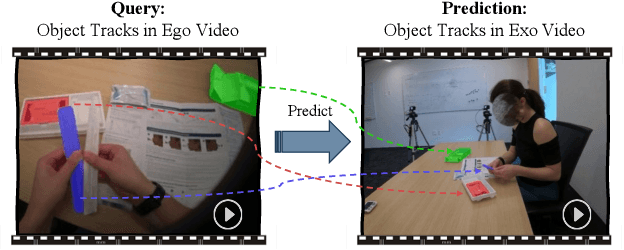

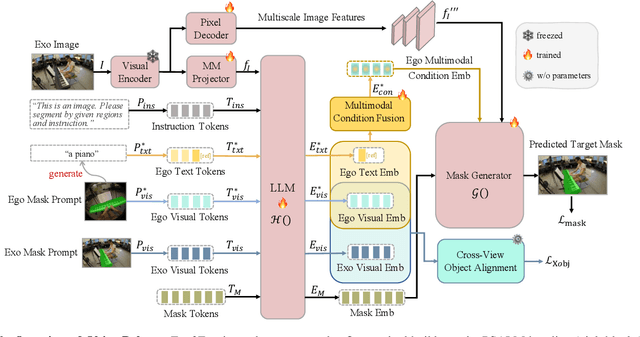
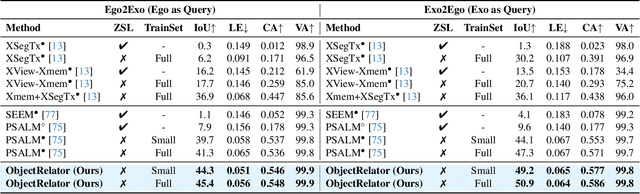
In this paper, we focus on the Ego-Exo Object Correspondence task, an emerging challenge in the field of computer vision that aims to map objects across ego-centric and exo-centric views. We introduce ObjectRelator, a novel method designed to tackle this task, featuring two new modules: Multimodal Condition Fusion (MCFuse) and SSL-based Cross-View Object Alignment (XObjAlign). MCFuse effectively fuses language and visual conditions to enhance target object localization, while XObjAlign enforces consistency in object representations across views through a self-supervised alignment strategy. Extensive experiments demonstrate the effectiveness of ObjectRelator, achieving state-of-the-art performance on Ego2Exo and Exo2Ego tasks with minimal additional parameters. This work provides a foundation for future research in comprehensive cross-view object relation understanding highlighting the potential of leveraging multimodal guidance and cross-view alignment. Codes and models will be released to advance further research in this direction.

Complexity Experts are Task-Discriminative Learners for Any Image Restoration
Nov 27, 2024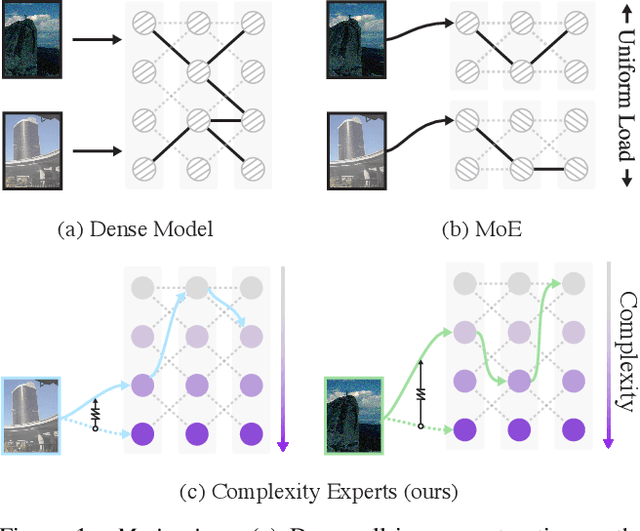
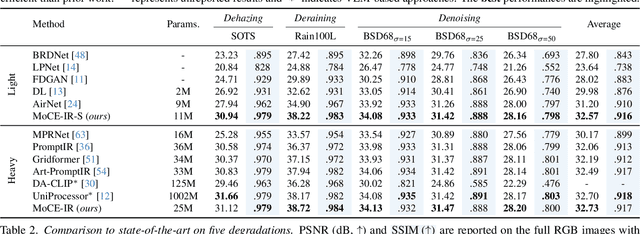
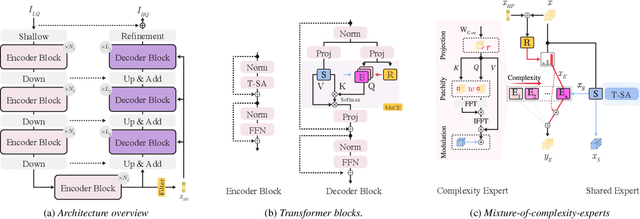
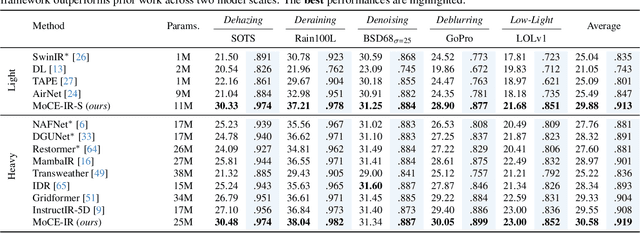
Recent advancements in all-in-one image restoration models have revolutionized the ability to address diverse degradations through a unified framework. However, parameters tied to specific tasks often remain inactive for other tasks, making mixture-of-experts (MoE) architectures a natural extension. Despite this, MoEs often show inconsistent behavior, with some experts unexpectedly generalizing across tasks while others struggle within their intended scope. This hinders leveraging MoEs' computational benefits by bypassing irrelevant experts during inference. We attribute this undesired behavior to the uniform and rigid architecture of traditional MoEs. To address this, we introduce ``complexity experts" -- flexible expert blocks with varying computational complexity and receptive fields. A key challenge is assigning tasks to each expert, as degradation complexity is unknown in advance. Thus, we execute tasks with a simple bias toward lower complexity. To our surprise, this preference effectively drives task-specific allocation, assigning tasks to experts with the appropriate complexity. Extensive experiments validate our approach, demonstrating the ability to bypass irrelevant experts during inference while maintaining superior performance. The proposed MoCE-IR model outperforms state-of-the-art methods, affirming its efficiency and practical applicability. The source will be publicly made available at \href{https://eduardzamfir.github.io/moceir/}{\texttt{eduardzamfir.github.io/MoCE-IR/}}
InTraGen: Trajectory-controlled Video Generation for Object Interactions
Nov 25, 2024
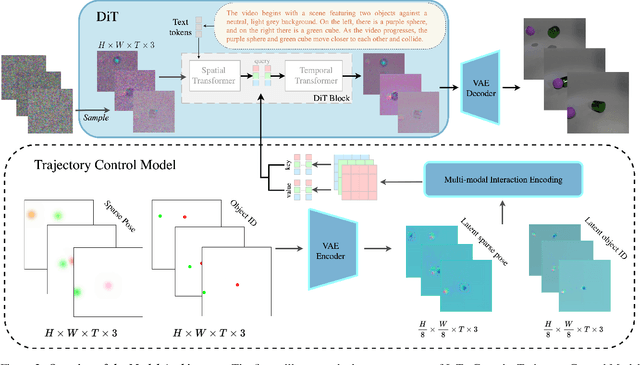

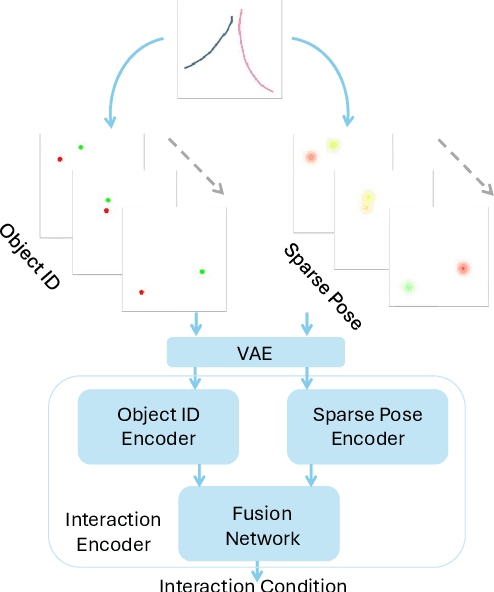
Advances in video generation have significantly improved the realism and quality of created scenes. This has fueled interest in developing intuitive tools that let users leverage video generation as world simulators. Text-to-video (T2V) generation is one such approach, enabling video creation from text descriptions only. Yet, due to the inherent ambiguity in texts and the limited temporal information offered by text prompts, researchers have explored additional control signals like trajectory-guided systems, for more accurate T2V generation. Nonetheless, methods to evaluate whether T2V models can generate realistic interactions between multiple objects are lacking. We introduce InTraGen, a pipeline for improved trajectory-based generation of object interaction scenarios. We propose 4 new datasets and a novel trajectory quality metric to evaluate the performance of the proposed InTraGen. To achieve object interaction, we introduce a multi-modal interaction encoding pipeline with an object ID injection mechanism that enriches object-environment interactions. Our results demonstrate improvements in both visual fidelity and quantitative performance. Code and datasets are available at https://github.com/insait-institute/InTraGen
RobustFormer: Noise-Robust Pre-training for images and videos
Nov 20, 2024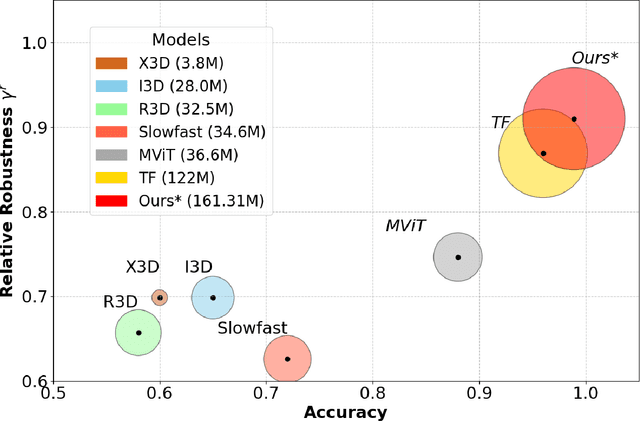

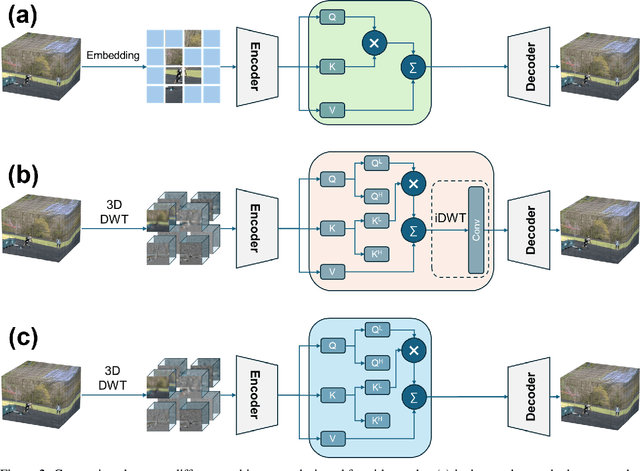
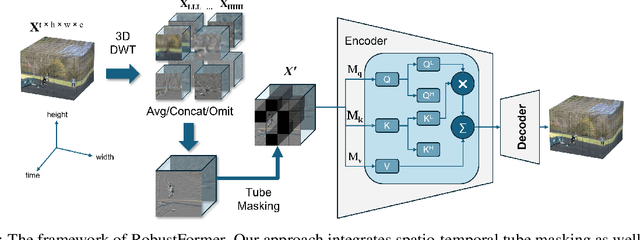
While deep learning models are powerful tools that revolutionized many areas, they are also vulnerable to noise as they rely heavily on learning patterns and features from the exact details of the clean data. Transformers, which have become the backbone of modern vision models, are no exception. Current Discrete Wavelet Transforms (DWT) based methods do not benefit from masked autoencoder (MAE) pre-training since the inverse DWT (iDWT) introduced in these approaches is computationally inefficient and lacks compatibility with video inputs in transformer architectures. In this work, we present RobustFormer, a method that overcomes these limitations by enabling noise-robust pre-training for both images and videos; improving the efficiency of DWT-based methods by removing the need for computationally iDWT steps and simplifying the attention mechanism. To our knowledge, the proposed method is the first DWT-based method compatible with video inputs and masked pre-training. Our experiments show that MAE-based pre-training allows us to bypass the iDWT step, greatly reducing computation. Through extensive tests on benchmark datasets, RobustFormer achieves state-of-the-art results for both image and video tasks.
EvenNICER-SLAM: Event-based Neural Implicit Encoding SLAM
Oct 04, 2024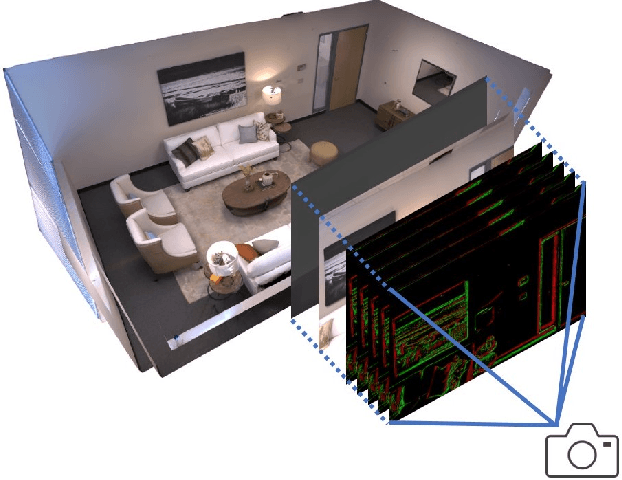

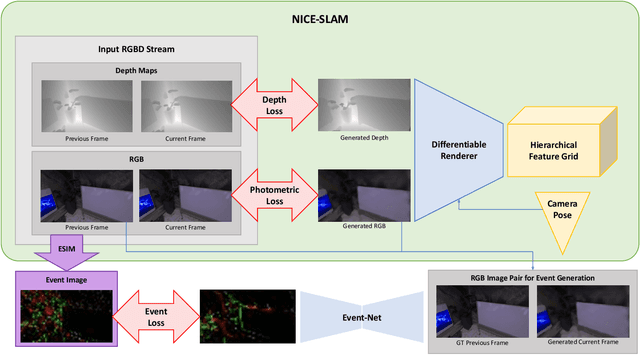
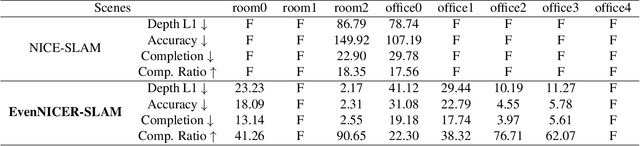
The advancement of dense visual simultaneous localization and mapping (SLAM) has been greatly facilitated by the emergence of neural implicit representations. Neural implicit encoding SLAM, a typical example of which is NICE-SLAM, has recently demonstrated promising results in large-scale indoor scenes. However, these methods typically rely on temporally dense RGB-D image streams as input in order to function properly. When the input source does not support high frame rates or the camera movement is too fast, these methods often experience crashes or significant degradation in tracking and mapping accuracy. In this paper, we propose EvenNICER-SLAM, a novel approach that addresses this issue through the incorporation of event cameras. Event cameras are bio-inspired cameras that respond to intensity changes instead of absolute brightness. Specifically, we integrated an event loss backpropagation stream into the NICE-SLAM pipeline to enhance camera tracking with insufficient RGB-D input. We found through quantitative evaluation that EvenNICER-SLAM, with an inclusion of higher-frequency event image input, significantly outperforms NICE-SLAM with reduced RGB-D input frequency. Our results suggest the potential for event cameras to improve the robustness of dense SLAM systems against fast camera motion in real-world scenarios.
Autonomous Vehicle Controllers From End-to-End Differentiable Simulation
Sep 12, 2024Current methods to learn controllers for autonomous vehicles (AVs) focus on behavioural cloning. Being trained only on exact historic data, the resulting agents often generalize poorly to novel scenarios. Simulators provide the opportunity to go beyond offline datasets, but they are still treated as complicated black boxes, only used to update the global simulation state. As a result, these RL algorithms are slow, sample-inefficient, and prior-agnostic. In this work, we leverage a differentiable simulator and design an analytic policy gradients (APG) approach to training AV controllers on the large-scale Waymo Open Motion Dataset. Our proposed framework brings the differentiable simulator into an end-to-end training loop, where gradients of the environment dynamics serve as a useful prior to help the agent learn a more grounded policy. We combine this setup with a recurrent architecture that can efficiently propagate temporal information across long simulated trajectories. This APG method allows us to learn robust, accurate, and fast policies, while only requiring widely-available expert trajectories, instead of scarce expert actions. We compare to behavioural cloning and find significant improvements in performance and robustness to noise in the dynamics, as well as overall more intuitive human-like handling.
Taming CLIP for Fine-grained and Structured Visual Understanding of Museum Exhibits
Sep 03, 2024CLIP is a powerful and widely used tool for understanding images in the context of natural language descriptions to perform nuanced tasks. However, it does not offer application-specific fine-grained and structured understanding, due to its generic nature. In this work, we aim to adapt CLIP for fine-grained and structured -- in the form of tabular data -- visual understanding of museum exhibits. To facilitate such understanding we (a) collect, curate, and benchmark a dataset of 200K+ image-table pairs, and (b) develop a method that allows predicting tabular outputs for input images. Our dataset is the first of its kind in the public domain. At the same time, the proposed method is novel in leveraging CLIP's powerful representations for fine-grained and tabular understanding. The proposed method (MUZE) learns to map CLIP's image embeddings to the tabular structure by means of a proposed transformer-based parsing network (parseNet). More specifically, parseNet enables prediction of missing attribute values while integrating context from known attribute-value pairs for an input image. We show that this leads to significant improvement in accuracy. Through exhaustive experiments, we show the effectiveness of the proposed method on fine-grained and structured understanding of museum exhibits, by achieving encouraging results in a newly established benchmark. Our dataset and source-code can be found at: https://github.com/insait-institute/MUZE
A Simple and Generalist Approach for Panoptic Segmentation
Aug 29, 2024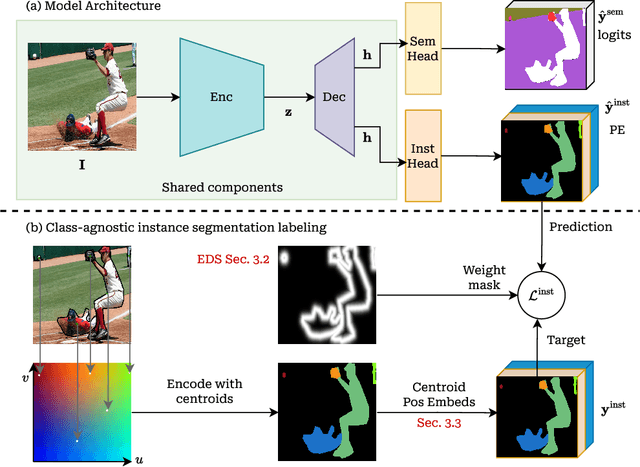
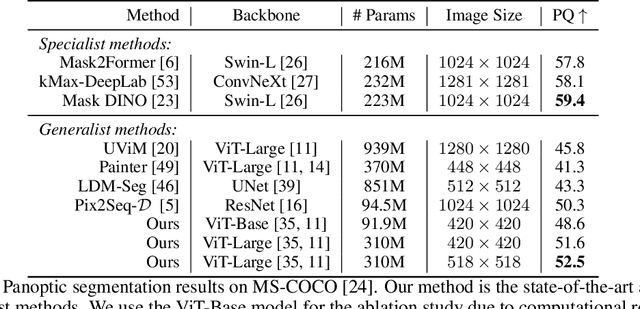
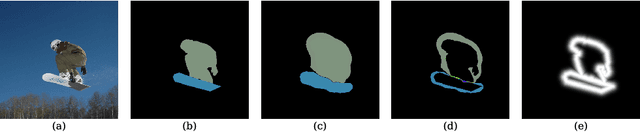

Generalist vision models aim for one and the same architecture for a variety of vision tasks. While such shared architecture may seem attractive, generalist models tend to be outperformed by their bespoken counterparts, especially in the case of panoptic segmentation. We address this problem by introducing two key contributions, without compromising the desirable properties of generalist models. These contributions are: (i) a positional-embedding (PE) based loss for improved centroid regressions; (ii) Edge Distance Sampling (EDS) for the better separation of instance boundaries. The PE-based loss facilitates a better per-pixel regression of the associated instance's centroid, whereas EDS contributes by carefully handling the void regions (caused by missing labels) and smaller instances. These two simple yet effective modifications significantly improve established baselines, while achieving state-of-the-art results among all generalist solutions. More specifically, our method achieves a panoptic quality(PQ) of 52.5 on the COCO dataset, which is an improvement of 10 points over the best model with similar approach (Painter), and is superior by 2 to the best performing diffusion-based method Pix2Seq-$\mathcal{D}$. Furthermore, we provide insights into and an in-depth analysis of our contributions through exhaustive experiments. Our source code and model weights will be made publicly available.
ShapeSplat: A Large-scale Dataset of Gaussian Splats and Their Self-Supervised Pretraining
Aug 20, 2024
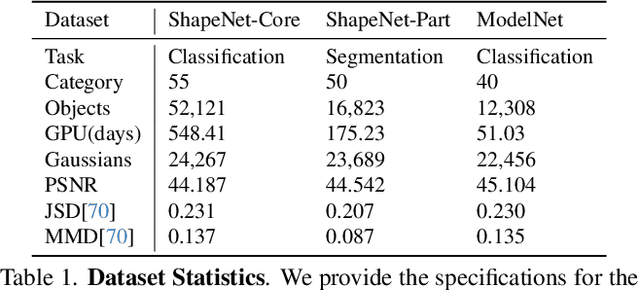
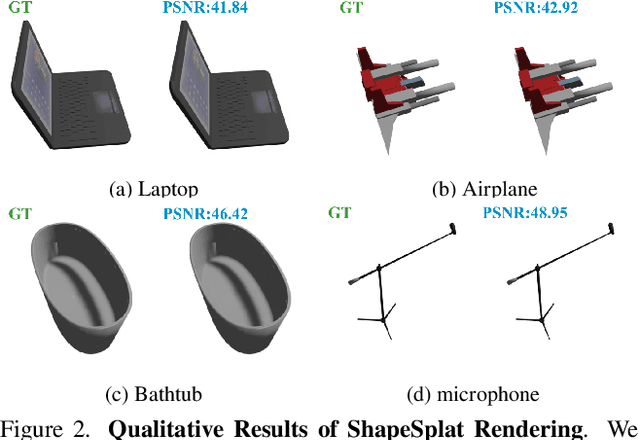
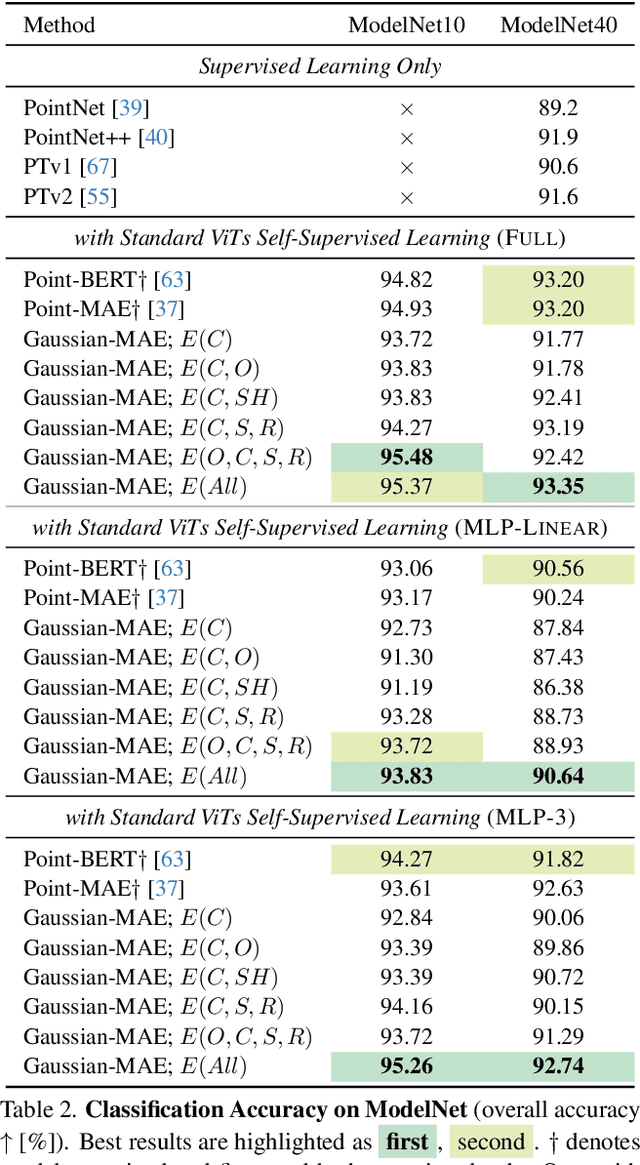
3D Gaussian Splatting (3DGS) has become the de facto method of 3D representation in many vision tasks. This calls for the 3D understanding directly in this representation space. To facilitate the research in this direction, we first build a large-scale dataset of 3DGS using the commonly used ShapeNet and ModelNet datasets. Our dataset ShapeSplat consists of 65K objects from 87 unique categories, whose labels are in accordance with the respective datasets. The creation of this dataset utilized the compute equivalent of 2 GPU years on a TITAN XP GPU. We utilize our dataset for unsupervised pretraining and supervised finetuning for classification and segmentation tasks. To this end, we introduce \textbf{\textit{Gaussian-MAE}}, which highlights the unique benefits of representation learning from Gaussian parameters. Through exhaustive experiments, we provide several valuable insights. In particular, we show that (1) the distribution of the optimized GS centroids significantly differs from the uniformly sampled point cloud (used for initialization) counterpart; (2) this change in distribution results in degradation in classification but improvement in segmentation tasks when using only the centroids; (3) to leverage additional Gaussian parameters, we propose Gaussian feature grouping in a normalized feature space, along with splats pooling layer, offering a tailored solution to effectively group and embed similar Gaussians, which leads to notable improvement in finetuning tasks.
Locate Anything on Earth: Advancing Open-Vocabulary Object Detection for Remote Sensing Community
Aug 17, 2024Object detection, particularly open-vocabulary object detection, plays a crucial role in Earth sciences, such as environmental monitoring, natural disaster assessment, and land-use planning. However, existing open-vocabulary detectors, primarily trained on natural-world images, struggle to generalize to remote sensing images due to a significant data domain gap. Thus, this paper aims to advance the development of open-vocabulary object detection in remote sensing community. To achieve this, we first reformulate the task as Locate Anything on Earth (LAE) with the goal of detecting any novel concepts on Earth. We then developed the LAE-Label Engine which collects, auto-annotates, and unifies up to 10 remote sensing datasets creating the LAE-1M - the first large-scale remote sensing object detection dataset with broad category coverage. Using the LAE-1M, we further propose and train the novel LAE-DINO Model, the first open-vocabulary foundation object detector for the LAE task, featuring Dynamic Vocabulary Construction (DVC) and Visual-Guided Text Prompt Learning (VisGT) modules. DVC dynamically constructs vocabulary for each training batch, while VisGT maps visual features to semantic space, enhancing text features. We comprehensively conduct experiments on established remote sensing benchmark DIOR, DOTAv2.0, as well as our newly introduced 80-class LAE-80C benchmark. Results demonstrate the advantages of the LAE-1M dataset and the effectiveness of the LAE-DINO method.