 Add to Chrome
 Add to Firefox
 Add to Edge
Accelerating Vision Foundation Models with Drop-in Depthwise Convolution
May 21, 2026
Pretrained vision foundation models deliver strong performance across tasks with limited fine-tuning. However, their Vision Transformer (ViT) backbones impose high inference costs, limiting deployment on resource-constrained devices. In this work, we accelerate large-scale pretrained ViTs while preserving their feature extraction capabilities by exploiting the intrinsic convolution-like behavior of some attention heads. Specifically, we introduce an efficient depthwise convolution-based layer that serves as a drop-in replacement for these heads. Additionally, we propose simple strategies to identify which heads can be replaced and introduce a fine-tuning procedure that recovers downstream task performance. Across both image classification and segmentation tasks, our method achieves 17-20\% percent inference speedup with minimal performance degradation. We validate the approach through detailed derivations, extensive experiments, and efficiency benchmarks. The reference implementation is publicly available.

Self-supervised pretraining for an iterative image size agnostic vision transformer
Apr 22, 2026Vision Transformers (ViTs) dominate self-supervised learning (SSL). While they have proven highly effective for large-scale pretraining, they are computationally inefficient and scale poorly with image size. Consequently, foundational models like DINO are constrained to low-resolution processing. A recent foveal-inspired transformer achieves resolution agnosticism by iteratively processing a fixed-size context of multi-zoom patches. This model demonstrated promising results via supervised learning, utilizing a sequential, recurrent-like process without backpropagation through time. To unlock its potential as a foundational backbone, we introduce a novel sequential-to-global SSL framework based on DINO's self-distillation objective. Supported by an efficient integral-image patch extraction method, our approach enables large-scale pretraining for image-size agnostic vision encoders. We achieve competitive performance on ImageNet-1K and downstream classification tasks, maintaining a constant computational budget regardless of input resolution.
A Simple and Generalist Approach for Panoptic Segmentation
Aug 29, 2024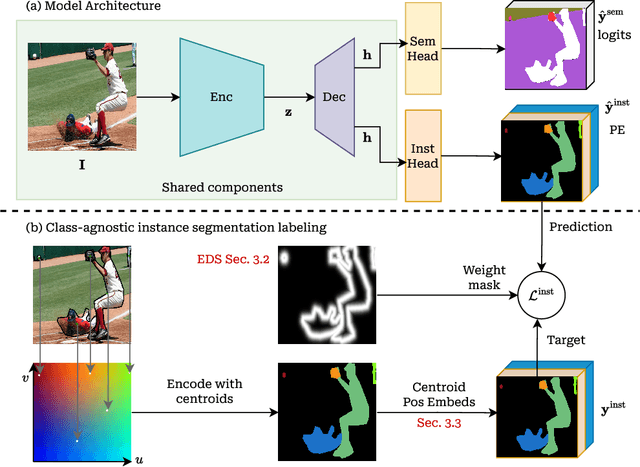
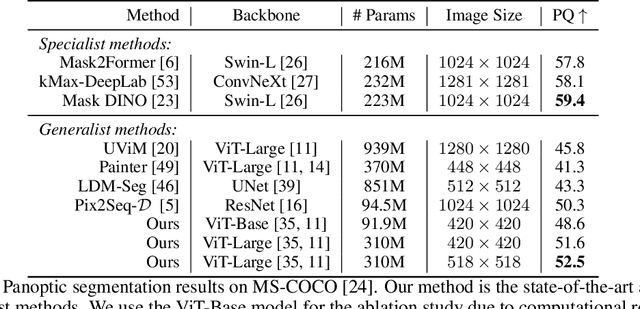
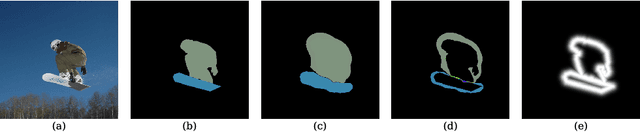

Generalist vision models aim for one and the same architecture for a variety of vision tasks. While such shared architecture may seem attractive, generalist models tend to be outperformed by their bespoken counterparts, especially in the case of panoptic segmentation. We address this problem by introducing two key contributions, without compromising the desirable properties of generalist models. These contributions are: (i) a positional-embedding (PE) based loss for improved centroid regressions; (ii) Edge Distance Sampling (EDS) for the better separation of instance boundaries. The PE-based loss facilitates a better per-pixel regression of the associated instance's centroid, whereas EDS contributes by carefully handling the void regions (caused by missing labels) and smaller instances. These two simple yet effective modifications significantly improve established baselines, while achieving state-of-the-art results among all generalist solutions. More specifically, our method achieves a panoptic quality(PQ) of 52.5 on the COCO dataset, which is an improvement of 10 points over the best model with similar approach (Painter), and is superior by 2 to the best performing diffusion-based method Pix2Seq-$\mathcal{D}$. Furthermore, we provide insights into and an in-depth analysis of our contributions through exhaustive experiments. Our source code and model weights will be made publicly available.