 Add to Chrome
 Add to Firefox
 Add to Edge
PQFA: Parallel Quantum Feature Augmentation of Fused Representations for Multimodal Classification
Jul 15, 2026
Most multimodal learning methods improve how heterogeneous representations are aligned and fused, while post-fusion enhancement remains less explored. We propose Parallel Quantum Feature Augmentation (PQFA), a hybrid quantum-classical framework that applies multiple shallow variational quantum circuits to fused multimodal features. Text and image representations extracted by frozen RoBERTa and ViT encoders are processed through bidirectional cross-attention, attentive pooling, and adaptive gated fusion. The fused feature is then amplitude-encoded into parallel quantum circuits, whose measurement readouts are concatenated with the classical representation for prediction. We evaluate PQFA on MM-IMDb and N24News through controlled comparisons using the same encoders, fusion backbone, data splits, projection dimension, and augmentation output width. PQFA consistently outperforms both the fusion backbone without quantum augmentation and a width-matched MLP augmentation baseline, while using approximately 2.2K augmentation parameters compared with 24.0K for the MLP branch. Missing-modality experiments further show improved robustness when textual or visual inputs are incomplete, with particularly clear gains when the more informative textual modality is severely degraded. Controlled ablations and feature-space analyses indicate that the improvement cannot be reproduced by random feature mappings, increased classical width, or untrained quantum transformations. Quantum-state diagnostics additionally show stable predictive performance across the tested simulated noise levels and distinct branch-specific transformations of the encoded states. These results establish PQFA as an effective and parameter-efficient strategy for post-fusion augmentation in hybrid quantum-classical multimodal learning.

RefGlass-GS: A UAV-Enabled Fusion Framework for Photorealistic, Semantic and Interactive Digitization of Reflective Glass Facades via Gaussian Splatting
Jun 27, 2026Existing digitization of buildings with reflective glass facades suffers from geometric reconstruction distortion, unrealistic view-dependent texture rendering, and difficulties in object-based semantic enhancement. Therefore, we propose RefGlass-GS, a fusion framework that enables end-to-end UAV-based photorealistic, semantic, and interactive digitization of reflective glass facades. The contributions include: (1) proposing an individual glass panel segmentation method based on maximum a posteriori estimation with structural regularities, robust to severe reflection and background interference; (2) formulating a UAV viewpoint planning optimization function that maximizes the coverage of view-dependent appearance for sufficient data capture; (3) developing an optimized Gaussian Splatting framework with a Reflection MLP, a novel deferred shading function, and two enhanced regularization terms for effective modeling of high-frequency near-field reflections; (4) introducing a standardized data organization paradigm for structuring GS-based representations into object-based models, facilitating interactive facility management on digital twin platforms. Experiments on real-world reflective glass facade scenes validate the effectiveness and superiority of the proposed method. Specifically, the glass panel segmentation achieves an improvement of 0.1927 in mIoU over SOTA methods, and only our method enables instance-level panel extraction. The UAV view planning improves novel view synthesis for reflective facades by 13.15 dB in PSNR compared to commercially used nap-of-the-object planning methods. The RefGlass-GS modeling outperforms SOTA Gaussian Splatting approaches for reflective scenes with an average improvement of 5.08 dB in PSNR.
Mask Proposal Voting Based on Geodesic Framework for Robust Image Segmentation
Jun 12, 2026Despite great advances, finding accurate segmentation remains a challenging task, especially in scenarios with cluttered backgrounds, complex intensity variations and topology appearance. Minimal path models have exhibited their strong ability in addressing image segmentation tasks. However, the performance of minimal paths-based segmentation approaches is heavily influenced by model initialization, hence limiting their application scope in practice. In this work, we propose a novel mask proposal voting framework that overcomes the major drawback of classical approaches, allowing robust segmentation even in complicated scenarios. Firstly, we introduce an efficient method for constructing adaptive domain cuts as a constraint for initializing the region-based min-cut evolution, by which diverse and reliable mask proposal candidates can be generated, substantially increasing the possibility of accurately covering the objective region by these proposals. Secondly, we propose a new mask voting scheme to build a voting score map encoding the final segmentation information. In contrast to classical path voting methods, our model allows incorporating priors to assign different importance to each individual mask. As a consequence, the proposed segmentation model is capable of accurately delineating object boundaries under complex scenarios, and is insensitive to initialization. Experiments demonstrate that our method consistently outperforms state-of-the-art minimal path-based approaches in both accuracy and robustness.
Leveraging Large Language Models for Cost-Effective, Multilingual Depression Detection and Severity Assessment
Apr 07, 2025Depression is a prevalent mental health disorder that is difficult to detect early due to subjective symptom assessments. Recent advancements in large language models have offered efficient and cost-effective approaches for this objective. In this study, we evaluated the performance of four LLMs in depression detection using clinical interview data. We selected the best performing model and further tested it in the severity evaluation scenario and knowledge enhanced scenario. The robustness was evaluated in complex diagnostic scenarios using a dataset comprising 51074 statements from six different mental disorders. We found that DeepSeek V3 is the most reliable and cost-effective model for depression detection, performing well in both zero-shot and few-shot scenarios, with zero-shot being the most efficient choice. The evaluation of severity showed low agreement with the human evaluator, particularly for mild depression. The model maintains stably high AUCs for detecting depression in complex diagnostic scenarios. These findings highlight DeepSeek V3s strong potential for text-based depression detection in real-world clinical applications. However, they also underscore the need for further refinement in severity assessment and the mitigation of potential biases to enhance clinical reliability.
Redefining Information Retrieval of Structured Database via Large Language Models
May 09, 2024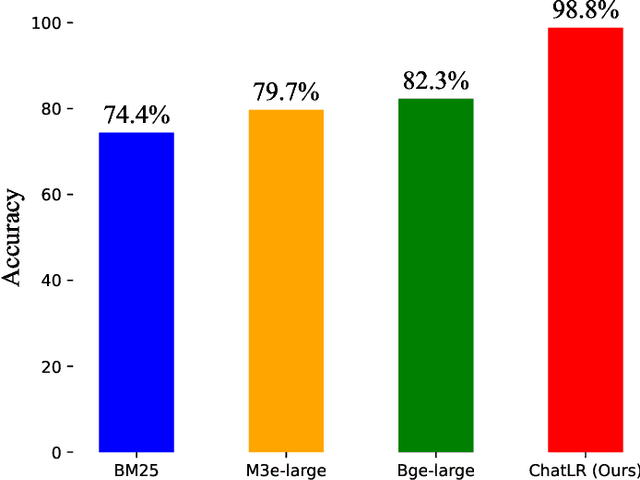
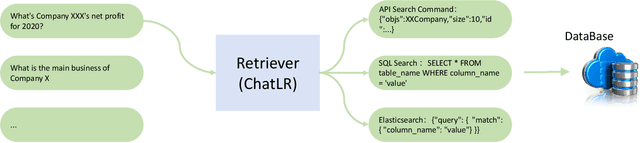
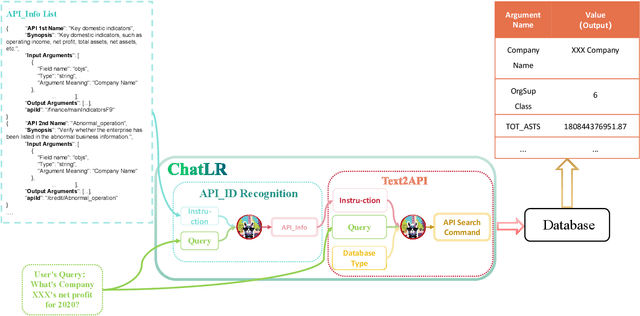
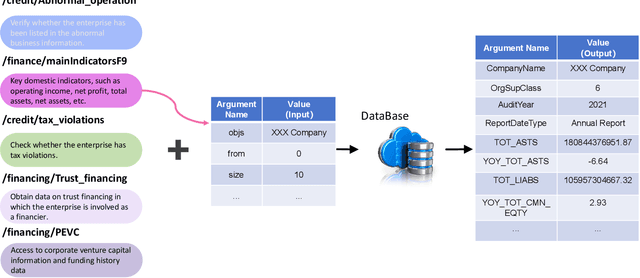
Retrieval augmentation is critical when Language Models (LMs) exploit non-parametric knowledge related to the query through external knowledge bases before reasoning. The retrieved information is incorporated into LMs as context alongside the query, enhancing the reliability of responses towards factual questions. Prior researches in retrieval augmentation typically follow a retriever-generator paradigm. In this context, traditional retrievers encounter challenges in precisely and seamlessly extracting query-relevant information from knowledge bases. To address this issue, this paper introduces a novel retrieval augmentation framework called ChatLR that primarily employs the powerful semantic understanding ability of Large Language Models (LLMs) as retrievers to achieve precise and concise information retrieval. Additionally, we construct an LLM-based search and question answering system tailored for the financial domain by fine-tuning LLM on two tasks including Text2API and API-ID recognition. Experimental results demonstrate the effectiveness of ChatLR in addressing user queries, achieving an overall information retrieval accuracy exceeding 98.8\%.