 Add to Chrome
 Add to Firefox
 Add to Edge
Thinking Hard, Not Smart: Reasoning Models Fail to Ration Test-Time Compute Across Questions
Aug 11, 2026
Reasoning language models increasingly use test-time compute to improve performance, but existing evaluations typically study this compute one question at a time. Yet when multiple problems share an end-to-end cost or latency constraint, models must decide how to divide limited inference compute among them. We introduce an exam-style evaluation framework for studying this setting, in which a model must distribute one shared token budget across questions with different difficulty and point values to maximize its total score. Across several open and frontier reasoning models, we find that models fail to allocate a shared budget strategically across questions of varying difficulties and values. Models behave largely as greedy sequential solvers: they prioritize questions by presentation order, front-load effort on early questions, and remain insensitive to value, with these tendencies becoming more pronounced as the number of questions grows. Explicit planning prompts spread compute more evenly but do not produce value- or difficulty-aware prioritization. The same behavioral pattern extends from mathematical to code reasoning. These findings establish global budget allocation as a distinct capability that is not captured by conventional per-question evaluation and remains a challenge for current reasoning models.

OrbitForge: Text-to-3D Scene Generation via Reconstruction-Anchored Video Synthesis
Jun 23, 2026Generic text-to-video models can be used as rich open-world scene priors. Despite the high quality of today's generated videos, they do not directly yield reliable 3D assets: camera motion is difficult to control, view coverage is partial, and frames often contain inconsistencies across time. We introduce OrbitForge, an adapter built from frozen video priors and per-prompt Gaussian Splatting reconstruction optimization that converts a single text-generated video into a canonical closed-orbit 3D Gaussian Splatting scene. We use 3D reconstruction as an anchor to improve the 3D consistency of the generated video. We obtain a preliminary 3D reconstruction from a first generated video via Deformable Gaussian Splatting with a robust MedianGS proxy. We render views from a prescribed orbit to detect missing viewpoints. OrbitForge uses the text-to-video model to complete only the missing views, and reconstructs the completed orbit into a final Gaussian Splatting scene. This design requires no task-specific video or multiview fine-tuning, avoids per-prompt score-distillation optimization, and does not progressively generate views one step at a time. We further argue that this setting demands coverage-aware evaluation: local smoothness alone rewards methods that never attempt a full orbit. On a frozen 300-prompt T3Bench-derived audit, OrbitForge reconstruction attains a 359.0-degree measured median span, raises originally unsupported-bin Q10 ImageReward from 8.07 to 16.36 relative to MedianGS-only reconstruction, while remaining competitive with VideoMV on the coverage-quality.
GeoT2V-Bench: Benchmarking 3D Consistency in Text-to-Video Models via 3D Reconstruction
Jun 23, 2026Camera-prompted text-to-video (T2V) models are increasingly used to synthesize virtual camera captures, such as orbiting objects or moving through static scenes. For these outputs, visual plausibility is insufficient: the generated frames should also provide coherent multi-view evidence for a single static 3D scene. We introduce GeoT2V-Bench, a reconstruction-based diagnostic benchmark for evaluating whether camera-prompted T2V clips can support explicit rigid 3D reconstruction. Our pipeline estimates per-frame camera intrinsics and poses with VGGT-style geometry estimation, fits DeformableGS, derives a static MedianGS proxy by temporal-median aggregation, and renders this proxy along the estimated camera path. Instead of producing a pass/fail label or a single scalar score, GeoT2V-Bench reports a continuous reconstruction profile covering apparent image motion, estimated trajectory behavior, MedianGS static rendering error, static-render flow agreement, and the gap between flexible and static fits. On a fair-format four-seed evaluation with 3,840 completed reconstructions from 12 open-weight model configurations and 80 GeCo-Eval static-scene prompts, we find that visible motion, static rendering error, flow agreement, and flexible-vs-static behavior often disagree. GeoT2V-Bench therefore captures complementary failure modes that emerge when generated videos are tested as global static-scene acquisitions.
When is Your LLM Steerable?
Jun 10, 2026Activation steering offers a lightweight approach to control language models' behavior at inference time, but whether it succeeds or fails heavily depends on the prompt, concept, model, and steering configuration. Finding the regime and boundaries of successful steering typically requires expensive grid searches and post-hoc evaluation of full autoregressive rollouts. In this work, we investigate whether steerability can be predicted from the model's internal states at the beginning of the generation process, e.g., after generating the first few tokens, and how to leverage such a predictor to improve steering success rate. To this end, we first introduce ASTEER, a testbed including 1.4M steered generations, spanning 150 concepts with each steering success/failure labeled. Leveraging this testbed, we analyze the model's early decoding dynamics by extracting features that compare hidden states before and after steering across layers and initial decoding steps. These features help us understand how steering's effects propagate along layers and token positions, which provide key information for steerability prediction. We then train a Gradient Boosting Decision Trees (GBDT) classifier on these features to predict whether an intervention will under-steer, succeed, or over-steer without requiring full rollout. Our predictor achieves around 0.7 macro-F1 score on unseen concepts, demonstrating that early hidden states encode substantial, structured information about eventual steering efficacy. We further leverage this steerability predictor as guidance for steering strength searching, achieving near-optimal performance with a small fraction of decoding cost.
Model-Adaptive Tool Necessity Reveals the Knowing-Doing Gap in LLM Tool Use
May 13, 2026Large language models (LLMs) increasingly act as autonomous agents that must decide when to answer directly vs. when to invoke external tools. Prior work studying adaptive tool use has largely treated tool necessity as a model-agnostic property, annotated by human or LLM judge, and mostly cover cases where the answer is obvious (e.g., fetching the weather vs. paraphrasing text). However, tool necessity in the wild is more nuanced due to the divergence of capability boundaries across models: a problem solvable by a strong model on its own may still require tools for a weaker one. In this work, we introduce a model-adaptive definition of tool-necessity, grounded in each model's empirical performance. Following this definition, we compare the necessity against observed tool-call behavior across four models on arithmetic and factual QA dataset, and find substantial mismatches of 26.5-54.0% and 30.8-41.8%, respectively. To diagnose the failure, we decompose tool use into two stages: an internal cognition stage that reflects whether a model believes a tool is necessary, and an execution stage that determines whether the model actually makes a tool-call action. By probing the LLM hidden states, we find that both signals are often linearly decodable, yet their probe directions become nearly orthogonal in the late-layer, last-token regime that drives the next-token action. By tracing the trajectory of samples in the two-stage process, we further discover that the majority of mismatch is concentrated in the cognition-to-action transition, not in cognition itself. These results reveal a knowing-doing gap in LLM tool-use: improving tool-use reliability requires not only better recognition of when tools are needed, but also better translation of that recognition into action.
Schoenfeld's Anatomy of Mathematical Reasoning by Language Models
Dec 23, 2025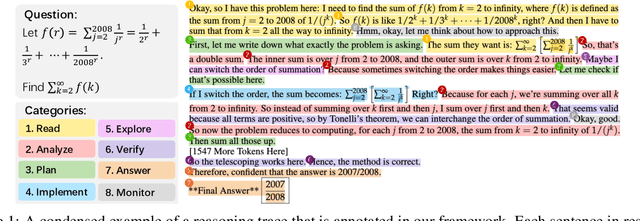
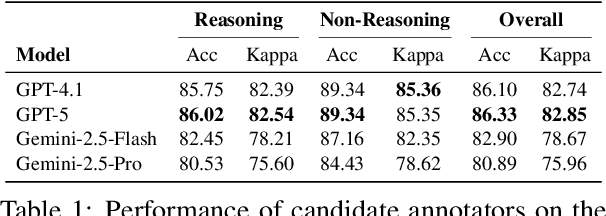
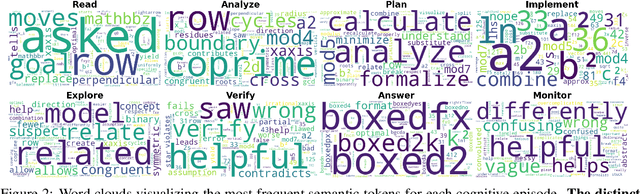
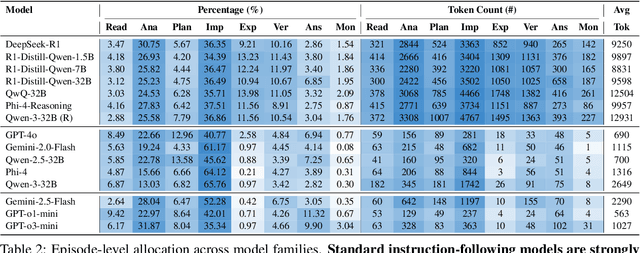
Large language models increasingly expose reasoning traces, yet their underlying cognitive structure and steps remain difficult to identify and analyze beyond surface-level statistics. We adopt Schoenfeld's Episode Theory as an inductive, intermediate-scale lens and introduce ThinkARM (Anatomy of Reasoning in Models), a scalable framework that explicitly abstracts reasoning traces into functional reasoning steps such as Analysis, Explore, Implement, Verify, etc. When applied to mathematical problem solving by diverse models, this abstraction reveals reproducible thinking dynamics and structural differences between reasoning and non-reasoning models, which are not apparent from token-level views. We further present two diagnostic case studies showing that exploration functions as a critical branching step associated with correctness, and that efficiency-oriented methods selectively suppress evaluative feedback steps rather than uniformly shortening responses. Together, our results demonstrate that episode-level representations make reasoning steps explicit, enabling systematic analysis of how reasoning is structured, stabilized, and altered in modern language models.
V-REX: Benchmarking Exploratory Visual Reasoning via Chain-of-Questions
Dec 12, 2025While many vision-language models (VLMs) are developed to answer well-defined, straightforward questions with highly specified targets, as in most benchmarks, they often struggle in practice with complex open-ended tasks, which usually require multiple rounds of exploration and reasoning in the visual space. Such visual thinking paths not only provide step-by-step exploration and verification as an AI detective but also produce better interpretations of the final answers. However, these paths are challenging to evaluate due to the large exploration space of intermediate steps. To bridge the gap, we develop an evaluation suite, ``Visual Reasoning with multi-step EXploration (V-REX)'', which is composed of a benchmark of challenging visual reasoning tasks requiring native multi-step exploration and an evaluation protocol. V-REX covers rich application scenarios across diverse domains. V-REX casts the multi-step exploratory reasoning into a Chain-of-Questions (CoQ) and disentangles VLMs' capability to (1) Planning: breaking down an open-ended task by selecting a chain of exploratory questions; and (2) Following: answering curated CoQ sequentially to collect information for deriving the final answer. By curating finite options of questions and answers per step, V-REX achieves a reliable quantitative and fine-grained analysis of the intermediate steps. By assessing SOTA proprietary and open-sourced VLMs, we reveal consistent scaling trends, significant differences between planning and following abilities, and substantial room for improvement in multi-step exploratory reasoning.
Understanding the Thinking Process of Reasoning Models: A Perspective from Schoenfeld's Episode Theory
Sep 18, 2025While Large Reasoning Models (LRMs) generate extensive chain-of-thought reasoning, we lack a principled framework for understanding how these thoughts are structured. In this paper, we introduce a novel approach by applying Schoenfeld's Episode Theory, a classic cognitive framework for human mathematical problem-solving, to analyze the reasoning traces of LRMs. We annotated thousands of sentences and paragraphs from model-generated solutions to math problems using seven cognitive labels (e.g., Plan, Implement, Verify). The result is the first publicly available benchmark for the fine-grained analysis of machine reasoning, including a large annotated corpus and detailed annotation guidebooks. Our preliminary analysis reveals distinct patterns in LRM reasoning, such as the transition dynamics between cognitive states. This framework provides a theoretically grounded methodology for interpreting LRM cognition and enables future work on more controllable and transparent reasoning systems.
Where to find Grokking in LLM Pretraining? Monitor Memorization-to-Generalization without Test
Jun 26, 2025Grokking, i.e., test performance keeps improving long after training loss converged, has been recently witnessed in neural network training, making the mechanism of generalization and other emerging capabilities such as reasoning mysterious. While prior studies usually train small models on a few toy or highly-specific tasks for thousands of epochs, we conduct the first study of grokking on checkpoints during one-pass pretraining of a 7B large language model (LLM), i.e., OLMoE. We compute the training loss and evaluate generalization on diverse benchmark tasks, including math reasoning, code generation, and commonsense/domain-specific knowledge retrieval tasks. Our study, for the first time, verifies that grokking still happens in the pretraining of large-scale foundation models, though different data may enter grokking stages asynchronously. We further demystify grokking's "emergence of generalization" by investigating LLM internal dynamics. Specifically, we find that training samples' pathways (i.e., expert choices across layers) evolve from random, instance-specific to more structured and shareable between samples during grokking. Also, the complexity of a sample's pathway reduces despite the converged loss. These indicate a memorization-to-generalization conversion, providing a mechanistic explanation of delayed generalization. In the study, we develop two novel metrics to quantify pathway distance and the complexity of a single pathway. We show their ability to predict the generalization improvement on diverse downstream tasks. They are efficient, simple to compute and solely dependent on training data. Hence, they have practical value for pretraining, enabling us to monitor the generalization performance without finetuning and test. Theoretically, we show that more structured pathways reduce model complexity and improve the generalization bound.
ColorBench: Can VLMs See and Understand the Colorful World? A Comprehensive Benchmark for Color Perception, Reasoning, and Robustness
Apr 10, 2025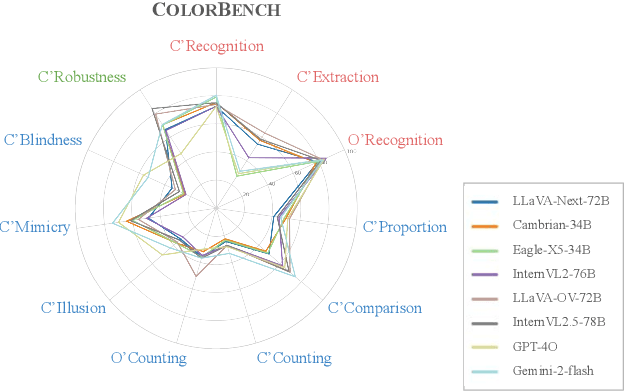
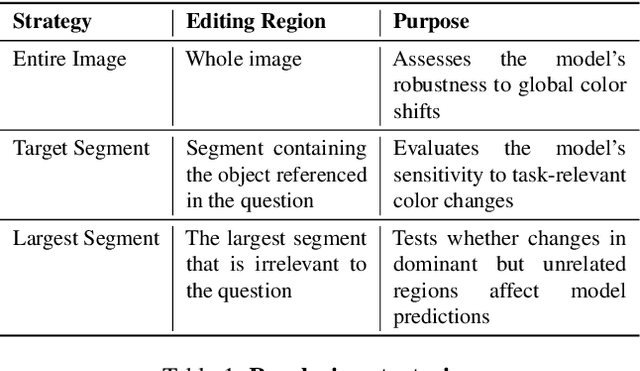
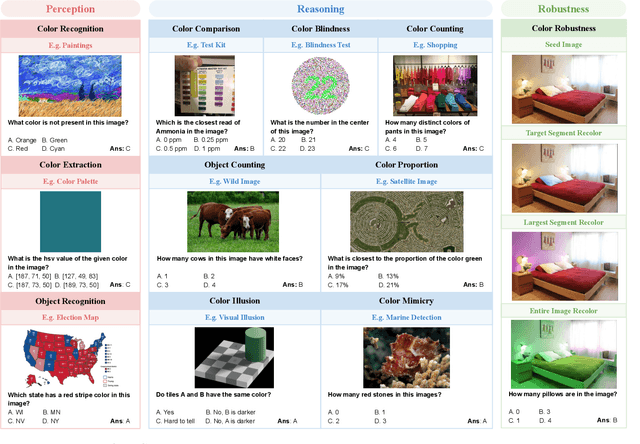
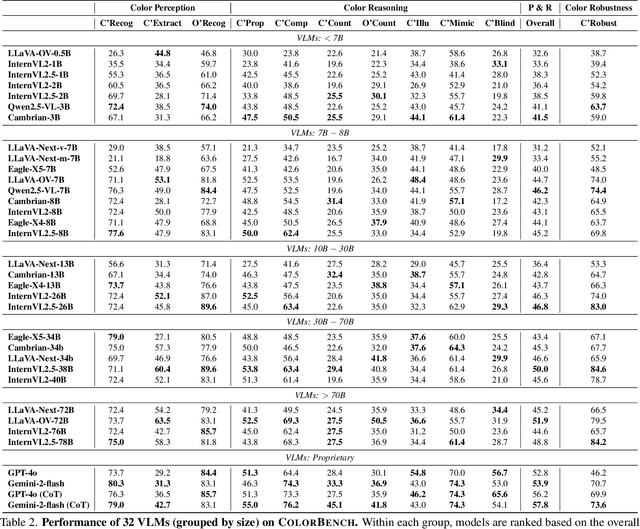
Color plays an important role in human perception and usually provides critical clues in visual reasoning. However, it is unclear whether and how vision-language models (VLMs) can perceive, understand, and leverage color as humans. This paper introduces ColorBench, an innovative benchmark meticulously crafted to assess the capabilities of VLMs in color understanding, including color perception, reasoning, and robustness. By curating a suite of diverse test scenarios, with grounding in real applications, ColorBench evaluates how these models perceive colors, infer meanings from color-based cues, and maintain consistent performance under varying color transformations. Through an extensive evaluation of 32 VLMs with varying language models and vision encoders, our paper reveals some undiscovered findings: (i) The scaling law (larger models are better) still holds on ColorBench, while the language model plays a more important role than the vision encoder. (ii) However, the performance gaps across models are relatively small, indicating that color understanding has been largely neglected by existing VLMs. (iii) CoT reasoning improves color understanding accuracies and robustness, though they are vision-centric tasks. (iv) Color clues are indeed leveraged by VLMs on ColorBench but they can also mislead models in some tasks. These findings highlight the critical limitations of current VLMs and underscore the need to enhance color comprehension. Our ColorBenchcan serve as a foundational tool for advancing the study of human-level color understanding of multimodal AI.