 Add to Chrome
 Add to Firefox
 Add to Edge
Large Language Models in Misinformation Ecosystems: Misuse, Defense, and Vulnerability
Jul 11, 2026
Large language models (LLMs) have transformed misinformation from a primarily content-centric problem into a broader ecosystem-level security challenge. When misused, LLMs create risks beyond false content generation, enabling attacks on the social contexts, evidence sources, retrieval corpora, and verification workflows that misinformation defense depends on. In this paper, we introduce a role-layer framework to unify these risks and defenses. The role dimension characterizes LLMs as attackers, defenders, and vulnerable components of verification systems, while the layer dimension covers content, social contexts, evidence environments, and verification workflows. Guided by this framework, we organize LLM-enabled attacks, investigate LLM-based detection and verification methods, analyze vulnerabilities in LLM-centric detection paradigms, and discuss existing countermeasures against LLM-enabled attacks. Building on this synthesis, we identify three key open challenges: moving from static detection accuracy to budgeted ecosystem-level risk evaluation, hardening LLM-centered verification pipelines against adversarial manipulation, and deploying auditable human-in-the-loop verification systems for trustworthy real-world misinformation defense.

ARC-STAR: Auditable Post-Hoc Correction for PDE Foundation Models
May 21, 2026Partial differential equation (PDE) foundation models are pretrained networks that forecast how physical fields like velocity and pressure evolve from a single reusable solver. On unfamiliar flows their predictions drift step by step, errors concentrate in a few regions, yet retraining destabilizes the network and uniform post-hoc correction overlooks this spatial concentration. To address this, we propose a frozen-solver post-hoc correction framework, Adaptive Risk-Calibrated Spatial Triage for Auditable Refinement (ARC-STAR). ARC-STAR organizes correction into three stages: a global corrector removes broad solver bias, a blockwise local refiner cleans the post-global residual, and, at deployment, a label-free score routes refinement to high-risk blocks under a compute budget. The framework is designed to be (i) frozen-host, preserving the pretrained solver without fine-tuning; (ii) auditable, with global and local stages trained and evaluated separately for measurable contributions; and (iii) budget-aware, using a blockwise interface that either refines the full field or routes limited compute to high-risk regions. Across five flow benchmarks spanning ten regime cells, ARC-STAR is the only method that cuts velocity rollout error by at least 36x over raw Poseidon on every cell. The global stage reduces raw host error by 91-99%, and the local stage further reduces the remaining post-global residual by up to 94.4%. Our code implementation is available at https://anonymous.4open.science/r/arc_star.
An Information-theoretic Propagation Denoising and Fusion Framework for Fake News Detection
May 04, 2026Incomplete propagation data significantly hinders robust fake news detection. Recent approaches leverage large language models to simulate missing user interactions via role-playing, thereby enriching propagation with synthetic signals. However, such propagation data is intrinsically unreliable, and directly fusing it can lead to biased representations, leading to limited detection performance. In this paper, we alleviate the unreliability of synthetic propagation from the mutual information perspective and propose a novel information-theoretic propagation denoising and fusion (InfoPDF) framework to learn effective representations from both real and synthetic propagation. Specifically, we first generate attribute-specific synthetic propagation using large language models. Then we model each synthetic propagation graph as a probabilistic latent distribution to guide reliability-aware adaptive fusion with real propagation. During training, we design a mutual information-based objective to learn compressed and task-sufficient propagation representations. It jointly suppresses noisy signals across attribute-specific synthetic propagation, maintains consistency between real and synthetic propagation representations, and ensures task sufficiency for fake news detection and attribute prediction. Experiments on three real-world datasets show that InfoPDF consistently achieves superior performance across various fake news detection tasks. Further analysis demonstrates that InfoPDF can estimate attribute-level reliabilities and learn more discriminative propagation representations.
Propagation Structure-Semantic Transfer Learning for Robust Fake News Detection
Apr 27, 2026Fake news generally refers to false information that is spread deliberately to deceive people, which has detrimental social effects. Existing fake news detection methods primarily learn the semantic features from news content or integrate structural features from propagation. However, in practical scenarios, due to the semantic ambiguity of informal language and unreliable user interactive behaviors on social media, there are inherent semantic and structural noises in news content and propagation. Although some recent works consider the effect of irrelevant user interactions in a hybrid-modeling way, they still suffer from the mutual interference between structural noise and semantic noise, leading to limited performance for robust detection. To alleviate this issue, this paper proposes a novel Propagation Structure-Semantic Transfer Learning framework (PSS-TL) for robust fake news detection under a teacher-student architecture. Specifically, we design dual teacher models to learn semantics knowledge and structure knowledge from noisy news content and propagation structure independently. Besides, we design a Multi-channel Knowledge Distillation (MKD) loss to enable the student model to acquire specialized knowledge from the teacher models, thereby avoiding mutual interference. Extensive experiments on two real-world datasets validate the effectiveness and robustness of our method.
Enhancing Multi-Hop Fact Verification with Structured Knowledge-Augmented Large Language Models
Mar 11, 2025
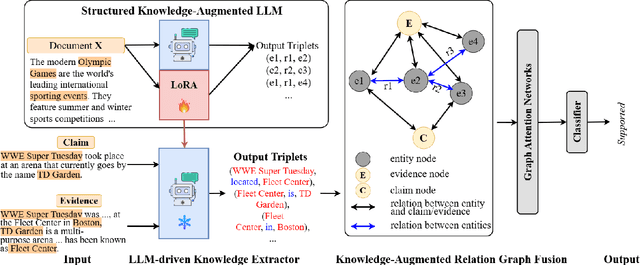
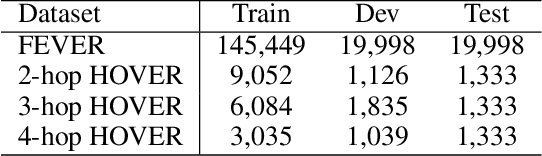
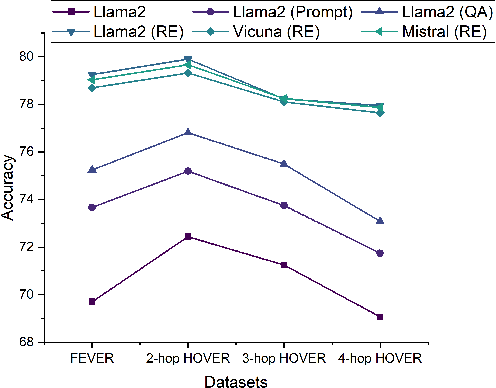
The rapid development of social platforms exacerbates the dissemination of misinformation, which stimulates the research in fact verification. Recent studies tend to leverage semantic features to solve this problem as a single-hop task. However, the process of verifying a claim requires several pieces of evidence with complicated inner logic and relations to verify the given claim in real-world situations. Recent studies attempt to improve both understanding and reasoning abilities to enhance the performance, but they overlook the crucial relations between entities that benefit models to understand better and facilitate the prediction. To emphasize the significance of relations, we resort to Large Language Models (LLMs) considering their excellent understanding ability. Instead of other methods using LLMs as the predictor, we take them as relation extractors, for they do better in understanding rather than reasoning according to the experimental results. Thus, to solve the challenges above, we propose a novel Structured Knowledge-Augmented LLM-based Network (LLM-SKAN) for multi-hop fact verification. Specifically, we utilize an LLM-driven Knowledge Extractor to capture fine-grained information, including entities and their complicated relations. Besides, we leverage a Knowledge-Augmented Relation Graph Fusion module to interact with each node and learn better claim-evidence representations comprehensively. The experimental results on four common-used datasets demonstrate the effectiveness and superiority of our model.
An Information-theoretic Multi-task Representation Learning Framework for Natural Language Understanding
Mar 06, 2025
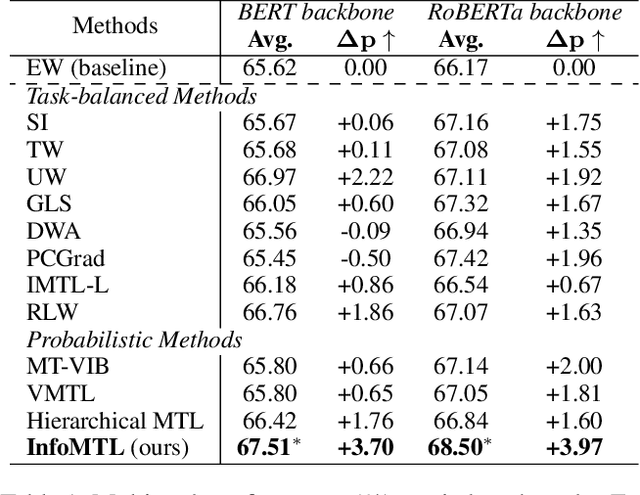

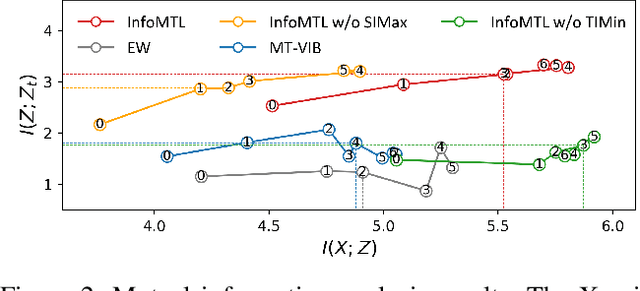
This paper proposes a new principled multi-task representation learning framework (InfoMTL) to extract noise-invariant sufficient representations for all tasks. It ensures sufficiency of shared representations for all tasks and mitigates the negative effect of redundant features, which can enhance language understanding of pre-trained language models (PLMs) under the multi-task paradigm. Firstly, a shared information maximization principle is proposed to learn more sufficient shared representations for all target tasks. It can avoid the insufficiency issue arising from representation compression in the multi-task paradigm. Secondly, a task-specific information minimization principle is designed to mitigate the negative effect of potential redundant features in the input for each task. It can compress task-irrelevant redundant information and preserve necessary information relevant to the target for multi-task prediction. Experiments on six classification benchmarks show that our method outperforms 12 comparative multi-task methods under the same multi-task settings, especially in data-constrained and noisy scenarios. Extensive experiments demonstrate that the learned representations are more sufficient, data-efficient, and robust.
Transferring Structure Knowledge: A New Task to Fake news Detection Towards Cold-Start Propagation
Jul 13, 2024Many fake news detection studies have achieved promising performance by extracting effective semantic and structure features from both content and propagation trees. However, it is challenging to apply them to practical situations, especially when using the trained propagation-based models to detect news with no propagation data. Towards this scenario, we study a new task named cold-start fake news detection, which aims to detect content-only samples with missing propagation. To achieve the task, we design a simple but effective Structure Adversarial Net (SAN) framework to learn transferable features from available propagation to boost the detection of content-only samples. SAN introduces a structure discriminator to estimate dissimilarities among learned features with and without propagation, and further learns structure-invariant features to enhance the generalization of existing propagation-based methods for content-only samples. We conduct qualitative and quantitative experiments on three datasets. Results show the challenge of the new task and the effectiveness of our SAN framework.
Representation Learning with Conditional Information Flow Maximization
Jun 08, 2024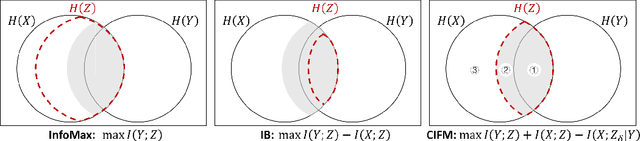
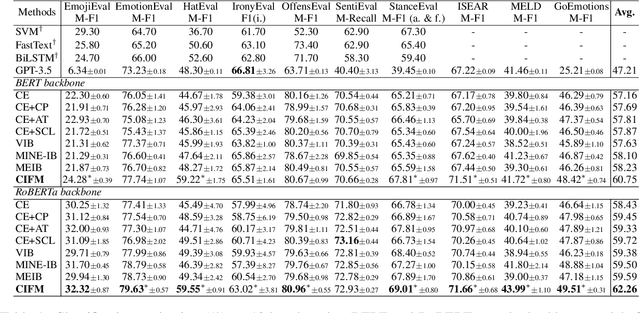

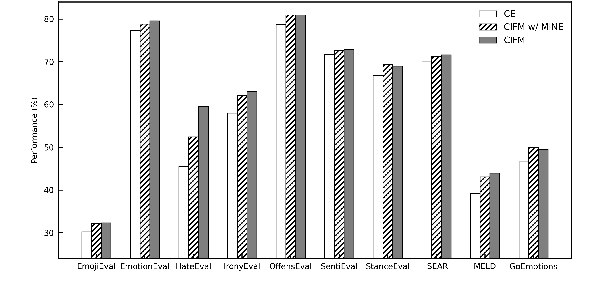
This paper proposes an information-theoretic representation learning framework, named conditional information flow maximization, to extract noise-invariant sufficient representations for the input data and target task. It promotes the learned representations have good feature uniformity and sufficient predictive ability, which can enhance the generalization of pre-trained language models (PLMs) for the target task. Firstly, an information flow maximization principle is proposed to learn more sufficient representations by simultaneously maximizing both input-representation and representation-label mutual information. In contrast to information bottleneck, we handle the input-representation information in an opposite way to avoid the over-compression issue of latent representations. Besides, to mitigate the negative effect of potential redundant features, a conditional information minimization principle is designed to eliminate negative redundant features while preserve noise-invariant features from the input. Experiments on 13 language understanding benchmarks demonstrate that our method effectively improves the performance of PLMs for classification and regression. Extensive experiments show that the learned representations are more sufficient, robust and transferable.
Structured Probabilistic Coding
Dec 25, 2023This paper presents a new supervised representation learning framework, namely structured probabilistic coding (SPC), to learn compact and informative representations from input related to the target task. SPC is an encoder-only probabilistic coding technology with a structured regularization from the target label space. It can enhance the generalization ability of pre-trained language models for better language understanding. Specifically, our probabilistic coding technology simultaneously performs information encoding and task prediction in one module to more fully utilize the effective information from input data. It uses variational inference in the output space to reduce randomness and uncertainty. Besides, to better control the probability distribution in the latent space, a structured regularization is proposed to promote class-level uniformity in the latent space. With the regularization term, SPC can preserve the Gaussian distribution structure of latent code as well as better cover the hidden space with class uniformly. Experimental results on 12 natural language understanding tasks demonstrate that our SPC effectively improves the performance of pre-trained language models for classification and regression. Extensive experiments show that SPC can enhance the generalization capability, robustness to label noise, and clustering quality of output representations.
Are Large Language Models Good Fact Checkers: A Preliminary Study
Nov 29, 2023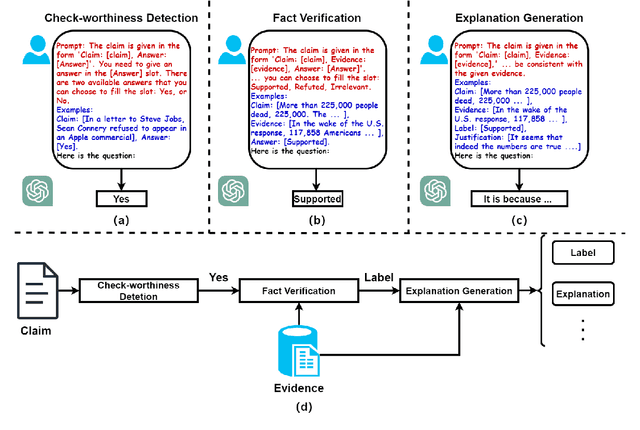
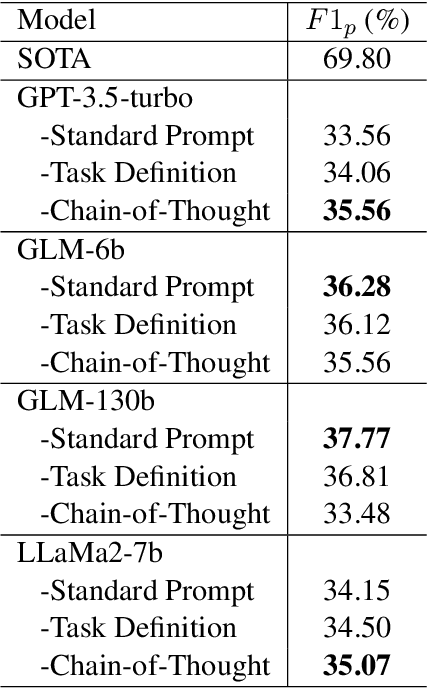
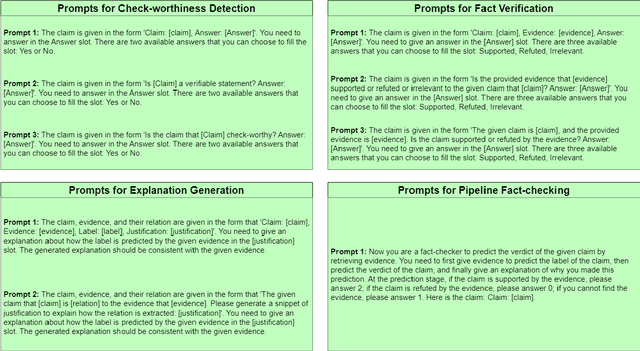
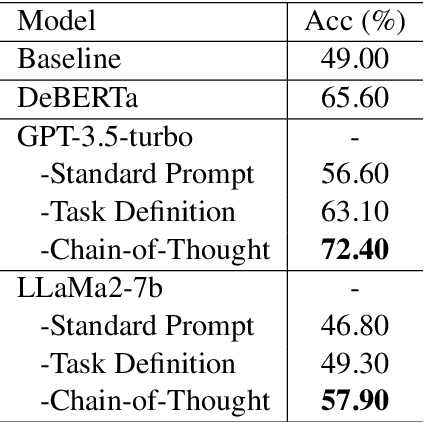
Recently, Large Language Models (LLMs) have drawn significant attention due to their outstanding reasoning capabilities and extensive knowledge repository, positioning them as superior in handling various natural language processing tasks compared to other language models. In this paper, we present a preliminary investigation into the potential of LLMs in fact-checking. This study aims to comprehensively evaluate various LLMs in tackling specific fact-checking subtasks, systematically evaluating their capabilities, and conducting a comparative analysis of their performance against pre-trained and state-of-the-art low-parameter models. Experiments demonstrate that LLMs achieve competitive performance compared to other small models in most scenarios. However, they encounter challenges in effectively handling Chinese fact verification and the entirety of the fact-checking pipeline due to language inconsistencies and hallucinations. These findings underscore the need for further exploration and research to enhance the proficiency of LLMs as reliable fact-checkers, unveiling the potential capability of LLMs and the possible challenges in fact-checking tasks.