 Add to Chrome
 Add to Firefox
 Add to Edge
ARC-STAR: Auditable Post-Hoc Correction for PDE Foundation Models
May 21, 2026
Partial differential equation (PDE) foundation models are pretrained networks that forecast how physical fields like velocity and pressure evolve from a single reusable solver. On unfamiliar flows their predictions drift step by step, errors concentrate in a few regions, yet retraining destabilizes the network and uniform post-hoc correction overlooks this spatial concentration. To address this, we propose a frozen-solver post-hoc correction framework, Adaptive Risk-Calibrated Spatial Triage for Auditable Refinement (ARC-STAR). ARC-STAR organizes correction into three stages: a global corrector removes broad solver bias, a blockwise local refiner cleans the post-global residual, and, at deployment, a label-free score routes refinement to high-risk blocks under a compute budget. The framework is designed to be (i) frozen-host, preserving the pretrained solver without fine-tuning; (ii) auditable, with global and local stages trained and evaluated separately for measurable contributions; and (iii) budget-aware, using a blockwise interface that either refines the full field or routes limited compute to high-risk regions. Across five flow benchmarks spanning ten regime cells, ARC-STAR is the only method that cuts velocity rollout error by at least 36x over raw Poseidon on every cell. The global stage reduces raw host error by 91-99%, and the local stage further reduces the remaining post-global residual by up to 94.4%. Our code implementation is available at https://anonymous.4open.science/r/arc_star.

Locally Confident, Globally Stuck: The Quality-Exploration Dilemma in Diffusion Language Models
Apr 01, 2026Diffusion large language models (dLLMs) theoretically permit token decoding in arbitrary order, a flexibility that could enable richer exploration of reasoning paths than autoregressive (AR) LLMs. In practice, however, random-order decoding often hurts generation quality. To mitigate this, low-confidence remasking improves single-sample quality (e.g., Pass@$1$) by prioritizing confident tokens, but it also suppresses exploration and limits multi-sample gains (e.g., Pass@$k$), creating a fundamental quality--exploration dilemma. In this paper, we provide a unified explanation of this dilemma. We show that low-confidence remasking improves a myopic proxy for quality while provably constraining the entropy of the induced sequence distribution. To overcome this limitation, we characterize the optimal distribution that explicitly balances quality and exploration, and develop a simple Independent Metropolis--Hastings sampler that approximately targets this distribution during decoding. Experiments across a range of reasoning benchmarks including MATH500, AIME24/25, HumanEval, and MBPP show that our approach yields better exploration-quality tradeoff than both random and low-confidence remasking.
CellMaster: Collaborative Cell Type Annotation in Single-Cell Analysis
Feb 12, 2026Single-cell RNA-seq (scRNA-seq) enables atlas-scale profiling of complex tissues, revealing rare lineages and transient states. Yet, assigning biologically valid cell identities remains a bottleneck because markers are tissue- and state-dependent, and novel states lack references. We present CellMaster, an AI agent that mimics expert practice for zero-shot cell-type annotation. Unlike existing automated tools, CellMaster leverages LLM-encoded knowledge (e.g., GPT-4o) to perform on-the-fly annotation with interpretable rationales, without pre-training or fixed marker databases. Across 9 datasets spanning 8 tissues, CellMaster improved accuracy by 7.1% over best-performing baselines (including CellTypist and scTab) in automatic mode. With human-in-the-loop refinement, this advantage increased to 18.6%, with a 22.1% gain on subtype populations. The system demonstrates particular strength in rare and novel cell states where baselines often fail. Source code and the web application are available at \href{https://github.com/AnonymousGym/CellMaster}{https://github.com/AnonymousGym/CellMaster}.
scPilot: Large Language Model Reasoning Toward Automated Single-Cell Analysis and Discovery
Feb 12, 2026We present scPilot, the first systematic framework to practice omics-native reasoning: a large language model (LLM) converses in natural language while directly inspecting single-cell RNA-seq data and on-demand bioinformatics tools. scPilot converts core single-cell analyses, i.e., cell-type annotation, developmental-trajectory reconstruction, and transcription-factor targeting, into step-by-step reasoning problems that the model must solve, justify, and, when needed, revise with new evidence. To measure progress, we release scBench, a suite of 9 expertly curated datasets and graders that faithfully evaluate the omics-native reasoning capability of scPilot w.r.t various LLMs. Experiments with o1 show that iterative omics-native reasoning lifts average accuracy by 11% for cell-type annotation and Gemini-2.5-Pro cuts trajectory graph-edit distance by 30% versus one-shot prompting, while generating transparent reasoning traces explain marker gene ambiguity and regulatory logic. By grounding LLMs in raw omics data, scPilot enables auditable, interpretable, and diagnostically informative single-cell analyses. Code, data, and package are available at https://github.com/maitrix-org/scPilot
PAN: A World Model for General, Interactable, and Long-Horizon World Simulation
Nov 15, 2025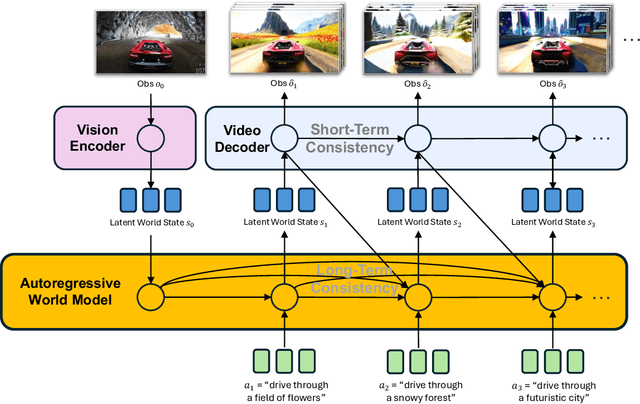
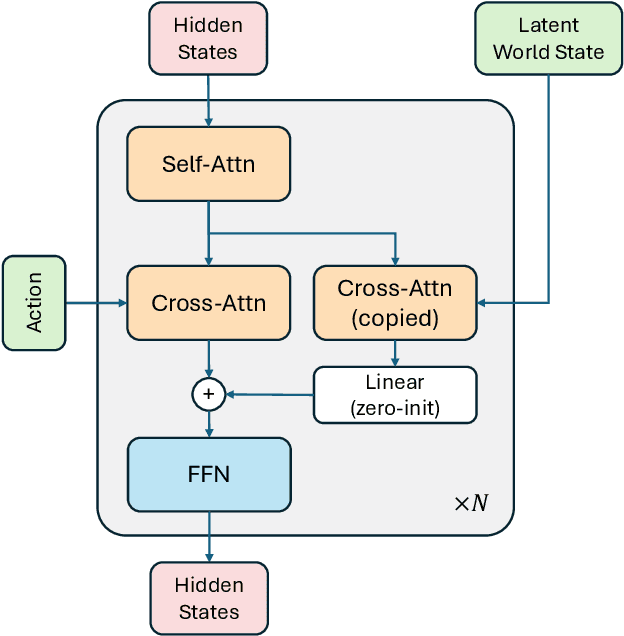
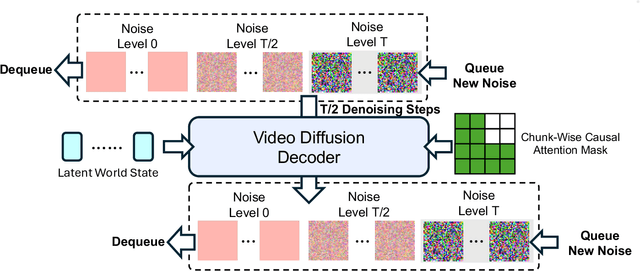
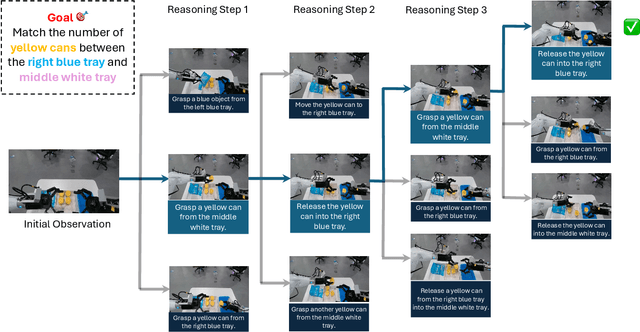
A world model enables an intelligent agent to imagine, predict, and reason about how the world evolves in response to its actions, and accordingly to plan and strategize. While recent video generation models produce realistic visual sequences, they typically operate in the prompt-to-full-video manner without causal control, interactivity, or long-horizon consistency required for purposeful reasoning. Existing world modeling efforts, on the other hand, often focus on restricted domains (e.g., physical, game, or 3D-scene dynamics) with limited depth and controllability, and struggle to generalize across diverse environments and interaction formats. In this work, we introduce PAN, a general, interactable, and long-horizon world model that predicts future world states through high-quality video simulation conditioned on history and natural language actions. PAN employs the Generative Latent Prediction (GLP) architecture that combines an autoregressive latent dynamics backbone based on a large language model (LLM), which grounds simulation in extensive text-based knowledge and enables conditioning on language-specified actions, with a video diffusion decoder that reconstructs perceptually detailed and temporally coherent visual observations, to achieve a unification between latent space reasoning (imagination) and realizable world dynamics (reality). Trained on large-scale video-action pairs spanning diverse domains, PAN supports open-domain, action-conditioned simulation with coherent, long-term dynamics. Extensive experiments show that PAN achieves strong performance in action-conditioned world simulation, long-horizon forecasting, and simulative reasoning compared to other video generators and world models, taking a step towards general world models that enable predictive simulation of future world states for reasoning and acting.