 Add to Chrome
 Add to Firefox
 Add to Edge
DeformToon3D: Deformable 3D Toonification from Neural Radiance Fields
Sep 08, 2023
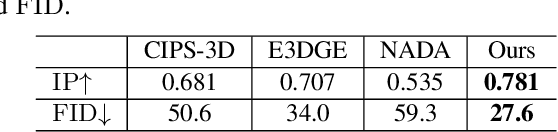
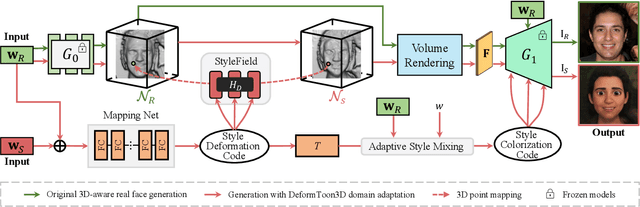
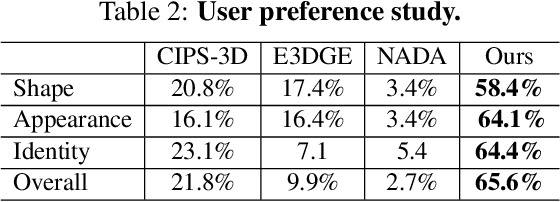
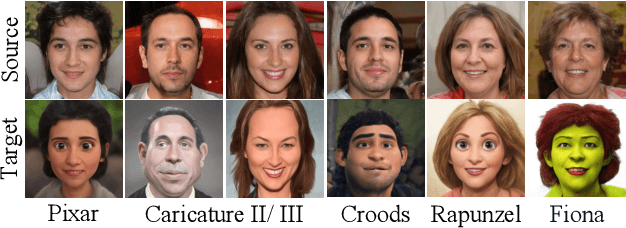
In this paper, we address the challenging problem of 3D toonification, which involves transferring the style of an artistic domain onto a target 3D face with stylized geometry and texture. Although fine-tuning a pre-trained 3D GAN on the artistic domain can produce reasonable performance, this strategy has limitations in the 3D domain. In particular, fine-tuning can deteriorate the original GAN latent space, which affects subsequent semantic editing, and requires independent optimization and storage for each new style, limiting flexibility and efficient deployment. To overcome these challenges, we propose DeformToon3D, an effective toonification framework tailored for hierarchical 3D GAN. Our approach decomposes 3D toonification into subproblems of geometry and texture stylization to better preserve the original latent space. Specifically, we devise a novel StyleField that predicts conditional 3D deformation to align a real-space NeRF to the style space for geometry stylization. Thanks to the StyleField formulation, which already handles geometry stylization well, texture stylization can be achieved conveniently via adaptive style mixing that injects information of the artistic domain into the decoder of the pre-trained 3D GAN. Due to the unique design, our method enables flexible style degree control and shape-texture-specific style swap. Furthermore, we achieve efficient training without any real-world 2D-3D training pairs but proxy samples synthesized from off-the-shelf 2D toonification models.

ProPainter: Improving Propagation and Transformer for Video Inpainting
Sep 07, 2023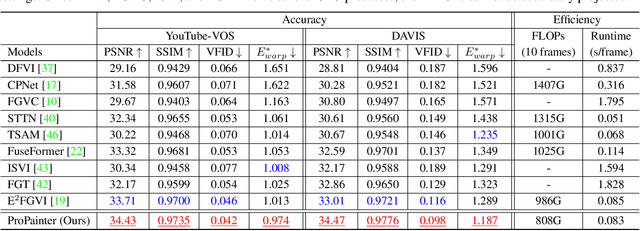
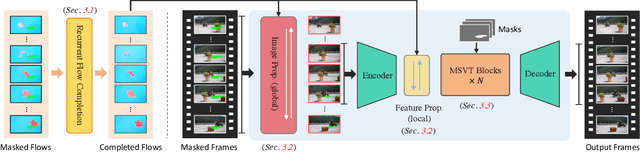
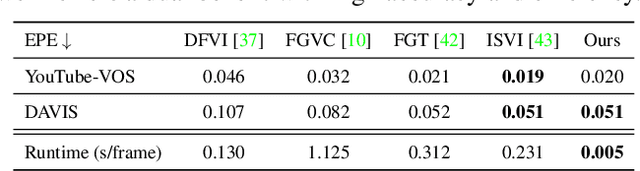

Flow-based propagation and spatiotemporal Transformer are two mainstream mechanisms in video inpainting (VI). Despite the effectiveness of these components, they still suffer from some limitations that affect their performance. Previous propagation-based approaches are performed separately either in the image or feature domain. Global image propagation isolated from learning may cause spatial misalignment due to inaccurate optical flow. Moreover, memory or computational constraints limit the temporal range of feature propagation and video Transformer, preventing exploration of correspondence information from distant frames. To address these issues, we propose an improved framework, called ProPainter, which involves enhanced ProPagation and an efficient Transformer. Specifically, we introduce dual-domain propagation that combines the advantages of image and feature warping, exploiting global correspondences reliably. We also propose a mask-guided sparse video Transformer, which achieves high efficiency by discarding unnecessary and redundant tokens. With these components, ProPainter outperforms prior arts by a large margin of 1.46 dB in PSNR while maintaining appealing efficiency.
Audio-Driven Dubbing for User Generated Contents via Style-Aware Semi-Parametric Synthesis
Aug 31, 2023Existing automated dubbing methods are usually designed for Professionally Generated Content (PGC) production, which requires massive training data and training time to learn a person-specific audio-video mapping. In this paper, we investigate an audio-driven dubbing method that is more feasible for User Generated Content (UGC) production. There are two unique challenges to design a method for UGC: 1) the appearances of speakers are diverse and arbitrary as the method needs to generalize across users; 2) the available video data of one speaker are very limited. In order to tackle the above challenges, we first introduce a new Style Translation Network to integrate the speaking style of the target and the speaking content of the source via a cross-modal AdaIN module. It enables our model to quickly adapt to a new speaker. Then, we further develop a semi-parametric video renderer, which takes full advantage of the limited training data of the unseen speaker via a video-level retrieve-warp-refine pipeline. Finally, we propose a temporal regularization for the semi-parametric renderer, generating more continuous videos. Extensive experiments show that our method generates videos that accurately preserve various speaking styles, yet with considerably lower amount of training data and training time in comparison to existing methods. Besides, our method achieves a faster testing speed than most recent methods.
* TCSVT 2022
StyleInV: A Temporal Style Modulated Inversion Network for Unconditional Video Generation
Aug 31, 2023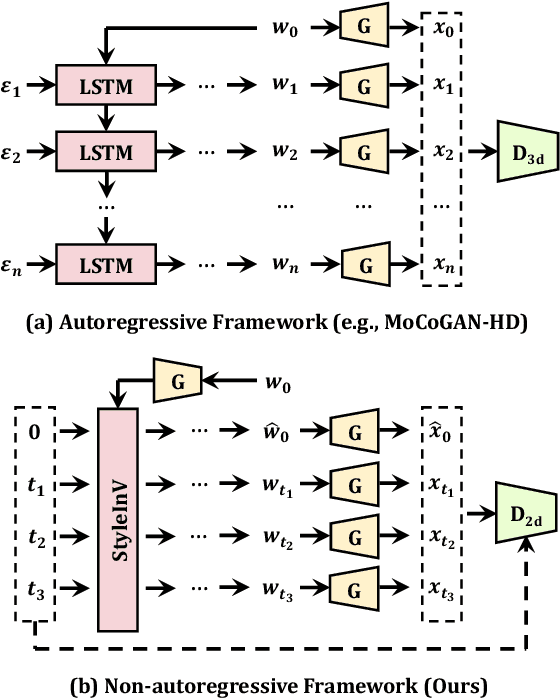
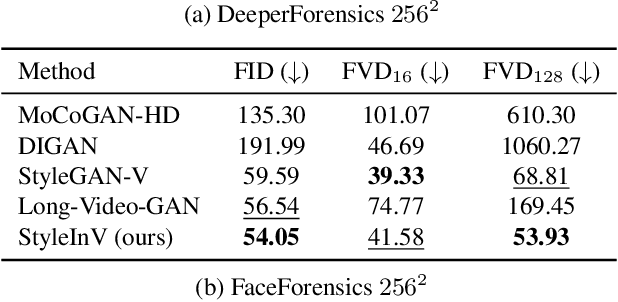
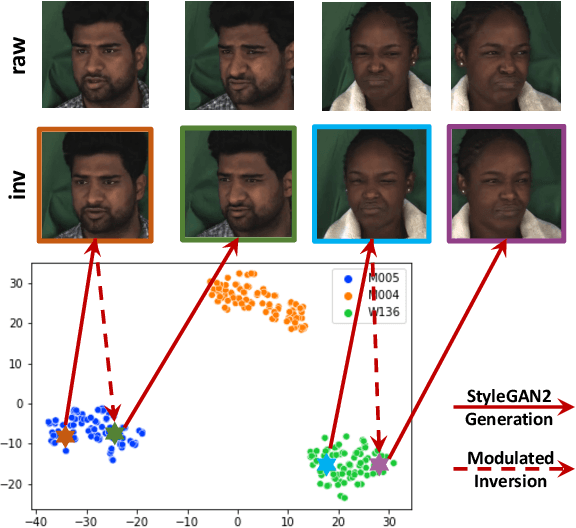
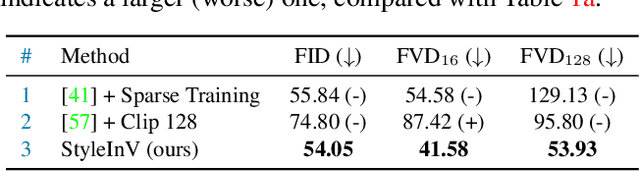
Unconditional video generation is a challenging task that involves synthesizing high-quality videos that are both coherent and of extended duration. To address this challenge, researchers have used pretrained StyleGAN image generators for high-quality frame synthesis and focused on motion generator design. The motion generator is trained in an autoregressive manner using heavy 3D convolutional discriminators to ensure motion coherence during video generation. In this paper, we introduce a novel motion generator design that uses a learning-based inversion network for GAN. The encoder in our method captures rich and smooth priors from encoding images to latents, and given the latent of an initially generated frame as guidance, our method can generate smooth future latent by modulating the inversion encoder temporally. Our method enjoys the advantage of sparse training and naturally constrains the generation space of our motion generator with the inversion network guided by the initial frame, eliminating the need for heavy discriminators. Moreover, our method supports style transfer with simple fine-tuning when the encoder is paired with a pretrained StyleGAN generator. Extensive experiments conducted on various benchmarks demonstrate the superiority of our method in generating long and high-resolution videos with decent single-frame quality and temporal consistency.
PointHPS: Cascaded 3D Human Pose and Shape Estimation from Point Clouds
Aug 28, 2023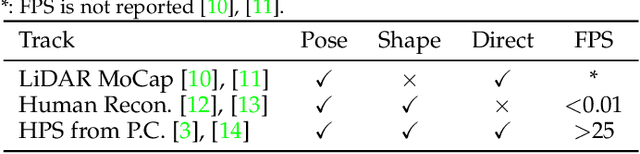
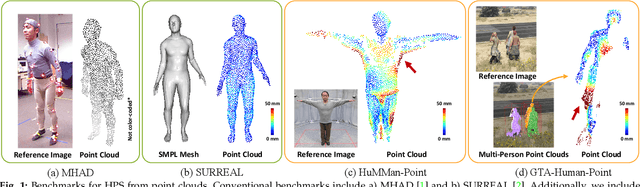
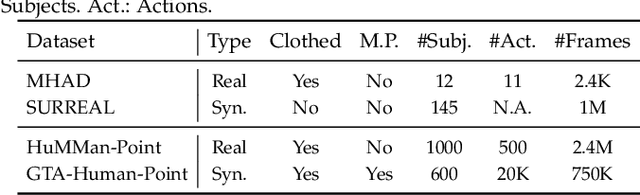
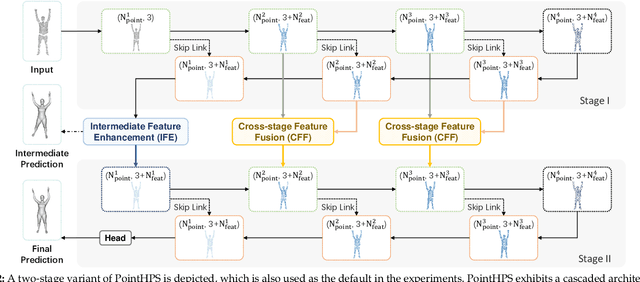
Human pose and shape estimation (HPS) has attracted increasing attention in recent years. While most existing studies focus on HPS from 2D images or videos with inherent depth ambiguity, there are surging need to investigate HPS from 3D point clouds as depth sensors have been frequently employed in commercial devices. However, real-world sensory 3D points are usually noisy and incomplete, and also human bodies could have different poses of high diversity. To tackle these challenges, we propose a principled framework, PointHPS, for accurate 3D HPS from point clouds captured in real-world settings, which iteratively refines point features through a cascaded architecture. Specifically, each stage of PointHPS performs a series of downsampling and upsampling operations to extract and collate both local and global cues, which are further enhanced by two novel modules: 1) Cross-stage Feature Fusion (CFF) for multi-scale feature propagation that allows information to flow effectively through the stages, and 2) Intermediate Feature Enhancement (IFE) for body-aware feature aggregation that improves feature quality after each stage. To facilitate a comprehensive study under various scenarios, we conduct our experiments on two large-scale benchmarks, comprising i) a dataset that features diverse subjects and actions captured by real commercial sensors in a laboratory environment, and ii) controlled synthetic data generated with realistic considerations such as clothed humans in crowded outdoor scenes. Extensive experiments demonstrate that PointHPS, with its powerful point feature extraction and processing scheme, outperforms State-of-the-Art methods by significant margins across the board. Homepage: https://caizhongang.github.io/projects/PointHPS/.
Scenimefy: Learning to Craft Anime Scene via Semi-Supervised Image-to-Image Translation
Aug 24, 2023


Automatic high-quality rendering of anime scenes from complex real-world images is of significant practical value. The challenges of this task lie in the complexity of the scenes, the unique features of anime style, and the lack of high-quality datasets to bridge the domain gap. Despite promising attempts, previous efforts are still incompetent in achieving satisfactory results with consistent semantic preservation, evident stylization, and fine details. In this study, we propose Scenimefy, a novel semi-supervised image-to-image translation framework that addresses these challenges. Our approach guides the learning with structure-consistent pseudo paired data, simplifying the pure unsupervised setting. The pseudo data are derived uniquely from a semantic-constrained StyleGAN leveraging rich model priors like CLIP. We further apply segmentation-guided data selection to obtain high-quality pseudo supervision. A patch-wise contrastive style loss is introduced to improve stylization and fine details. Besides, we contribute a high-resolution anime scene dataset to facilitate future research. Our extensive experiments demonstrate the superiority of our method over state-of-the-art baselines in terms of both perceptual quality and quantitative performance.
MeViS: A Large-scale Benchmark for Video Segmentation with Motion Expressions
Aug 16, 2023This paper strives for motion expressions guided video segmentation, which focuses on segmenting objects in video content based on a sentence describing the motion of the objects. Existing referring video object datasets typically focus on salient objects and use language expressions that contain excessive static attributes that could potentially enable the target object to be identified in a single frame. These datasets downplay the importance of motion in video content for language-guided video object segmentation. To investigate the feasibility of using motion expressions to ground and segment objects in videos, we propose a large-scale dataset called MeViS, which contains numerous motion expressions to indicate target objects in complex environments. We benchmarked 5 existing referring video object segmentation (RVOS) methods and conducted a comprehensive comparison on the MeViS dataset. The results show that current RVOS methods cannot effectively address motion expression-guided video segmentation. We further analyze the challenges and propose a baseline approach for the proposed MeViS dataset. The goal of our benchmark is to provide a platform that enables the development of effective language-guided video segmentation algorithms that leverage motion expressions as a primary cue for object segmentation in complex video scenes. The proposed MeViS dataset has been released at https://henghuiding.github.io/MeViS.
ResShift: Efficient Diffusion Model for Image Super-resolution by Residual Shifting
Jul 25, 2023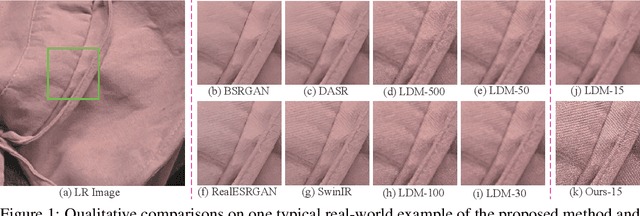
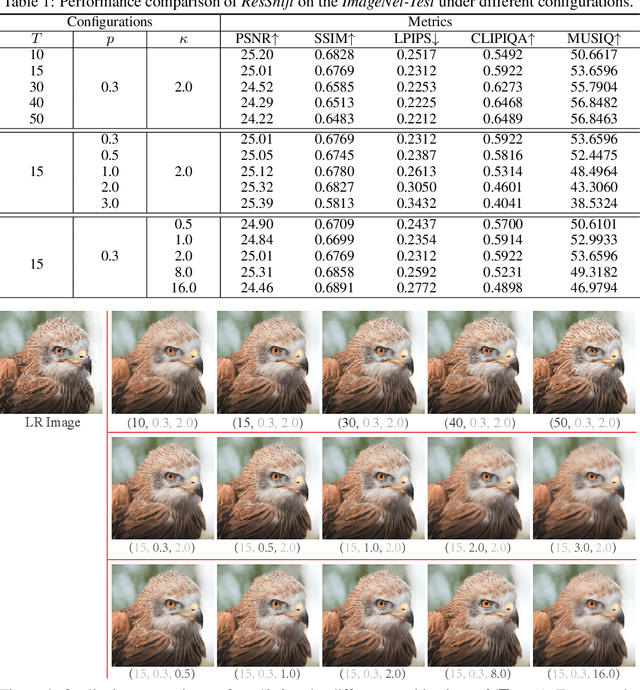
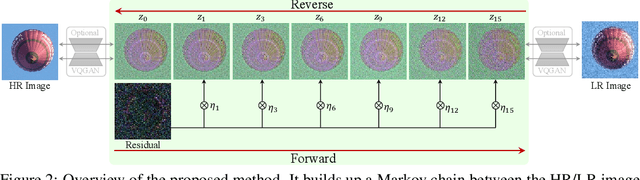
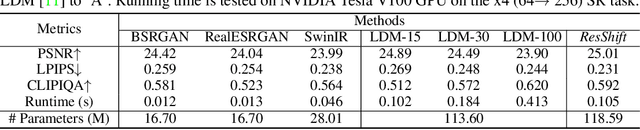
Diffusion-based image super-resolution (SR) methods are mainly limited by the low inference speed due to the requirements of hundreds or even thousands of sampling steps. Existing acceleration sampling techniques inevitably sacrifice performance to some extent, leading to over-blurry SR results. To address this issue, we propose a novel and efficient diffusion model for SR that significantly reduces the number of diffusion steps, thereby eliminating the need for post-acceleration during inference and its associated performance deterioration. Our method constructs a Markov chain that transfers between the high-resolution image and the low-resolution image by shifting the residual between them, substantially improving the transition efficiency. Additionally, an elaborate noise schedule is developed to flexibly control the shifting speed and the noise strength during the diffusion process. Extensive experiments demonstrate that the proposed method obtains superior or at least comparable performance to current state-of-the-art methods on both synthetic and real-world datasets, even only with 15 sampling steps. Our code and model are available at https://github.com/zsyOAOA/ResShift.
DNA-Rendering: A Diverse Neural Actor Repository for High-Fidelity Human-centric Rendering
Jul 19, 2023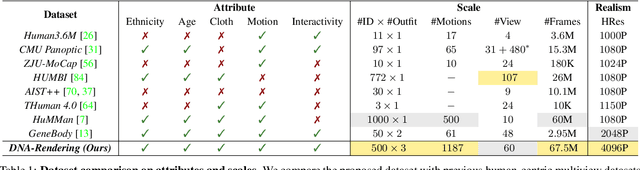

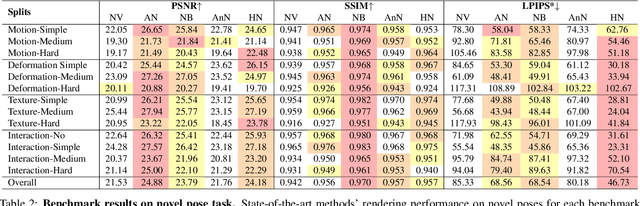

Realistic human-centric rendering plays a key role in both computer vision and computer graphics. Rapid progress has been made in the algorithm aspect over the years, yet existing human-centric rendering datasets and benchmarks are rather impoverished in terms of diversity, which are crucial for rendering effect. Researchers are usually constrained to explore and evaluate a small set of rendering problems on current datasets, while real-world applications require methods to be robust across different scenarios. In this work, we present DNA-Rendering, a large-scale, high-fidelity repository of human performance data for neural actor rendering. DNA-Rendering presents several alluring attributes. First, our dataset contains over 1500 human subjects, 5000 motion sequences, and 67.5M frames' data volume. Second, we provide rich assets for each subject -- 2D/3D human body keypoints, foreground masks, SMPLX models, cloth/accessory materials, multi-view images, and videos. These assets boost the current method's accuracy on downstream rendering tasks. Third, we construct a professional multi-view system to capture data, which contains 60 synchronous cameras with max 4096 x 3000 resolution, 15 fps speed, and stern camera calibration steps, ensuring high-quality resources for task training and evaluation. Along with the dataset, we provide a large-scale and quantitative benchmark in full-scale, with multiple tasks to evaluate the existing progress of novel view synthesis, novel pose animation synthesis, and novel identity rendering methods. In this manuscript, we describe our DNA-Rendering effort as a revealing of new observations, challenges, and future directions to human-centric rendering. The dataset, code, and benchmarks will be publicly available at https://dna-rendering.github.io/
Adaptive Window Pruning for Efficient Local Motion Deblurring
Jun 25, 2023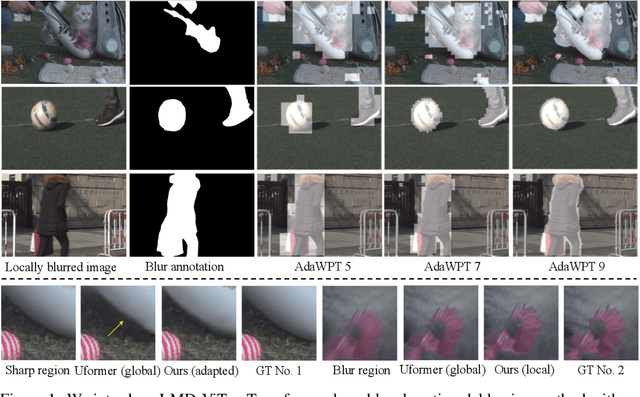
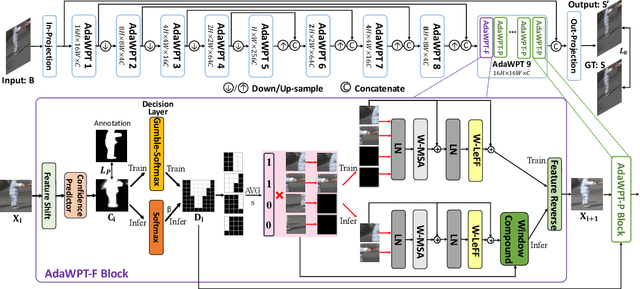
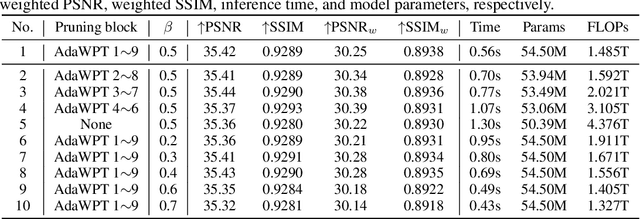
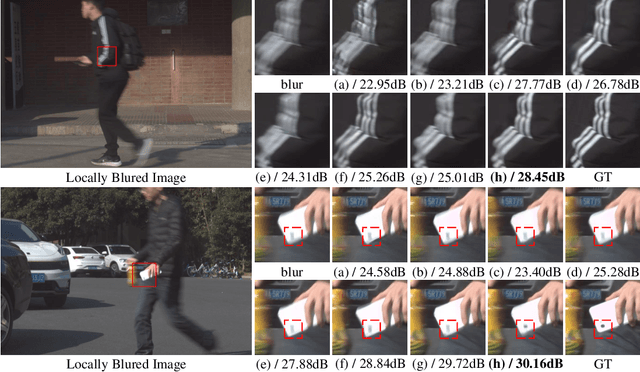
Local motion blur commonly occurs in real-world photography due to the mixing between moving objects and stationary backgrounds during exposure. Existing image deblurring methods predominantly focus on global deblurring, inadvertently affecting the sharpness of backgrounds in locally blurred images and wasting unnecessary computation on sharp pixels, especially for high-resolution images. This paper aims to adaptively and efficiently restore high-resolution locally blurred images. We propose a local motion deblurring vision Transformer (LMD-ViT) built on adaptive window pruning Transformer blocks (AdaWPT). To focus deblurring on local regions and reduce computation, AdaWPT prunes unnecessary windows, only allowing the active windows to be involved in the deblurring processes. The pruning operation relies on the blurriness confidence predicted by a confidence predictor that is trained end-to-end using a reconstruction loss with Gumbel-Softmax re-parameterization and a pruning loss guided by annotated blur masks. Our method removes local motion blur effectively without distorting sharp regions, demonstrated by its exceptional perceptual and quantitative improvements (+0.24dB) compared to state-of-the-art methods. In addition, our approach substantially reduces FLOPs by 66% and achieves more than a twofold increase in inference speed compared to Transformer-based deblurring methods. We will make our code and annotated blur masks publicly available.