 Add to Chrome
 Add to Firefox
 Add to Edge
Bridging the Information Gap: Semantic Densification and Hindsight Distillation for Cold-Start Prediction
Jul 19, 2026
New-user cold-start is a critical bottleneck for e-commerce platforms: predicting user lifetime value (LTV) and conversion rate (CVR) for users with sparse interaction history. Two prior directions -- LLM-based semantic augmentation and learning using privileged information (LUPI) -- each face a key limitation. First, LLM augmentation produces unstructured rationales that are noisy and hard to operationalize in production. Second, naive student-teacher distillation can be brittle due to an information gap between the privileged teacher and the sparse student; moreover, this gap is heterogeneous across users. We propose SemRaD, a Semantic Reasoning-aware Distillation framework addressing both limitations. First, a Structured Semantic Reasoning Pipeline replaces free-form rationales with a structured schema built via a discover-curate-audit workflow, producing per user a Densified Semantic Profile (consumed by the deployed student via a Semantic-Gated Encoder that focuses on the most informative dimensions) and a Hindsight Distillation Target reconciled from pre- and post-conversion reasoning (used only at training). Second, to bridge this gap and handle its heterogeneity, a Hindsight-Aware Distillation Network transfers privileged knowledge via the hindsight target, with Distillation Experts improving transfer under per-user variability. On a large-scale industrial dataset, SemRaD lifts +1.9% LTV (Gini) and +1.0% CVR (AUROC) over a production-grade base; a four-week online A/B at Keeta confirms +1.0% LTV / +0.43% CVR. SemRaD also matches the production system's LTV using only 9% of the training data while improving CVR by 0.8%.

Multi-Agent Causal Discovery Using Large Language Models
Jul 21, 2024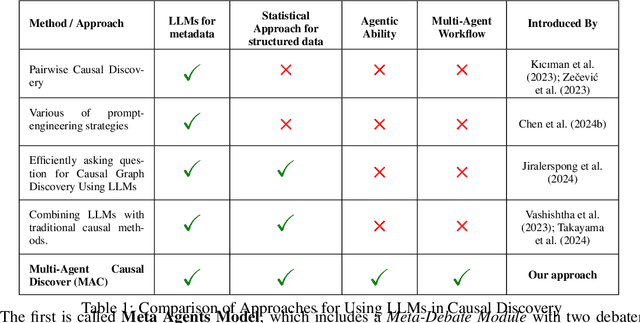
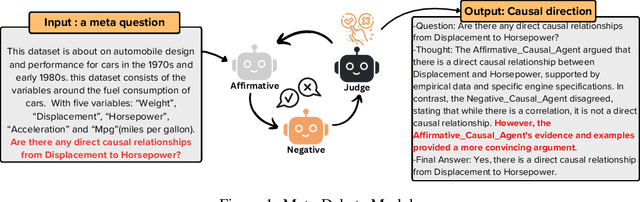
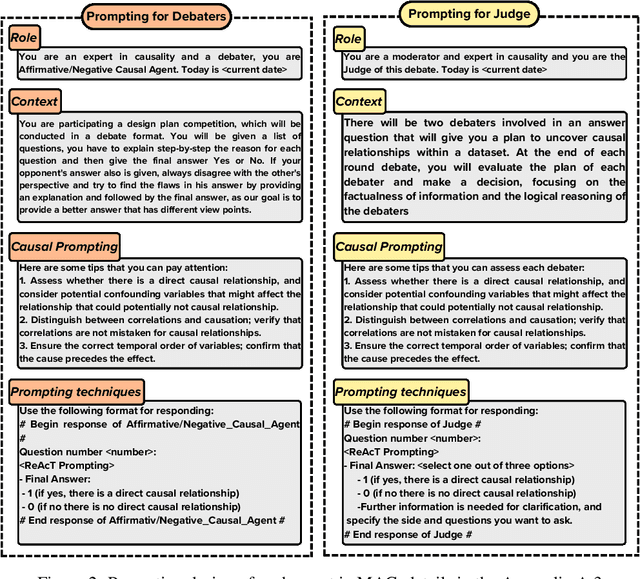
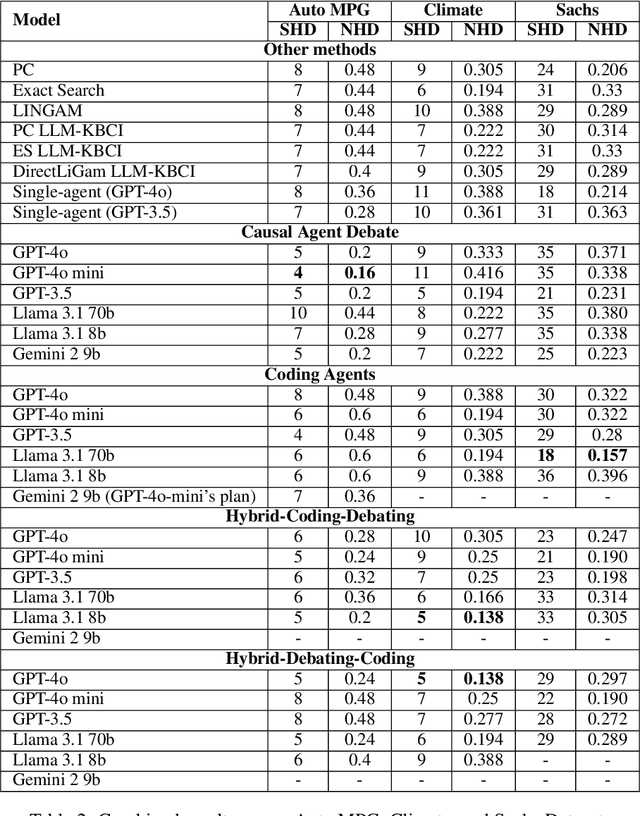
Large Language Models (LLMs) have demonstrated significant potential in causal discovery tasks by utilizing their vast expert knowledge from extensive text corpora. However, the multi-agent capabilities of LLMs in causal discovery remain underexplored. This paper introduces a general framework to investigate this potential. The first is the Meta Agents Model, which relies exclusively on reasoning and discussions among LLM agents to conduct causal discovery. The second is the Coding Agents Model, which leverages the agents' ability to plan, write, and execute code, utilizing advanced statistical libraries for causal discovery. The third is the Hybrid Model, which integrates both the Meta Agents Model and CodingAgents Model approaches, combining the statistical analysis and reasoning skills of multiple agents. Our proposed framework shows promising results by effectively utilizing LLMs expert knowledge, reasoning capabilities, multi-agent cooperation, and statistical causal methods. By exploring the multi-agent potential of LLMs, we aim to establish a foundation for further research in utilizing LLMs multi-agent for solving causal-related problems.