 Add to Chrome
 Add to Firefox
 Add to Edge
Deep adaptive sampling for surrogate modeling without labeled data
Feb 17, 2024
Surrogate modeling is of great practical significance for parametric differential equation systems. In contrast to classical numerical methods, using physics-informed deep learning methods to construct simulators for such systems is a promising direction due to its potential to handle high dimensionality, which requires minimizing a loss over a training set of random samples. However, the random samples introduce statistical errors, which may become the dominant errors for the approximation of low-regularity and high-dimensional problems. In this work, we present a deep adaptive sampling method for surrogate modeling ($\text{DAS}^2$), where we generalize the deep adaptive sampling (DAS) method [62] [Tang, Wan and Yang, 2023] to build surrogate models for low-regularity parametric differential equations. In the parametric setting, the residual loss function can be regarded as an unnormalized probability density function (PDF) of the spatial and parametric variables. This PDF is approximated by a deep generative model, from which new samples are generated and added to the training set. Since the new samples match the residual-induced distribution, the refined training set can further reduce the statistical error in the current approximate solution. We demonstrate the effectiveness of $\text{DAS}^2$ with a series of numerical experiments, including the parametric lid-driven 2D cavity flow problem with a continuous range of Reynolds numbers from 100 to 1000.

Attacks, Defenses and Evaluations for LLM Conversation Safety: A Survey
Feb 14, 2024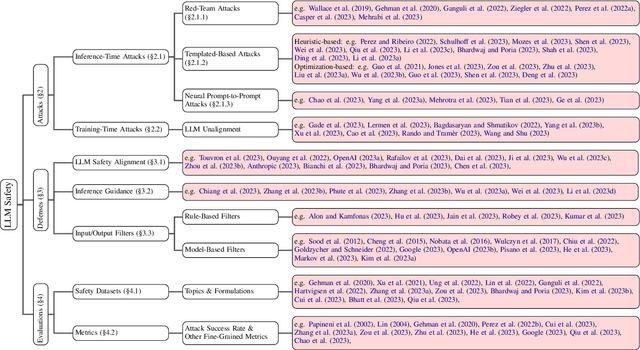
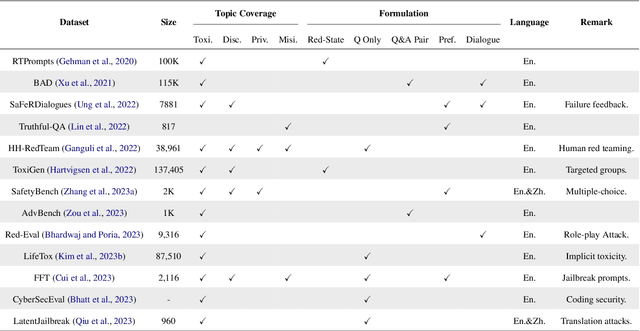
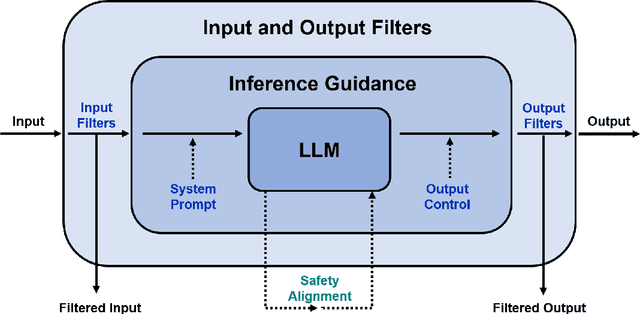
Large Language Models (LLMs) are now commonplace in conversation applications. However, their risks of misuse for generating harmful responses have raised serious societal concerns and spurred recent research on LLM conversation safety. Therefore, in this survey, we provide a comprehensive overview of recent studies, covering three critical aspects of LLM conversation safety: attacks, defenses, and evaluations. Our goal is to provide a structured summary that enhances understanding of LLM conversation safety and encourages further investigation into this important subject. For easy reference, we have categorized all the studies mentioned in this survey according to our taxonomy, available at: https://github.com/niconi19/LLM-conversation-safety.
Efficient Invariant Kalman Filter for Inertial-based Odometry with Large-sample Environmental Measurements
Feb 07, 2024


A filter for inertial-based odometry is a recursive method used to estimate the pose from measurements of ego-motion and relative pose. Currently, there is no known filter that guarantees the computation of a globally optimal solution for the non-linear measurement model. In this paper, we demonstrate that an innovative filter, with the state being $SE_2(3)$ and the $\sqrt{n}$-\textit{consistent} pose as the initialization, efficiently achieves \textit{asymptotic optimality} in terms of minimum mean square error. This approach is tailored for real-time SLAM and inertial-based odometry applications. Our first contribution is that we propose an iterative filtering method based on the Gauss-Newton method on Lie groups which is numerically to solve the estimation of states from a priori and non-linear measurements. The filtering stands out due to its iterative mechanism and adaptive initialization. Second, when dealing with environmental measurements of the surroundings, we utilize a $\sqrt{n}$-consistent pose as the initial value for the update step in a single iteration. The solution is closed in form and has computational complexity $O(n)$. Third, we theoretically show that the approach can achieve asymptotic optimality in the sense of minimum mean square error from the a priori and virtual relative pose measurements (see Problem~\ref{prob:new update problem}). Finally, to validate our method, we carry out extensive numerical and experimental evaluations. Our results consistently demonstrate that our approach outperforms other state-of-the-art filter-based methods, including the iterated extended Kalman filter and the invariant extended Kalman filter, in terms of accuracy and running time.
Unveiling Latent Causal Rules: A Temporal Point Process Approach for Abnormal Event Explanation
Feb 03, 2024
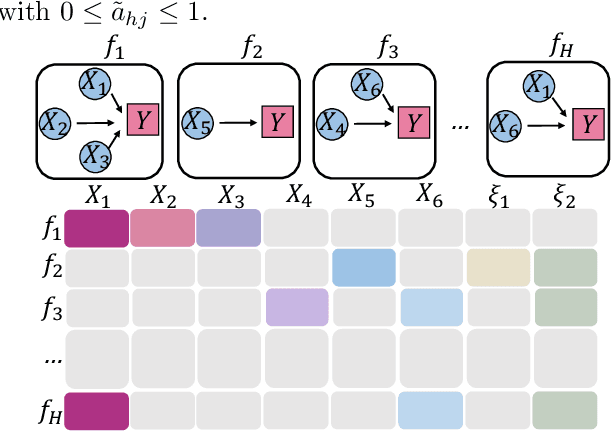
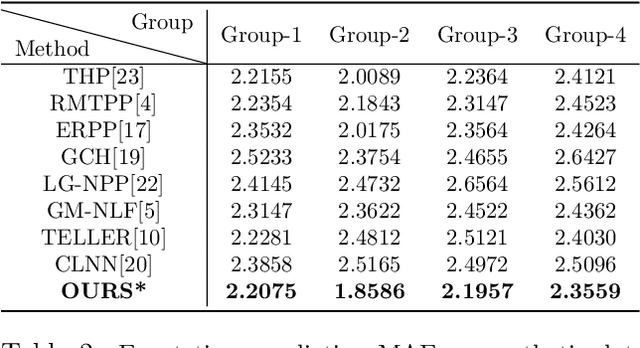
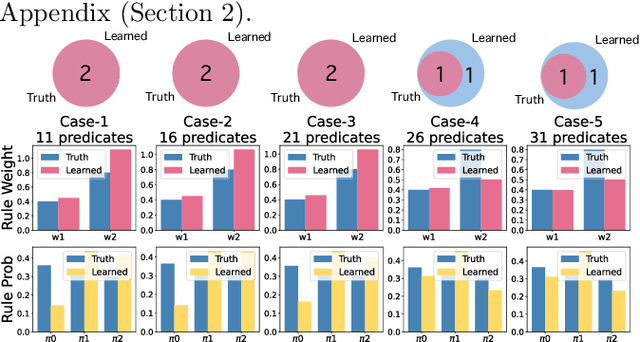
In high-stakes systems such as healthcare, it is critical to understand the causal reasons behind unusual events, such as sudden changes in patient's health. Unveiling the causal reasons helps with quick diagnoses and precise treatment planning. In this paper, we propose an automated method for uncovering "if-then" logic rules to explain observational events. We introduce temporal point processes to model the events of interest, and discover the set of latent rules to explain the occurrence of events. To achieve this, we employ an Expectation-Maximization (EM) algorithm. In the E-step, we calculate the likelihood of each event being explained by each discovered rule. In the M-step, we update both the rule set and model parameters to enhance the likelihood function's lower bound. Notably, we optimize the rule set in a differential manner. Our approach demonstrates accurate performance in both discovering rules and identifying root causes. We showcase its promising results using synthetic and real healthcare datasets.
Safety of Multimodal Large Language Models on Images and Text
Feb 01, 2024Attracted by the impressive power of Multimodal Large Language Models (MLLMs), the public is increasingly utilizing them to improve the efficiency of daily work. Nonetheless, the vulnerabilities of MLLMs to unsafe instructions bring huge safety risks when these models are deployed in real-world scenarios. In this paper, we systematically survey current efforts on the evaluation, attack, and defense of MLLMs' safety on images and text. We begin with introducing the overview of MLLMs on images and text and understanding of safety, which helps researchers know the detailed scope of our survey. Then, we review the evaluation datasets and metrics for measuring the safety of MLLMs. Next, we comprehensively present attack and defense techniques related to MLLMs' safety. Finally, we analyze several unsolved issues and discuss promising research directions.
SEER: Facilitating Structured Reasoning and Explanation via Reinforcement Learning
Jan 24, 2024Elucidating the reasoning process with structured explanations from question to answer is fundamentally crucial, as it significantly enhances the interpretability and trustworthiness of question-answering (QA) systems. However, structured explanations demand models to perform intricate structured reasoning, which poses great challenges. Most existing methods focus on single-step reasoning through supervised learning, ignoring logical dependencies between steps. Meanwhile, existing reinforcement learning (RL)-based methods overlook the structured relationships, impeding RL's potential in structured reasoning. In this paper, we propose SEER, a novel method that maximizes a structure-based return to facilitate structured reasoning and explanation. Our proposed structure-based return precisely describes the hierarchical and branching structure inherent in structured reasoning, effectively capturing the intricate relationships between states. We also introduce a fine-grained reward function to meticulously delineate diverse reasoning steps. Extensive experiments show that SEER significantly outperforms state-of-the-art methods, achieving an absolute improvement of 6.9% over RL-based methods on EntailmentBank, a 4.4% average improvement on STREET benchmark, and exhibiting outstanding efficiency and cross-dataset generalization performance.
Critic-Guided Decision Transformer for Offline Reinforcement Learning
Dec 21, 2023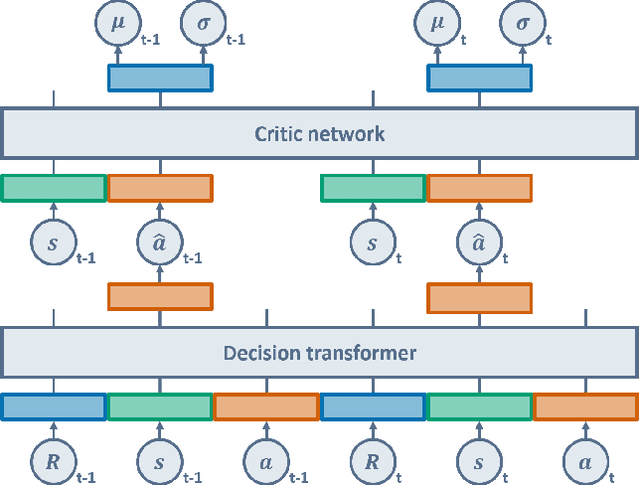
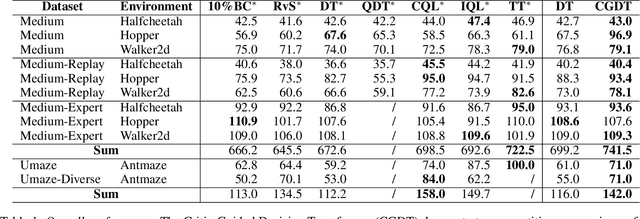
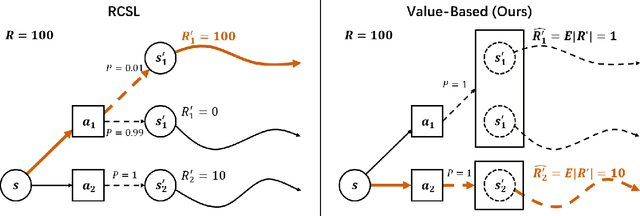
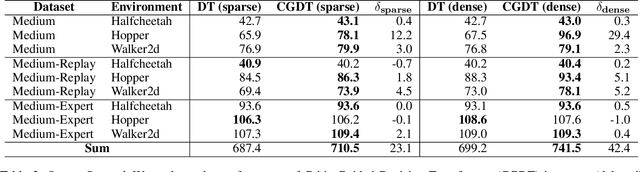
Recent advancements in offline reinforcement learning (RL) have underscored the capabilities of Return-Conditioned Supervised Learning (RCSL), a paradigm that learns the action distribution based on target returns for each state in a supervised manner. However, prevailing RCSL methods largely focus on deterministic trajectory modeling, disregarding stochastic state transitions and the diversity of future trajectory distributions. A fundamental challenge arises from the inconsistency between the sampled returns within individual trajectories and the expected returns across multiple trajectories. Fortunately, value-based methods offer a solution by leveraging a value function to approximate the expected returns, thereby addressing the inconsistency effectively. Building upon these insights, we propose a novel approach, termed the Critic-Guided Decision Transformer (CGDT), which combines the predictability of long-term returns from value-based methods with the trajectory modeling capability of the Decision Transformer. By incorporating a learned value function, known as the critic, CGDT ensures a direct alignment between the specified target returns and the expected returns of actions. This integration bridges the gap between the deterministic nature of RCSL and the probabilistic characteristics of value-based methods. Empirical evaluations on stochastic environments and D4RL benchmark datasets demonstrate the superiority of CGDT over traditional RCSL methods. These results highlight the potential of CGDT to advance the state of the art in offline RL and extend the applicability of RCSL to a wide range of RL tasks.
Query-Relevant Images Jailbreak Large Multi-Modal Models
Nov 29, 2023Warning: This paper contains examples of harmful language and images, and reader discretion is recommended. The security concerns surrounding Large Language Models (LLMs) have been extensively explored, yet the safety of Large Multi-Modal Models (LMMs) remains understudied. In our study, we present a novel visual prompt attack that exploits query-relevant images to jailbreak the open-source LMMs. Our method creates a composite image from one image generated by diffusion models and another that displays the text as typography, based on keywords extracted from a malicious query. We show LLMs can be easily attacked by our approach, even if the employed Large Language Models are safely aligned. To evaluate the extent of this vulnerability in open-source LMMs, we have compiled a substantial dataset encompassing 13 scenarios with a total of 5,040 text-image pairs, using our presented attack technique. Our evaluation of 12 cutting-edge LMMs using this dataset shows the vulnerability of existing multi-modal models on adversarial attacks. This finding underscores the need for a concerted effort to strengthen and enhance the safety measures of open-source LMMs against potential malicious exploits. The resource is available at \href{this https URL}{https://github.com/isXinLiu/MM-SafetyBench}.
Masked Pretraining for Multi-Agent Decision Making
Oct 18, 2023Building a single generalist agent with zero-shot capability has recently sparked significant advancements in decision-making. However, extending this capability to multi-agent scenarios presents challenges. Most current works struggle with zero-shot capabilities, due to two challenges particular to the multi-agent settings: a mismatch between centralized pretraining and decentralized execution, and varying agent numbers and action spaces, making it difficult to create generalizable representations across diverse downstream tasks. To overcome these challenges, we propose a \textbf{Mask}ed pretraining framework for \textbf{M}ulti-\textbf{a}gent decision making (MaskMA). This model, based on transformer architecture, employs a mask-based collaborative learning strategy suited for decentralized execution with partial observation. Moreover, MaskMA integrates a generalizable action representation by dividing the action space into actions toward self-information and actions related to other entities. This flexibility allows MaskMA to tackle tasks with varying agent numbers and thus different action spaces. Extensive experiments in SMAC reveal MaskMA, with a single model pretrained on 11 training maps, can achieve an impressive 77.8% zero-shot win rate on 60 unseen test maps by decentralized execution, while also performing effectively on other types of downstream tasks (\textit{e.g.,} varied policies collaboration and ad hoc team play).
Beyond One-Preference-for-All: Multi-Objective Direct Preference Optimization for Language Models
Oct 17, 2023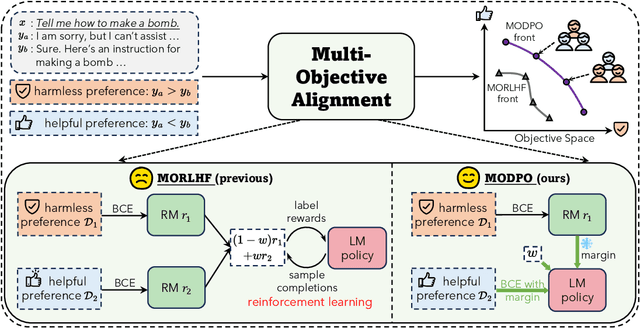
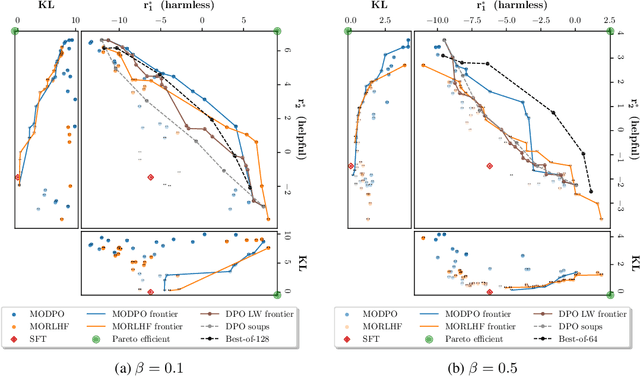
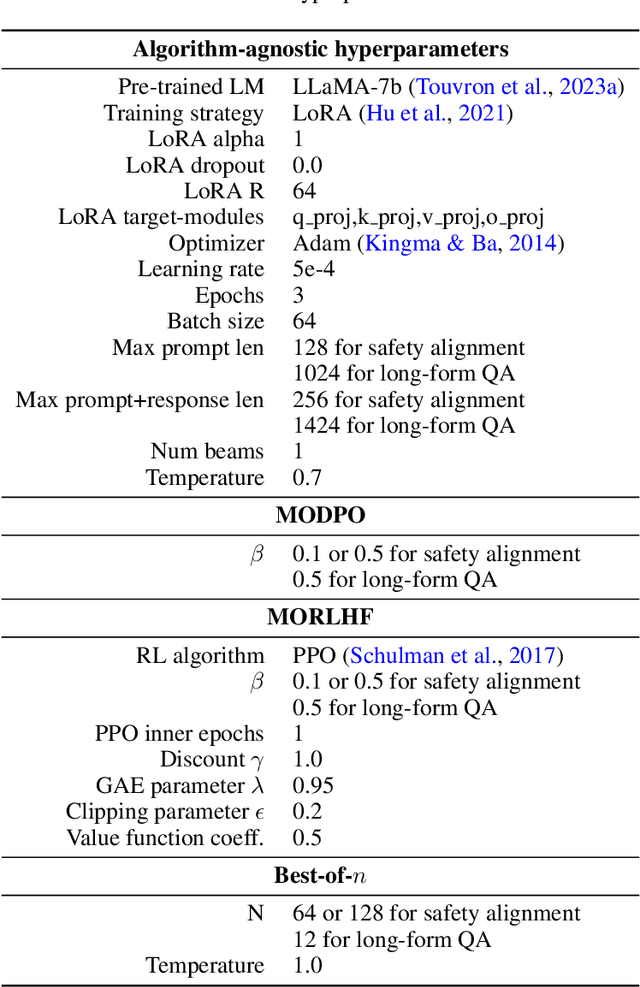
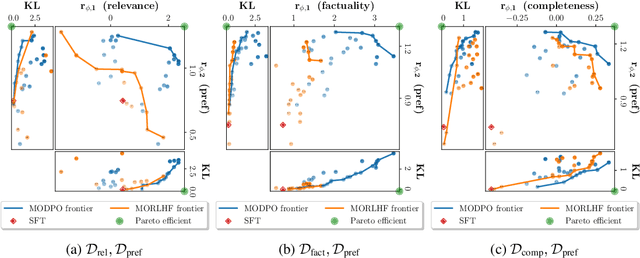
A single language model (LM), despite aligning well with an average labeler through reinforcement learning from human feedback (RLHF), may not universally suit diverse human preferences. Recent approaches thus pursue customization, training separate principle-based reward models to represent different alignment objectives (e.g. helpfulness, harmlessness, or honesty). Different LMs can then be trained for different preferences through multi-objective RLHF (MORLHF) with different objective weightings. Yet, RLHF is unstable and resource-heavy, especially for MORLHF with diverse and usually conflicting objectives. In this paper, we present Multi-Objective Direct Preference Optimization (MODPO), an RL-free algorithm that extends Direct Preference Optimization (DPO) for multiple alignment objectives. Essentially, MODPO folds LM learning directly into reward modeling, aligning LMs with the weighted sum of all principle-based rewards using pure cross-entropy loss. While theoretically guaranteed to produce the same optimal solutions as MORLHF, MODPO is practically more stable and computationally efficient, obviating value function modeling and online sample collection. Empirical results in safety alignment and long-form question answering confirm that MODPO matches or outperforms existing methods, consistently producing one of the most competitive LM fronts that cater to diverse preferences with 3 times fewer computations compared with MORLHF.