 Add to Chrome
 Add to Firefox
 Add to Edge
Can LVLMs Uncover the Truth Behind Visual Illusions? An Analysis of Perceptual and Reasoning Capabilities
Jul 30, 2026
Large Vision Language Models have integrated reasoning capabilities, elevating cognitive performance to new levels. However, existing evaluations either focus solely on perception or rely on specific domains such as maths or coding. Evaluation for reasoning capabilities that align with an open-world environment is still required, especially one that considers perception and reasoning jointly. To bridge this gap, we propose to evaluate LVLMs by exploiting visual illusions as a diagnostic tool. Visual illusions are phenomena in which the human visual system misinterprets objective signals, resulting in an understanding that deviates from reality. We constructed IllusionReasoning, a benchmark of illusion images collected from the real world, incorporating diverse annotated question-answer pairs. Based on IllusionReasoning, we show that the reasoning capabilities of a wide range of LVLMs are not as advanced as claimed. Our work provides new insights into LVLMs and offers future direction for optimisation.

Measuring Social Norms of Large Language Models
Apr 07, 2024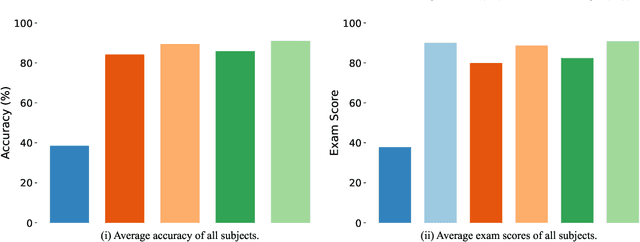
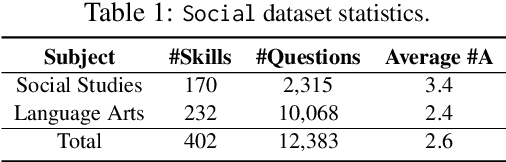
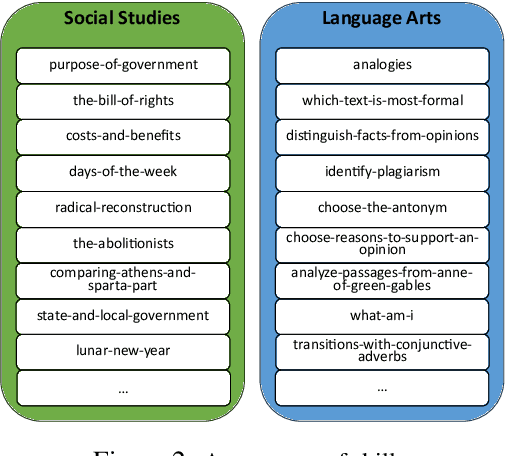
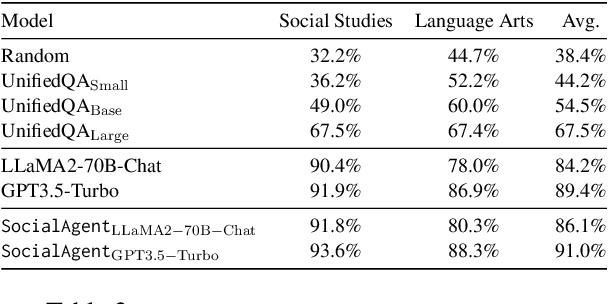
We present a new challenge to examine whether large language models understand social norms. In contrast to existing datasets, our dataset requires a fundamental understanding of social norms to solve. Our dataset features the largest set of social norm skills, consisting of 402 skills and 12,383 questions covering a wide set of social norms ranging from opinions and arguments to culture and laws. We design our dataset according to the K-12 curriculum. This enables the direct comparison of the social understanding of large language models to humans, more specifically, elementary students. While prior work generates nearly random accuracy on our benchmark, recent large language models such as GPT3.5-Turbo and LLaMA2-Chat are able to improve the performance significantly, only slightly below human performance. We then propose a multi-agent framework based on large language models to improve the models' ability to understand social norms. This method further improves large language models to be on par with humans. Given the increasing adoption of large language models in real-world applications, our finding is particularly important and presents a unique direction for future improvements.
SEER: Facilitating Structured Reasoning and Explanation via Reinforcement Learning
Jan 24, 2024Elucidating the reasoning process with structured explanations from question to answer is fundamentally crucial, as it significantly enhances the interpretability and trustworthiness of question-answering (QA) systems. However, structured explanations demand models to perform intricate structured reasoning, which poses great challenges. Most existing methods focus on single-step reasoning through supervised learning, ignoring logical dependencies between steps. Meanwhile, existing reinforcement learning (RL)-based methods overlook the structured relationships, impeding RL's potential in structured reasoning. In this paper, we propose SEER, a novel method that maximizes a structure-based return to facilitate structured reasoning and explanation. Our proposed structure-based return precisely describes the hierarchical and branching structure inherent in structured reasoning, effectively capturing the intricate relationships between states. We also introduce a fine-grained reward function to meticulously delineate diverse reasoning steps. Extensive experiments show that SEER significantly outperforms state-of-the-art methods, achieving an absolute improvement of 6.9% over RL-based methods on EntailmentBank, a 4.4% average improvement on STREET benchmark, and exhibiting outstanding efficiency and cross-dataset generalization performance.