 Add to Chrome
 Add to Firefox
 Add to Edge
SafeSceneReason: A Multimodal Reasoning Benchmark Connecting Industrial Hazards with Accident Knowledge
Aug 10, 2026
Industrial-safety understanding requires more than detecting workers, equipment, and personal protective equipment. Models must also assess compliance, identify hazardous interactions, explain potential accident mechanisms, and recommend preventive actions. Existing safety datasets primarily focus on visual perception or isolated violation recognition and provide limited supervision for evidence-grounded reasoning. We introduce SafeSceneReason, a multimodal industrial-safety reasoning benchmark and companion training corpus that connects workplace scenes with knowledge from occupational accident investigations. SafeSceneReason combines two complementary data-construction pipelines. The scene-centric pipeline converts annotated workplace images into executable safety scene graphs and generates deterministic answers through program execution over objects, relations, and safety rules. The report-centric pipeline extracts figures and contextual evidence from accident reports and constructs multimodal questions using evidence graphs, explicit information boundaries, multi-step reasoning paths, and iterative verification. The resulting resource contains 110,581 verified scene-centric question--answer pairs and 13,114 refined report-centric question--answer pairs, covering perception, spatial and quantitative reasoning, compliance assessment, evidence synthesis, causal analysis, and mitigation-oriented decision making. Evaluation of representative proprietary and open-source vision--language models reveals substantial performance differences and persistent weaknesses in comparative, technical, and multi-evidence reasoning, demonstrating that strong general visual understanding does not yet guarantee reliable industrial-safety reasoning.

DaX: Learning General Pathology Representations Across Scales
Jun 05, 2026Computational pathology requires visual representations that transfer across diverse clinical endpoints and remain robust to variation in magnification, staining, scanner type, slide preparation, and input resolution. We present DaX, a pathology vision foundation model that adapts DINOv3-style self-supervised learning to whole-slide histopathology. DaX is initialized from natural-image DINOv3 weights and incorporates continuous magnification training, cross-scale tissue views, orientation-agnostic and acquisition-robust augmentation, multi-input-size training, and Gram-anchored dense consistency. These designs aim to connect local cellular morphology with global tissue architecture while stabilizing dense token-level representations across input scales. We further construct a WSI-level benchmark comprising 161 clinically meaningful tasks from 44 public datasets, covering 28,182 patients and 34,394 slides across four clinical domains and nine task categories. All models are evaluated under a fixed patient-level cross-validation protocol with fold-level statistical ranking, enabling reproducible comparisons that are less sensitive to split-dependent variation. Across this benchmark, DaX achieves the highest mean performance across tasks and consistently strong task-level ranking scores, with gains spanning diagnostic pathology, biomarker and molecular profiling, tissue/specimen context, and risk, response, and prognosis. These results support DaX as a transferable visual encoder for computational pathology and provide a standardized evaluation framework for future pathology foundation models. Project page: https://alibaba-damo-academy.github.io/DaX/benchboard/.
MUSE: Multi-Scale Dense Self-Distillation for Nucleus Detection and Classification
Nov 07, 2025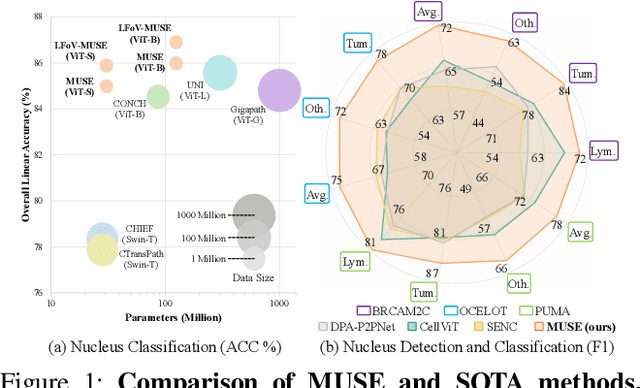
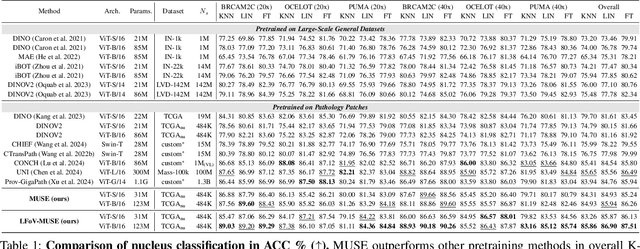
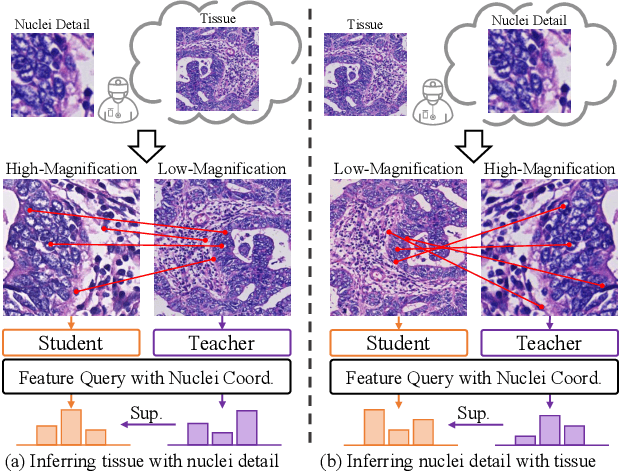
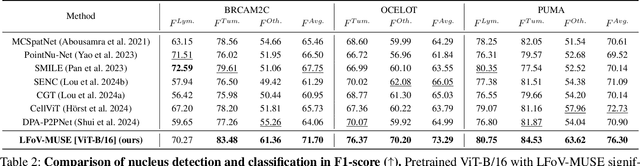
Nucleus detection and classification (NDC) in histopathology analysis is a fundamental task that underpins a wide range of high-level pathology applications. However, existing methods heavily rely on labor-intensive nucleus-level annotations and struggle to fully exploit large-scale unlabeled data for learning discriminative nucleus representations. In this work, we propose MUSE (MUlti-scale denSE self-distillation), a novel self-supervised learning method tailored for NDC. At its core is NuLo (Nucleus-based Local self-distillation), a coordinate-guided mechanism that enables flexible local self-distillation based on predicted nucleus positions. By removing the need for strict spatial alignment between augmented views, NuLo allows critical cross-scale alignment, thus unlocking the capacity of models for fine-grained nucleus-level representation. To support MUSE, we design a simple yet effective encoder-decoder architecture and a large field-of-view semi-supervised fine-tuning strategy that together maximize the value of unlabeled pathology images. Extensive experiments on three widely used benchmarks demonstrate that MUSE effectively addresses the core challenges of histopathological NDC. The resulting models not only surpass state-of-the-art supervised baselines but also outperform generic pathology foundation models.
Neural Proteomics Fields for Super-resolved Spatial Proteomics Prediction
Aug 24, 2025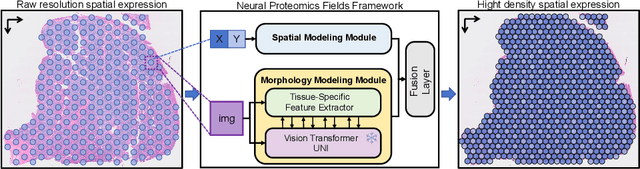
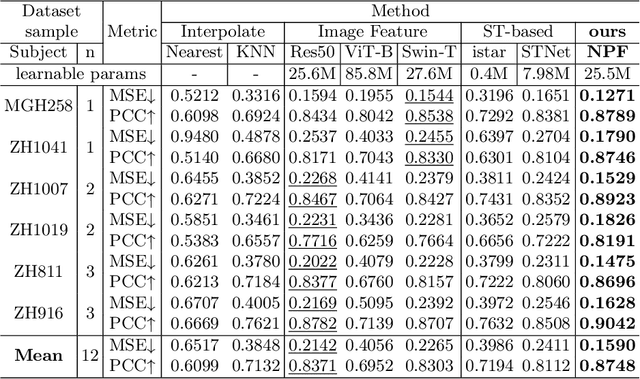
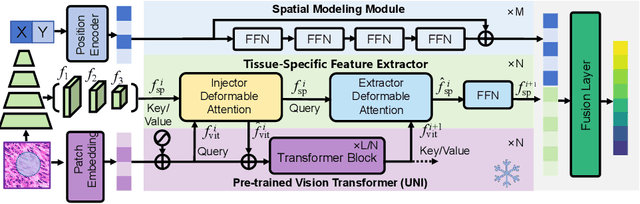

Spatial proteomics maps protein distributions in tissues, providing transformative insights for life sciences. However, current sequencing-based technologies suffer from low spatial resolution, and substantial inter-tissue variability in protein expression further compromises the performance of existing molecular data prediction methods. In this work, we introduce the novel task of spatial super-resolution for sequencing-based spatial proteomics (seq-SP) and, to the best of our knowledge, propose the first deep learning model for this task--Neural Proteomics Fields (NPF). NPF formulates seq-SP as a protein reconstruction problem in continuous space by training a dedicated network for each tissue. The model comprises a Spatial Modeling Module, which learns tissue-specific protein spatial distributions, and a Morphology Modeling Module, which extracts tissue-specific morphological features. Furthermore, to facilitate rigorous evaluation, we establish an open-source benchmark dataset, Pseudo-Visium SP, for this task. Experimental results demonstrate that NPF achieves state-of-the-art performance with fewer learnable parameters, underscoring its potential for advancing spatial proteomics research. Our code and dataset are publicly available at https://github.com/Bokai-Zhao/NPF.
PharmacyGPT: The AI Pharmacist
Jul 21, 2023In this study, we introduce PharmacyGPT, a novel framework to assess the capabilities of large language models (LLMs) such as ChatGPT and GPT-4 in emulating the role of clinical pharmacists. Our methodology encompasses the utilization of LLMs to generate comprehensible patient clusters, formulate medication plans, and forecast patient outcomes. We conduct our investigation using real data acquired from the intensive care unit (ICU) at the University of North Carolina Chapel Hill (UNC) Hospital. Our analysis offers valuable insights into the potential applications and limitations of LLMs in the field of clinical pharmacy, with implications for both patient care and the development of future AI-driven healthcare solutions. By evaluating the performance of PharmacyGPT, we aim to contribute to the ongoing discourse surrounding the integration of artificial intelligence in healthcare settings, ultimately promoting the responsible and efficacious use of such technologies.