 Add to Chrome
 Add to Firefox
 Add to Edge
SafeSceneReason: A Multimodal Reasoning Benchmark Connecting Industrial Hazards with Accident Knowledge
Aug 10, 2026
Industrial-safety understanding requires more than detecting workers, equipment, and personal protective equipment. Models must also assess compliance, identify hazardous interactions, explain potential accident mechanisms, and recommend preventive actions. Existing safety datasets primarily focus on visual perception or isolated violation recognition and provide limited supervision for evidence-grounded reasoning. We introduce SafeSceneReason, a multimodal industrial-safety reasoning benchmark and companion training corpus that connects workplace scenes with knowledge from occupational accident investigations. SafeSceneReason combines two complementary data-construction pipelines. The scene-centric pipeline converts annotated workplace images into executable safety scene graphs and generates deterministic answers through program execution over objects, relations, and safety rules. The report-centric pipeline extracts figures and contextual evidence from accident reports and constructs multimodal questions using evidence graphs, explicit information boundaries, multi-step reasoning paths, and iterative verification. The resulting resource contains 110,581 verified scene-centric question--answer pairs and 13,114 refined report-centric question--answer pairs, covering perception, spatial and quantitative reasoning, compliance assessment, evidence synthesis, causal analysis, and mitigation-oriented decision making. Evaluation of representative proprietary and open-source vision--language models reveals substantial performance differences and persistent weaknesses in comparative, technical, and multi-evidence reasoning, demonstrating that strong general visual understanding does not yet guarantee reliable industrial-safety reasoning.

Neural Proteomics Fields for Super-resolved Spatial Proteomics Prediction
Aug 24, 2025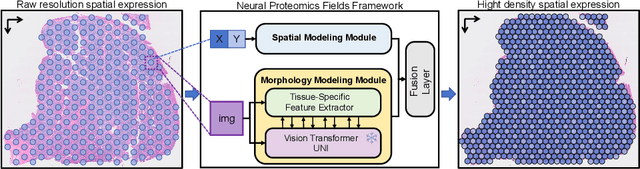
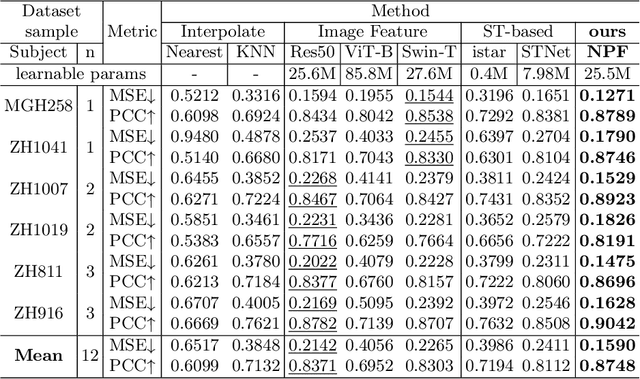
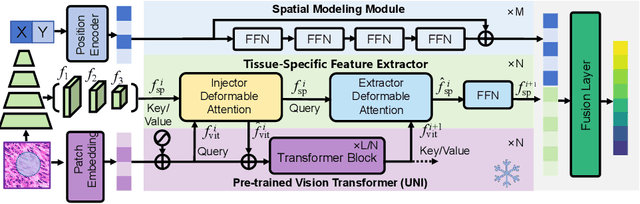

Spatial proteomics maps protein distributions in tissues, providing transformative insights for life sciences. However, current sequencing-based technologies suffer from low spatial resolution, and substantial inter-tissue variability in protein expression further compromises the performance of existing molecular data prediction methods. In this work, we introduce the novel task of spatial super-resolution for sequencing-based spatial proteomics (seq-SP) and, to the best of our knowledge, propose the first deep learning model for this task--Neural Proteomics Fields (NPF). NPF formulates seq-SP as a protein reconstruction problem in continuous space by training a dedicated network for each tissue. The model comprises a Spatial Modeling Module, which learns tissue-specific protein spatial distributions, and a Morphology Modeling Module, which extracts tissue-specific morphological features. Furthermore, to facilitate rigorous evaluation, we establish an open-source benchmark dataset, Pseudo-Visium SP, for this task. Experimental results demonstrate that NPF achieves state-of-the-art performance with fewer learnable parameters, underscoring its potential for advancing spatial proteomics research. Our code and dataset are publicly available at https://github.com/Bokai-Zhao/NPF.