 Add to Chrome
 Add to Firefox
 Add to Edge
SafeSceneReason: A Multimodal Reasoning Benchmark Connecting Industrial Hazards with Accident Knowledge
Aug 10, 2026
Industrial-safety understanding requires more than detecting workers, equipment, and personal protective equipment. Models must also assess compliance, identify hazardous interactions, explain potential accident mechanisms, and recommend preventive actions. Existing safety datasets primarily focus on visual perception or isolated violation recognition and provide limited supervision for evidence-grounded reasoning. We introduce SafeSceneReason, a multimodal industrial-safety reasoning benchmark and companion training corpus that connects workplace scenes with knowledge from occupational accident investigations. SafeSceneReason combines two complementary data-construction pipelines. The scene-centric pipeline converts annotated workplace images into executable safety scene graphs and generates deterministic answers through program execution over objects, relations, and safety rules. The report-centric pipeline extracts figures and contextual evidence from accident reports and constructs multimodal questions using evidence graphs, explicit information boundaries, multi-step reasoning paths, and iterative verification. The resulting resource contains 110,581 verified scene-centric question--answer pairs and 13,114 refined report-centric question--answer pairs, covering perception, spatial and quantitative reasoning, compliance assessment, evidence synthesis, causal analysis, and mitigation-oriented decision making. Evaluation of representative proprietary and open-source vision--language models reveals substantial performance differences and persistent weaknesses in comparative, technical, and multi-evidence reasoning, demonstrating that strong general visual understanding does not yet guarantee reliable industrial-safety reasoning.

MMArch: Benchmarking Multimodal Reasoning Grounded in Architectural Evidence
Aug 10, 2026Multimodal large language models (MLLMs) perform strongly on engineering imagery, yet existing benchmarks mostly test drawing recognition, information extraction, or compliance checking, leaving open whether models can combine distributed visual evidence with engineering principles to reach a conclusion. We introduce MMArch, a benchmark for architecture and civil engineering spanning ten subdomains and built entirely from figures in peer-reviewed papers. Its $1{,}212$ short-answer items are produced by a decoupled planner--writer pipeline and validated through automated screening, a blind adversarial audit, and expert review, so that answering requires perceiving the relevant evidence, identifying the governing principle, and applying it, not exploiting textual or single-figure shortcuts. Evaluating $18$ open-weight and proprietary MLLMs against a domain-expert panel, we find a wide gap: the strongest open-source model attains about $30\%$ and the best proprietary system $52\%$, while human experts reach $95\%$, more than forty points ahead. Our error analysis shows that failures concentrate in applying principles and combining evidence across figures rather than in locating it, pointing to substantial headroom for future research. Code and data are available at https://dcx-swjtu.github.io/MMArch/.
CircuitReason-1k: Benchmarking Long-Horizon Visual-to-Symbolic Reasoning inElectrical Circuits
Aug 10, 2026Electrical circuit analysis requires more than recognizing components in an image. A solver must ground symbols and labels, recover latent topology, select a physical model, formulate coupled equations, propagate intermediate quantities, and preserve units, signs, directions, and phase conventions. We introduce \benchmark, a benchmark of 1,000 authentic textbook problems for evaluating this complete long-horizon visual-to-symbolic reasoning process. Each problem pairs one or more circuit diagrams with a self-contained question, a typed or semantically specified answer, and a reference worked solution. An evidence-first construction pipeline aligns questions, figures, and solutions, while a reasoning-oriented taxonomy organizes problems by circuit type and dependency depth. Evaluation combines conservative typed scoring with identity-blinded multi-model semantic consensus, retaining every problem in the denominator. Across three commercial chatbot systems and six open-source multimodal large language models, the highest-scoring system reaches 84.8\% accuracy. However, performance consistently deteriorates on long-horizon problems, and qualitative analysis exposes persistent failures in topology-to-target binding, physical conventions, and late-stage output propagation. \benchmark{} provides a focused testbed for measuring whether multimodal models can transform technical visual evidence into sustained, physically valid symbolic reasoning. Code are available at GitHub - CircuitReason/CircuitReason1K.
Evaluating Large Language Models on Financial Report Summarization: An Empirical Study
Nov 11, 2024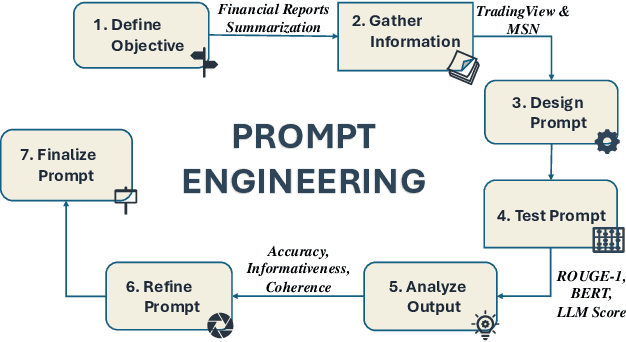
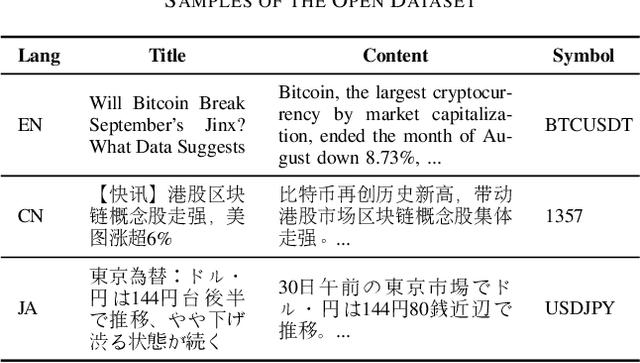
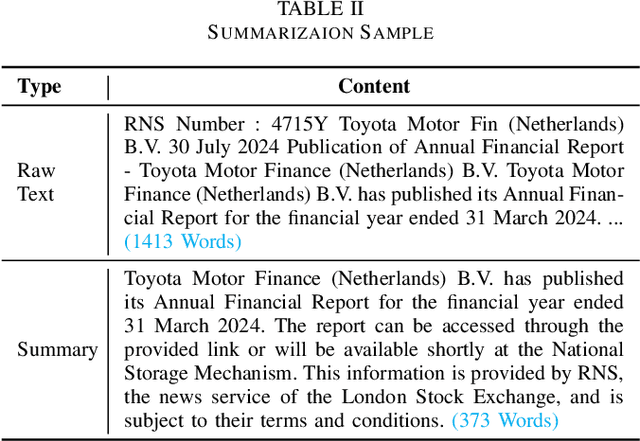
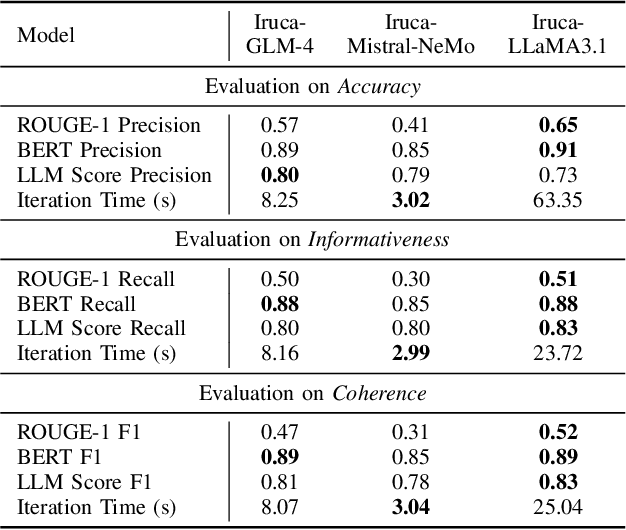
In recent years, Large Language Models (LLMs) have demonstrated remarkable versatility across various applications, including natural language understanding, domain-specific knowledge tasks, etc. However, applying LLMs to complex, high-stakes domains like finance requires rigorous evaluation to ensure reliability, accuracy, and compliance with industry standards. To address this need, we conduct a comprehensive and comparative study on three state-of-the-art LLMs, GLM-4, Mistral-NeMo, and LLaMA3.1, focusing on their effectiveness in generating automated financial reports. Our primary motivation is to explore how these models can be harnessed within finance, a field demanding precision, contextual relevance, and robustness against erroneous or misleading information. By examining each model's capabilities, we aim to provide an insightful assessment of their strengths and limitations. Our paper offers benchmarks for financial report analysis, encompassing proposed metrics such as ROUGE-1, BERT Score, and LLM Score. We introduce an innovative evaluation framework that integrates both quantitative metrics (e.g., precision, recall) and qualitative analyses (e.g., contextual fit, consistency) to provide a holistic view of each model's output quality. Additionally, we make our financial dataset publicly available, inviting researchers and practitioners to leverage, scrutinize, and enhance our findings through broader community engagement and collaborative improvement. Our dataset is available on huggingface.