 Add to Chrome
 Add to Firefox
 Add to Edge
MMArch: Benchmarking Multimodal Reasoning Grounded in Architectural Evidence
Aug 10, 2026
Multimodal large language models (MLLMs) perform strongly on engineering imagery, yet existing benchmarks mostly test drawing recognition, information extraction, or compliance checking, leaving open whether models can combine distributed visual evidence with engineering principles to reach a conclusion. We introduce MMArch, a benchmark for architecture and civil engineering spanning ten subdomains and built entirely from figures in peer-reviewed papers. Its $1{,}212$ short-answer items are produced by a decoupled planner--writer pipeline and validated through automated screening, a blind adversarial audit, and expert review, so that answering requires perceiving the relevant evidence, identifying the governing principle, and applying it, not exploiting textual or single-figure shortcuts. Evaluating $18$ open-weight and proprietary MLLMs against a domain-expert panel, we find a wide gap: the strongest open-source model attains about $30\%$ and the best proprietary system $52\%$, while human experts reach $95\%$, more than forty points ahead. Our error analysis shows that failures concentrate in applying principles and combining evidence across figures rather than in locating it, pointing to substantial headroom for future research. Code and data are available at https://dcx-swjtu.github.io/MMArch/.

SafeSceneReason: A Multimodal Reasoning Benchmark Connecting Industrial Hazards with Accident Knowledge
Aug 10, 2026Industrial-safety understanding requires more than detecting workers, equipment, and personal protective equipment. Models must also assess compliance, identify hazardous interactions, explain potential accident mechanisms, and recommend preventive actions. Existing safety datasets primarily focus on visual perception or isolated violation recognition and provide limited supervision for evidence-grounded reasoning. We introduce SafeSceneReason, a multimodal industrial-safety reasoning benchmark and companion training corpus that connects workplace scenes with knowledge from occupational accident investigations. SafeSceneReason combines two complementary data-construction pipelines. The scene-centric pipeline converts annotated workplace images into executable safety scene graphs and generates deterministic answers through program execution over objects, relations, and safety rules. The report-centric pipeline extracts figures and contextual evidence from accident reports and constructs multimodal questions using evidence graphs, explicit information boundaries, multi-step reasoning paths, and iterative verification. The resulting resource contains 110,581 verified scene-centric question--answer pairs and 13,114 refined report-centric question--answer pairs, covering perception, spatial and quantitative reasoning, compliance assessment, evidence synthesis, causal analysis, and mitigation-oriented decision making. Evaluation of representative proprietary and open-source vision--language models reveals substantial performance differences and persistent weaknesses in comparative, technical, and multi-evidence reasoning, demonstrating that strong general visual understanding does not yet guarantee reliable industrial-safety reasoning.
CircuitReason-1k: Benchmarking Long-Horizon Visual-to-Symbolic Reasoning inElectrical Circuits
Aug 10, 2026Electrical circuit analysis requires more than recognizing components in an image. A solver must ground symbols and labels, recover latent topology, select a physical model, formulate coupled equations, propagate intermediate quantities, and preserve units, signs, directions, and phase conventions. We introduce \benchmark, a benchmark of 1,000 authentic textbook problems for evaluating this complete long-horizon visual-to-symbolic reasoning process. Each problem pairs one or more circuit diagrams with a self-contained question, a typed or semantically specified answer, and a reference worked solution. An evidence-first construction pipeline aligns questions, figures, and solutions, while a reasoning-oriented taxonomy organizes problems by circuit type and dependency depth. Evaluation combines conservative typed scoring with identity-blinded multi-model semantic consensus, retaining every problem in the denominator. Across three commercial chatbot systems and six open-source multimodal large language models, the highest-scoring system reaches 84.8\% accuracy. However, performance consistently deteriorates on long-horizon problems, and qualitative analysis exposes persistent failures in topology-to-target binding, physical conventions, and late-stage output propagation. \benchmark{} provides a focused testbed for measuring whether multimodal models can transform technical visual evidence into sustained, physically valid symbolic reasoning. Code are available at GitHub - CircuitReason/CircuitReason1K.
Locker-based Truck-Drone Routing with Integrated Considerations of Pickups, Deliveries, and No-Fly Zones
Jun 26, 2026Truck-drone delivery is an emerging last-mile logistics mode combining the long-haul capacity of trucks with the flexible service capability of drones. In locker-based operations, smart lockers serve not only as temporary parcel storage facilities but also as automated drone docking and service nodes. These automated nodes support drone takeoff, landing, parcel handover, and battery replacement, thereby significantly extending the service range and operational flexibility of drone-assisted delivery networks. However, practical locker-based delivery systems face complex real-world challenges, requiring the integrated coordination of not only parcel delivery, return pickup, battery-constrained and load-dependent drone flights, but also necessary detours around restricted airspace. To address this practical and multifaceted challenge, this paper introduces a locker-based truck-drone routing problem with integrated considerations of pickups, deliveries, and no-fly zones (LTDRP-PDNF), with the objective of minimizing the total operational cost of a fleet of drone-equipped trucks. We formulate the route construction process as a Markov Decision Process and develop a two-stage deep reinforcement learning-based neural heuristic. The first stage utilizes an attention-based encoder and a Bidirectional Gated Recurrent Unit decoder to solve the truck-only routing problem, formulated as a capacitated vehicle routing problem. The second stage combines a policy-transfer strategy with a hybrid dispatch assignment heuristic to construct fully coordinated truck and drone routes for LTDRP-PDNF. Experiments on instances of different scales demonstrate that the proposed method outperforms metaheuristic and neural heuristic baselines in most cases while maintaining exceptionally short computation times, offering an effective, scalable solution framework under practical operational constraints.
Shattering the Autoregressive Curse: Dynamic Epistemic Entropy Orchestrated Erasable Reinforcement Learning for LLMs
Jun 16, 2026Although reinforcement learning (RL) has expanded the cognitive boundaries of large language models (LLMs), it often remains vulnerable to the autoregressive curse in long-horizon logical reasoning: small epistemic perturbations introduced early in generation can propagate irreversibly along the Markov decision process flow, triggering cascading failures that drive the reasoning trajectory toward collapse. To overcome this autoregressive cascade, in which a single early mistake can compromise all subsequent reasoning steps, we propose dynamic epistemic entropy orchestrated erasable reinforcement learning ($\text{E}^3\text{RL}$). $\text{E}^3\text{RL}$ eliminates reliance on external signals by grounding the model's endogenous local autoregressive cross-entropy as an intrinsic coordinate of epistemic uncertainty. By introducing segment-level adaptive dynamic thresholds and advantage allocation, $\text{E}^3\text{RL}$ enables the model to precisely excise localized logical defects while reusing historical key-value (KV) cache streams, thereby endowing the reasoning process with a self-healing capability. We train $\text{E}^3\text{RL}$ on the DeepMath-103k dataset. Experimental results show that $\text{E}^3\text{RL}$ reshapes the exploration efficiency of long-sequence reasoning and improves sample efficiency while maintaining linear memory overhead. On mathematical reasoning benchmarks such as AIME, $\text{E}^3\text{RL}$ achieves substantial performance gains, with the 4B and 8B parameter models surpassing previous state-of-the-art (SOTA) results by 5.349\% and 6.514\%, respectively. These findings suggest that $\text{E}^3\text{RL}$ shatters the autoregressive curse in long-sequence reasoning and establishes a theoretical and systems-level foundation for the next generation of self-healing artificial general intelligence (AGI).
Decoupled Residual Quantization for Robust Semantic IDs in Recommendation
Jun 01, 2026Semantic IDs represent items as shared discrete token sequences and have become a practical tool for recommendation and retrieval. Yet it remains difficult to tell why a tokenizer fails: poor quality may come from codebook underutilization, unstable decision boundaries, or geometric distortion of the embedding space. This paper develops a quantitative framework for diagnosing these failures through expected codeword overlap and effective codebook capacity. The former measures expected codeword confusion under retrieval-time perturbation, while the latter converts that confusion into an effective number of usable, well-separated codes. The framework links semantic boundary confusion to both code usage imbalance and Euclidean geometric constraints. As a proof of concept, we present Decoupled Residual Quantization (DRQ), which separates continuous geometry reconstruction from discrete distribution matching. Experiments on a large-scale industrial dataset show that Semantic ID quality is multi-objective: symbolic robustness, reconstruction fidelity, and behavior-aware soft matching each stress different aspects of a tokenizer. These downstream observations are based on one proprietary industrial dataset, so they should be read as a case study rather than a universal benchmark claim.
SELF-EMO: Emotional Self-Evolution from Recognition to Consistent Expression
Apr 20, 2026Emotion Recognition in Conversation (ERC) has become a fundamental capability for large language models (LLMs) in human-centric interaction. Beyond accurate recognition, coherent emotional expression is also crucial, yet both are limited by the scarcity and static nature of high-quality annotated data. In this work, we propose SELF-EMO, a self-evolution framework grounded in the hypothesis that better emotion prediction leads to more consistent emotional responses. We introduce two auxiliary tasks, emotional understanding and emotional expression, and design a role-based self-play paradigm where the model acts as both an emotion recognizer and a dialogue responder. Through iterative interactions, the model generates diverse conversational trajectories, enabling scalable data generation. To ensure quality, we adopt a data flywheel mechanism that filters candidate predictions and responses using a smoothed IoU-based reward and feeds selected samples back for continuous self-improvement without external supervision. We further develop SELF-GRPO, a reinforcement learning algorithm that stabilizes optimization with multi-label alignment rewards and group-level consistency signals. Experiments on IEMOCAP, MELD, and EmoryNLP show that SELF-EMO achieves state-of-the-art performance, improving accuracy by +6.33% on Qwen3-4B and +8.54% on Qwen3-8B, demonstrating strong effectiveness and generalization.
UniRec: Bridging the Expressive Gap between Generative and Discriminative Recommendation via Chain-of-Attribute
Apr 14, 2026Generative Recommendation (GR) reframes retrieval and ranking as autoregressive decoding over Semantic IDs (SIDs), unifying the multi-stage pipeline into a single model. Yet a fundamental expressive gap persists: discriminative models score items with direct feature access, enabling explicit user-item crossing, whereas GR decodes over compact SID tokens without item-side signal. We formalize this via Bayes' theorem, showing ranking by p(y|f,u) is equivalent to ranking by p(f|y,u), which factorizes autoregressively over item features. This establishes that a generative model with full feature access is as expressive as its discriminative counterpart; any practical gap stems solely from incomplete feature coverage. We propose UniRec with Chain-of-Attribute (CoA) as its core mechanism. CoA prefixes each SID sequence with structured attribute tokens--category, seller, brand--before decoding the SID itself, recovering the item-side feature crossing that discriminative models exploit. Because items sharing identical attributes cluster in adjacent SID regions, attribute conditioning yields a measurable per-step entropy reduction H(s_k|s_{<k},a) < H(s_k|s_{<k}), narrowing the search space and stabilizing beam search trajectories. We further address two deployment challenges: Capacity-constrained SID introduces exposure-weighted capacity penalties into residual quantization to suppress token collapse and the Matthew effect across SID layers; Conditional Decoding Context (CDC) combines Task-Conditioned BOS with hash-based Content Summaries, injecting scenario-conditioned signals at each decoding step. A joint RFT and DPO framework aligns the model with business objectives beyond distribution matching. Experiments show UniRec outperforms the strongest baseline by +22.6% HR@50 overall and +15.5% on high-value orders, with online A/B tests confirming significant business metric gains.
MMRPT: MultiModal Reinforcement Pre-Training via Masked Vision-Dependent Reasoning
Dec 08, 2025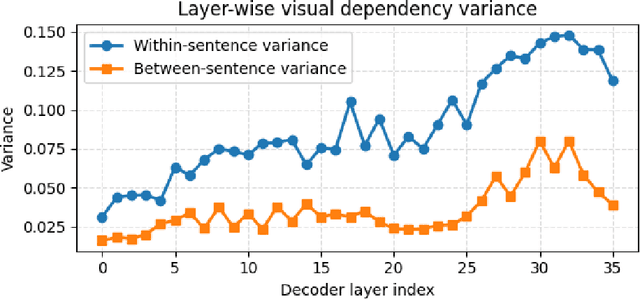
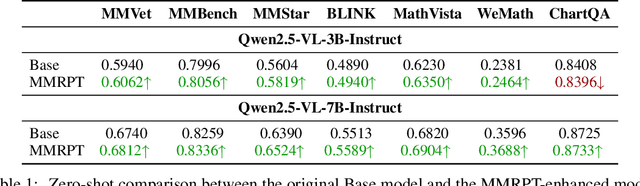
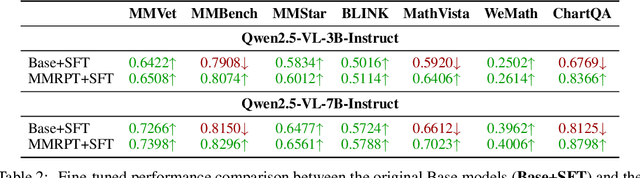
Multimodal pre-training remains constrained by the descriptive bias of image-caption pairs, leading models to favor surface linguistic cues over grounded visual understanding. We introduce MMRPT, a masked multimodal reinforcement pre-training framework that strengthens visual reasoning in MLLMs. We are the first to incorporate reinforcement learning directly into the pre-training of large vision-language models, enabling learning signals that reward visual grounding rather than caption imitation. MMRPT constructs masked multimodal data by estimating sentence-level visual dependency via attention over visual tokens and masking highly vision-dependent segments; the model reconstructs these spans through vision-grounded reasoning guided by a semantic-visual reward. Experiments show consistent zero-shot gains across diverse benchmarks and substantially improved robustness under supervised fine-tuning, demonstrating that reinforcement-driven masked reasoning provides a more reliable and generalizable pre-training objective for multimodal models.
Erase to Improve: Erasable Reinforcement Learning for Search-Augmented LLMs
Oct 01, 2025While search-augmented large language models (LLMs) exhibit impressive capabilities, their reliability in complex multi-hop reasoning remains limited. This limitation arises from three fundamental challenges: decomposition errors, where tasks are incorrectly broken down; retrieval missing, where key evidence fails to be retrieved; and reasoning errors, where flawed logic propagates through the reasoning chain. A single failure in any of these stages can derail the final answer. We propose Erasable Reinforcement Learning (ERL), a novel framework that transforms fragile reasoning into a robust process. ERL explicitly identifies faulty steps, erases them, and regenerates reasoning in place, preventing defective logic from propagating through the reasoning chain. This targeted correction mechanism turns brittle reasoning into a more resilient process. Models trained with ERL, termed ESearch, achieve substantial improvements on HotpotQA, MuSiQue, 2Wiki, and Bamboogle, with the 3B model achieving +8.48% EM and +11.56% F1, and the 7B model achieving +5.38% EM and +7.22% F1 over previous state-of-the-art(SOTA) results. These findings suggest that erasable reinforcement learning provides a powerful paradigm shift for robust multi-step reasoning in LLMs.