 Add to Chrome
 Add to Firefox
 Add to Edge
SafeSceneReason: A Multimodal Reasoning Benchmark Connecting Industrial Hazards with Accident Knowledge
Aug 10, 2026
Industrial-safety understanding requires more than detecting workers, equipment, and personal protective equipment. Models must also assess compliance, identify hazardous interactions, explain potential accident mechanisms, and recommend preventive actions. Existing safety datasets primarily focus on visual perception or isolated violation recognition and provide limited supervision for evidence-grounded reasoning. We introduce SafeSceneReason, a multimodal industrial-safety reasoning benchmark and companion training corpus that connects workplace scenes with knowledge from occupational accident investigations. SafeSceneReason combines two complementary data-construction pipelines. The scene-centric pipeline converts annotated workplace images into executable safety scene graphs and generates deterministic answers through program execution over objects, relations, and safety rules. The report-centric pipeline extracts figures and contextual evidence from accident reports and constructs multimodal questions using evidence graphs, explicit information boundaries, multi-step reasoning paths, and iterative verification. The resulting resource contains 110,581 verified scene-centric question--answer pairs and 13,114 refined report-centric question--answer pairs, covering perception, spatial and quantitative reasoning, compliance assessment, evidence synthesis, causal analysis, and mitigation-oriented decision making. Evaluation of representative proprietary and open-source vision--language models reveals substantial performance differences and persistent weaknesses in comparative, technical, and multi-evidence reasoning, demonstrating that strong general visual understanding does not yet guarantee reliable industrial-safety reasoning.

Same Semantics, Different Paths: Self-Improving Alignment for Vision-Text Compression
Aug 03, 2026Vision-Text Compression (VTC) renders long texts into images and encodes them through the vision encoder (ViT), compressing thousands of text tokens into far fewer visual tokens. However, since the ViT is pretrained predominantly on natural images, it captures visual attributes (glyphs, font sizes, layout) rather than linguistic semantics, causing rendered-image representations to diverge from native-text representations. We term this cross-path inconsistency and show, via rendering perturbation experiments, that it is a critical yet overlooked bottleneck of VTC. We propose SPIRAL (Self-improving Path Integration and Realignment), a self-supervised alignment framework that closes this gap using only the model's own text-path behavior as supervision, requiring no external teachers or additional annotations. SPIRAL operates at two complementary granularities: token-level on-policy distillation (OPD) for local faithfulness, and sequence-level preference optimization (DPO) for global coherence. On VTCBench, SPIRAL improves the overall score of Qwen3-VL-8B from 35.10 to 54.02, approaching the native text-input performance (55.60) and outperforming models up to 30x larger. The two granularities exhibit complementary strengths: OPD excels at retrieval and is sample-efficient, while DPO is stronger on reasoning and memory and scales better with data. SPIRAL's benefits also generalize to out-of-domain benchmarks, confirming that effective VTC hinges on aligning rendered-image representations back to native-text semantics.
Synthesizing Reality: Leveraging the Generative AI-Powered Platform Midjourney for Construction Worker Detection
Jul 17, 2025While recent advancements in deep neural networks (DNNs) have substantially enhanced visual AI's capabilities, the challenge of inadequate data diversity and volume remains, particularly in construction domain. This study presents a novel image synthesis methodology tailored for construction worker detection, leveraging the generative-AI platform Midjourney. The approach entails generating a collection of 12,000 synthetic images by formulating 3000 different prompts, with an emphasis on image realism and diversity. These images, after manual labeling, serve as a dataset for DNN training. Evaluation on a real construction image dataset yielded promising results, with the model attaining average precisions (APs) of 0.937 and 0.642 at intersection-over-union (IoU) thresholds of 0.5 and 0.5 to 0.95, respectively. Notably, the model demonstrated near-perfect performance on the synthetic dataset, achieving APs of 0.994 and 0.919 at the two mentioned thresholds. These findings reveal both the potential and weakness of generative AI in addressing DNN training data scarcity.
WaterHE-NeRF: Water-ray Tracing Neural Radiance Fields for Underwater Scene Reconstruction
Dec 12, 2023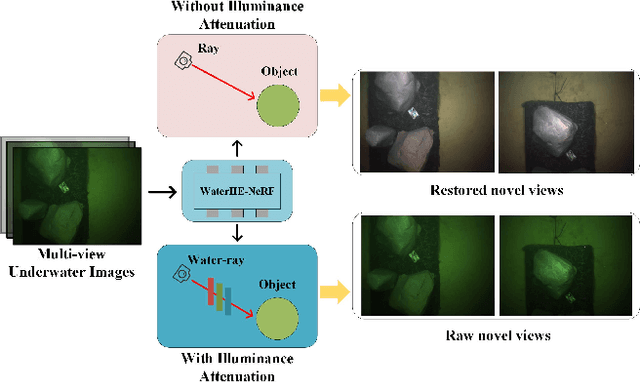


Neural Radiance Field (NeRF) technology demonstrates immense potential in novel viewpoint synthesis tasks, due to its physics-based volumetric rendering process, which is particularly promising in underwater scenes. Addressing the limitations of existing underwater NeRF methods in handling light attenuation caused by the water medium and the lack of real Ground Truth (GT) supervision, this study proposes WaterHE-NeRF. We develop a new water-ray tracing field by Retinex theory that precisely encodes color, density, and illuminance attenuation in three-dimensional space. WaterHE-NeRF, through its illuminance attenuation mechanism, generates both degraded and clear multi-view images and optimizes image restoration by combining reconstruction loss with Wasserstein distance. Additionally, the use of histogram equalization (HE) as pseudo-GT enhances the network's accuracy in preserving original details and color distribution. Extensive experiments on real underwater datasets and synthetic datasets validate the effectiveness of WaterHE-NeRF. Our code will be made publicly available.
Classification-Aware Neural Topic Model Combined With Interpretable Analysis -- For Conflict Classification
Aug 29, 2023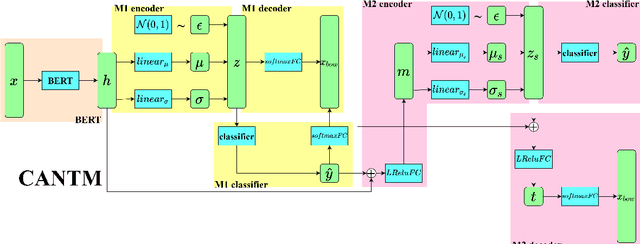

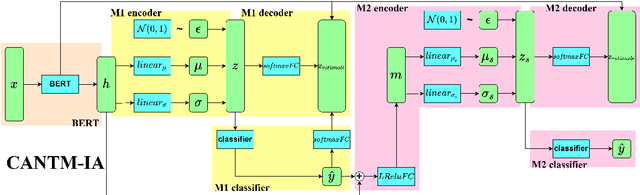

A large number of conflict events are affecting the world all the time. In order to analyse such conflict events effectively, this paper presents a Classification-Aware Neural Topic Model (CANTM-IA) for Conflict Information Classification and Topic Discovery. The model provides a reliable interpretation of classification results and discovered topics by introducing interpretability analysis. At the same time, interpretation is introduced into the model architecture to improve the classification performance of the model and to allow interpretation to focus further on the details of the data. Finally, the model architecture is optimised to reduce the complexity of the model.
I4U System Description for NIST SRE'20 CTS Challenge
Nov 02, 2022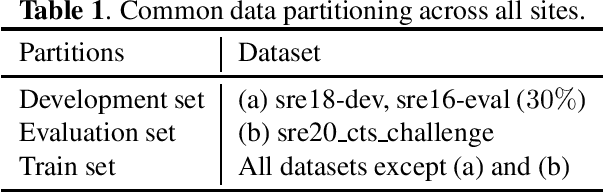
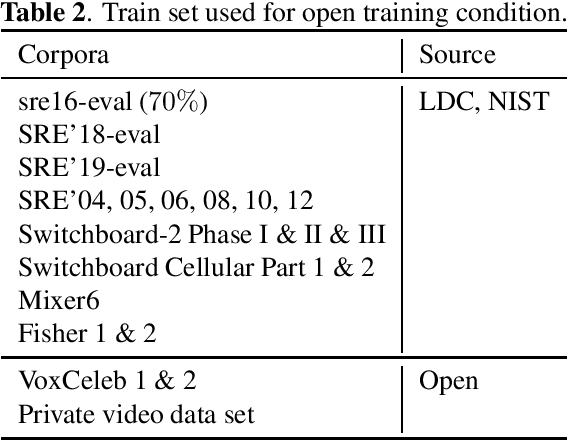
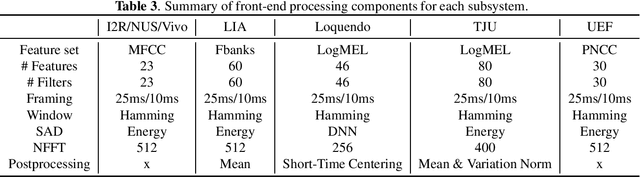
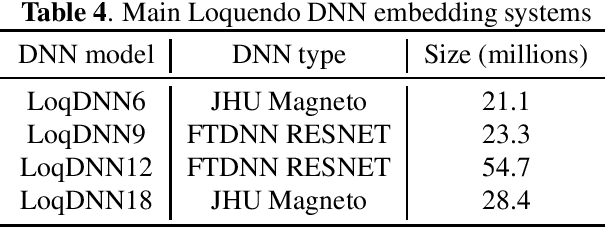
This manuscript describes the I4U submission to the 2020 NIST Speaker Recognition Evaluation (SRE'20) Conversational Telephone Speech (CTS) Challenge. The I4U's submission was resulted from active collaboration among researchers across eight research teams - I$^2$R (Singapore), UEF (Finland), VALPT (Italy, Spain), NEC (Japan), THUEE (China), LIA (France), NUS (Singapore), INRIA (France) and TJU (China). The submission was based on the fusion of top performing sub-systems and sub-fusion systems contributed by individual teams. Efforts have been spent on the use of common development and validation sets, submission schedule and milestone, minimizing inconsistency in trial list and score file format across sites.
THUEE system description for NIST 2020 SRE CTS challenge
Oct 12, 2022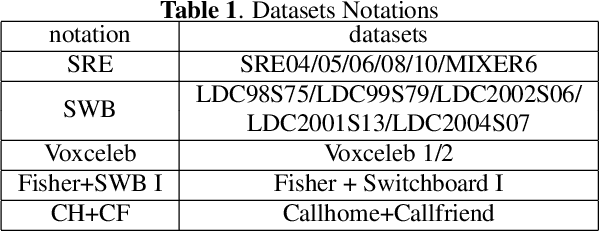
This paper presents the system description of the THUEE team for the NIST 2020 Speaker Recognition Evaluation (SRE) conversational telephone speech (CTS) challenge. The subsystems including ResNet74, ResNet152, and RepVGG-B2 are developed as speaker embedding extractors in this evaluation. We used combined AM-Softmax and AAM-Softmax based loss functions, namely CM-Softmax. We adopted a two-staged training strategy to further improve system performance. We fused all individual systems as our final submission. Our approach leads to excellent performance and ranks 1st in the challenge.
THUEE system description for NIST 2019 SRE CTS Challenge
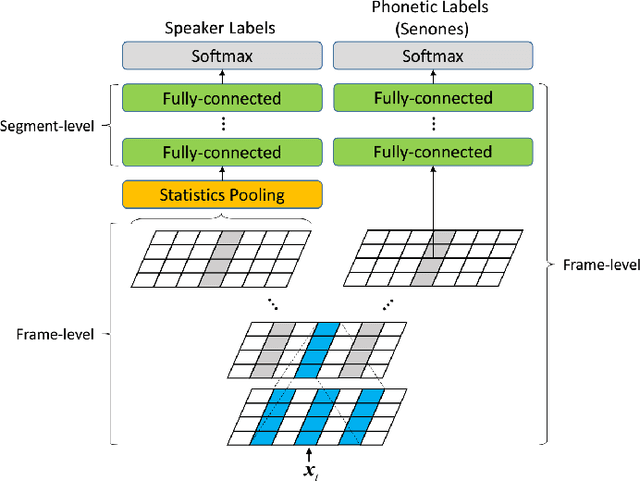
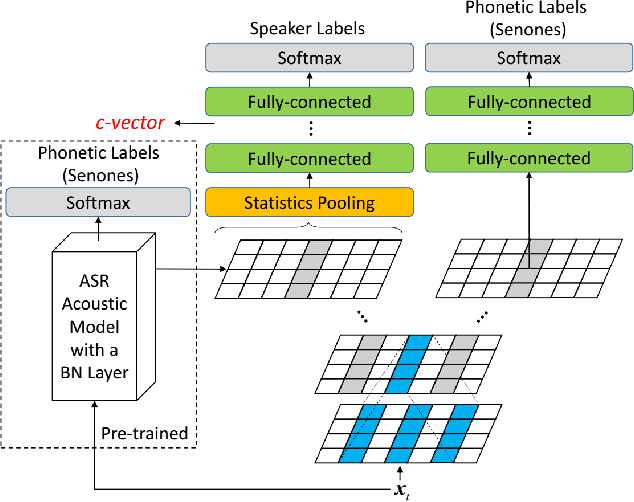
Dec 25, 2019This paper describes the systems submitted by the department of electronic engineering, institute of microelectronics of Tsinghua university and TsingMicro Co. Ltd. (THUEE) to the NIST 2019 speaker recognition evaluation CTS challenge. Six subsystems, including etdnn/ams, ftdnn/as, eftdnn/ams, resnet, multitask and c-vector are developed in this evaluation.