 Add to Chrome
 Add to Firefox
 Add to Edge
MoE$^2$-LoRA: When MoE Models Meet MoE-style Low-Rank Adaptation
Jul 24, 2026
Mixture-of-Experts (MoE) architectures have been widely adopted in large language models, yet parameter-efficient fine-tuning (PEFT) for MoE models remains underexplored. Existing PEFT methods for MoE either ignore router priors with uniform adapters, reducing efficiency and risking forgetting, or rely on static expert selection, limiting per-token capacity and cross-expert feature learning. In this paper, we make the first attempt to fine-tune MoE models with MoE-style low-rank adaptation: our method, entitled MoE$^2$-LoRA, deeply couples the pretrained expert specialization with task-specific adaptivity via a dual-channel Routing-Conditioned Projection (RCP) module, which reuses base router activations to inform LoRA routing. We further introduce a single global LoRA expert pool shared across all layers, enabling model-wide adaptation with emergent layer-wise affinities and balanced expert utilization. MoE$^2$-LoRA simultaneously benefits from the advantages of prior reuse, dynamic adapter routing, and model-wide knowledge sharing. Evaluated on multiple MoE backbones with varying scales and expert granularities, MoE$^2$-LoRA consistently achieves state-of-the-art downstream accuracy while retaining stronger general capabilities.

From Memory to Skills: Evidence-Grounded Co-Evolution Governance for Long-Horizon LLM Agents
Jul 18, 2026Existing memory systems for long-horizon LLM agents often retrieve prior traces as passive context rather than converting them into executable capabilities. In this paper, we propose MSCE, a training-free Memory--Skill Co-Evolution framework that organizes agent experience into grounded step traces, reusable procedural policies, and declarative environmental cognition. MSCE crystallizes evidence-backed L2 policies with positive estimated gain into callable skills that retain evidence links, applicability boundaries, decision guidance, verification rules, and reliability estimates. It further introduces reflection-weighted value backfilling, which propagates sparse terminal feedback through dense local self-reflections to produce evidence-calibrated trace values for governing memory and skill evolution. Experiments on EvoAgentBench and LoCoMo demonstrate that MSCE significantly outperforms state-of-the-art skill-augmented and memory-driven agent baselines, exhibiting strong cross-domain transferability and lifelong-evolution capabilities.
Parametric Skills
Jun 29, 2026Since intelligence fundamentally relies on efficient skill acquisition (Chollet, 2019), the ability to leverage skills is critical. For LLMs, skills, manually authored or extracted from task trajectories, are textual recipes encoding mature problem-solving experience and are critical to agentic capabilities. Despite widespread deployment, their utility is limited by the model's ability to comprehend and follow skill instructions, especially under complex and long-context scenarios, where key instructions are difficult to locate and adhere to. To address this limitation, we propose ParametricSkills, a framework that can convert free-form textual skills into parameters at test time, enabling context-free skill exploitation. Specifically, we first construct a large-scale, high-quality skill library, and synthesize single-turn and multi-turn skill exploitation trajectories built around these skills with OpenCode. Using these data, we then train a hypernetwork that parameterizes both the skill content and the test-time exploitation methodology by receiving textual skills and converting them into LoRA adapters. Experimental results on six complex software engineering (SWE) subtasks demonstrate that, the proposed ParametricSkills averagely outperforms in-context learning by 6.44 points as judged by DeepSeek-V4-Flash, while also achieving significantly higher BERT Score and F1 score, confirming its effectiveness. Beyond performance, we further find that parametric skills, being inherently accumulative, offer a preliminary yet promising avenue toward test-time continual learning.
Wavelet-Enhanced Desnowing: A Novel Single Image Restoration Approach for Traffic Surveillance under Adverse Weather Conditions
Mar 03, 2025Image restoration under adverse weather conditions refers to the process of removing degradation caused by weather particles while improving visual quality. Most existing deweathering methods rely on increasing the network scale and data volume to achieve better performance which requires more expensive computing power. Also, many methods lack generalization for specific applications. In the traffic surveillance screener, the main challenges are snow removal and veil effect elimination. In this paper, we propose a wavelet-enhanced snow removal method that use a Dual-Tree Complex Wavelet Transform feature enhancement module and a dynamic convolution acceleration module to address snow degradation in surveillance images. We also use a residual learning restoration module to remove veil effects caused by rain, snow, and fog. The proposed architecture extracts and analyzes information from snow-covered regions, significantly improving snow removal performance. And the residual learning restoration module removes veiling effects in images, enhancing clarity and detail. Experiments show that it performs better than some popular desnowing methods. Our approach also demonstrates effectiveness and accuracy when applied to real traffic surveillance images.
Zero-shot Load Forecasting for Integrated Energy Systems: A Large Language Model-based Framework with Multi-task Learning
Feb 24, 2025The growing penetration of renewable energy sources in power systems has increased the complexity and uncertainty of load forecasting, especially for integrated energy systems with multiple energy carriers. Traditional forecasting methods heavily rely on historical data and exhibit limited transferability across different scenarios, posing significant challenges for emerging applications in smart grids and energy internet. This paper proposes the TSLLM-Load Forecasting Mechanism, a novel zero-shot load forecasting framework based on large language models (LLMs) to address these challenges. The framework consists of three key components: a data preprocessing module that handles multi-source energy load data, a time series prompt generation module that bridges the semantic gap between energy data and LLMs through multi-task learning and similarity alignment, and a prediction module that leverages pre-trained LLMs for accurate forecasting. The framework's effectiveness was validated on a real-world dataset comprising load profiles from 20 Australian solar-powered households, demonstrating superior performance in both conventional and zero-shot scenarios. In conventional testing, our method achieved a Mean Squared Error (MSE) of 0.4163 and a Mean Absolute Error (MAE) of 0.3760, outperforming existing approaches by at least 8\%. In zero-shot prediction experiments across 19 households, the framework maintained consistent accuracy with a total MSE of 11.2712 and MAE of 7.6709, showing at least 12\% improvement over current methods. The results validate the framework's potential for accurate and transferable load forecasting in integrated energy systems, particularly beneficial for renewable energy integration and smart grid applications.
MIPI 2023 Challenge on RGBW Fusion: Methods and Results
Apr 24, 2023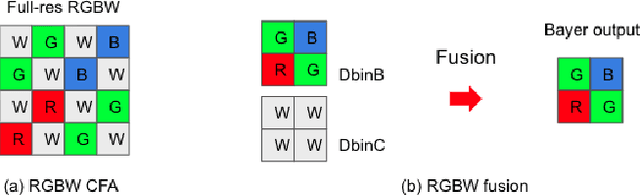


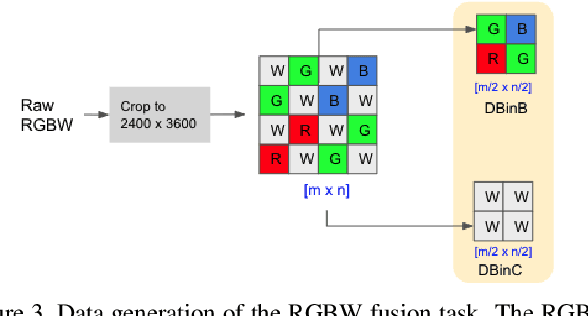
Developing and integrating advanced image sensors with novel algorithms in camera systems are prevalent with the increasing demand for computational photography and imaging on mobile platforms. However, the lack of high-quality data for research and the rare opportunity for an in-depth exchange of views from industry and academia constrain the development of mobile intelligent photography and imaging (MIPI). With the success of the 1st MIPI Workshop@ECCV 2022, we introduce the second MIPI challenge, including four tracks focusing on novel image sensors and imaging algorithms. This paper summarizes and reviews the RGBW Joint Fusion and Denoise track on MIPI 2023. In total, 69 participants were successfully registered, and 4 teams submitted results in the final testing phase. The final results are evaluated using objective metrics, including PSNR, SSIM, LPIPS, and KLD. A detailed description of the top three models developed in this challenge is provided in this paper. More details of this challenge and the link to the dataset can be found at https://mipi-challenge.org/MIPI2023/.
MIPI 2023 Challenge on RGBW Remosaic: Methods and Results
Apr 20, 2023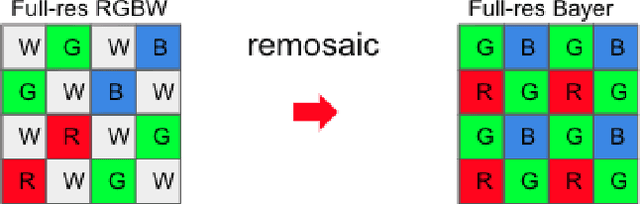

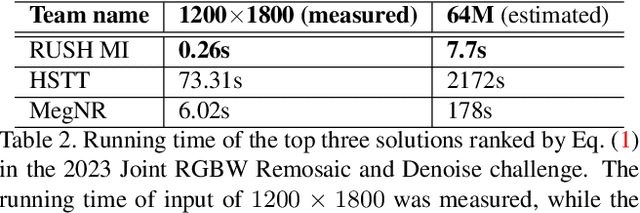
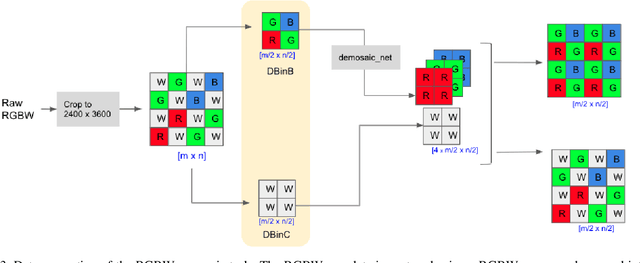
Developing and integrating advanced image sensors with novel algorithms in camera systems are prevalent with the increasing demand for computational photography and imaging on mobile platforms. However, the lack of high-quality data for research and the rare opportunity for an in-depth exchange of views from industry and academia constrain the development of mobile intelligent photography and imaging (MIPI). With the success of the 1st MIPI Workshop@ECCV 2022, we introduce the second MIPI challenge, including four tracks focusing on novel image sensors and imaging algorithms. This paper summarizes and reviews the RGBW Joint Remosaic and Denoise track on MIPI 2023. In total, 81 participants were successfully registered, and 4 teams submitted results in the final testing phase. The final results are evaluated using objective metrics, including PSNR, SSIM, LPIPS, and KLD. A detailed description of the top three models developed in this challenge is provided in this paper. More details of this challenge and the link to the dataset can be found at https://mipi-challenge.org/MIPI2023/.
MIPI 2022 Challenge on RGBW Sensor Fusion: Dataset and Report
Sep 27, 2022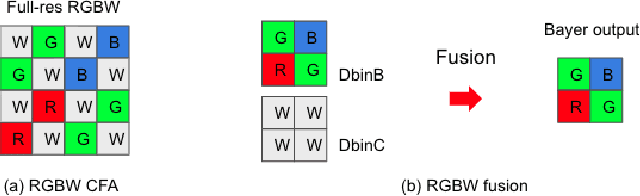
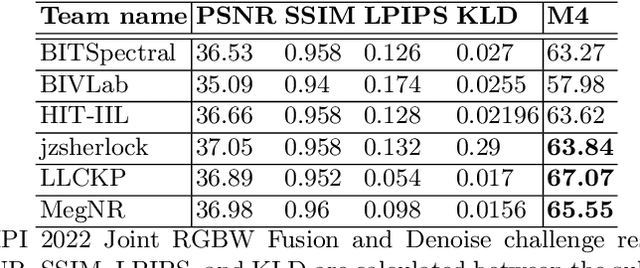

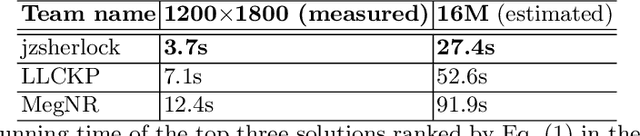
Developing and integrating advanced image sensors with novel algorithms in camera systems are prevalent with the increasing demand for computational photography and imaging on mobile platforms. However, the lack of high-quality data for research and the rare opportunity for in-depth exchange of views from industry and academia constrain the development of mobile intelligent photography and imaging (MIPI). To bridge the gap, we introduce the first MIPI challenge, including five tracks focusing on novel image sensors and imaging algorithms. In this paper, RGBW Joint Fusion and Denoise, one of the five tracks, working on the fusion of binning-mode RGBW to Bayer, is introduced. The participants were provided with a new dataset including 70 (training) and 15 (validation) scenes of high-quality RGBW and Bayer pairs. In addition, for each scene, RGBW of different noise levels was provided at 24dB and 42dB. All the data were captured using an RGBW sensor in both outdoor and indoor conditions. The final results are evaluated using objective metrics, including PSNR, SSIM}, LPIPS, and KLD. A detailed description of all models developed in this challenge is provided in this paper. More details of this challenge and the link to the dataset can be found at https://github.com/mipi-challenge/MIPI2022.
MIPI 2022 Challenge on RGBW Sensor Re-mosaic: Dataset and Report
Sep 15, 2022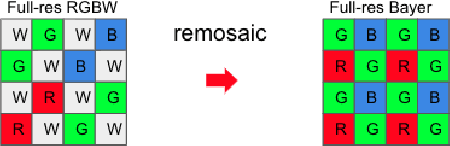


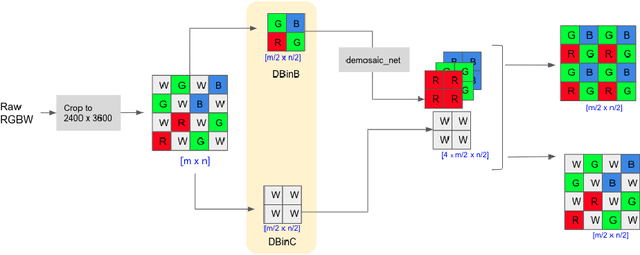
Developing and integrating advanced image sensors with novel algorithms in camera systems are prevalent with the increasing demand for computational photography and imaging on mobile platforms. However, the lack of high-quality data for research and the rare opportunity for in-depth exchange of views from industry and academia constrain the development of mobile intelligent photography and imaging (MIPI). To bridge the gap, we introduce the first MIPI challenge including five tracks focusing on novel image sensors and imaging algorithms. In this paper, RGBW Joint Remosaic and Denoise, one of the five tracks, working on the interpolation of RGBW CFA to Bayer at full resolution, is introduced. The participants were provided with a new dataset including 70 (training) and 15 (validation) scenes of high-quality RGBW and Bayer pairs. In addition, for each scene, RGBW of different noise levels was provided at 0dB, 24dB, and 42dB. All the data were captured using an RGBW sensor in both outdoor and indoor conditions. The final results are evaluated using objective metrics including PSNR, SSIM, LPIPS, and KLD. A detailed description of all models developed in this challenge is provided in this paper. More details of this challenge and the link to the dataset can be found at https://github.com/mipi-challenge/MIPI2022.
MIPI 2022 Challenge on Quad-Bayer Re-mosaic: Dataset and Report
Sep 15, 2022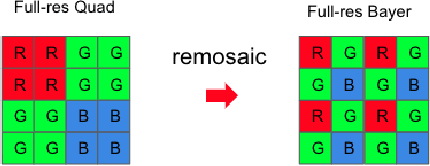



Developing and integrating advanced image sensors with novel algorithms in camera systems are prevalent with the increasing demand for computational photography and imaging on mobile platforms. However, the lack of high-quality data for research and the rare opportunity for in-depth exchange of views from industry and academia constrain the development of mobile intelligent photography and imaging (MIPI). To bridge the gap, we introduce the first MIPI challenge, including five tracks focusing on novel image sensors and imaging algorithms. In this paper, Quad Joint Remosaic and Denoise, one of the five tracks, working on the interpolation of Quad CFA to Bayer at full resolution, is introduced. The participants were provided a new dataset, including 70 (training) and 15 (validation) scenes of high-quality Quad and Bayer pairs. In addition, for each scene, Quad of different noise levels was provided at 0dB, 24dB, and 42dB. All the data were captured using a Quad sensor in both outdoor and indoor conditions. The final results are evaluated using objective metrics, including PSNR, SSIM, LPIPS, and KLD. A detailed description of all models developed in this challenge is provided in this paper. More details of this challenge and the link to the dataset can be found at https://github.com/mipi-challenge/MIPI2022.