 Add to Chrome
 Add to Firefox
 Add to Edge
Compass: Navigating Global Marine Lead Data Integration through Expert-Guided LLM Agent
May 28, 2026
Marine lead (Pb) and its isotopes are critical tracers for ocean circulation and anthropogenic pollution, yet in-situ observations remain costly and sparse. While vast historical records exist, they lie buried within the unstructured content of academic papers, creating "data silos" inaccessible to comprehensive analysis. Manual extraction is unscalable, while general-purpose Large Language Models (LLMs) lack the necessary domain-specific knowledge, leading to hallucinations and scientifically invalid outputs. To address this, we introduce an expert-guided adaptation approach that enables LLMs to perform rigorous scientific data extraction without fine-tuning. We operationalize this approach through Compass, an LLM agent framework enhanced by a Knowledge Tree co-designed with marine scientists, which decomposes complex tasks into verifiable steps, guiding the agent's reasoning to ensure scientific validity. Deploying Compass across a corpus of over 230,000 relevant open-access papers, we successfully extract 3,751 previously unincorporated Pb records. This effort establishes the largest integrated marine Pb database to date. Beyond standard metrics, Compass demonstrates superior reliability through multi-layered validation, achieving 92% accuracy as confirmed through expert manual verification. The newly integrated data expand coverage in previously under-sampled regions such as the East China Sea and the Southern Ocean, providing an enriched data foundation for future scientific discoveries. We release an interactive visualization platform to facilitate open scientific access. Our work demonstrates that expert-guided agents can effectively bridge the gap between general-purpose LLMs and high-stakes scientific domains, enabling scalable data discovery in geosciences.

Rethinking Efficient Graph Coarsening via a Non-Selfishness Principle
May 13, 2026Graph coarsening is a graph dimensionality reduction technique that aims to construct a smaller and more tractable graph while preserving the essential structural and semantic properties of the original graph. However, most existing methods rely on pair-wise similarity matching, where each node independently searches for its best partner based on global information. This selfishness matching paradigm incurs substantial computational and memory overhead. To address this problem, we shift to a non-selfishness principle that prioritizes the collective interference of neighborhood in coarsening, and propose an efficient method named NOPE, which achieves linear memory consumption and near-linear computational complexity in the number of nodes. Furthermore, we derive a faster variant NOPE*, which reduces O(δ\dot d) interference evaluation to O(d) based on the local isotropy assumption, and consequently alleviates the computational bottleneck for high-degree nodes. Experimental results show that NOPE* achieves 1.8-10\times speedup over NOPE and surpass almost all baselines with 1-3 orders of magnitude acceleration. Meanwhile, learning on coarsened graphs yields comparable performance to original graphs, and can even show superior performance over LLM-based graph reasoning owing to compact graph information. The code can be available at https://github.com/dazonglian/NOPE-main.
SLASH the Sink: Sharpening Structural Attention Inside LLMs
May 11, 2026Large Language Models (LLMs) show remarkable semantic understanding but often struggle with structural understanding when processing graph topologies in a serialized format. Existing solutions rely on training external graph-based adapters or fine-tuning, which incur high costs and lost generalizability. In this work, we investigate the internal mechanisms of LLMs and present a critical finding: LLMs spontaneously reconstruct the graph's topology internally, evidenced by a distinct "sawtooth" pattern in their attention maps that structurally aligns with the "token-level adjacency matrix". However, this intrinsic structural understanding is diluted by the attention sink. We theoretically formalize this dilution as a representation bottleneck, stemming from a fundamental conflict: the model's anisotropic bias, essential for language tasks, suppresses the topology-aware local aggregation required for graph reasoning. To address this, we propose a training-free solution, named StructuraL Attention SHarpening (Slash), which amplifies this internal structural understanding via a plug-and-play attention redistribution. Experiments on pure graph tasks and molecular prediction validate Slash delivers significant and consistent performance gains across diverse LLMs.
Inductive Reasoning for Temporal Knowledge Graphs with Emerging Entities
Apr 11, 2026Reasoning on Temporal Knowledge Graphs (TKGs) is essential for predicting future events and time-aware facts. While existing methods are effective at capturing relational dynamics, their performance is limited by a closed-world assumption, which fails to account for emerging entities not present in the training. Notably, these entities continuously join the network without historical interactions. Empirical study reveals that emerging entities are widespread in TKGs, comprising roughly 25\% of all entities. The absence of historical interactions of these entities leads to significant performance degradation in reasoning tasks. Whereas, we observe that entities with semantic similarities often exhibit comparable interaction histories, suggesting the presence of transferable temporal patterns. Inspired by this insight, we propose TransFIR (Transferable Inductive Reasoning), a novel framework that leverages historical interaction sequences from semantically similar known entities to support inductive reasoning. Specifically, we propose a codebook-based classifier that categorizes emerging entities into latent semantic clusters, allowing them to adopt reasoning patterns from similar entities. Experimental results demonstrate that TransFIR outperforms all baselines in reasoning on emerging entities, achieving an average improvement of 28.6% in Mean Reciprocal Rank (MRR) across multiple datasets. The implementations are available at https://github.com/zhaodazhuang2333/TransFIR.
<SOG_k>: One LLM Token for Explicit Graph Structural Understanding
Feb 02, 2026Large language models show great potential in unstructured data understanding, but still face significant challenges with graphs due to their structural hallucination. Existing approaches mainly either verbalize graphs into natural language, which leads to excessive token consumption and scattered attention, or transform graphs into trainable continuous embeddings (i.e., soft prompt), but exhibit severe misalignment with original text tokens. To solve this problem, we propose to incorporate one special token <SOG_k> to fully represent the Structure Of Graph within a unified token space, facilitating explicit topology input and structural information sharing. Specifically, we propose a topology-aware structural tokenizer that maps each graph topology into a highly selective single token. Afterwards, we construct a set of hybrid structure Question-Answering corpora to align new structural tokens with existing text tokens. With this approach, <SOG_k> empowers LLMs to understand, generate, and reason in a concise and accurate manner. Extensive experiments on five graph-level benchmarks demonstrate the superiority of our method, achieving a performance improvement of 9.9% to 41.4% compared to the baselines while exhibiting interpretability and consistency. Furthermore, our method provides a flexible extension to node-level tasks, enabling both global and local structural understanding. The codebase is publicly available at https://github.com/Jingyao-Wu/SOG.
Improving LLM Reasoning with Homophily-aware Structural and Semantic Text-Attributed Graph Compression
Jan 13, 2026Large language models (LLMs) have demonstrated promising capabilities in Text-Attributed Graph (TAG) understanding. Recent studies typically focus on verbalizing the graph structures via handcrafted prompts, feeding the target node and its neighborhood context into LLMs. However, constrained by the context window, existing methods mainly resort to random sampling, often implemented via dropping node/edge randomly, which inevitably introduces noise and cause reasoning instability. We argue that graphs inherently contain rich structural and semantic information, and that their effective exploitation can unlock potential gains in LLMs reasoning performance. To this end, we propose Homophily-aware Structural and Semantic Compression for LLMs (HS2C), a framework centered on exploiting graph homophily. Structurally, guided by the principle of Structural Entropy minimization, we perform a global hierarchical partition that decodes the graph's essential topology. This partition identifies naturally cohesive, homophilic communities, while discarding stochastic connectivity noise. Semantically, we deliver the detected structural homophily to the LLM, empowering it to perform differentiated semantic aggregation based on predefined community type. This process compresses redundant background contexts into concise community-level consensus, selectively preserving semantically homophilic information aligned with the target nodes. Extensive experiments on 10 node-level benchmarks across LLMs of varying sizes and families demonstrate that, by feeding LLMs with structurally and semantically compressed inputs, HS2C simultaneously enhances the compression rate and downstream inference accuracy, validating its superiority and scalability. Extensions to 7 diverse graph-level benchmarks further consolidate HS2C's task generalizability.
RayFusion: Ray Fusion Enhanced Collaborative Visual Perception
Oct 09, 2025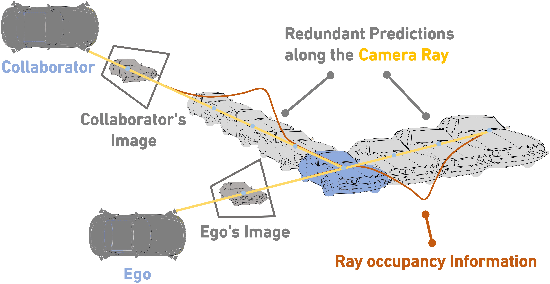
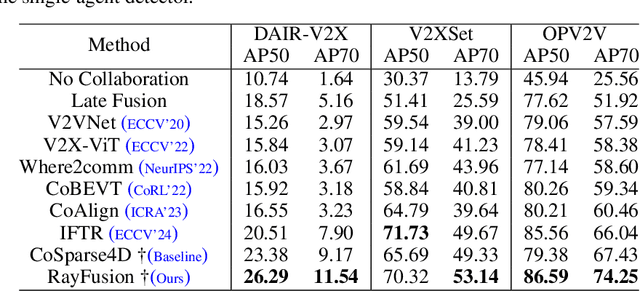
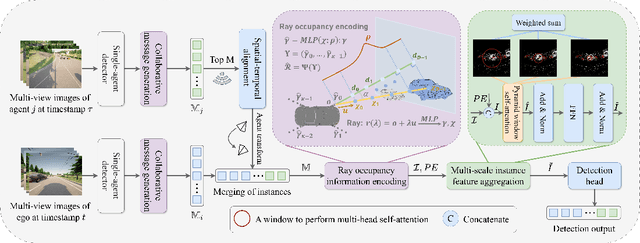
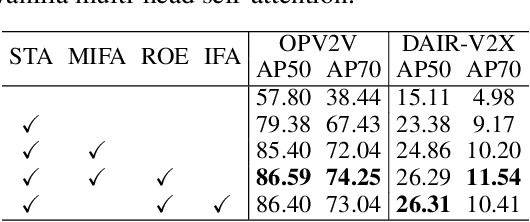
Collaborative visual perception methods have gained widespread attention in the autonomous driving community in recent years due to their ability to address sensor limitation problems. However, the absence of explicit depth information often makes it difficult for camera-based perception systems, e.g., 3D object detection, to generate accurate predictions. To alleviate the ambiguity in depth estimation, we propose RayFusion, a ray-based fusion method for collaborative visual perception. Using ray occupancy information from collaborators, RayFusion reduces redundancy and false positive predictions along camera rays, enhancing the detection performance of purely camera-based collaborative perception systems. Comprehensive experiments show that our method consistently outperforms existing state-of-the-art models, substantially advancing the performance of collaborative visual perception. The code is available at https://github.com/wangsh0111/RayFusion.
CHAINSFORMER: Numerical Reasoning on Knowledge Graphs from a Chain Perspective
Apr 19, 2025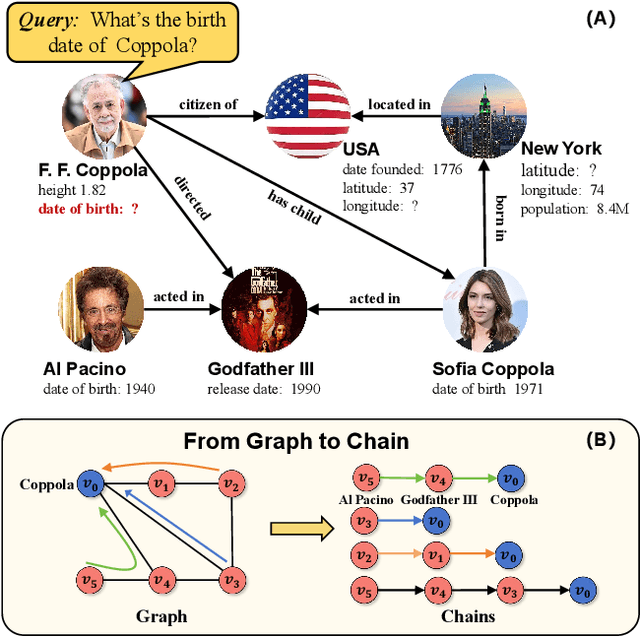
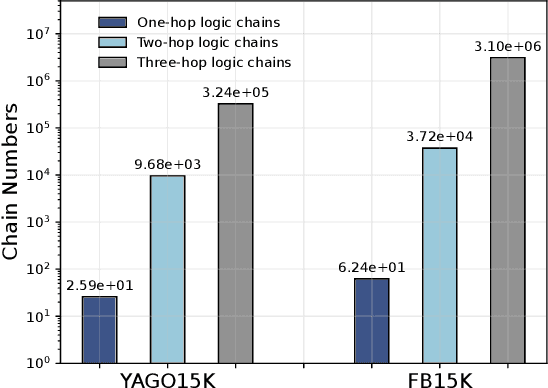
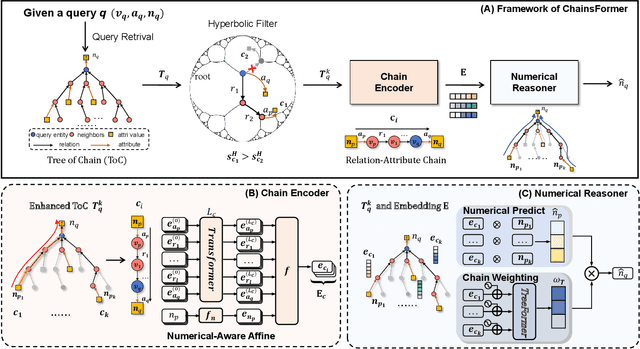
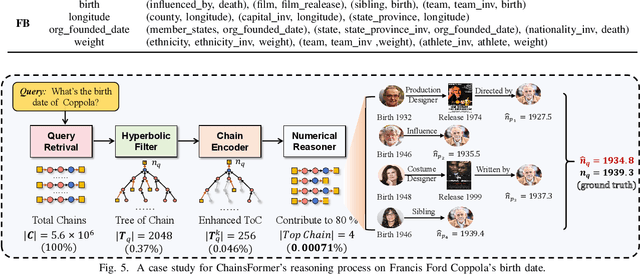
Reasoning over Knowledge Graphs (KGs) plays a pivotal role in knowledge graph completion or question answering systems, providing richer and more accurate triples and attributes. As numerical attributes become increasingly essential in characterizing entities and relations in KGs, the ability to reason over these attributes has gained significant importance. Existing graph-based methods such as Graph Neural Networks (GNNs) and Knowledge Graph Embeddings (KGEs), primarily focus on aggregating homogeneous local neighbors and implicitly embedding diverse triples. However, these approaches often fail to fully leverage the potential of logical paths within the graph, limiting their effectiveness in exploiting the reasoning process. To address these limitations, we propose ChainsFormer, a novel chain-based framework designed to support numerical reasoning. Chainsformer not only explicitly constructs logical chains but also expands the reasoning depth to multiple hops. Specially, we introduces Relation-Attribute Chains (RA-Chains), a specialized logic chain, to model sequential reasoning patterns. ChainsFormer captures the step-by-step nature of multi-hop reasoning along RA-Chains by employing sequential in-context learning. To mitigate the impact of noisy chains, we propose a hyperbolic affinity scoring mechanism that selects relevant logic chains in a variable-resolution space. Furthermore, ChainsFormer incorporates an attention-based numerical reasoner to identify critical reasoning paths, enhancing both reasoning accuracy and transparency. Experimental results demonstrate that ChainsFormer significantly outperforms state-of-the-art methods, achieving up to a 20.0% improvement in performance. The implementations are available at https://github.com/zhaodazhuang2333/ChainsFormer.
AutoFAIR : Automatic Data FAIRification via Machine Reading
Aug 07, 2024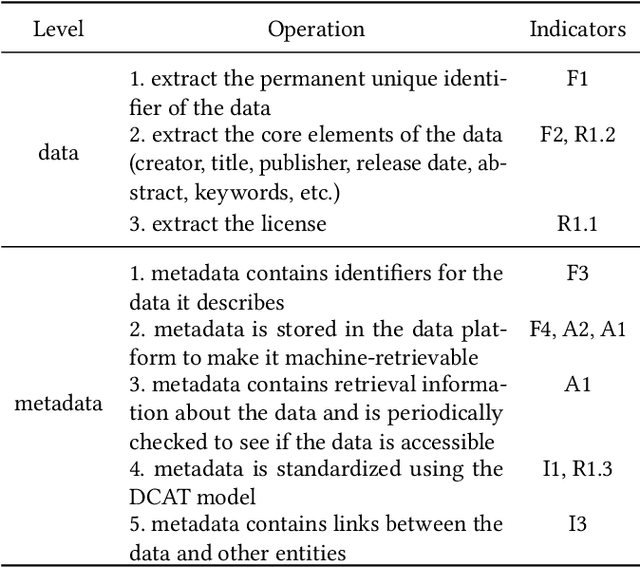
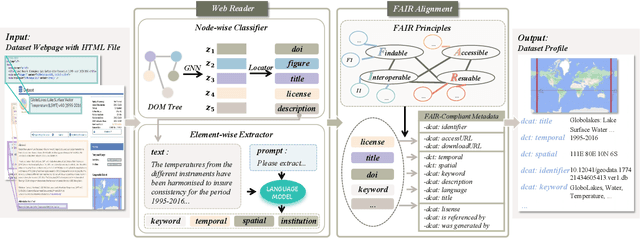
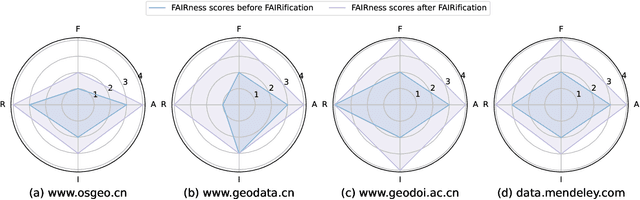
The explosive growth of data fuels data-driven research, facilitating progress across diverse domains. The FAIR principles emerge as a guiding standard, aiming to enhance the findability, accessibility, interoperability, and reusability of data. However, current efforts primarily focus on manual data FAIRification, which can only handle targeted data and lack efficiency. To address this issue, we propose AutoFAIR, an architecture designed to enhance data FAIRness automately. Firstly, We align each data and metadata operation with specific FAIR indicators to guide machine-executable actions. Then, We utilize Web Reader to automatically extract metadata based on language models, even in the absence of structured data webpage schemas. Subsequently, FAIR Alignment is employed to make metadata comply with FAIR principles by ontology guidance and semantic matching. Finally, by applying AutoFAIR to various data, especially in the field of mountain hazards, we observe significant improvements in findability, accessibility, interoperability, and reusability of data. The FAIRness scores before and after applying AutoFAIR indicate enhanced data value.
MagiNet: Mask-Aware Graph Imputation Network for Incomplete Traffic Data
Jun 05, 2024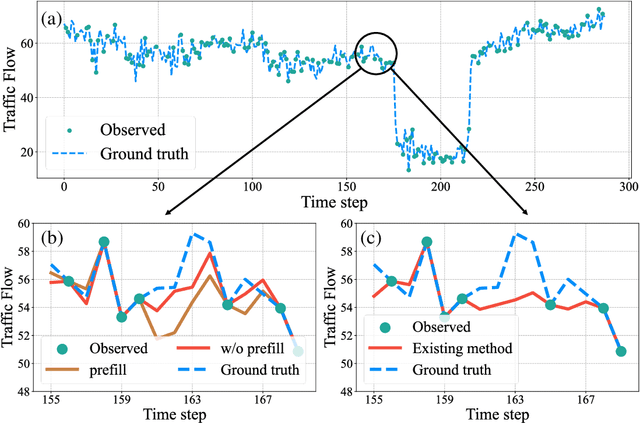
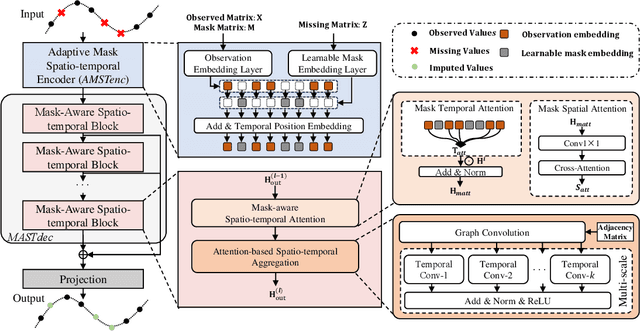
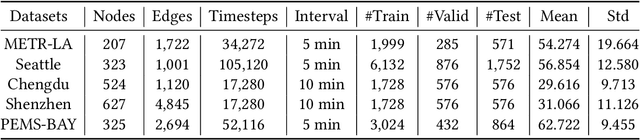
Due to detector malfunctions and communication failures, missing data is ubiquitous during the collection of traffic data. Therefore, it is of vital importance to impute the missing values to facilitate data analysis and decision-making for Intelligent Transportation System (ITS). However, existing imputation methods generally perform zero pre-filling techniques to initialize missing values, introducing inevitable noises. Moreover, we observe prevalent over-smoothing interpolations, falling short in revealing the intrinsic spatio-temporal correlations of incomplete traffic data. To this end, we propose Mask-Aware Graph imputation Network: MagiNet. Our method designs an adaptive mask spatio-temporal encoder to learn the latent representations of incomplete data, eliminating the reliance on pre-filling missing values. Furthermore, we devise a spatio-temporal decoder that stacks multiple blocks to capture the inherent spatial and temporal dependencies within incomplete traffic data, alleviating over-smoothing imputation. Extensive experiments demonstrate that our method outperforms state-of-the-art imputation methods on five real-world traffic datasets, yielding an average improvement of 4.31% in RMSE and 3.72% in MAPE.