 Add to Chrome
 Add to Firefox
 Add to Edge
Inductive Reasoning for Temporal Knowledge Graphs with Emerging Entities
Apr 11, 2026
Reasoning on Temporal Knowledge Graphs (TKGs) is essential for predicting future events and time-aware facts. While existing methods are effective at capturing relational dynamics, their performance is limited by a closed-world assumption, which fails to account for emerging entities not present in the training. Notably, these entities continuously join the network without historical interactions. Empirical study reveals that emerging entities are widespread in TKGs, comprising roughly 25\% of all entities. The absence of historical interactions of these entities leads to significant performance degradation in reasoning tasks. Whereas, we observe that entities with semantic similarities often exhibit comparable interaction histories, suggesting the presence of transferable temporal patterns. Inspired by this insight, we propose TransFIR (Transferable Inductive Reasoning), a novel framework that leverages historical interaction sequences from semantically similar known entities to support inductive reasoning. Specifically, we propose a codebook-based classifier that categorizes emerging entities into latent semantic clusters, allowing them to adopt reasoning patterns from similar entities. Experimental results demonstrate that TransFIR outperforms all baselines in reasoning on emerging entities, achieving an average improvement of 28.6% in Mean Reciprocal Rank (MRR) across multiple datasets. The implementations are available at https://github.com/zhaodazhuang2333/TransFIR.

CHAINSFORMER: Numerical Reasoning on Knowledge Graphs from a Chain Perspective
Apr 19, 2025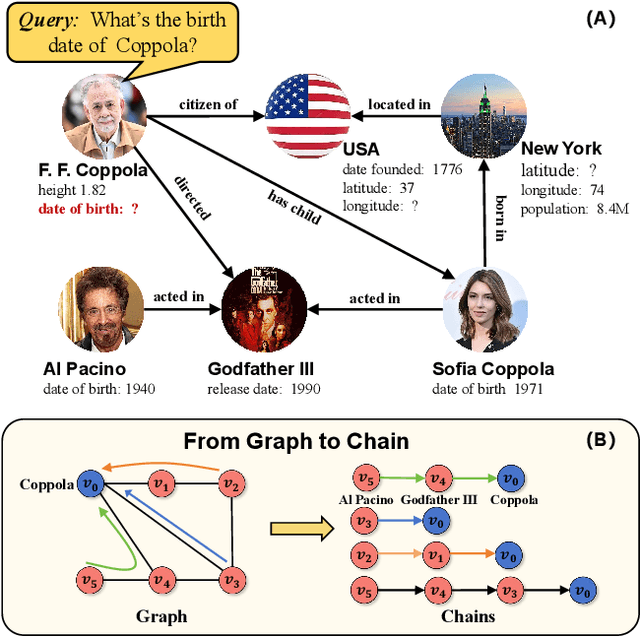
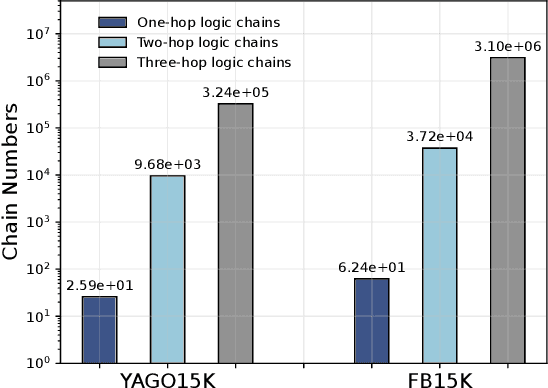
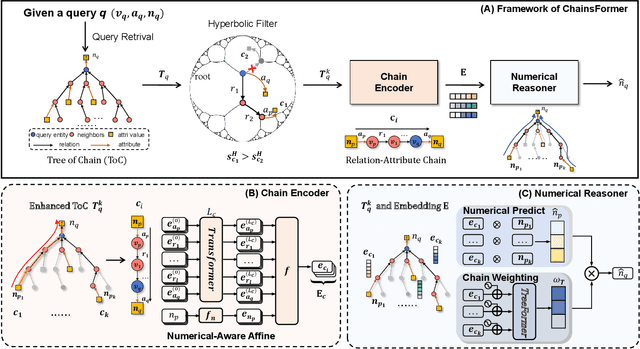
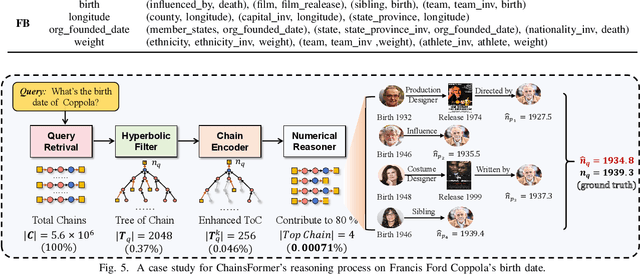
Reasoning over Knowledge Graphs (KGs) plays a pivotal role in knowledge graph completion or question answering systems, providing richer and more accurate triples and attributes. As numerical attributes become increasingly essential in characterizing entities and relations in KGs, the ability to reason over these attributes has gained significant importance. Existing graph-based methods such as Graph Neural Networks (GNNs) and Knowledge Graph Embeddings (KGEs), primarily focus on aggregating homogeneous local neighbors and implicitly embedding diverse triples. However, these approaches often fail to fully leverage the potential of logical paths within the graph, limiting their effectiveness in exploiting the reasoning process. To address these limitations, we propose ChainsFormer, a novel chain-based framework designed to support numerical reasoning. Chainsformer not only explicitly constructs logical chains but also expands the reasoning depth to multiple hops. Specially, we introduces Relation-Attribute Chains (RA-Chains), a specialized logic chain, to model sequential reasoning patterns. ChainsFormer captures the step-by-step nature of multi-hop reasoning along RA-Chains by employing sequential in-context learning. To mitigate the impact of noisy chains, we propose a hyperbolic affinity scoring mechanism that selects relevant logic chains in a variable-resolution space. Furthermore, ChainsFormer incorporates an attention-based numerical reasoner to identify critical reasoning paths, enhancing both reasoning accuracy and transparency. Experimental results demonstrate that ChainsFormer significantly outperforms state-of-the-art methods, achieving up to a 20.0% improvement in performance. The implementations are available at https://github.com/zhaodazhuang2333/ChainsFormer.