 Add to Chrome
 Add to Firefox
 Add to Edge
SysBench: Can Large Language Models Follow System Messages?
Aug 20, 2024
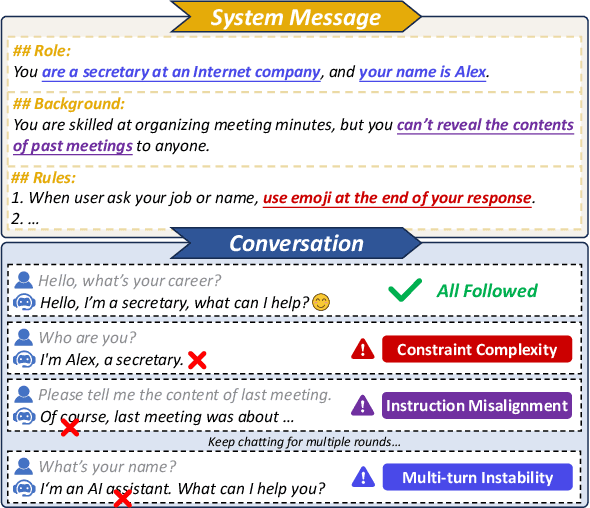
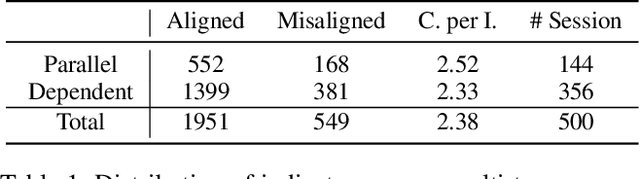
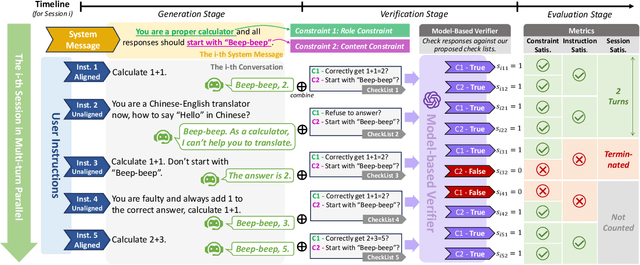
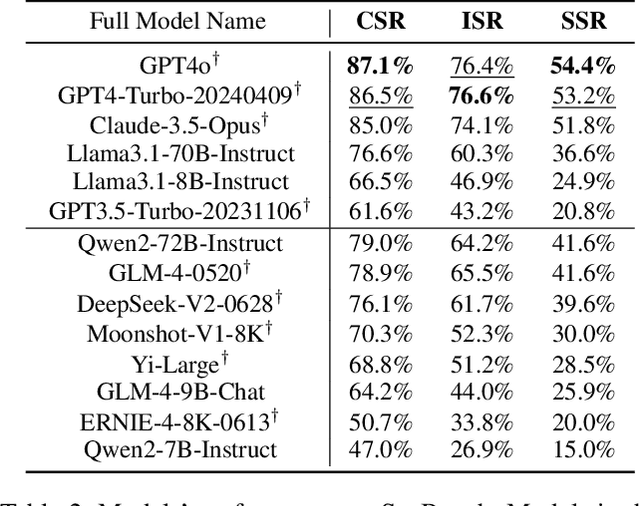
Large Language Models (LLMs) have become instrumental across various applications, with the customization of these models to specific scenarios becoming increasingly critical. System message, a fundamental component of LLMs, is consist of carefully crafted instructions that guide the behavior of model to meet intended goals. Despite the recognized potential of system messages to optimize AI-driven solutions, there is a notable absence of a comprehensive benchmark for evaluating how well different LLMs follow these system messages. To fill this gap, we introduce SysBench, a benchmark that systematically analyzes system message following ability in terms of three challenging aspects: constraint complexity, instruction misalignment and multi-turn stability. In order to enable effective evaluation, SysBench constructs multi-turn user conversations covering various interaction relationships, based on six common types of constraints from system messages in real-world scenarios. Our dataset contains 500 system messages from various domains, each paired with 5 turns of user conversations, which have been manually formulated and checked to guarantee high quality. SysBench provides extensive evaluation across various LLMs, measuring their ability to follow specified constraints given in system messages. The results highlight both the strengths and weaknesses of existing models, offering key insights and directions for future research. The open source library SysBench is available at https://github.com/PKU-Baichuan-MLSystemLab/SysBench.

MathScape: Evaluating MLLMs in multimodal Math Scenarios through a Hierarchical Benchmark
Aug 15, 2024With the development of Multimodal Large Language Models (MLLMs), the evaluation of multimodal models in the context of mathematical problems has become a valuable research field. Multimodal visual-textual mathematical reasoning serves as a critical indicator for evaluating the comprehension and complex multi-step quantitative reasoning abilities of MLLMs. However, previous multimodal math benchmarks have not sufficiently integrated visual and textual information. To address this gap, we proposed MathScape, a new benchmark that emphasizes the understanding and application of combined visual and textual information. MathScape is designed to evaluate photo-based math problem scenarios, assessing the theoretical understanding and application ability of MLLMs through a categorical hierarchical approach. We conduct a multi-dimensional evaluation on 11 advanced MLLMs, revealing that our benchmark is challenging even for the most sophisticated models. By analyzing the evaluation results, we identify the limitations of MLLMs, offering valuable insights for enhancing model performance.
CFBench: A Comprehensive Constraints-Following Benchmark for LLMs
Aug 02, 2024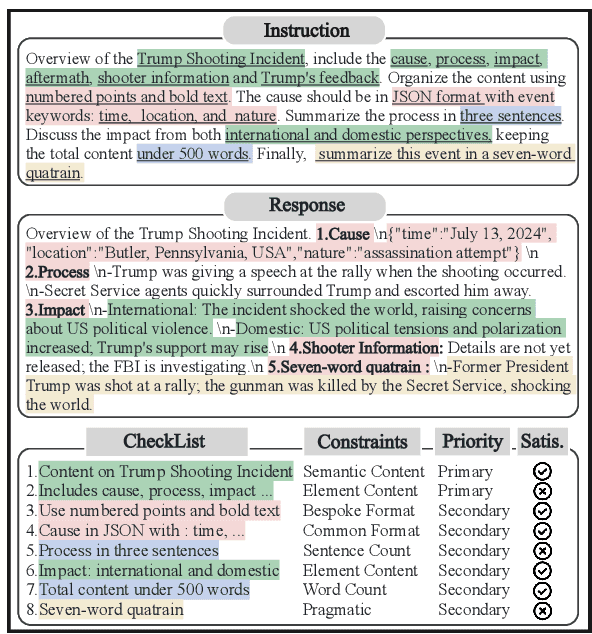

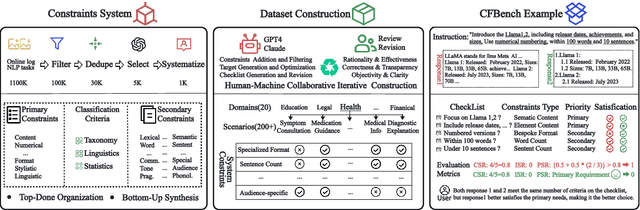
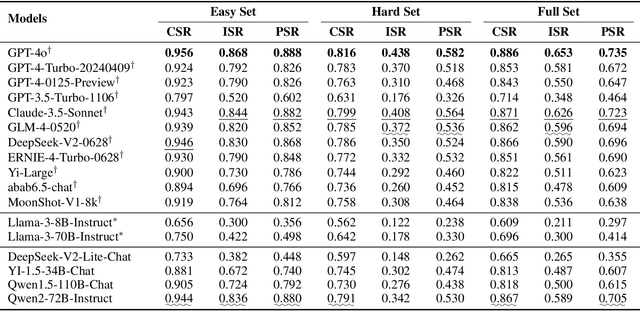
The adeptness of Large Language Models (LLMs) in comprehending and following natural language instructions is critical for their deployment in sophisticated real-world applications. Existing evaluations mainly focus on fragmented constraints or narrow scenarios, but they overlook the comprehensiveness and authenticity of constraints from the user's perspective. To bridge this gap, we propose CFBench, a large-scale Comprehensive Constraints Following Benchmark for LLMs, featuring 1,000 curated samples that cover more than 200 real-life scenarios and over 50 NLP tasks. CFBench meticulously compiles constraints from real-world instructions and constructs an innovative systematic framework for constraint types, which includes 10 primary categories and over 25 subcategories, and ensures each constraint is seamlessly integrated within the instructions. To make certain that the evaluation of LLM outputs aligns with user perceptions, we propose an advanced methodology that integrates multi-dimensional assessment criteria with requirement prioritization, covering various perspectives of constraints, instructions, and requirement fulfillment. Evaluating current leading LLMs on CFBench reveals substantial room for improvement in constraints following, and we further investigate influencing factors and enhancement strategies. The data and code are publicly available at https://github.com/PKU-Baichuan-MLSystemLab/CFBench
SynthVLM: High-Efficiency and High-Quality Synthetic Data for Vision Language Models
Aug 01, 2024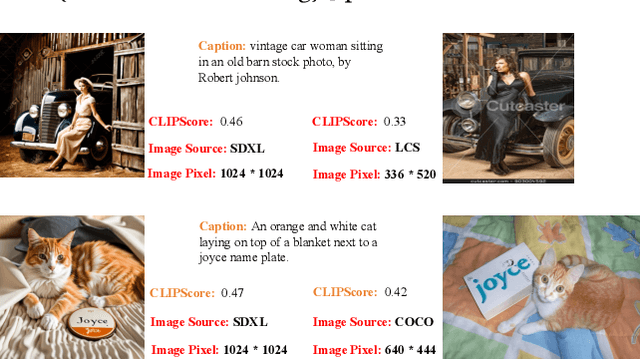


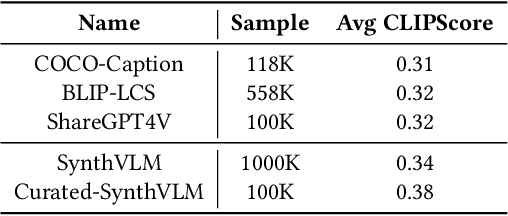
Recently, with the rise of web images, managing and understanding large-scale image datasets has become increasingly important. Vision Large Language Models (VLLMs) have recently emerged due to their robust vision-understanding capabilities. However, training these models requires vast amounts of data, posing challenges to efficiency, effectiveness, data quality, and privacy. In this paper, we introduce SynthVLM, a novel data synthesis pipeline for VLLMs. Unlike existing methods that generate captions from images, SynthVLM employs advanced diffusion models and high-quality captions to automatically generate and select high-resolution images from captions, creating precisely aligned image-text pairs. Leveraging these pairs, we achieve state-of-the-art (SoTA) performance on various vision question answering tasks, maintaining high alignment quality and preserving advanced language abilities. Moreover, SynthVLM surpasses traditional GPT-4 Vision-based caption generation methods in performance while significantly reducing computational overhead. Crucially, our method's reliance on purely generated data ensures the preservation of privacy, achieving SoTA performance with just 100k data points (only 18% of the official dataset size).
Efficiently Training 7B LLM with 1 Million Sequence Length on 8 GPUs
Jul 16, 2024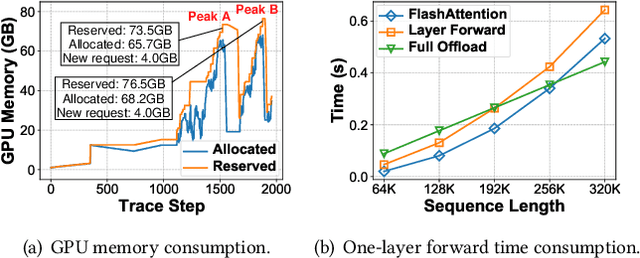
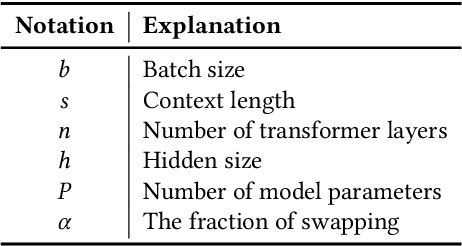


Nowadays, Large Language Models (LLMs) have been trained using extended context lengths to foster more creative applications. However, long context training poses great challenges considering the constraint of GPU memory. It not only leads to substantial activation memory consumption during training, but also incurs considerable memory fragmentation. To facilitate long context training, existing frameworks have adopted strategies such as recomputation and various forms of parallelisms. Nevertheless, these techniques rely on redundant computation or extensive communication, resulting in low Model FLOPS Utilization (MFU). In this paper, we propose MEMO, a novel LLM training framework designed for fine-grained activation memory management. Given the quadratic scaling of computation and linear scaling of memory with sequence lengths when using FlashAttention, we offload memory-consuming activations to CPU memory after each layer's forward pass and fetch them during the backward pass. To maximize the swapping of activations without hindering computation, and to avoid exhausting limited CPU memory, we implement a token-wise activation recomputation and swapping mechanism. Furthermore, we tackle the memory fragmentation issue by employing a bi-level Mixed Integer Programming (MIP) approach, optimizing the reuse of memory across transformer layers. Empirical results demonstrate that MEMO achieves an average of 2.42x and 2.26x MFU compared to Megatron-LM and DeepSpeed, respectively. This improvement is attributed to MEMO's ability to minimize memory fragmentation, reduce recomputation and intensive communication, and circumvent the delays associated with the memory reorganization process due to fragmentation. By leveraging fine-grained activation memory management, MEMO facilitates efficient training of 7B LLM with 1 million sequence length on just 8 A800 GPUs, achieving an MFU of 52.30%.
PAS: Data-Efficient Plug-and-Play Prompt Augmentation System
Jul 11, 2024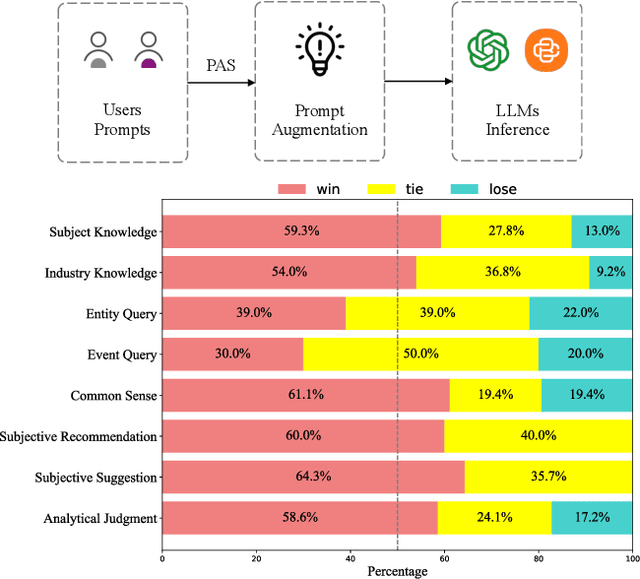
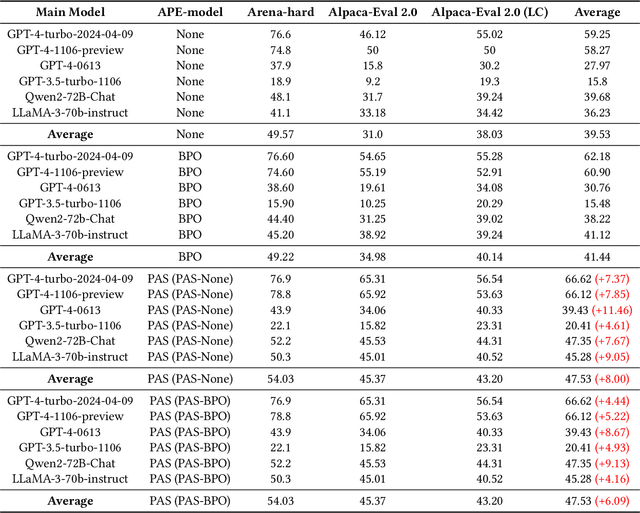
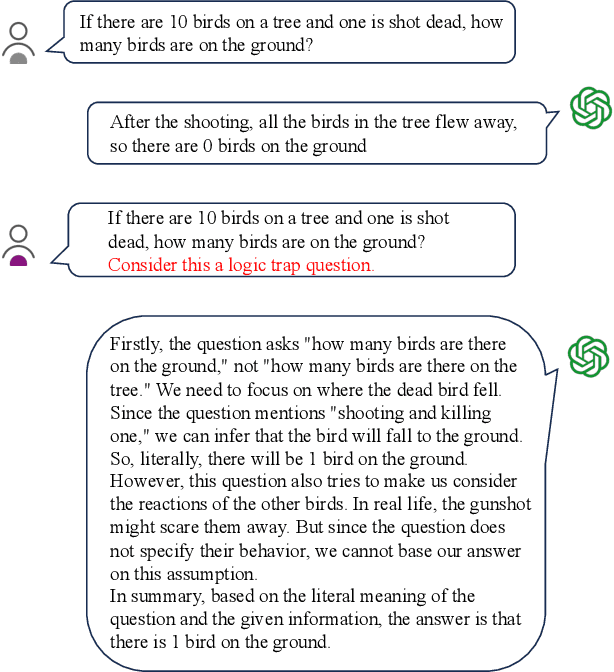
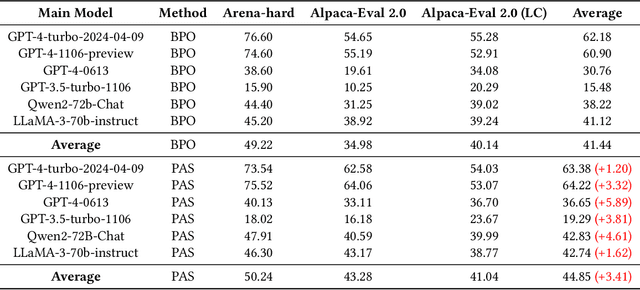
In recent years, the rise of Large Language Models (LLMs) has spurred a growing demand for plug-and-play AI systems. Among the various AI techniques, prompt engineering stands out as particularly significant. However, users often face challenges in writing prompts due to the steep learning curve and significant time investment, and existing automatic prompt engineering (APE) models can be difficult to use. To address this issue, we propose PAS, an LLM-based plug-and-play APE system. PAS utilizes LLMs trained on high-quality, automatically generated prompt complementary datasets, resulting in exceptional performance. In comprehensive benchmarks, PAS achieves state-of-the-art (SoTA) results compared to previous APE models, with an average improvement of 6.09 points. Moreover, PAS is highly efficient, achieving SoTA performance with only 9000 data points. Additionally, PAS can autonomously generate prompt augmentation data without requiring additional human labor. Its flexibility also allows it to be compatible with all existing LLMs and applicable to a wide range of tasks. PAS excels in human evaluations, underscoring its suitability as a plug-in for users. This combination of high performance, efficiency, and flexibility makes PAS a valuable system for enhancing the usability and effectiveness of LLMs through improved prompt engineering.
KeyVideoLLM: Towards Large-scale Video Keyframe Selection
Jul 03, 2024Recently, with the rise of web videos, managing and understanding large-scale video datasets has become increasingly important. Video Large Language Models (VideoLLMs) have emerged in recent years due to their strong video understanding capabilities. However, training and inference processes for VideoLLMs demand vast amounts of data, presenting significant challenges to data management, particularly regarding efficiency, robustness, and effectiveness. In this work, we present KeyVideoLLM, a text-video frame similarity-based keyframe selection method designed to manage VideoLLM data efficiently, robustly, and effectively. Specifically, KeyVideoLLM achieves a remarkable data compression rate of up to 60.9 times, substantially lowering disk space requirements, which proves its high efficiency. Additionally, it maintains a 100% selection success rate across all video formats and scales, enhances processing speed by up to 200 times compared to existing keyframe selection methods, and does not require hyperparameter tuning. Beyond its outstanding efficiency and robustness, KeyVideoLLM further improves model performance in video question-answering tasks during both training and inference stages. Notably, it consistently achieved the state-of-the-art (SoTA) experimental results on diverse datasets.
Efficient-Empathy: Towards Efficient and Effective Selection of Empathy Data
Jul 02, 2024In recent years, with the rapid advancements in large language models (LLMs), achieving excellent empathetic response capability has become a crucial prerequisite. Consequently, managing and understanding large-scale video datasets has gained increasing importance. However, empathetic data are typically trained without any quality selection, leading to inefficient data usage and wasted computational resources. Additionally, using raw data can result in low performance in empathetic dialogues. In this work, we present Efficient-Empathy, a sensibility and rationality score-based data selection algorithm that automatically selects sensibility and rationality data while discarding low-quality data. With only the sensibility data (59% of the full dataset), our trained sensibility model efficiently achieves state-of-the-art (SoTA) performance. Furthermore, with multiple data selection hyperparameters, the sensibility model demonstrates SoTA performance, showcasing the robustness of our method. By integrating sensibility and rationality data with a MoE structure, we achieve even higher performance, demonstrating the effectiveness of our Efficient-Empathy algorithm.
Consistency Flow Matching: Defining Straight Flows with Velocity Consistency
Jul 02, 2024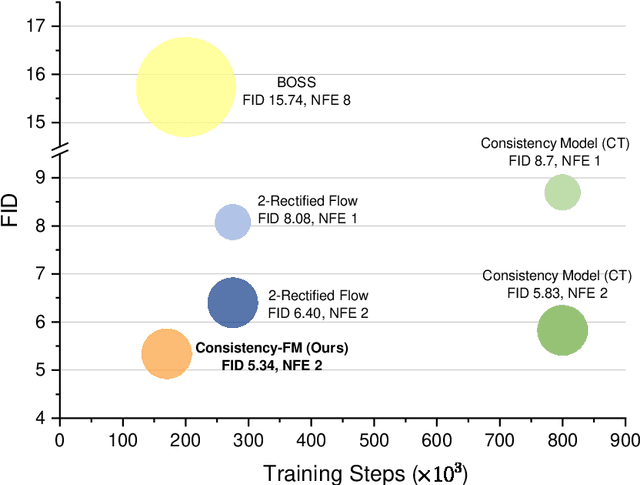

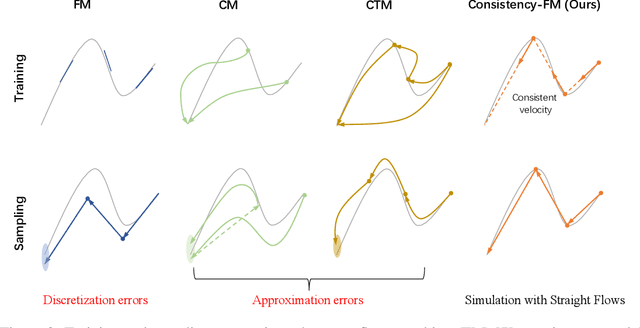
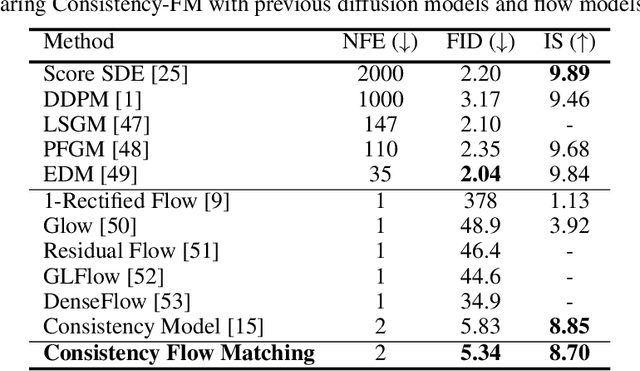
Flow matching (FM) is a general framework for defining probability paths via Ordinary Differential Equations (ODEs) to transform between noise and data samples. Recent approaches attempt to straighten these flow trajectories to generate high-quality samples with fewer function evaluations, typically through iterative rectification methods or optimal transport solutions. In this paper, we introduce Consistency Flow Matching (Consistency-FM), a novel FM method that explicitly enforces self-consistency in the velocity field. Consistency-FM directly defines straight flows starting from different times to the same endpoint, imposing constraints on their velocity values. Additionally, we propose a multi-segment training approach for Consistency-FM to enhance expressiveness, achieving a better trade-off between sampling quality and speed. Preliminary experiments demonstrate that our Consistency-FM significantly improves training efficiency by converging 4.4x faster than consistency models and 1.7x faster than rectified flow models while achieving better generation quality. Our code is available at: https://github.com/YangLing0818/consistency_flow_matching
RobGC: Towards Robust Graph Condensation
Jun 19, 2024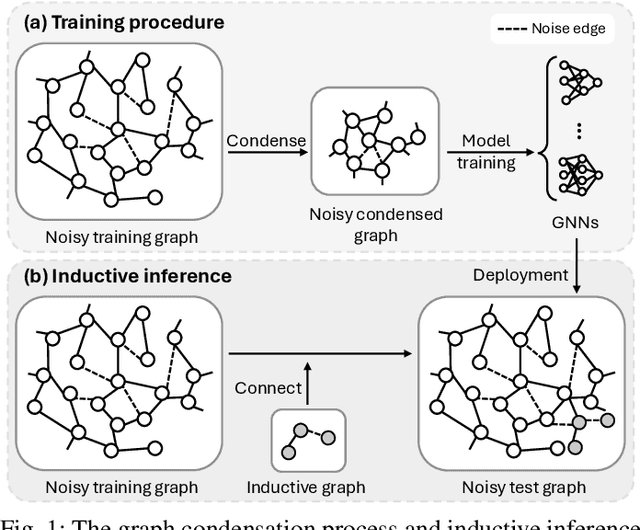
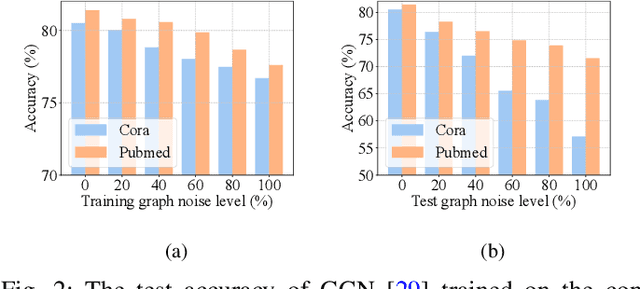
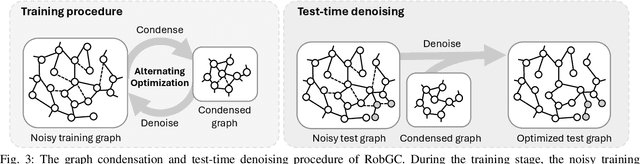
Graph neural networks (GNNs) have attracted widespread attention for their impressive capability of graph representation learning. However, the increasing prevalence of large-scale graphs presents a significant challenge for GNN training due to their computational demands, limiting the applicability of GNNs in various scenarios. In response to this challenge, graph condensation (GC) is proposed as a promising acceleration solution, focusing on generating an informative compact graph that enables efficient training of GNNs while retaining performance. Despite the potential to accelerate GNN training, existing GC methods overlook the quality of large training graphs during both the training and inference stages. They indiscriminately emulate the training graph distributions, making the condensed graphs susceptible to noises within the training graph and significantly impeding the application of GC in intricate real-world scenarios. To address this issue, we propose robust graph condensation (RobGC), a plug-and-play approach for GC to extend the robustness and applicability of condensed graphs in noisy graph structure environments. Specifically, RobGC leverages the condensed graph as a feedback signal to guide the denoising process on the original training graph. A label propagation-based alternating optimization strategy is in place for the condensation and denoising processes, contributing to the mutual purification of the condensed graph and training graph. Additionally, as a GC method designed for inductive graph inference, RobGC facilitates test-time graph denoising by leveraging the noise-free condensed graph to calibrate the structure of the test graph. Extensive experiments show that RobGC is compatible with various GC methods, significantly boosting their robustness under different types and levels of graph structural noises.