 Add to Chrome
 Add to Firefox
 Add to Edge
A Streaming On-Device End-to-End Model Surpassing Server-Side Conventional Model Quality and Latency
Mar 28, 2020
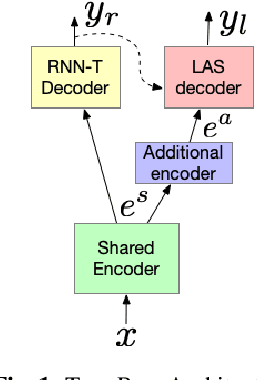
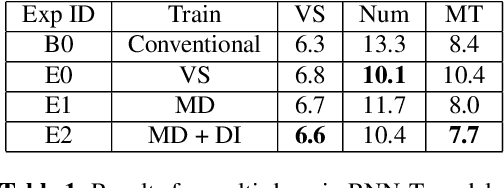
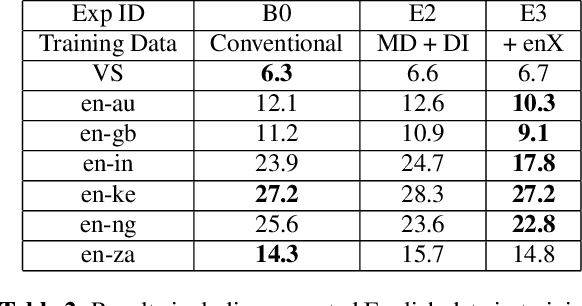
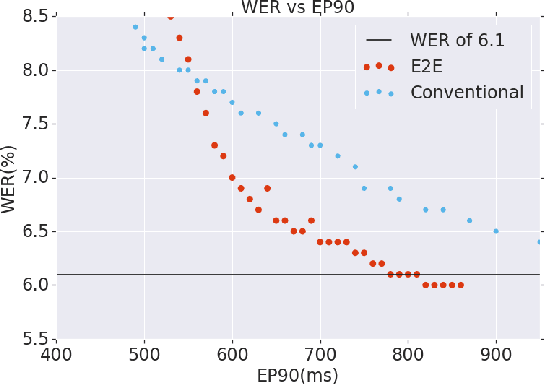
Thus far, end-to-end (E2E) models have not been shown to outperform state-of-the-art conventional models with respect to both quality, i.e., word error rate (WER), and latency, i.e., the time the hypothesis is finalized after the user stops speaking. In this paper, we develop a first-pass Recurrent Neural Network Transducer (RNN-T) model and a second-pass Listen, Attend, Spell (LAS) rescorer that surpasses a conventional model in both quality and latency. On the quality side, we incorporate a large number of utterances across varied domains to increase acoustic diversity and the vocabulary seen by the model. We also train with accented English speech to make the model more robust to different pronunciations. In addition, given the increased amount of training data, we explore a varied learning rate schedule. On the latency front, we explore using the end-of-sentence decision emitted by the RNN-T model to close the microphone, and also introduce various optimizations to improve the speed of LAS rescoring. Overall, we find that RNN-T+LAS offers a better WER and latency tradeoff compared to a conventional model. For example, for the same latency, RNN-T+LAS obtains a 8% relative improvement in WER, while being more than 400-times smaller in model size.

A comparison of end-to-end models for long-form speech recognition
Nov 06, 2019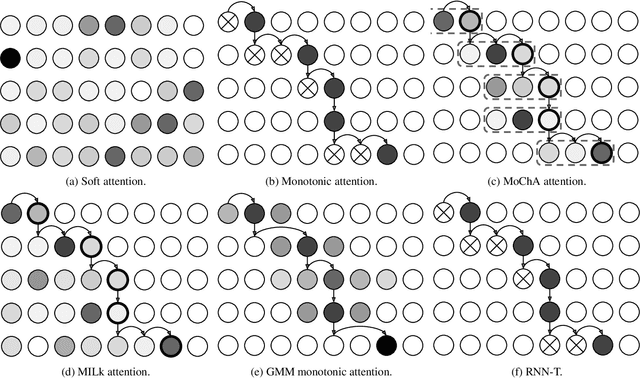
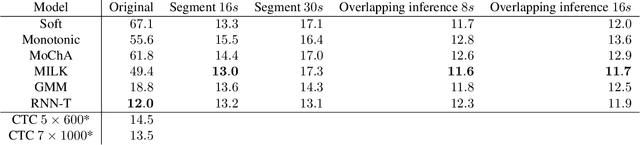
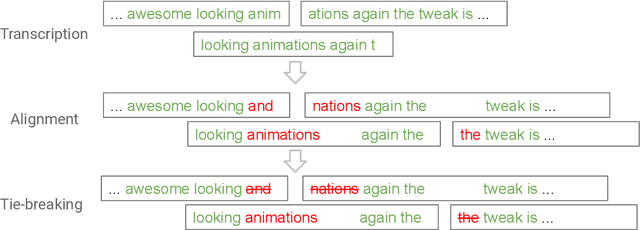
End-to-end automatic speech recognition (ASR) models, including both attention-based models and the recurrent neural network transducer (RNN-T), have shown superior performance compared to conventional systems. However, previous studies have focused primarily on short utterances that typically last for just a few seconds or, at most, a few tens of seconds. Whether such architectures are practical on long utterances that last from minutes to hours remains an open question. In this paper, we both investigate and improve the performance of end-to-end models on long-form transcription. We first present an empirical comparison of different end-to-end models on a real world long-form task and demonstrate that the RNN-T model is much more robust than attention-based systems in this regime. We next explore two improvements to attention-based systems that significantly improve its performance: restricting the attention to be monotonic, and applying a novel decoding algorithm that breaks long utterances into shorter overlapping segments. Combining these two improvements, we show that attention-based end-to-end models can be very competitive to RNN-T on long-form speech recognition.
Recognizing long-form speech using streaming end-to-end models
Oct 24, 2019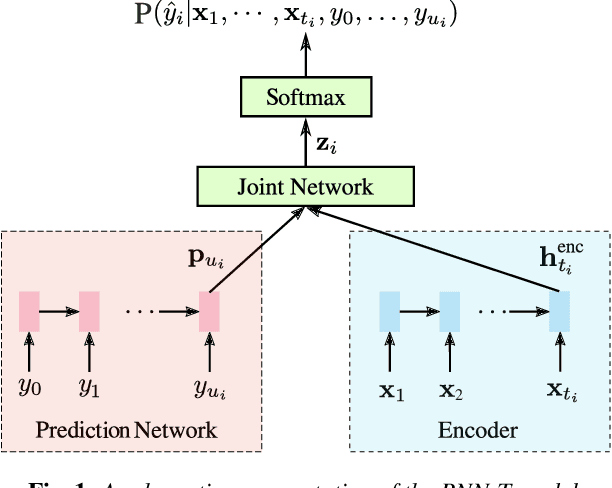
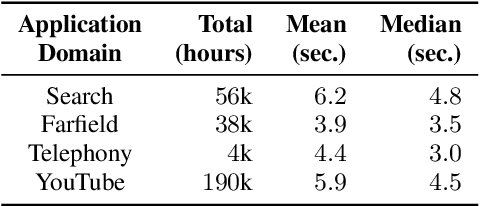
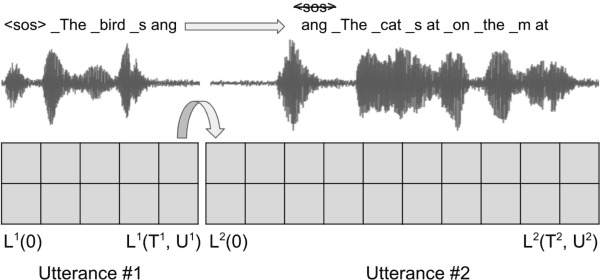
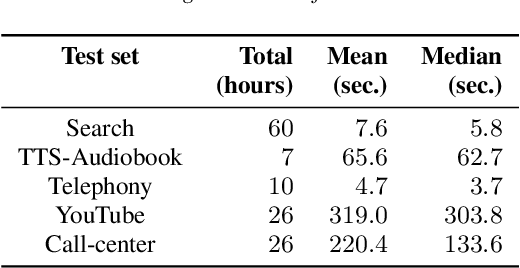
All-neural end-to-end (E2E) automatic speech recognition (ASR) systems that use a single neural network to transduce audio to word sequences have been shown to achieve state-of-the-art results on several tasks. In this work, we examine the ability of E2E models to generalize to unseen domains, where we find that models trained on short utterances fail to generalize to long-form speech. We propose two complementary solutions to address this: training on diverse acoustic data, and LSTM state manipulation to simulate long-form audio when training using short utterances. On a synthesized long-form test set, adding data diversity improves word error rate (WER) by 90% relative, while simulating long-form training improves it by 67% relative, though the combination doesn't improve over data diversity alone. On a real long-form call-center test set, adding data diversity improves WER by 40% relative. Simulating long-form training on top of data diversity improves performance by an additional 27% relative.
From Audio to Semantics: Approaches to end-to-end spoken language understanding
Sep 24, 2018
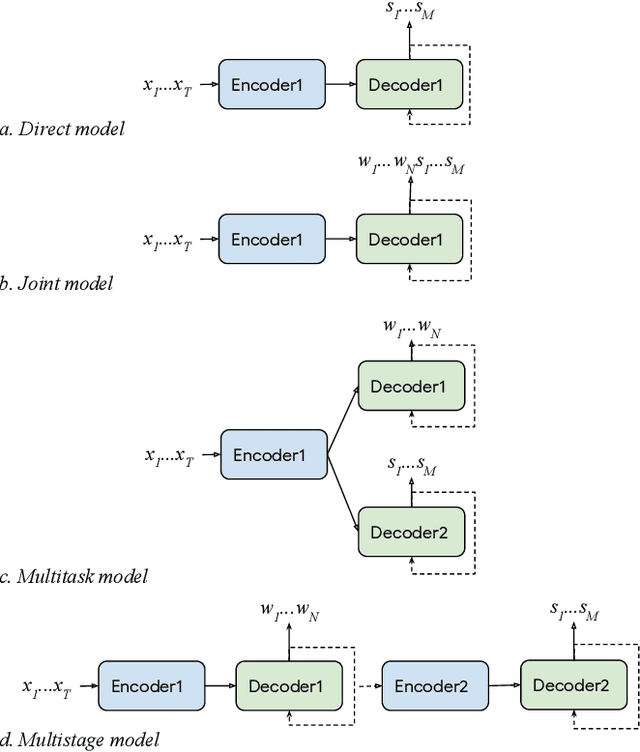
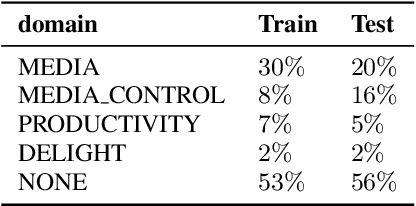
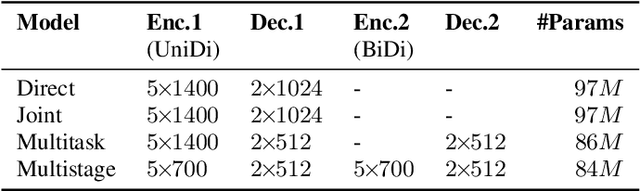
Conventional spoken language understanding systems consist of two main components: an automatic speech recognition module that converts audio to a transcript, and a natural language understanding module that transforms the resulting text (or top N hypotheses) into a set of domains, intents, and arguments. These modules are typically optimized independently. In this paper, we formulate audio to semantic understanding as a sequence-to-sequence problem [1]. We propose and compare various encoder-decoder based approaches that optimize both modules jointly, in an end-to-end manner. Evaluations on a real-world task show that 1) having an intermediate text representation is crucial for the quality of the predicted semantics, especially the intent arguments and 2) jointly optimizing the full system improves overall accuracy of prediction. Compared to independently trained models, our best jointly trained model achieves similar domain and intent prediction F1 scores, but improves argument word error rate by 18% relative.
Toward domain-invariant speech recognition via large scale training
Aug 16, 2018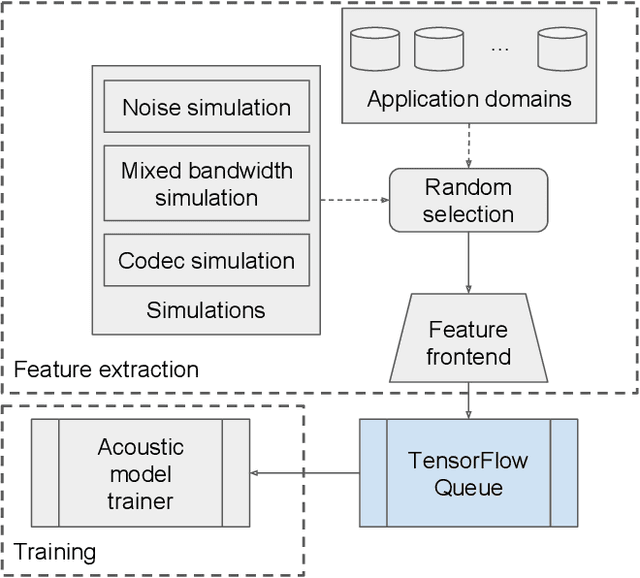
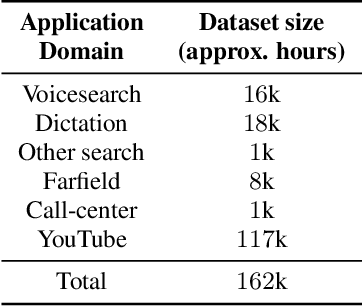
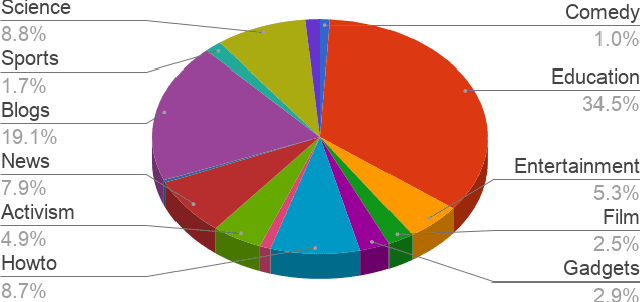
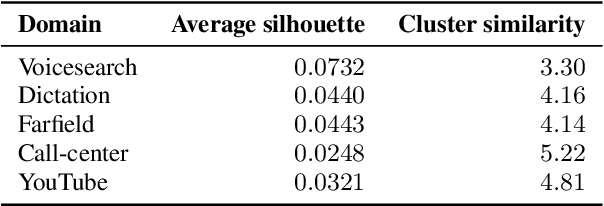
Current state-of-the-art automatic speech recognition systems are trained to work in specific `domains', defined based on factors like application, sampling rate and codec. When such recognizers are used in conditions that do not match the training domain, performance significantly drops. This work explores the idea of building a single domain-invariant model for varied use-cases by combining large scale training data from multiple application domains. Our final system is trained using 162,000 hours of speech. Additionally, each utterance is artificially distorted during training to simulate effects like background noise, codec distortion, and sampling rates. Our results show that, even at such a scale, a model thus trained works almost as well as those fine-tuned to specific subsets: A single model can be robust to multiple application domains, and variations like codecs and noise. More importantly, such models generalize better to unseen conditions and allow for rapid adaptation -- we show that by using as little as 10 hours of data from a new domain, an adapted domain-invariant model can match performance of a domain-specific model trained from scratch using 70 times as much data. We also highlight some of the limitations of such models and areas that need addressing in future work.