 Add to Chrome
 Add to Firefox
 Add to Edge
Scalable Group Choreography via Variational Phase Manifold Learning
Jul 26, 2024
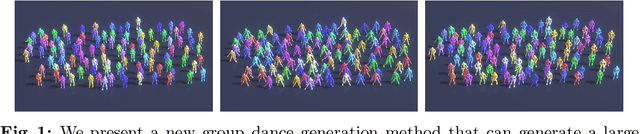
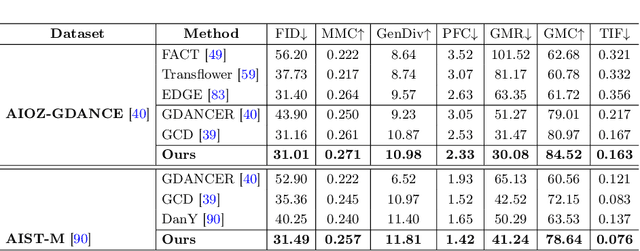
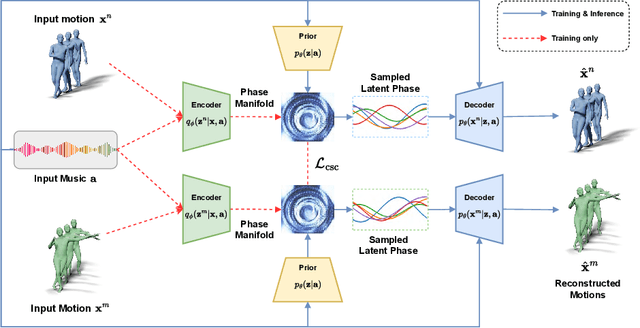
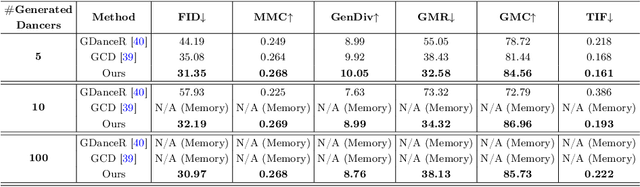
Generating group dance motion from the music is a challenging task with several industrial applications. Although several methods have been proposed to tackle this problem, most of them prioritize optimizing the fidelity in dancing movement, constrained by predetermined dancer counts in datasets. This limitation impedes adaptability to real-world applications. Our study addresses the scalability problem in group choreography while preserving naturalness and synchronization. In particular, we propose a phase-based variational generative model for group dance generation on learning a generative manifold. Our method achieves high-fidelity group dance motion and enables the generation with an unlimited number of dancers while consuming only a minimal and constant amount of memory. The intensive experiments on two public datasets show that our proposed method outperforms recent state-of-the-art approaches by a large margin and is scalable to a great number of dancers beyond the training data.

Lightweight Language-driven Grasp Detection using Conditional Consistency Model
Jul 25, 2024


Language-driven grasp detection is a fundamental yet challenging task in robotics with various industrial applications. In this work, we present a new approach for language-driven grasp detection that leverages the concept of lightweight diffusion models to achieve fast inference time. By integrating diffusion processes with grasping prompts in natural language, our method can effectively encode visual and textual information, enabling more accurate and versatile grasp positioning that aligns well with the text query. To overcome the long inference time problem in diffusion models, we leverage the image and text features as the condition in the consistency model to reduce the number of denoising timesteps during inference. The intensive experimental results show that our method outperforms other recent grasp detection methods and lightweight diffusion models by a clear margin. We further validate our method in real-world robotic experiments to demonstrate its fast inference time capability.
Language-Driven 6-DoF Grasp Detection Using Negative Prompt Guidance
Jul 18, 2024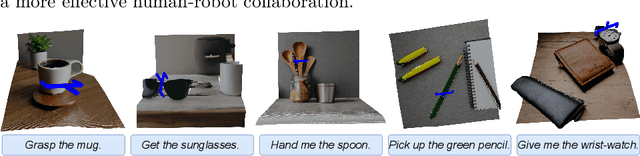
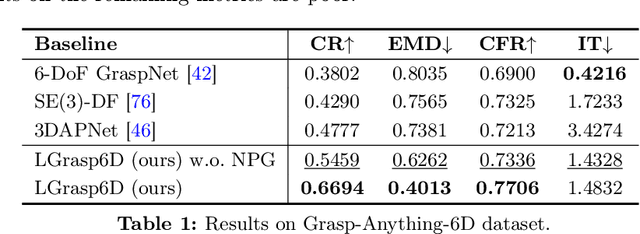
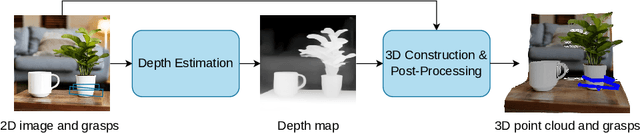
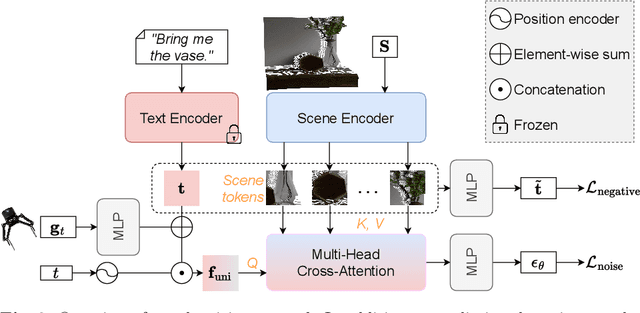
6-DoF grasp detection has been a fundamental and challenging problem in robotic vision. While previous works have focused on ensuring grasp stability, they often do not consider human intention conveyed through natural language, hindering effective collaboration between robots and users in complex 3D environments. In this paper, we present a new approach for language-driven 6-DoF grasp detection in cluttered point clouds. We first introduce Grasp-Anything-6D, a large-scale dataset for the language-driven 6-DoF grasp detection task with 1M point cloud scenes and more than 200M language-associated 3D grasp poses. We further introduce a novel diffusion model that incorporates a new negative prompt guidance learning strategy. The proposed negative prompt strategy directs the detection process toward the desired object while steering away from unwanted ones given the language input. Our method enables an end-to-end framework where humans can command the robot to grasp desired objects in a cluttered scene using natural language. Intensive experimental results show the effectiveness of our method in both benchmarking experiments and real-world scenarios, surpassing other baselines. In addition, we demonstrate the practicality of our approach in real-world robotic applications. Our project is available at https://airvlab.github.io/grasp-anything.
Adaptive Parametric Activation
Jul 11, 2024The activation function plays a crucial role in model optimisation, yet the optimal choice remains unclear. For example, the Sigmoid activation is the de-facto activation in balanced classification tasks, however, in imbalanced classification, it proves inappropriate due to bias towards frequent classes. In this work, we delve deeper in this phenomenon by performing a comprehensive statistical analysis in the classification and intermediate layers of both balanced and imbalanced networks and we empirically show that aligning the activation function with the data distribution, enhances the performance in both balanced and imbalanced tasks. To this end, we propose the Adaptive Parametric Activation (APA) function, a novel and versatile activation function that unifies most common activation functions under a single formula. APA can be applied in both intermediate layers and attention layers, significantly outperforming the state-of-the-art on several imbalanced benchmarks such as ImageNet-LT, iNaturalist2018, Places-LT, CIFAR100-LT and LVIS and balanced benchmarks such as ImageNet1K, COCO and V3DET. The code is available at https://github.com/kostas1515/AGLU.
CLIP-DR: Textual Knowledge-Guided Diabetic Retinopathy Grading with Ranking-aware Prompting
Jul 04, 2024Diabetic retinopathy (DR) is a complication of diabetes and usually takes decades to reach sight-threatening levels. Accurate and robust detection of DR severity is critical for the timely management and treatment of diabetes. However, most current DR grading methods suffer from insufficient robustness to data variability (\textit{e.g.} colour fundus images), posing a significant difficulty for accurate and robust grading. In this work, we propose a novel DR grading framework CLIP-DR based on three observations: 1) Recent pre-trained visual language models, such as CLIP, showcase a notable capacity for generalisation across various downstream tasks, serving as effective baseline models. 2) The grading of image-text pairs for DR often adheres to a discernible natural sequence, yet most existing DR grading methods have primarily overlooked this aspect. 3) A long-tailed distribution among DR severity levels complicates the grading process. This work proposes a novel ranking-aware prompting strategy to help the CLIP model exploit the ordinal information. Specifically, we sequentially design learnable prompts between neighbouring text-image pairs in two different ranking directions. Additionally, we introduce a Similarity Matrix Smooth module into the structure of CLIP to balance the class distribution. Finally, we perform extensive comparisons with several state-of-the-art methods on the GDRBench benchmark, demonstrating our CLIP-DR's robustness and superior performance. The implementation code is available \footnote{\url{https://github.com/Qinkaiyu/CLIP-DR}
Language-Driven Closed-Loop Grasping with Model-Predictive Trajectory Replanning
Jun 14, 2024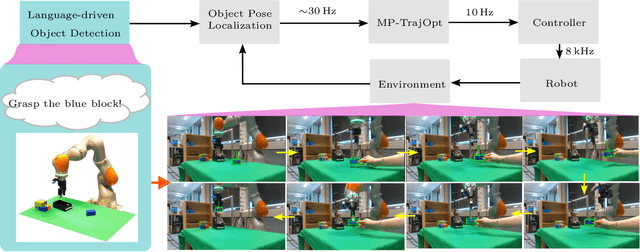
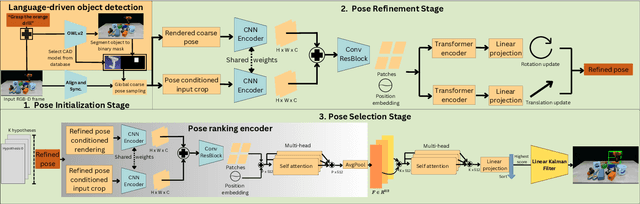
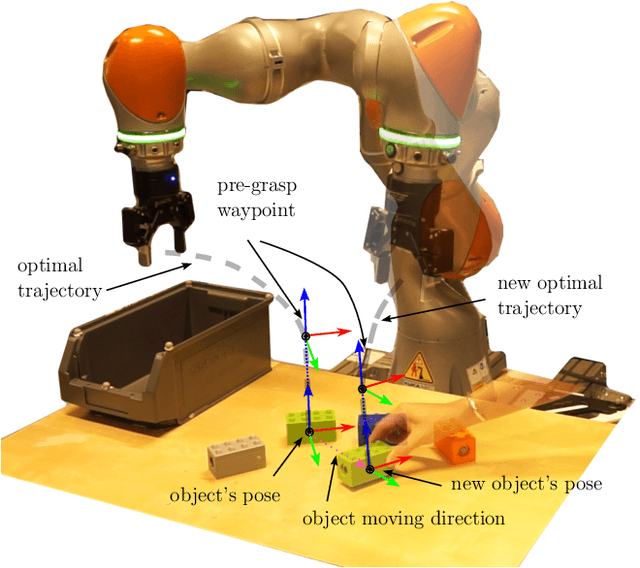
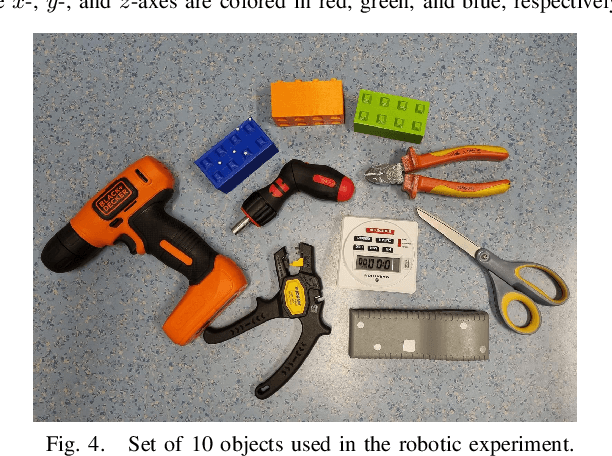
Combining a vision module inside a closed-loop control system for a \emph{seamless movement} of a robot in a manipulation task is challenging due to the inconsistent update rates between utilized modules. This task is even more difficult in a dynamic environment, e.g., objects are moving. This paper presents a \emph{modular} zero-shot framework for language-driven manipulation of (dynamic) objects through a closed-loop control system with real-time trajectory replanning and an online 6D object pose localization. We segment an object within $\SI{0.5}{\second}$ by leveraging a vision language model via language commands. Then, guided by natural language commands, a closed-loop system, including a unified pose estimation and tracking and online trajectory planning, is utilized to continuously track this object and compute the optimal trajectory in real-time. Our proposed zero-shot framework provides a smooth trajectory that avoids jerky movements and ensures the robot can grasp a non-stationary object. Experiment results exhibit the real-time capability of the proposed zero-shot modular framework for the trajectory optimization module to accurately and efficiently grasp moving objects, i.e., up to \SI{30}{\hertz} update rates for the online 6D pose localization module and \SI{10}{\hertz} update rates for the receding-horizon trajectory optimization. These advantages highlight the modular framework's potential applications in robotics and human-robot interaction; see the video in https://www.acin.tuwien.ac.at/en/6e64/.
Language-driven Grasp Detection
Jun 13, 2024Grasp detection is a persistent and intricate challenge with various industrial applications. Recently, many methods and datasets have been proposed to tackle the grasp detection problem. However, most of them do not consider using natural language as a condition to detect the grasp poses. In this paper, we introduce Grasp-Anything++, a new language-driven grasp detection dataset featuring 1M samples, over 3M objects, and upwards of 10M grasping instructions. We utilize foundation models to create a large-scale scene corpus with corresponding images and grasp prompts. We approach the language-driven grasp detection task as a conditional generation problem. Drawing on the success of diffusion models in generative tasks and given that language plays a vital role in this task, we propose a new language-driven grasp detection method based on diffusion models. Our key contribution is the contrastive training objective, which explicitly contributes to the denoising process to detect the grasp pose given the language instructions. We illustrate that our approach is theoretically supportive. The intensive experiments show that our method outperforms state-of-the-art approaches and allows real-world robotic grasping. Finally, we demonstrate our large-scale dataset enables zero-short grasp detection and is a challenging benchmark for future work. Project website: https://airvlab.github.io/grasp-anything/
Phi-3 Technical Report: A Highly Capable Language Model Locally on Your Phone
Apr 23, 2024


We introduce phi-3-mini, a 3.8 billion parameter language model trained on 3.3 trillion tokens, whose overall performance, as measured by both academic benchmarks and internal testing, rivals that of models such as Mixtral 8x7B and GPT-3.5 (e.g., phi-3-mini achieves 69% on MMLU and 8.38 on MT-bench), despite being small enough to be deployed on a phone. The innovation lies entirely in our dataset for training, a scaled-up version of the one used for phi-2, composed of heavily filtered web data and synthetic data. The model is also further aligned for robustness, safety, and chat format. We also provide some initial parameter-scaling results with a 7B and 14B models trained for 4.8T tokens, called phi-3-small and phi-3-medium, both significantly more capable than phi-3-mini (e.g., respectively 75% and 78% on MMLU, and 8.7 and 8.9 on MT-bench).
High-fidelity Endoscopic Image Synthesis by Utilizing Depth-guided Neural Surfaces
Apr 20, 2024In surgical oncology, screening colonoscopy plays a pivotal role in providing diagnostic assistance, such as biopsy, and facilitating surgical navigation, particularly in polyp detection. Computer-assisted endoscopic surgery has recently gained attention and amalgamated various 3D computer vision techniques, including camera localization, depth estimation, surface reconstruction, etc. Neural Radiance Fields (NeRFs) and Neural Implicit Surfaces (NeuS) have emerged as promising methodologies for deriving accurate 3D surface models from sets of registered images, addressing the limitations of existing colon reconstruction approaches stemming from constrained camera movement. However, the inadequate tissue texture representation and confused scale problem in monocular colonoscopic image reconstruction still impede the progress of the final rendering results. In this paper, we introduce a novel method for colon section reconstruction by leveraging NeuS applied to endoscopic images, supplemented by a single frame of depth map. Notably, we pioneered the exploration of utilizing only one frame depth map in photorealistic reconstruction and neural rendering applications while this single depth map can be easily obtainable from other monocular depth estimation networks with an object scale. Through rigorous experimentation and validation on phantom imagery, our approach demonstrates exceptional accuracy in completely rendering colon sections, even capturing unseen portions of the surface. This breakthrough opens avenues for achieving stable and consistently scaled reconstructions, promising enhanced quality in cancer screening procedures and treatment interventions.
Allowing humans to interactively guide machines where to look does not always improve human-AI team's classification accuracy
Apr 14, 2024Via thousands of papers in Explainable AI (XAI), attention maps \cite{vaswani2017attention} and feature attribution maps \cite{bansal2020sam} have been established as a common means for finding how important each input feature is to an AI's decisions. It is an interesting, unexplored question whether allowing users to edit the feature importance at test time would improve a human-AI team's accuracy on downstream tasks. In this paper, we address this question by leveraging CHM-Corr, a state-of-the-art, ante-hoc explainable classifier \cite{taesiri2022visual} that first predicts patch-wise correspondences between the input and training-set images, and then base on them to make classification decisions. We build CHM-Corr++, an interactive interface for CHM-Corr, enabling users to edit the feature attribution map provided by CHM-Corr and observe updated model decisions. Via CHM-Corr++, users can gain insights into if, when, and how the model changes its outputs, improving their understanding beyond static explanations. However, our user study with 18 users who performed 1,400 decisions finds no statistical significance that our interactive approach improves user accuracy on CUB-200 bird image classification over static explanations. This challenges the hypothesis that interactivity can boost human-AI team accuracy~\cite{sokol2020one,sun2022exploring,shen2024towards,singh2024rethinking,mindlin2024beyond,lakkaraju2022rethinking,cheng2019explaining,liu2021understanding} and raises needs for future research. We open-source CHM-Corr++, an interactive tool for editing image classifier attention (see an interactive demo \href{http://137.184.82.109:7080/}{here}). % , and it lays the groundwork for future research to enable effective human-AI interaction in computer vision. We release code and data on \href{https://github.com/anguyen8/chm-corr-interactive}{github}.