 Add to Chrome
 Add to Firefox
 Add to Edge
Benchmarking the Robustness of Foundation Models for Mammography under Domain Shift
Jul 11, 2026
Foundation models are increasingly used as image feature extractors for mammography, but their robustness under external domain shift remains unclear. We benchmark 15 foundation-model backbones across breast density, BI-RADS severity, and cancer status using a unified frozen-backbone linear-probe protocol, training on 3 source datasets and evaluating on 12 task-compatible out-of-distribution (OOD) datasets after label harmonization. Mammography-specific vision-language models (Mammo-FM and MaMA) provide the strongest mean OOD performance, but robustness is not explained by mammography exposure alone. DINOv3 remains a competitive vision-only baseline, and mammography-adapted pretraining does not consistently improve generalization. Dataset-level analysis further shows that even leading models show heterogeneous performance across datasets. Feature-space inspection reveals that useful representations can preserve clinical signal while retaining dataset and acquisition structure. These findings highlight dataset-level OOD evaluation as a central criterion for assessing mammography representations. Our code is publicly available: https://github.com/biomedia-mira/mammo-ood.

Prototype Language Models
Jul 01, 2026Knowing which training examples drive outputs is fundamental to auditing, correcting, and understanding language models, yet for modern LLMs this remains expensive, approximate, and largely post-hoc. Standard language models generate tokens through a dense network pathway, causing training data's influence to be distributed across parameters rather than organized along explicit, traceable components. We introduce a prototype language model architecture, Prototypes for Interpretable Sequence Modeling (PRISM), that forms each prediction via a sparse, non-negative mixture of learned prototypes, trained with clustering objectives that anchor each prototype to coherent neighborhoods of training examples. Across architectures from 130M to 1.6B parameters trained on up to 50B tokens, prototype language models either surpass or remain within 2.5 percentage points on average downstream accuracy of matched dense baselines. We show that sparse prototype structure localizes curvature in the loss landscape, yielding a more tractable Hessian and enabling training data attribution that is ~500x faster than post hoc baselines when consuming equivalent memory. Calibrating linear prototype controllers can improve downstream accuracy by roughly 3 points while tracing those corrections back to training neighborhoods, and targeted prototype suppression can remove model behaviors without finetuning or measurable loss in generation quality.
The Attribution Contract: Feature Attribution for Generative Language Models
May 21, 2026Feature attribution methods promise to identify which input features matter for a model output. In generative language models, however, it is often unclear what should count as a feature in the first place. In autoregressive language models, earlier generated tokens are both outputs of the model and inputs to later predictions. In diffusion language models, generation proceeds through iterative denoising or unmasking rather than fixed left-to-right prediction, so local explanation may target a state of diffusion rather than a next token. We argue that this ambiguity is not merely an implementation detail, but a conceptual limitation of carrying classifier-era feature attribution directly into generative language modeling. We introduce the Attribution Contract, a specification for feature-attribution claims that names what output is being explained, which features are eligible to receive attribution, what generative process is assumed, what is held fixed, and what model score is being attributed. The contract clarifies why the same attribution method can answer different questions depending on how it is instantiated. We argue that many disagreements about feature attribution in generative language models are not disagreements about attribution algorithms, but about unstated explanatory contracts. Using autoregressive and diffusion language models as case studies, we show when attribution to earlier generated tokens, intermediate states, or denoising stages is informative, when it is misleading, and why feature-attribution methods in generative language models should be evaluated as method-contract pairs.
Implementing Knowledge Representation and Reasoning with Object Oriented Design
Jan 21, 2026This paper introduces KRROOD, a framework designed to bridge the integration gap between modern software engineering and Knowledge Representation & Reasoning (KR&R) systems. While Object-Oriented Programming (OOP) is the standard for developing complex applications, existing KR&R frameworks often rely on external ontologies and specialized languages that are difficult to integrate with imperative code. KRROOD addresses this by treating knowledge as a first-class programming abstraction using native class structures, bridging the gap between the logic programming and OOP paradigms. We evaluate the system on the OWL2Bench benchmark and a human-robot task learning scenario. Experimental results show that KRROOD achieves strong performance while supporting the expressive reasoning required for real-world autonomous systems.
AI4EOSC: a Federated Cloud Platform for Artificial Intelligence in Scientific Research
Dec 18, 2025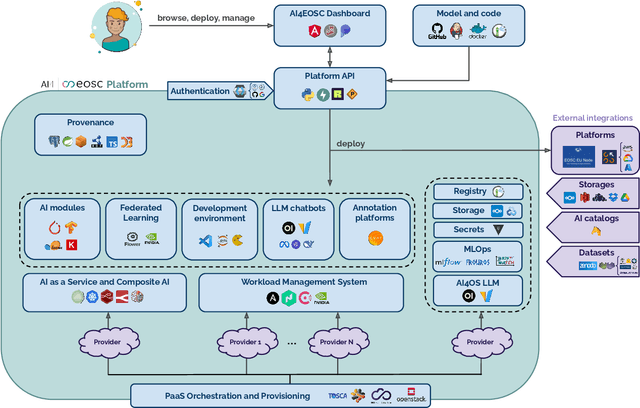
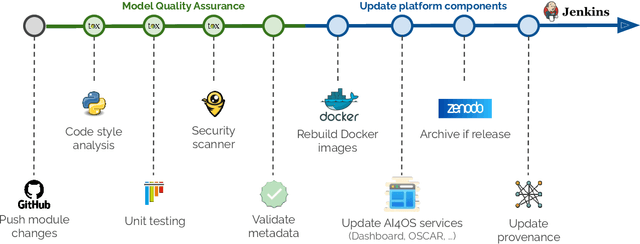
In this paper, we describe a federated compute platform dedicated to support Artificial Intelligence in scientific workloads. Putting the effort into reproducible deployments, it delivers consistent, transparent access to a federation of physically distributed e-Infrastructures. Through a comprehensive service catalogue, the platform is able to offer an integrated user experience covering the full Machine Learning lifecycle, including model development (with dedicated interactive development environments), training (with GPU resources, annotation tools, experiment tracking, and federated learning support) and deployment (covering a wide range of deployment options all along the Cloud Continuum). The platform also provides tools for traceability and reproducibility of AI models, integrates with different Artificial Intelligence model providers, datasets and storage resources, allowing users to interact with the broader Machine Learning ecosystem. Finally, it is easily customizable to lower the adoption barrier by external communities.
Generating Actionable Robot Knowledge Bases by Combining 3D Scene Graphs with Robot Ontologies
Jul 15, 2025In robotics, the effective integration of environmental data into actionable knowledge remains a significant challenge due to the variety and incompatibility of data formats commonly used in scene descriptions, such as MJCF, URDF, and SDF. This paper presents a novel approach that addresses these challenges by developing a unified scene graph model that standardizes these varied formats into the Universal Scene Description (USD) format. This standardization facilitates the integration of these scene graphs with robot ontologies through semantic reporting, enabling the translation of complex environmental data into actionable knowledge essential for cognitive robotic control. We evaluated our approach by converting procedural 3D environments into USD format, which is then annotated semantically and translated into a knowledge graph to effectively answer competency questions, demonstrating its utility for real-time robotic decision-making. Additionally, we developed a web-based visualization tool to support the semantic mapping process, providing users with an intuitive interface to manage the 3D environment.
Digital Twin Generation from Visual Data: A Survey
Apr 17, 2025This survey explores recent developments in generating digital twins from videos. Such digital twins can be used for robotics application, media content creation, or design and construction works. We analyze various approaches, including 3D Gaussian Splatting, generative in-painting, semantic segmentation, and foundation models highlighting their advantages and limitations. Additionally, we discuss challenges such as occlusions, lighting variations, and scalability, as well as potential future research directions. This survey aims to provide a comprehensive overview of state-of-the-art methodologies and their implications for real-world applications. Awesome list: https://github.com/ndrwmlnk/awesome-digital-twins
GPU-Accelerated Motion Planning of an Underactuated Forestry Crane in Cluttered Environments
Mar 18, 2025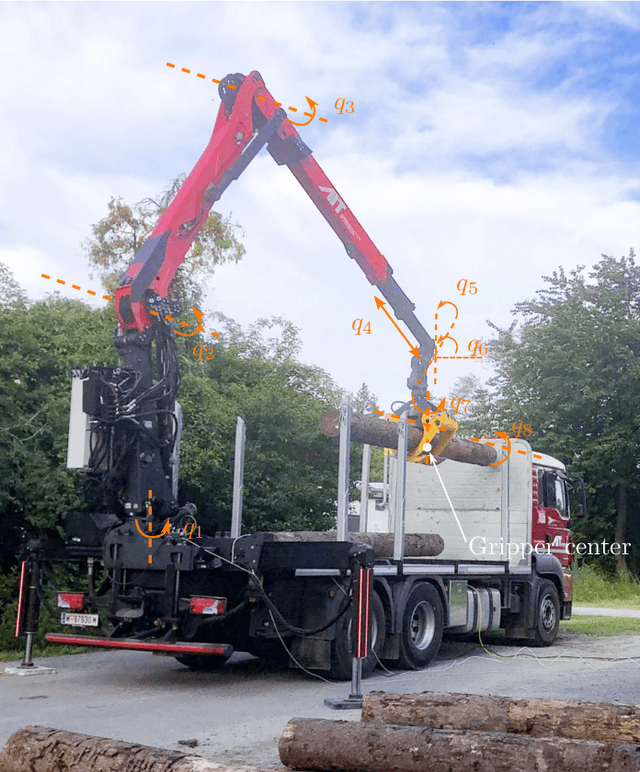

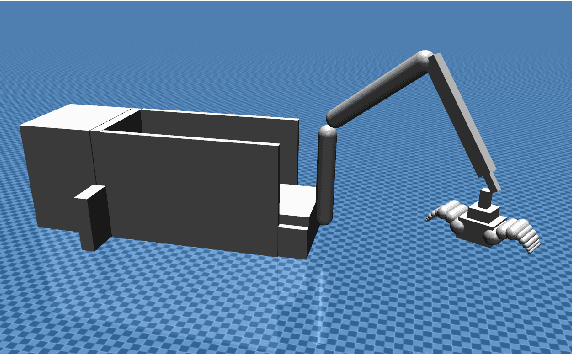
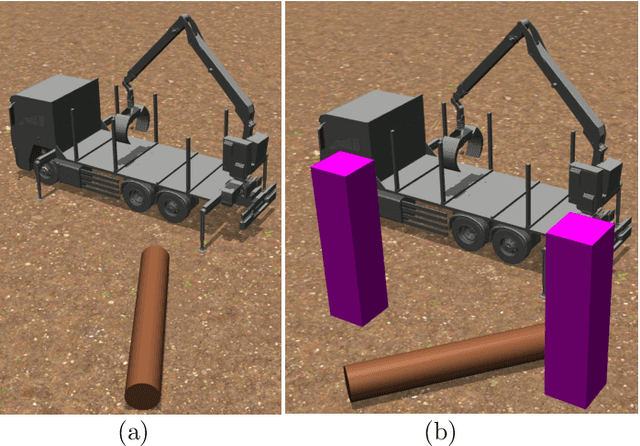
Autonomous large-scale machine operations require fast, efficient, and collision-free motion planning while addressing unique challenges such as hydraulic actuation limits and underactuated joint dynamics. This paper presents a novel two-step motion planning framework designed for an underactuated forestry crane. The first step employs GPU-accelerated stochastic optimization to rapidly compute a globally shortest collision-free path. The second step refines this path into a dynamically feasible trajectory using a trajectory optimizer that ensures compliance with system dynamics and actuation constraints. The proposed approach is benchmarked against conventional techniques, including RRT-based methods and purely optimization-based approaches. Simulation results demonstrate substantial improvements in computation speed and motion feasibility, making this method highly suitable for complex crane systems.
Crowdsource, Crawl, or Generate? Creating SEA-VL, a Multicultural Vision-Language Dataset for Southeast Asia
Mar 10, 2025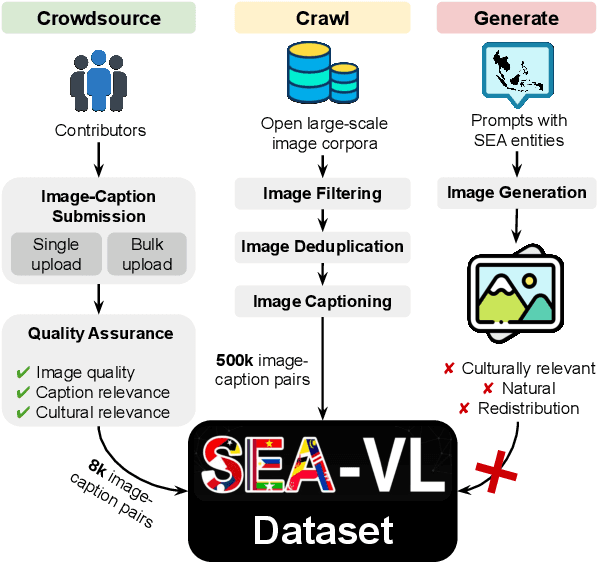
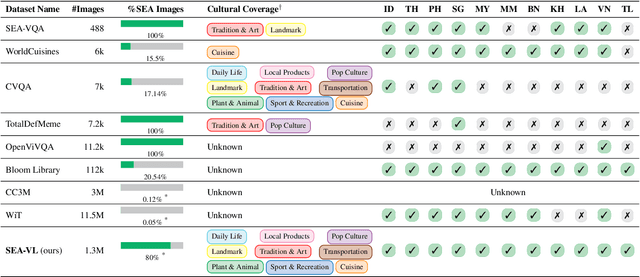
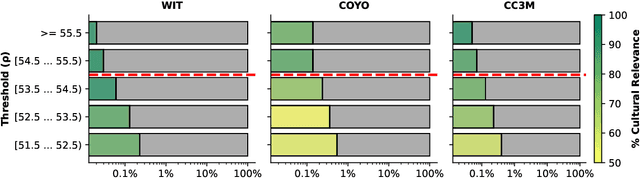
Southeast Asia (SEA) is a region of extraordinary linguistic and cultural diversity, yet it remains significantly underrepresented in vision-language (VL) research. This often results in artificial intelligence (AI) models that fail to capture SEA cultural nuances. To fill this gap, we present SEA-VL, an open-source initiative dedicated to developing high-quality, culturally relevant data for SEA languages. By involving contributors from SEA countries, SEA-VL aims to ensure better cultural relevance and diversity, fostering greater inclusivity of underrepresented languages in VL research. Beyond crowdsourcing, our initiative goes one step further in the exploration of the automatic collection of culturally relevant images through crawling and image generation. First, we find that image crawling achieves approximately ~85% cultural relevance while being more cost- and time-efficient than crowdsourcing. Second, despite the substantial progress in generative vision models, synthetic images remain unreliable in accurately reflecting SEA cultures. The generated images often fail to reflect the nuanced traditions and cultural contexts of the region. Collectively, we gather 1.28M SEA culturally-relevant images, more than 50 times larger than other existing datasets. Through SEA-VL, we aim to bridge the representation gap in SEA, fostering the development of more inclusive AI systems that authentically represent diverse cultures across SEA.
Allowing humans to interactively guide machines where to look does not always improve human-AI team's classification accuracy
Apr 14, 2024Via thousands of papers in Explainable AI (XAI), attention maps \cite{vaswani2017attention} and feature attribution maps \cite{bansal2020sam} have been established as a common means for finding how important each input feature is to an AI's decisions. It is an interesting, unexplored question whether allowing users to edit the feature importance at test time would improve a human-AI team's accuracy on downstream tasks. In this paper, we address this question by leveraging CHM-Corr, a state-of-the-art, ante-hoc explainable classifier \cite{taesiri2022visual} that first predicts patch-wise correspondences between the input and training-set images, and then base on them to make classification decisions. We build CHM-Corr++, an interactive interface for CHM-Corr, enabling users to edit the feature attribution map provided by CHM-Corr and observe updated model decisions. Via CHM-Corr++, users can gain insights into if, when, and how the model changes its outputs, improving their understanding beyond static explanations. However, our user study with 18 users who performed 1,400 decisions finds no statistical significance that our interactive approach improves user accuracy on CUB-200 bird image classification over static explanations. This challenges the hypothesis that interactivity can boost human-AI team accuracy~\cite{sokol2020one,sun2022exploring,shen2024towards,singh2024rethinking,mindlin2024beyond,lakkaraju2022rethinking,cheng2019explaining,liu2021understanding} and raises needs for future research. We open-source CHM-Corr++, an interactive tool for editing image classifier attention (see an interactive demo \href{http://137.184.82.109:7080/}{here}). % , and it lays the groundwork for future research to enable effective human-AI interaction in computer vision. We release code and data on \href{https://github.com/anguyen8/chm-corr-interactive}{github}.