 Add to Chrome
 Add to Firefox
 Add to Edge
Understanding the Challenges in Iterative Generative Optimization with LLMs
Mar 25, 2026
Generative optimization uses large language models (LLMs) to iteratively improve artifacts (such as code, workflows or prompts) using execution feedback. It is a promising approach to building self-improving agents, yet in practice remains brittle: despite active research, only 9% of surveyed agents used any automated optimization. We argue that this brittleness arises because, to set up a learning loop, an engineer must make ``hidden'' design choices: What can the optimizer edit and what is the "right" learning evidence to provide at each update? We investigate three factors that affect most applications: the starting artifact, the credit horizon for execution traces, and batching trials and errors into learning evidence. Through case studies in MLAgentBench, Atari, and BigBench Extra Hard, we find that these design decisions can determine whether generative optimization succeeds, yet they are rarely made explicit in prior work. Different starting artifacts determine which solutions are reachable in MLAgentBench, truncated traces can still improve Atari agents, and larger minibatches do not monotonically improve generalization on BBEH. We conclude that the lack of a simple, universal way to set up learning loops across domains is a major hurdle for productionization and adoption. We provide practical guidance for making these choices.

WHOLE: World-Grounded Hand-Object Lifted from Egocentric Videos
Feb 25, 2026Egocentric manipulation videos are highly challenging due to severe occlusions during interactions and frequent object entries and exits from the camera view as the person moves. Current methods typically focus on recovering either hand or object pose in isolation, but both struggle during interactions and fail to handle out-of-sight cases. Moreover, their independent predictions often lead to inconsistent hand-object relations. We introduce WHOLE, a method that holistically reconstructs hand and object motion in world space from egocentric videos given object templates. Our key insight is to learn a generative prior over hand-object motion to jointly reason about their interactions. At test time, the pretrained prior is guided to generate trajectories that conform to the video observations. This joint generative reconstruction substantially outperforms approaches that process hands and objects separately followed by post-processing. WHOLE achieves state-of-the-art performance on hand motion estimation, 6D object pose estimation, and their relative interaction reconstruction. Project website: https://judyye.github.io/whole-www
Learning Game-Playing Agents with Generative Code Optimization
Aug 27, 2025We present a generative optimization approach for learning game-playing agents, where policies are represented as Python programs and refined using large language models (LLMs). Our method treats decision-making policies as self-evolving code, with current observation as input and an in-game action as output, enabling agents to self-improve through execution traces and natural language feedback with minimal human intervention. Applied to Atari games, our game-playing Python program achieves performance competitive with deep reinforcement learning (RL) baselines while using significantly less training time and much fewer environment interactions. This work highlights the promise of programmatic policy representations for building efficient, adaptable agents capable of complex, long-horizon reasoning.
Automated Bug Generation in the era of Large Language Models
Oct 03, 2023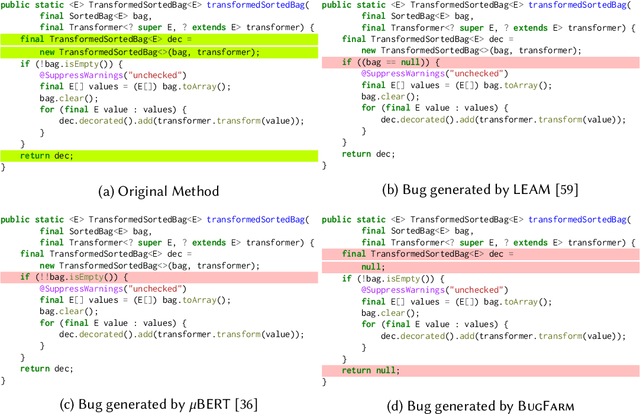
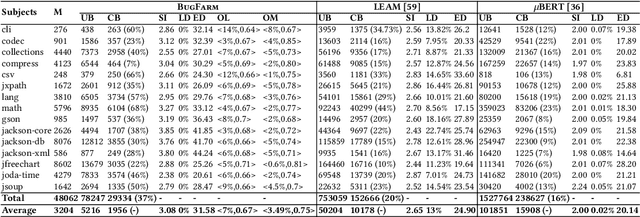

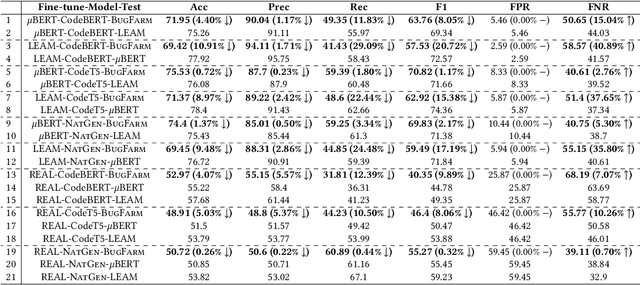
Bugs are essential in software engineering; many research studies in the past decades have been proposed to detect, localize, and repair bugs in software systems. Effectiveness evaluation of such techniques requires complex bugs, i.e., those that are hard to detect through testing and hard to repair through debugging. From the classic software engineering point of view, a hard-to-repair bug differs from the correct code in multiple locations, making it hard to localize and repair. Hard-to-detect bugs, on the other hand, manifest themselves under specific test inputs and reachability conditions. These two objectives, i.e., generating hard-to-detect and hard-to-repair bugs, are mostly aligned; a bug generation technique can change multiple statements to be covered only under a specific set of inputs. However, these two objectives are conflicting for learning-based techniques: A bug should have a similar code representation to the correct code in the training data to challenge a bug prediction model to distinguish them. The hard-to-repair bug definition remains the same but with a caveat: the more a bug differs from the original code (at multiple locations), the more distant their representations are and easier to be detected. We propose BugFarm, to transform arbitrary code into multiple complex bugs. BugFarm leverages LLMs to mutate code in multiple locations (hard-to-repair). To ensure that multiple modifications do not notably change the code representation, BugFarm analyzes the attention of the underlying model and instructs LLMs to only change the least attended locations (hard-to-detect). Our comprehensive evaluation of 320k+ bugs from over 2.5M mutants generated by BugFarm and two alternative approaches demonstrates our superiority in generating bugs that are hard to detect by learning-based bug prediction approaches and hard to repair by SOTA learning-based program repair technique.