 Add to Chrome
 Add to Firefox
 Add to Edge
Precipitation Forecasting
Papers and Code
Extreme Weather Nowcasting via Local Precipitation Pattern Prediction
Feb 05, 2026
Accurate forecasting of extreme weather events such as heavy rainfall or storms is critical for risk management and disaster mitigation. Although high-resolution radar observations have spurred extensive research on nowcasting models, precipitation nowcasting remains particularly challenging due to pronounced spatial locality, intricate fine-scale rainfall structures, and variability in forecasting horizons. While recent diffusion-based generative ensembles show promising results, they are computationally expensive and unsuitable for real-time applications. In contrast, deterministic models are computationally efficient but remain biased toward normal rainfall. Furthermore, the benchmark datasets commonly used in prior studies are themselves skewed--either dominated by ordinary rainfall events or restricted to extreme rainfall episodes--thereby hindering general applicability in real-world settings. In this paper, we propose exPreCast, an efficient deterministic framework for generating finely detailed radar forecasts, and introduce a newly constructed balanced radar dataset from the Korea Meteorological Administration (KMA), which encompasses both ordinary precipitation and extreme events. Our model integrates local spatiotemporal attention, a texture-preserving cubic dual upsampling decoder, and a temporal extractor to flexibly adjust forecasting horizons. Experiments on established benchmarks (SEVIR and MeteoNet) as well as on the balanced KMA dataset demonstrate that our approach achieves state-of-the-art performance, delivering accurate and reliable nowcasts across both normal and extreme rainfall regimes.

WADEPre: A Wavelet-based Decomposition Model for Extreme Precipitation Nowcasting with Multi-Scale Learning
Feb 02, 2026The heavy-tailed nature of precipitation intensity impedes precise precipitation nowcasting. Standard models that optimize pixel-wise losses are prone to regression-to-the-mean bias, which blurs extreme values. Existing Fourier-based methods also lack the spatial localization needed to resolve transient convective cells. To overcome these intrinsic limitations, we propose WADEPre, a wavelet-based decomposition model for extreme precipitation that transitions the modeling into the wavelet domain. By leveraging the Discrete Wavelet Transform for explicit decomposition, WADEPre employs a dual-branch architecture: an Approximation Network to model stable, low-frequency advection, isolating deterministic trends from statistical bias, and a spatially localized Detail Network to capture high-frequency stochastic convection, resolving transient singularities and preserving sharp boundaries. A subsequent Refiner module then dynamically reconstructs these decoupled multi-scale components into the final high-fidelity forecast. To address optimization instability, we introduce a multi-scale curriculum learning strategy that progressively shifts supervision from coarse scales to fine-grained details. Extensive experiments on the SEVIR and Shanghai Radar datasets demonstrate that WADEPre achieves state-of-the-art performance, yielding significant improvements in capturing extreme thresholds and maintaining structural fidelity. Our code is available at https://github.com/sonderlau/WADEPre.
Long-Term Probabilistic Forecast of Vegetation Conditions Using Climate Attributes in the Four Corners Region
Jan 22, 2026Weather conditions can drastically alter the state of crops and rangelands, and in turn, impact the incomes and food security of individuals worldwide. Satellite-based remote sensing offers an effective way to monitor vegetation and climate variables on regional and global scales. The annual peak Normalized Difference Vegetation Index (NDVI), derived from satellite observations, is closely associated with crop development, rangeland biomass, and vegetation growth. Although various machine learning methods have been developed to forecast NDVI over short time ranges, such as one-month-ahead predictions, long-term forecasting approaches, such as one-year-ahead predictions of vegetation conditions, are not yet available. To fill this gap, we develop a two-phase machine learning model to forecast the one-year-ahead peak NDVI over high-resolution grids, using the Four Corners region of the Southwestern United States as a testbed. In phase one, we identify informative climate attributes, including precipitation and maximum vapor pressure deficit, and develop the generalized parallel Gaussian process that captures the relationship between climate attributes and NDVI. In phase two, we forecast these climate attributes using historical data at least one year before the NDVI prediction month, which then serve as inputs to forecast the peak NDVI at each spatial grid. We developed open-source tools that outperform alternative methods for both gross NDVI and grid-based NDVI one-year forecasts, providing information that can help farmers and ranchers make actionable plans a year in advance.
A Dataset of Dengue Hospitalizations in Brazil (1999 to 2021) with Weekly Disaggregation from Monthly Counts
Jan 12, 2026This data paper describes and publicly releases this dataset (v1.0.0), published on Zenodo under DOI 10.5281/zenodo.18189192. Motivated by the need to increase the temporal granularity of originally monthly data to enable more effective training of AI models for epidemiological forecasting, the dataset harmonizes municipal-level dengue hospitalization time series across Brazil and disaggregates them to weekly resolution (epidemiological weeks) through an interpolation protocol with a correction step that preserves monthly totals. The statistical and temporal validity of this disaggregation was assessed using a high-resolution reference dataset from the state of Sao Paulo (2024), which simultaneously provides monthly and epidemiological-week counts, enabling a direct comparison of three strategies: linear interpolation, jittering, and cubic spline. Results indicated that cubic spline interpolation achieved the highest adherence to the reference data, and this strategy was therefore adopted to generate weekly series for the 1999 to 2021 period. In addition to hospitalization time series, the dataset includes a comprehensive set of explanatory variables commonly used in epidemiological and environmental modeling, such as demographic density, CH4, CO2, and NO2 emissions, poverty and urbanization indices, maximum temperature, mean monthly precipitation, minimum relative humidity, and municipal latitude and longitude, following the same temporal disaggregation scheme to ensure multivariate compatibility. The paper documents the datasets provenance, structure, formats, licenses, limitations, and quality metrics (MAE, RMSE, R2, KL, JSD, DTW, and the KS test), and provides usage recommendations for multivariate time-series analysis, environmental health studies, and the development of machine learning and deep learning models for outbreak forecasting.
STIPP: Space-time in situ postprocessing over the French Alps using proper scoring rules
Jan 06, 2026We propose Space-time in situ postprocessing (STIPP), a machine learning model that generates spatio-temporally consistent weather forecasts for a network of station locations. Gridded forecasts from classical numerical weather prediction or data-driven models often lack the necessary precision due to unresolved local effects. Typical statistical postprocessing methods correct these biases, but often degrade spatio-temporal correlation structures in doing so. Recent works based on generative modeling successfully improve spatial correlation structures but have to forecast every lead time independently. In contrast, STIPP makes joint spatio-temporal forecasts which have increased accuracy for surface temperature, wind, relative humidity and precipitation when compared to baseline methods. It makes hourly ensemble predictions given only a six-hourly deterministic forecast, blending the boundaries of postprocessing and temporal interpolation. By leveraging a multivariate proper scoring rule for training, STIPP contributes to ongoing work data-driven atmospheric models supervised only with distribution marginals.
REE-TTT: Highly Adaptive Radar Echo Extrapolation Based on Test-Time Training
Jan 04, 2026Precipitation nowcasting is critically important for meteorological forecasting. Deep learning-based Radar Echo Extrapolation (REE) has become a predominant nowcasting approach, yet it suffers from poor generalization due to its reliance on high-quality local training data and static model parameters, limiting its applicability across diverse regions and extreme events. To overcome this, we propose REE-TTT, a novel model that incorporates an adaptive Test-Time Training (TTT) mechanism. The core of our model lies in the newly designed Spatio-temporal Test-Time Training (ST-TTT) block, which replaces the standard linear projections in TTT layers with task-specific attention mechanisms, enabling robust adaptation to non-stationary meteorological distributions and thereby significantly enhancing the feature representation of precipitation. Experiments under cross-regional extreme precipitation scenarios demonstrate that REE-TTT substantially outperforms state-of-the-art baseline models in prediction accuracy and generalization, exhibiting remarkable adaptability to data distribution shifts.
Spatio-temporal modeling and forecasting with Fourier neural operators
Jan 05, 2026Spatio-temporal process models are often used for modeling dynamic physical and biological phenomena that evolve across space and time. These phenomena may exhibit environmental heterogeneity and complex interactions that are difficult to capture using traditional statistical process models such as Gaussian processes. This work proposes the use of Fourier neural operators (FNOs) for constructing statistical dynamical spatio-temporal models for forecasting. An FNO is a flexible mapping of functions that approximates the solution operator of possibly unknown linear or non-linear partial differential equations (PDEs) in a computationally efficient manner. It does so using samples of inputs and their respective outputs, and hence explicit knowledge of the underlying PDE is not required. Through simulations from a nonlinear PDE with known solution, we compare FNO forecasts to those from state-of-the-art statistical spatio-temporal-forecasting methods. Further, using sea surface temperature data over the Atlantic Ocean and precipitation data across Europe, we demonstrate the ability of FNO-based dynamic spatio-temporal (DST) statistical modeling to capture complex real-world spatio-temporal dependencies. Using collections of testing instances, we show that the FNO-DST forecasts are accurate with valid uncertainty quantification.
DK-STN: A Domain Knowledge Embedded Spatio-Temporal Network Model for MJO Forecast
Dec 22, 2025
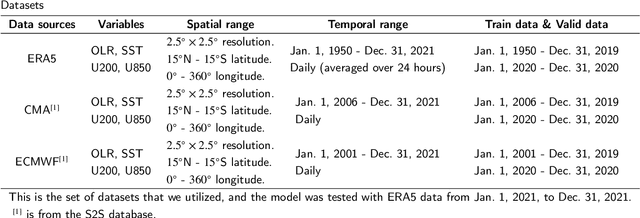
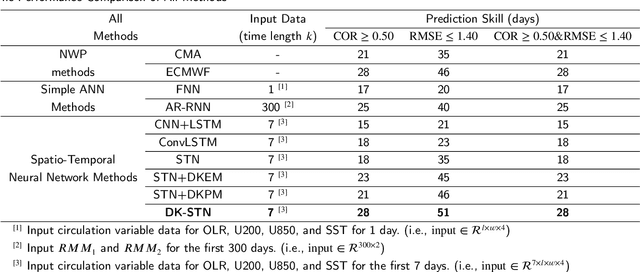

Understanding and predicting the Madden-Julian Oscillation (MJO) is fundamental for precipitation forecasting and disaster prevention. To date, long-term and accurate MJO prediction has remained a challenge for researchers. Conventional MJO prediction methods using Numerical Weather Prediction (NWP) are resource-intensive, time-consuming, and highly unstable (most NWP methods are sensitive to seasons, with better MJO forecast results in winter). While existing Artificial Neural Network (ANN) methods save resources and speed forecasting, their accuracy never reaches the 28 days predicted by the state-of-the-art NWP method, i.e., the operational forecasts from ECMWF, since neural networks cannot handle climate data effectively. In this paper, we present a Domain Knowledge Embedded Spatio-Temporal Network (DK-STN), a stable neural network model for accurate and efficient MJO forecasting. It combines the benefits of NWP and ANN methods and successfully improves the forecast accuracy of ANN methods while maintaining a high level of efficiency and stability. We begin with a spatial-temporal network (STN) and embed domain knowledge in it using two key methods: (i) applying a domain knowledge enhancement method and (ii) integrating a domain knowledge processing method into network training. We evaluated DK-STN with the 5th generation of ECMWF reanalysis (ERA5) data and compared it with ECMWF. Given 7 days of climate data as input, DK-STN can generate reliable forecasts for the following 28 days in 1-2 seconds, with an error of only 2-3 days in different seasons. DK-STN significantly exceeds ECMWF in that its forecast accuracy is equivalent to ECMWF's, while its efficiency and stability are significantly superior.
LangPrecip: Language-Aware Multimodal Precipitation Nowcasting
Dec 26, 2025Short-term precipitation nowcasting is an inherently uncertain and under-constrained spatiotemporal forecasting problem, especially for rapidly evolving and extreme weather events. Existing generative approaches rely primarily on visual conditioning, leaving future motion weakly constrained and ambiguous. We propose a language-aware multimodal nowcasting framework(LangPrecip) that treats meteorological text as a semantic motion constraint on precipitation evolution. By formulating nowcasting as a semantically constrained trajectory generation problem under the Rectified Flow paradigm, our method enables efficient and physically consistent integration of textual and radar information in latent space.We further introduce LangPrecip-160k, a large-scale multimodal dataset with 160k paired radar sequences and motion descriptions. Experiments on Swedish and MRMS datasets show consistent improvements over state-of-the-art methods, achieving over 60 \% and 19\% gains in heavy-rainfall CSI at an 80-minute lead time.
Exploring Machine Learning, Deep Learning, and Explainable AI Methods for Seasonal Precipitation Prediction in South America
Dec 15, 2025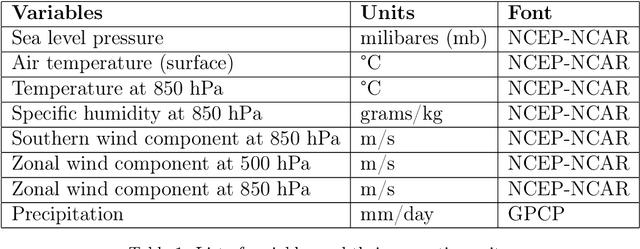
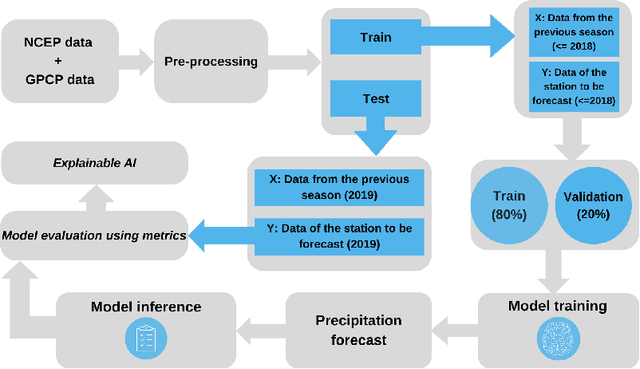
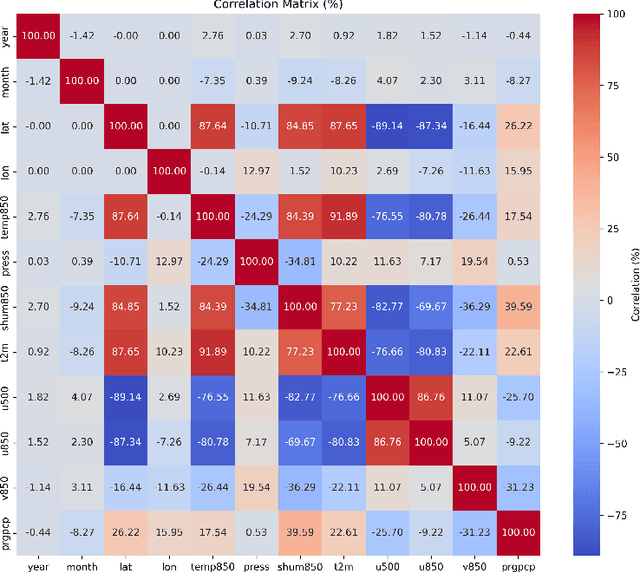
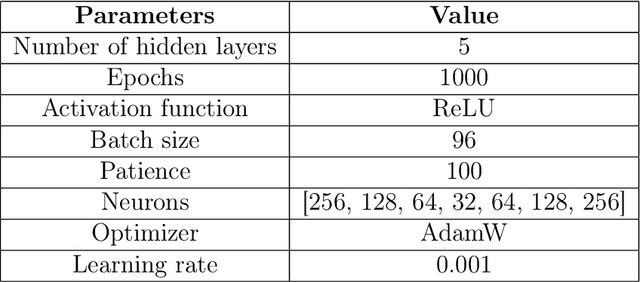
Forecasting meteorological variables is challenging due to the complexity of their processes, requiring advanced models for accuracy. Accurate precipitation forecasts are vital for society. Reliable predictions help communities mitigate climatic impacts. Based on the current relevance of artificial intelligence (AI), classical machine learning (ML) and deep learning (DL) techniques have been used as an alternative or complement to dynamic modeling. However, there is still a lack of broad investigations into the feasibility of purely data-driven approaches for precipitation forecasting. This study aims at addressing this issue where different classical ML and DL approaches for forecasting precipitation in South America, taking into account all 2019 seasons, are considered in a detailed investigation. The selected classical ML techniques were Random Forests and extreme gradient boosting (XGBoost), while the DL counterparts were a 1D convolutional neural network (CNN 1D), a long short-term memory (LSTM) model, and a gated recurrent unit (GRU) model. Additionally, the Brazilian Global Atmospheric Model (BAM) was used as a representative of the traditional dynamic modeling approach. We also relied on explainable artificial intelligence (XAI) to provide some explanations for the models behaviors. LSTM showed strong predictive performance while BAM, the traditional dynamic model representative, had the worst results. Despite presented the higher latency, LSTM was most accurate for heavy precipitation. If cost is a concern, XGBoost offers lower latency with slightly accuracy loss. The results of this research confirm the viability of DL models for climate forecasting, solidifying a global trend in major meteorological and climate forecasting centers.