 Add to Chrome
 Add to Firefox
 Add to Edge
DK-STN: A Domain Knowledge Embedded Spatio-Temporal Network Model for MJO Forecast
Dec 22, 2025

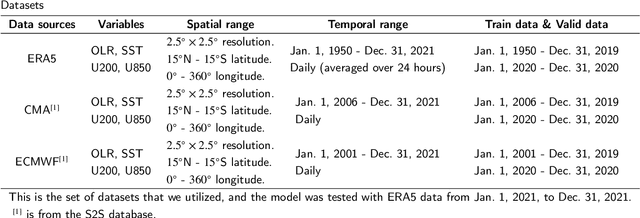
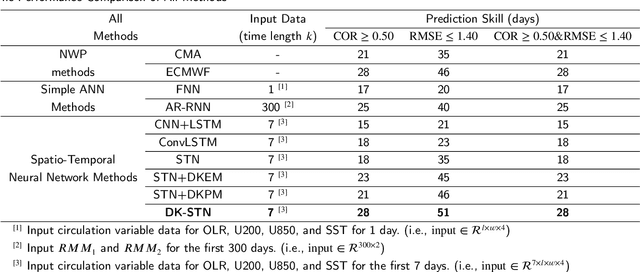

Understanding and predicting the Madden-Julian Oscillation (MJO) is fundamental for precipitation forecasting and disaster prevention. To date, long-term and accurate MJO prediction has remained a challenge for researchers. Conventional MJO prediction methods using Numerical Weather Prediction (NWP) are resource-intensive, time-consuming, and highly unstable (most NWP methods are sensitive to seasons, with better MJO forecast results in winter). While existing Artificial Neural Network (ANN) methods save resources and speed forecasting, their accuracy never reaches the 28 days predicted by the state-of-the-art NWP method, i.e., the operational forecasts from ECMWF, since neural networks cannot handle climate data effectively. In this paper, we present a Domain Knowledge Embedded Spatio-Temporal Network (DK-STN), a stable neural network model for accurate and efficient MJO forecasting. It combines the benefits of NWP and ANN methods and successfully improves the forecast accuracy of ANN methods while maintaining a high level of efficiency and stability. We begin with a spatial-temporal network (STN) and embed domain knowledge in it using two key methods: (i) applying a domain knowledge enhancement method and (ii) integrating a domain knowledge processing method into network training. We evaluated DK-STN with the 5th generation of ECMWF reanalysis (ERA5) data and compared it with ECMWF. Given 7 days of climate data as input, DK-STN can generate reliable forecasts for the following 28 days in 1-2 seconds, with an error of only 2-3 days in different seasons. DK-STN significantly exceeds ECMWF in that its forecast accuracy is equivalent to ECMWF's, while its efficiency and stability are significantly superior.

HiHa: Introducing Hierarchical Harmonic Decomposition to Implicit Neural Compression for Atmospheric Data
Nov 09, 2024
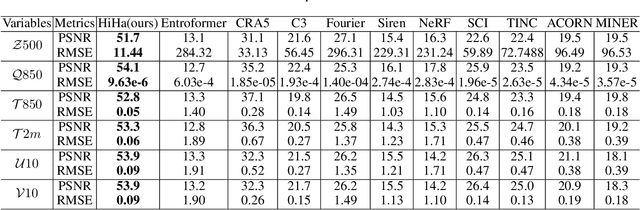
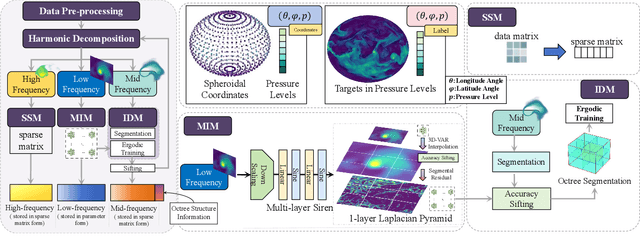
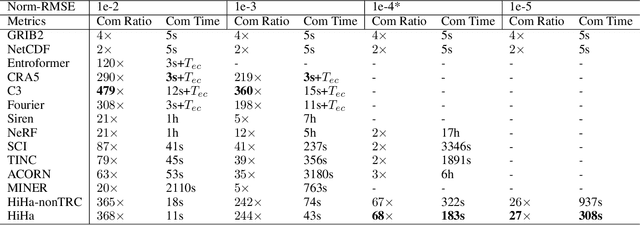
The rapid development of large climate models has created the requirement of storing and transferring massive atmospheric data worldwide. Therefore, data compression is essential for meteorological research, but an efficient compression scheme capable of keeping high accuracy with high compressibility is still lacking. As an emerging technique, Implicit Neural Representation (INR) has recently acquired impressive momentum and demonstrates high promise for compressing diverse natural data. However, the INR-based compression encounters a bottleneck due to the sophisticated spatio-temporal properties and variability. To address this issue, we propose Hierarchical Harmonic decomposition implicit neural compression (HiHa) for atmospheric data. HiHa firstly segments the data into multi-frequency signals through decomposition of multiple complex harmonic, and then tackles each harmonic respectively with a frequency-based hierarchical compression module consisting of sparse storage, multi-scale INR and iterative decomposition sub-modules. We additionally design a temporal residual compression module to accelerate compression by utilizing temporal continuity. Experiments depict that HiHa outperforms both mainstream compressors and other INR-based methods in both compression fidelity and capabilities, and also demonstrate that using compressed data in existing data-driven models can achieve the same accuracy as raw data.