 Add to Chrome
 Add to Firefox
 Add to Edge
DK-STN: A Domain Knowledge Embedded Spatio-Temporal Network Model for MJO Forecast
Dec 22, 2025

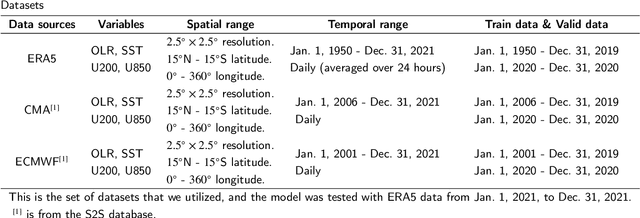
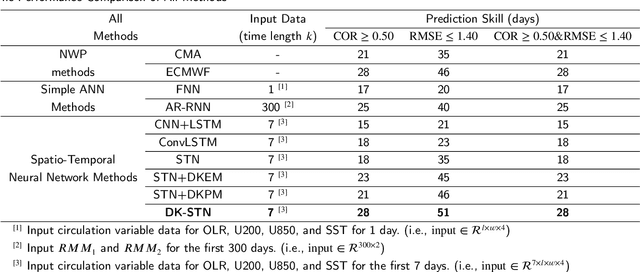

Understanding and predicting the Madden-Julian Oscillation (MJO) is fundamental for precipitation forecasting and disaster prevention. To date, long-term and accurate MJO prediction has remained a challenge for researchers. Conventional MJO prediction methods using Numerical Weather Prediction (NWP) are resource-intensive, time-consuming, and highly unstable (most NWP methods are sensitive to seasons, with better MJO forecast results in winter). While existing Artificial Neural Network (ANN) methods save resources and speed forecasting, their accuracy never reaches the 28 days predicted by the state-of-the-art NWP method, i.e., the operational forecasts from ECMWF, since neural networks cannot handle climate data effectively. In this paper, we present a Domain Knowledge Embedded Spatio-Temporal Network (DK-STN), a stable neural network model for accurate and efficient MJO forecasting. It combines the benefits of NWP and ANN methods and successfully improves the forecast accuracy of ANN methods while maintaining a high level of efficiency and stability. We begin with a spatial-temporal network (STN) and embed domain knowledge in it using two key methods: (i) applying a domain knowledge enhancement method and (ii) integrating a domain knowledge processing method into network training. We evaluated DK-STN with the 5th generation of ECMWF reanalysis (ERA5) data and compared it with ECMWF. Given 7 days of climate data as input, DK-STN can generate reliable forecasts for the following 28 days in 1-2 seconds, with an error of only 2-3 days in different seasons. DK-STN significantly exceeds ECMWF in that its forecast accuracy is equivalent to ECMWF's, while its efficiency and stability are significantly superior.

Finding Lookalike Customers for E-Commerce Marketing
Jan 09, 2023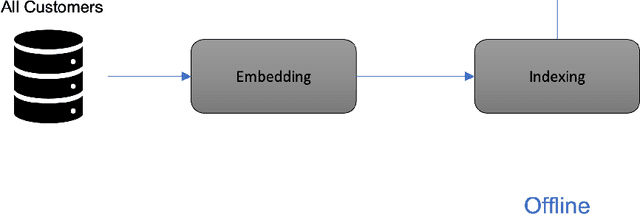

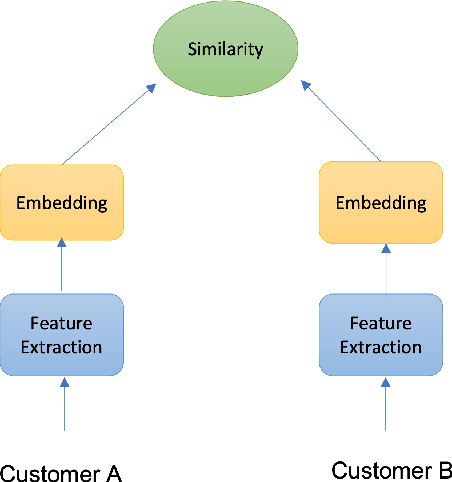

Customer-centric marketing campaigns generate a large portion of e-commerce website traffic for Walmart. As the scale of customer data grows larger, expanding the marketing audience to reach more customers is becoming more critical for e-commerce companies to drive business growth and bring more value to customers. In this paper, we present a scalable and efficient system to expand targeted audience of marketing campaigns, which can handle hundreds of millions of customers. We use a deep learning based embedding model to represent customers and an approximate nearest neighbor search method to quickly find lookalike customers of interest. The model can deal with various business interests by constructing interpretable and meaningful customer similarity metrics. We conduct extensive experiments to demonstrate the great performance of our system and customer embedding model.