 Add to Chrome
 Add to Firefox
 Add to Edge
Furniture Segmentation
Papers and Code
Multifaceted Exploration of Spatial Openness in Rental Housing: A Big Data Analysis in Tokyo's 23 Wards
Dec 20, 2025
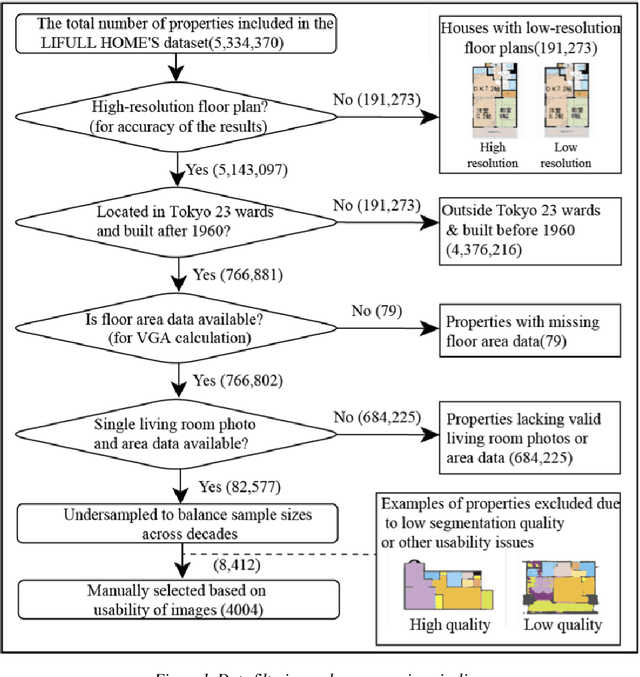
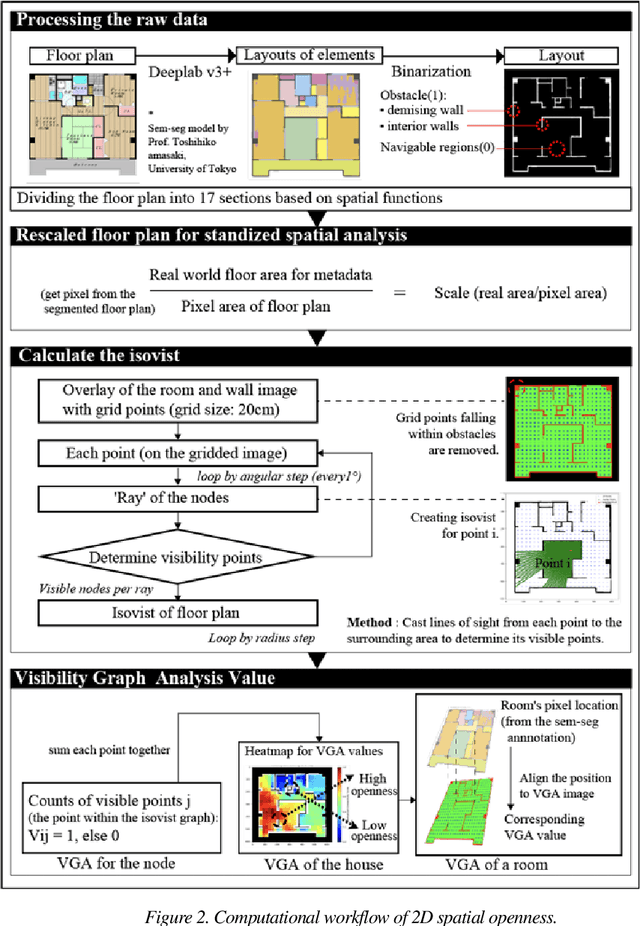
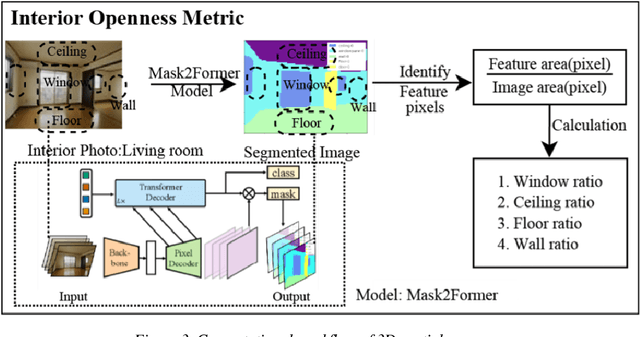
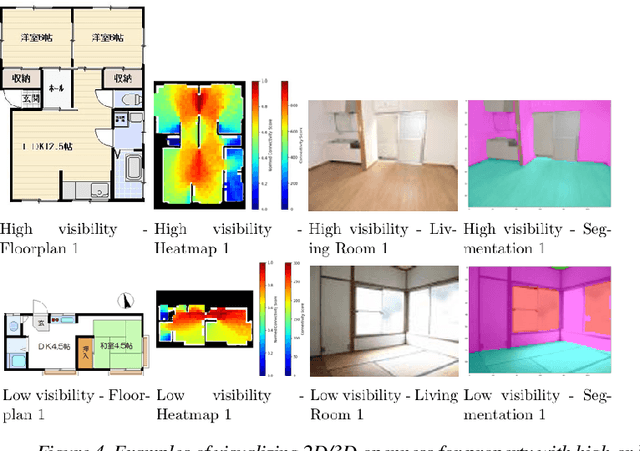
Understanding spatial openness is vital for improving residential quality and design; however, studies often treat its influencing factors separately. This study developed a quantitative framework to evaluate the spatial openness in housing from two- (2D) and three- (3D) dimensional perspectives. Using data from 4,004 rental units in Tokyo's 23 wards, we examined the temporal and spatial variations in openness and its relationship with rent and housing attributes. 2D openness was computed via planar visibility using visibility graph analysis (VGA) from floor plans, whereas 3D openness was derived from interior images analysed using Mask2Former, a semantic segmentation model that identifies walls, ceilings, floors, and windows. The results showed an increase in living room visibility and a 1990s peak in overall openness. Spatial analyses revealed partial correlations among openness, rent, and building characteristics, reflecting urban redevelopment trends. Although the 2D and 3D openness indicators were not directly correlated, higher openness tended to correspond to higher rent. The impression scores predicted by the existing models were only weakly related to openness, suggesting that the interior design and furniture more strongly shape perceived space. This study offers a new multidimensional data-driven framework for quantifying residential spatial openness and linking it with urban and market dynamics.

Defurnishing with X-Ray Vision: Joint Removal of Furniture from Panoramas and Mesh
Jun 06, 2025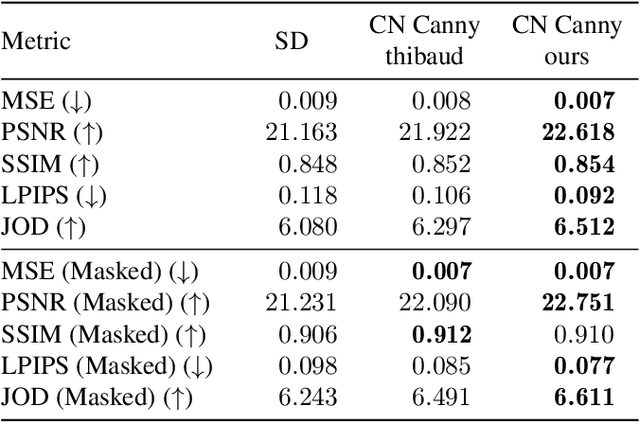
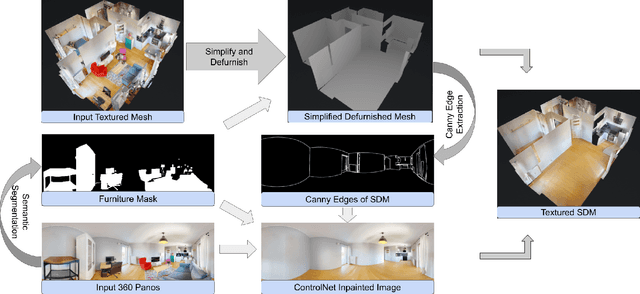
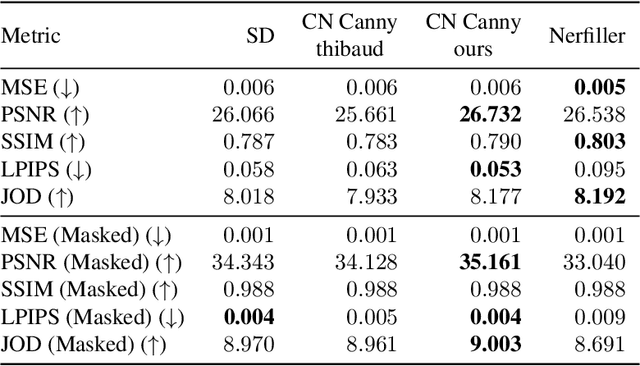

We present a pipeline for generating defurnished replicas of indoor spaces represented as textured meshes and corresponding multi-view panoramic images. To achieve this, we first segment and remove furniture from the mesh representation, extend planes, and fill holes, obtaining a simplified defurnished mesh (SDM). This SDM acts as an ``X-ray'' of the scene's underlying structure, guiding the defurnishing process. We extract Canny edges from depth and normal images rendered from the SDM. We then use these as a guide to remove the furniture from panorama images via ControlNet inpainting. This control signal ensures the availability of global geometric information that may be hidden from a particular panoramic view by the furniture being removed. The inpainted panoramas are used to texture the mesh. We show that our approach produces higher quality assets than methods that rely on neural radiance fields, which tend to produce blurry low-resolution images, or RGB-D inpainting, which is highly susceptible to hallucinations.
Multi-dataset synergistic in supervised learning to pre-label structural components in point clouds from shell construction scenes
Feb 20, 2025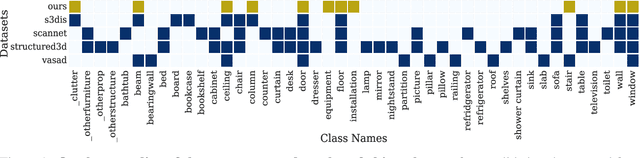
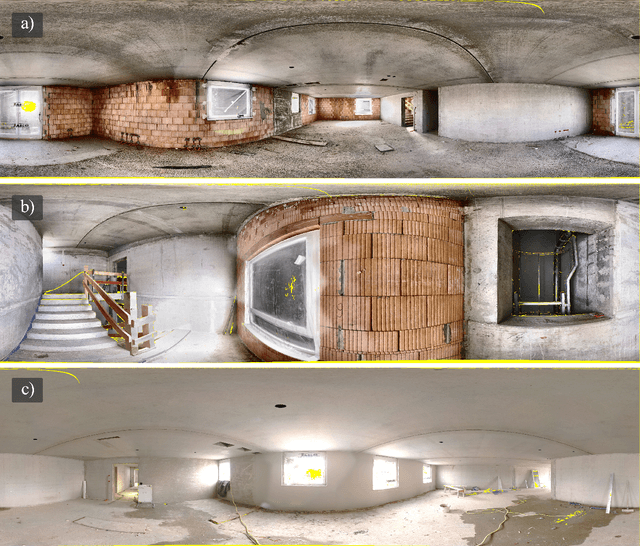
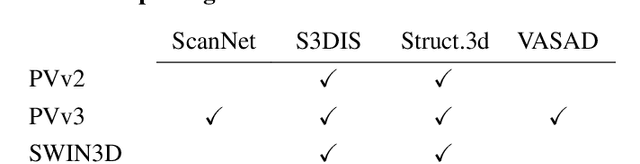
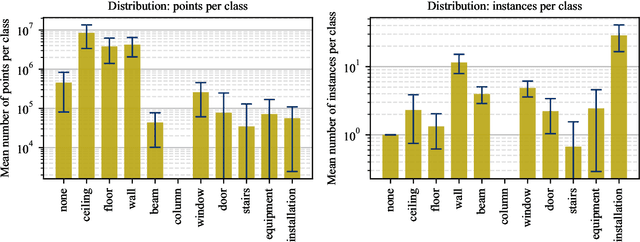
The significant effort required to annotate data for new training datasets hinders computer vision research and machine learning in the construction industry. This work explores adapting standard datasets and the latest transformer model architectures for point cloud semantic segmentation in the context of shell construction sites. Unlike common approaches focused on object segmentation of building interiors and furniture, this study addressed the challenges of segmenting complex structural components in Architecture, Engineering, and Construction (AEC). We establish a baseline through supervised training and a custom validation dataset, evaluate the cross-domain inference with large-scale indoor datasets, and utilize transfer learning to maximize segmentation performance with minimal new data. The findings indicate that with minimal fine-tuning, pre-trained transformer architectures offer an effective strategy for building component segmentation. Our results are promising for automating the annotation of new, previously unseen data when creating larger training resources and for the segmentation of frequently recurring objects.
IKEA Manuals at Work: 4D Grounding of Assembly Instructions on Internet Videos
Nov 18, 2024Shape assembly is a ubiquitous task in daily life, integral for constructing complex 3D structures like IKEA furniture. While significant progress has been made in developing autonomous agents for shape assembly, existing datasets have not yet tackled the 4D grounding of assembly instructions in videos, essential for a holistic understanding of assembly in 3D space over time. We introduce IKEA Video Manuals, a dataset that features 3D models of furniture parts, instructional manuals, assembly videos from the Internet, and most importantly, annotations of dense spatio-temporal alignments between these data modalities. To demonstrate the utility of IKEA Video Manuals, we present five applications essential for shape assembly: assembly plan generation, part-conditioned segmentation, part-conditioned pose estimation, video object segmentation, and furniture assembly based on instructional video manuals. For each application, we provide evaluation metrics and baseline methods. Through experiments on our annotated data, we highlight many challenges in grounding assembly instructions in videos to improve shape assembly, including handling occlusions, varying viewpoints, and extended assembly sequences.
Subtask-Aware Visual Reward Learning from Segmented Demonstrations
Feb 28, 2025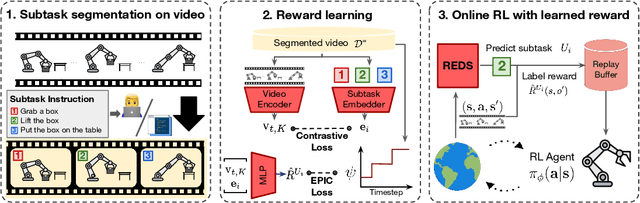
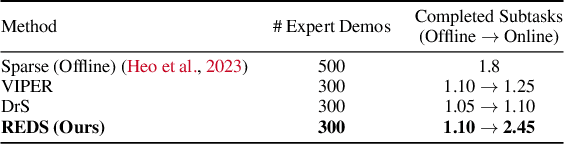
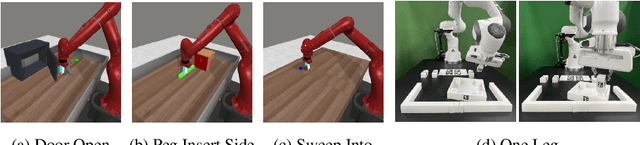
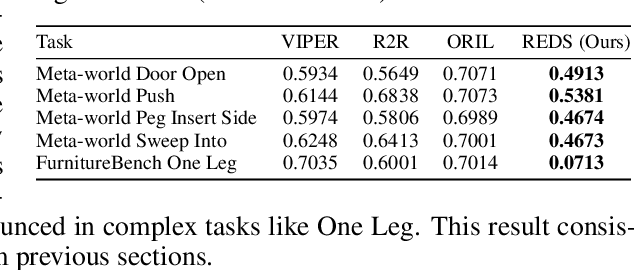
Reinforcement Learning (RL) agents have demonstrated their potential across various robotic tasks. However, they still heavily rely on human-engineered reward functions, requiring extensive trial-and-error and access to target behavior information, often unavailable in real-world settings. This paper introduces REDS: REward learning from Demonstration with Segmentations, a novel reward learning framework that leverages action-free videos with minimal supervision. Specifically, REDS employs video demonstrations segmented into subtasks from diverse sources and treats these segments as ground-truth rewards. We train a dense reward function conditioned on video segments and their corresponding subtasks to ensure alignment with ground-truth reward signals by minimizing the Equivalent-Policy Invariant Comparison distance. Additionally, we employ contrastive learning objectives to align video representations with subtasks, ensuring precise subtask inference during online interactions. Our experiments show that REDS significantly outperforms baseline methods on complex robotic manipulation tasks in Meta-World and more challenging real-world tasks, such as furniture assembly in FurnitureBench, with minimal human intervention. Moreover, REDS facilitates generalization to unseen tasks and robot embodiments, highlighting its potential for scalable deployment in diverse environments.
Semantic Layering in Room Segmentation via LLMs
Mar 19, 2024


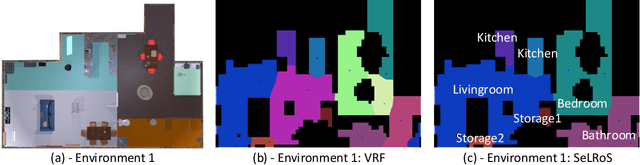
In this paper, we introduce Semantic Layering in Room Segmentation via LLMs (SeLRoS), an advanced method for semantic room segmentation by integrating Large Language Models (LLMs) with traditional 2D map-based segmentation. Unlike previous approaches that solely focus on the geometric segmentation of indoor environments, our work enriches segmented maps with semantic data, including object identification and spatial relationships, to enhance robotic navigation. By leveraging LLMs, we provide a novel framework that interprets and organizes complex information about each segmented area, thereby improving the accuracy and contextual relevance of room segmentation. Furthermore, SeLRoS overcomes the limitations of existing algorithms by using a semantic evaluation method to accurately distinguish true room divisions from those erroneously generated by furniture and segmentation inaccuracies. The effectiveness of SeLRoS is verified through its application across 30 different 3D environments. Source code and experiment videos for this work are available at: https://sites.google.com/view/selros.
Generalize by Touching: Tactile Ensemble Skill Transfer for Robotic Furniture Assembly
Apr 26, 2024Furniture assembly remains an unsolved problem in robotic manipulation due to its long task horizon and nongeneralizable operations plan. This paper presents the Tactile Ensemble Skill Transfer (TEST) framework, a pioneering offline reinforcement learning (RL) approach that incorporates tactile feedback in the control loop. TEST's core design is to learn a skill transition model for high-level planning, along with a set of adaptive intra-skill goal-reaching policies. Such design aims to solve the robotic furniture assembly problem in a more generalizable way, facilitating seamless chaining of skills for this long-horizon task. We first sample demonstration from a set of heuristic policies and trajectories consisting of a set of randomized sub-skill segments, enabling the acquisition of rich robot trajectories that capture skill stages, robot states, visual indicators, and crucially, tactile signals. Leveraging these trajectories, our offline RL method discerns skill termination conditions and coordinates skill transitions. Our evaluations highlight the proficiency of TEST on the in-distribution furniture assemblies, its adaptability to unseen furniture configurations, and its robustness against visual disturbances. Ablation studies further accentuate the pivotal role of two algorithmic components: the skill transition model and tactile ensemble policies. Results indicate that TEST can achieve a success rate of 90\% and is over 4 times more efficient than the heuristic policy in both in-distribution and generalization settings, suggesting a scalable skill transfer approach for contact-rich manipulation.
Approximately Piecewise E(3) Equivariant Point Networks
Feb 13, 2024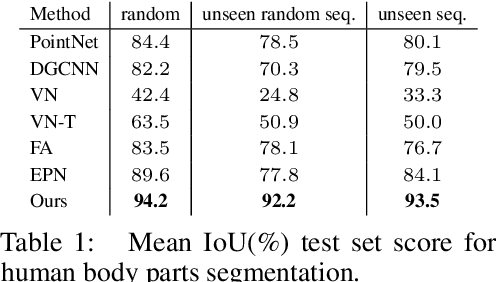
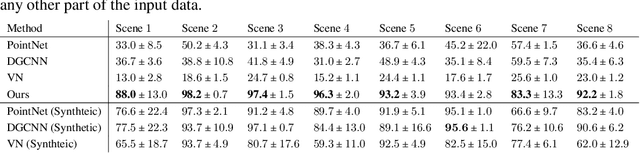
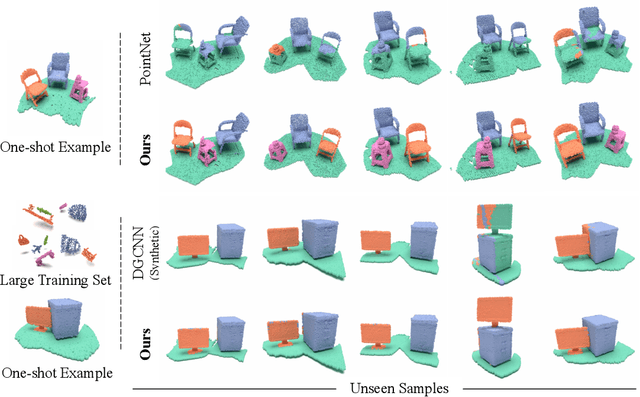
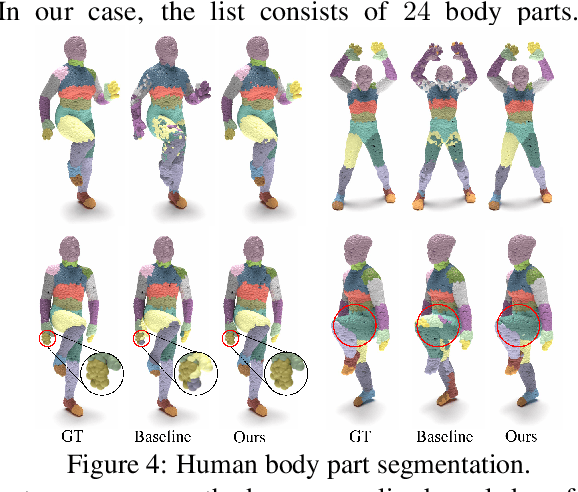
Integrating a notion of symmetry into point cloud neural networks is a provably effective way to improve their generalization capability. Of particular interest are $E(3)$ equivariant point cloud networks where Euclidean transformations applied to the inputs are preserved in the outputs. Recent efforts aim to extend networks that are $E(3)$ equivariant, to accommodate inputs made of multiple parts, each of which exhibits local $E(3)$ symmetry. In practical settings, however, the partitioning into individually transforming regions is unknown a priori. Errors in the partition prediction would unavoidably map to errors in respecting the true input symmetry. Past works have proposed different ways to predict the partition, which may exhibit uncontrolled errors in their ability to maintain equivariance to the actual partition. To this end, we introduce APEN: a general framework for constructing approximate piecewise-$E(3)$ equivariant point networks. Our primary insight is that functions that are equivariant with respect to a finer partition will also maintain equivariance in relation to the true partition. Leveraging this observation, we propose a design where the equivariance approximation error at each layers can be bounded solely in terms of (i) uncertainty quantification of the partition prediction, and (ii) bounds on the probability of failing to suggest a proper subpartition of the ground truth one. We demonstrate the effectiveness of APEN using two data types exemplifying part-based symmetry: (i) real-world scans of room scenes containing multiple furniture-type objects; and, (ii) human motions, characterized by articulated parts exhibiting rigid movement. Our empirical results demonstrate the advantage of integrating piecewise $E(3)$ symmetry into network design, showing a distinct improvement in generalization compared to prior works for both classification and segmentation tasks.
Segment Anything Model for Pedestrian Infrastructure Inventory: Assessing Zero-Shot Segmentation on Multi-Mode Geospatial Data
Oct 24, 2023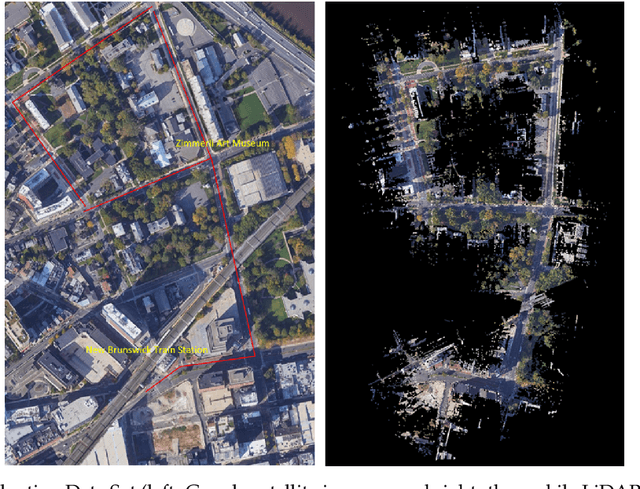
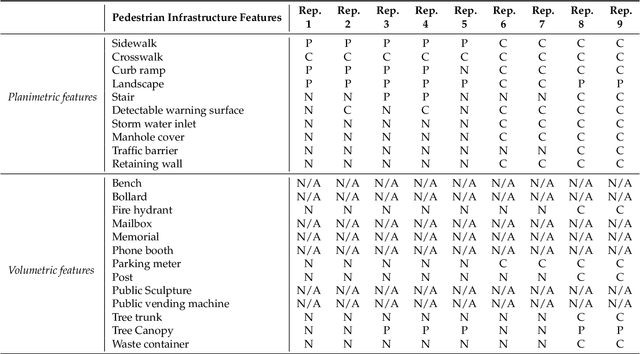
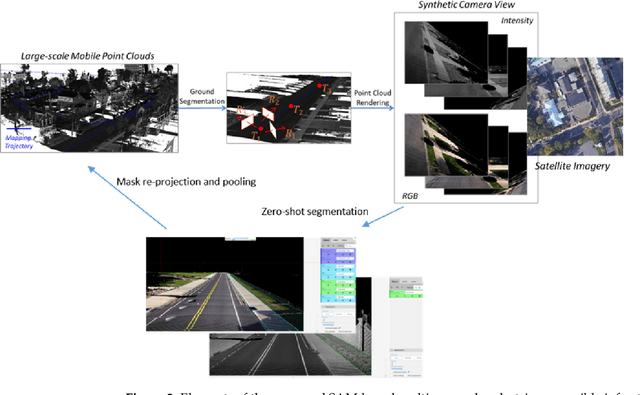
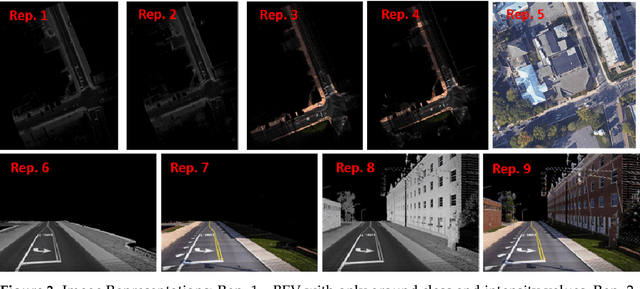
In this paper, a Segment Anything Model (SAM)-based pedestrian infrastructure segmentation workflow is designed and optimized, which is capable of efficiently processing multi-sourced geospatial data including LiDAR data and satellite imagery data. We used an expanded definition of pedestrian infrastructure inventory which goes beyond the traditional transportation elements to include street furniture objects often omitted from the traditional definition. Our contributions lie in producing the necessary knowledge to answer the following two questions. First, which data representation can facilitate zero-shot segmentation of infrastructure objects with SAM? Second, how well does the SAM-based method perform on segmenting pedestrian infrastructure objects? Our findings indicate that street view images generated from mobile LiDAR point cloud data, when paired along with satellite imagery data, can work efficiently with SAM to create a scalable pedestrian infrastructure inventory approach with immediate benefits to GIS professionals, city managers, transportation owners, and walkers, especially those with travel-limiting disabilities.
Unveiling Spaces: Architecturally meaningful semantic descriptions from images of interior spaces
Dec 19, 2023There has been a growing adoption of computer vision tools and technologies in architectural design workflows over the past decade. Notable use cases include point cloud generation, visual content analysis, and spatial awareness for robotic fabrication. Multiple image classification, object detection, and semantic pixel segmentation models have become popular for the extraction of high-level symbolic descriptions and semantic content from two-dimensional images and videos. However, a major challenge in this regard has been the extraction of high-level architectural structures (walls, floors, ceilings windows etc.) from diverse imagery where parts of these elements are occluded by furniture, people, or other non-architectural elements. This project aims to tackle this problem by proposing models that are capable of extracting architecturally meaningful semantic descriptions from two-dimensional scenes of populated interior spaces. 1000 virtual classrooms are parametrically generated, randomized along key spatial parameters such as length, width, height, and door/window positions. The positions of cameras, and non-architectural visual obstructions (furniture/objects) are also randomized. A Generative Adversarial Network (GAN) for image-to-image translation (Pix2Pix) is trained on synthetically generated rendered images of these enclosures, along with corresponding image abstractions representing high-level architectural structure. The model is then tested on unseen synthetic imagery of new enclosures, and outputs are compared to ground truth using pixel-wise comparison for evaluation. A similar model evaluation is also carried out on photographs of existing indoor enclosures, to measure its performance in real-world settings.