 Add to Chrome
 Add to Firefox
 Add to Edge
3D Bin Packing
Papers and Code
Diffusion Reinforcement Learning Based Online 3D Bin Packing Spatial Strategy Optimization
Apr 13, 2026
The online 3D bin packing problem is important in logistics, warehousing and intelligent manufacturing, with solutions shifting to deep reinforcement learning (DRL) which faces challenges like low sample efficiency. This paper proposes a diffusion reinforcement learning-based algorithm, using a Markov decision chain for packing modeling, height map-based state representation and a diffusion model-based actor network. Experiments show it significantly improves the average number of packed items compared to state-of-the-art DRL methods, with excellent application potential in complex online scenarios.

Preference-Conditioned Reinforcement Learning for Space-Time Efficient Online 3D Bin Packing
Mar 08, 2026Robotic bin packing is widely deployed in warehouse automation, with current systems achieving robust performance through heuristic and learning-based strategies. These systems must balance compact placement with rapid execution, where selecting alternative items or reorienting them can improve space utilization but introduce additional time. We propose a selection-based formulation that explicitly reasons over this trade-off: at each step, the robot evaluates multiple candidate actions, weighing expected packing benefit against estimated operational time. This enables time-aware strategies that selectively accept increased operational time when it yields meaningful spatial improvements. Our method, STEP (Space-Time Efficient Packing), uses a preference-conditioned, Transformer-based reinforcement learning policy, and allows generalization across candidate set sizes and integration with standard placement modules. It achieves a 44% reduction in operational time without compromising packing density. Additional material is available at https://step-packing.github.io.
GENPACK: KPI-Guided Multi-Objective Genetic Algorithm for Industrial 3D Bin Packing
Jan 16, 2026The three-dimensional bin packing problem (3D-BPP) is a longstanding challenge in operations research and logistics. Classical heuristics and constructive methods can generate packings quickly, but often fail to address industrial constraints such as stability, balance, and handling feasibility. Metaheuristics such as genetic algorithms (GAs) provide flexibility and the ability to optimize across multiple objectives; however, pure GA approaches frequently struggle with efficiency, parameter sensitivity, and scalability to industrial order sizes. This gap is especially evident when scaling to real-world pallet dimensions, where even state-of-the-art algorithms often fail to achieve robust, deployable solutions. We propose a KPI-driven GA-based pipeline for industrial 3D-BPP that integrates key performance indicators directly into a multi-objective fitness function. The methodology combines a layer-based chromosome representation with domain-specific operators and constructive heuristics to balance efficiency and feasibility. On the BED-BPP benchmark of 1,500 real-world orders, our Hybrid-GA pipeline consistently outperforms heuristic- and learning-based state-of-the-art methods, achieving up to 35% higher space utilization and 15 to 20% stronger surface support, with lower variance across orders. These improvements come at a modest runtime cost but remain feasible for batch-scale deployment, yielding stable, balanced, and space-efficient packings.
Effective Online 3D Bin Packing with Lookahead Parcels Using Monte Carlo Tree Search
Jan 06, 2026Online 3D Bin Packing (3D-BP) with robotic arms is crucial for reducing transportation and labor costs in modern logistics. While Deep Reinforcement Learning (DRL) has shown strong performance, it often fails to adapt to real-world short-term distribution shifts, which arise as different batches of goods arrive sequentially, causing performance drops. We argue that the short-term lookahead information available in modern logistics systems is key to mitigating this issue, especially during distribution shifts. We formulate online 3D-BP with lookahead parcels as a Model Predictive Control (MPC) problem and adapt the Monte Carlo Tree Search (MCTS) framework to solve it. Our framework employs a dynamic exploration prior that automatically balances a learned RL policy and a robust random policy based on the lookahead characteristics. Additionally, we design an auxiliary reward to penalize long-term spatial waste from individual placements. Extensive experiments on real-world datasets show that our method consistently outperforms state-of-the-art baselines, achieving over 10\% gains under distributional shifts, 4\% average improvement in online deployment, and up to more than 8\% in the best case--demonstrating the effectiveness of our framework.
SDT-6D: Fully Sparse Depth-Transformer for Staged End-to-End 6D Pose Estimation in Industrial Multi-View Bin Picking
Dec 09, 2025Accurately recovering 6D poses in densely packed industrial bin-picking environments remain a serious challenge, owing to occlusions, reflections, and textureless parts. We introduce a holistic depth-only 6D pose estimation approach that fuses multi-view depth maps into either a fine-grained 3D point cloud in its vanilla version, or a sparse Truncated Signed Distance Field (TSDF). At the core of our framework lies a staged heatmap mechanism that yields scene-adaptive attention priors across different resolutions, steering computation toward foreground regions, thus keeping memory requirements at high resolutions feasible. Along, we propose a density-aware sparse transformer block that dynamically attends to (self-) occlusions and the non-uniform distribution of 3D data. While sparse 3D approaches has proven effective for long-range perception, its potential in close-range robotic applications remains underexplored. Our framework operates fully sparse, enabling high-resolution volumetric representations to capture fine geometric details crucial for accurate pose estimation in clutter. Our method processes the entire scene integrally, predicting the 6D pose via a novel per-voxel voting strategy, allowing simultaneous pose predictions for an arbitrary number of target objects. We validate our method on the recently published IPD and MV-YCB multi-view datasets, demonstrating competitive performance in heavily cluttered industrial and household bin picking scenarios.
Deliberate Planning of 3D Bin Packing on Packing Configuration Trees
Apr 06, 2025Online 3D Bin Packing Problem (3D-BPP) has widespread applications in industrial automation. Existing methods usually solve the problem with limited resolution of spatial discretization, and/or cannot deal with complex practical constraints well. We propose to enhance the practical applicability of online 3D-BPP via learning on a novel hierarchical representation, packing configuration tree (PCT). PCT is a full-fledged description of the state and action space of bin packing which can support packing policy learning based on deep reinforcement learning (DRL). The size of the packing action space is proportional to the number of leaf nodes, making the DRL model easy to train and well-performing even with continuous solution space. We further discover the potential of PCT as tree-based planners in deliberately solving packing problems of industrial significance, including large-scale packing and different variations of BPP setting. A recursive packing method is proposed to decompose large-scale packing into smaller sub-trees while a spatial ensemble mechanism integrates local solutions into global. For different BPP variations with additional decision variables, such as lookahead, buffering, and offline packing, we propose a unified planning framework enabling out-of-the-box problem solving. Extensive evaluations demonstrate that our method outperforms existing online BPP baselines and is versatile in incorporating various practical constraints. The planning process excels across large-scale problems and diverse problem variations. We develop a real-world packing robot for industrial warehousing, with careful designs accounting for constrained placement and transportation stability. Our packing robot operates reliably and efficiently on unprotected pallets at 10 seconds per box. It achieves averagely 19 boxes per pallet with 57.4% space utilization for relatively large-size boxes.
ASAP: Learning Generalizable Online Bin Packing via Adaptive Selection After Pruning
Jan 29, 2025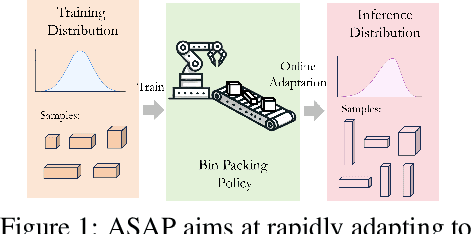
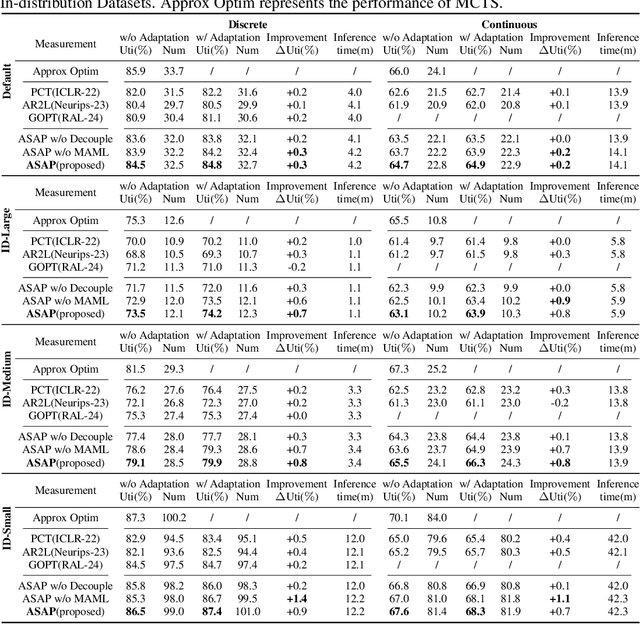
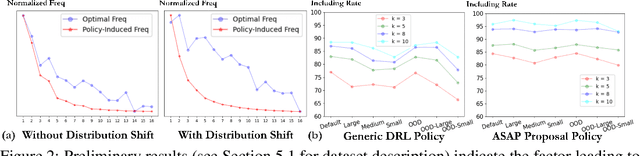
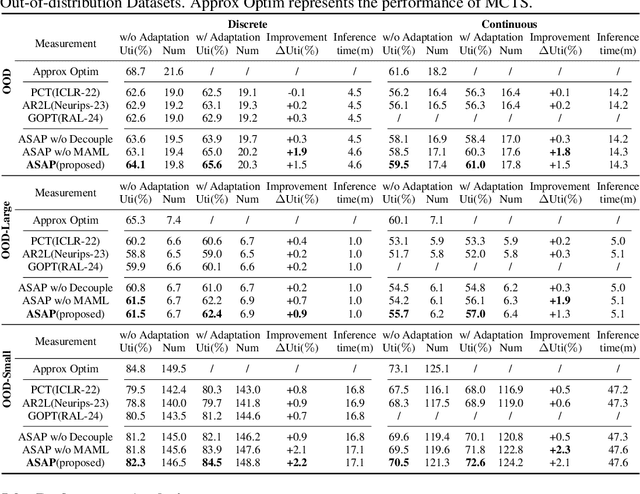
Recently, deep reinforcement learning (DRL) has achieved promising results in solving online 3D Bin Packing Problems (3D-BPP). However, these DRL-based policies may perform poorly on new instances due to distribution shift. Besides generalization, we also consider adaptation, completely overlooked by previous work, which aims at rapidly finetuning these policies to a new test distribution. To tackle both generalization and adaptation issues, we propose Adaptive Selection After Pruning (ASAP), which decomposes a solver's decision-making into two policies, one for pruning and one for selection. The role of the pruning policy is to remove inherently bad actions, which allows the selection policy to choose among the remaining most valuable actions. To learn these policies, we propose a training scheme based on a meta-learning phase of both policies followed by a finetuning phase of the sole selection policy to rapidly adapt it to a test distribution. Our experiments demonstrate that ASAP exhibits excellent generalization and adaptation capabilities on in-distribution and out-of-distribution instances under both discrete and continuous setup.
HERB: Human-augmented Efficient Reinforcement learning for Bin-packing
Apr 23, 2025Packing objects efficiently is a fundamental problem in logistics, warehouse automation, and robotics. While traditional packing solutions focus on geometric optimization, packing irregular, 3D objects presents significant challenges due to variations in shape and stability. Reinforcement Learning~(RL) has gained popularity in robotic packing tasks, but training purely from simulation can be inefficient and computationally expensive. In this work, we propose HERB, a human-augmented RL framework for packing irregular objects. We first leverage human demonstrations to learn the best sequence of objects to pack, incorporating latent factors such as space optimization, stability, and object relationships that are difficult to model explicitly. Next, we train a placement algorithm that uses visual information to determine the optimal object positioning inside a packing container. Our approach is validated through extensive performance evaluations, analyzing both packing efficiency and latency. Finally, we demonstrate the real-world feasibility of our method on a robotic system. Experimental results show that our method outperforms geometric and purely RL-based approaches by leveraging human intuition, improving both packing robustness and adaptability. This work highlights the potential of combining human expertise-driven RL to tackle complex real-world packing challenges in robotic systems.
PacTure: Efficient PBR Texture Generation on Packed Views with Visual Autoregressive Models
May 28, 2025We present PacTure, a novel framework for generating physically-based rendering (PBR) material textures from an untextured 3D mesh, a text description, and an optional image prompt. Early 2D generation-based texturing approaches generate textures sequentially from different views, resulting in long inference times and globally inconsistent textures. More recent approaches adopt multi-view generation with cross-view attention to enhance global consistency, which, however, limits the resolution for each view. In response to these weaknesses, we first introduce view packing, a novel technique that significantly increases the effective resolution for each view during multi-view generation without imposing additional inference cost, by formulating the arrangement of multi-view maps as a 2D rectangle bin packing problem. In contrast to UV mapping, it preserves the spatial proximity essential for image generation and maintains full compatibility with current 2D generative models. To further reduce the inference cost, we enable fine-grained control and multi-domain generation within the next-scale prediction autoregressive framework to create an efficient multi-view multi-domain generative backbone. Extensive experiments show that PacTure outperforms state-of-the-art methods in both quality of generated PBR textures and efficiency in training and inference.
Optimizing Data Distribution and Kernel Performance for Efficient Training of Chemistry Foundation Models: A Case Study with MACE
Apr 14, 2025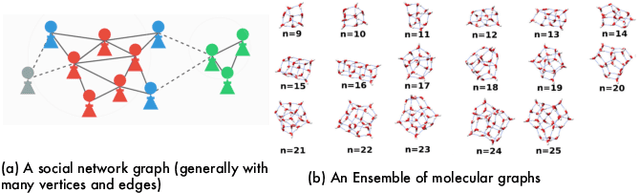
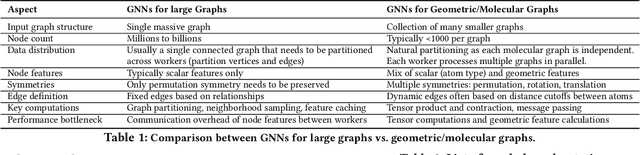
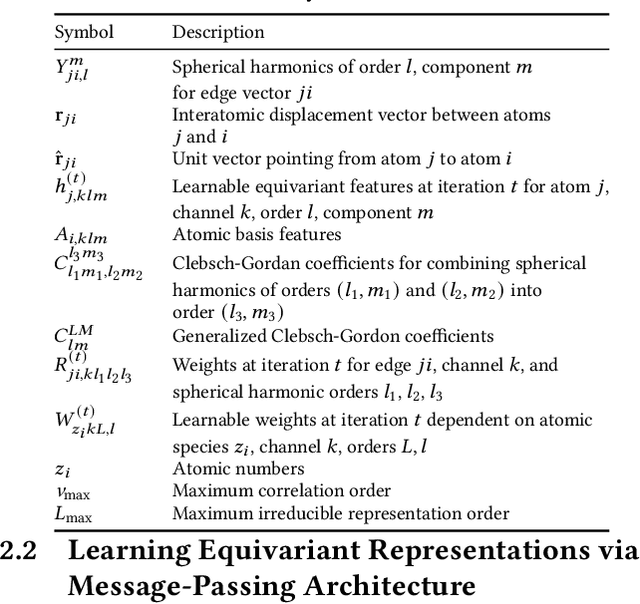
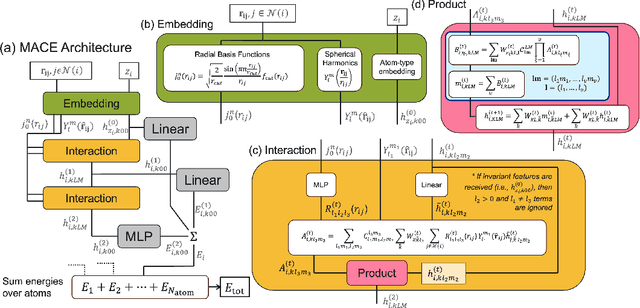
Chemistry Foundation Models (CFMs) that leverage Graph Neural Networks (GNNs) operating on 3D molecular graph structures are becoming indispensable tools for computational chemists and materials scientists. These models facilitate the understanding of matter and the discovery of new molecules and materials. In contrast to GNNs operating on a large homogeneous graphs, GNNs used by CFMs process a large number of geometric graphs of varying sizes, requiring different optimization strategies than those developed for large homogeneous GNNs. This paper presents optimizations for two critical phases of CFM training: data distribution and model training, targeting MACE - a state-of-the-art CFM. We address the challenge of load balancing in data distribution by formulating it as a multi-objective bin packing problem. We propose an iterative algorithm that provides a highly effective, fast, and practical solution, ensuring efficient data distribution. For the training phase, we identify symmetric tensor contraction as the key computational kernel in MACE and optimize this kernel to improve the overall performance. Our combined approach of balanced data distribution and kernel optimization significantly enhances the training process of MACE. Experimental results demonstrate a substantial speedup, reducing per-epoch execution time for training from 12 to 2 minutes on 740 GPUs with a 2.6M sample dataset.