 Add to Chrome
 Add to Firefox
 Add to Edge
S2-HWM: Sparse Event-Structured Hierarchical World Model for Long-Horizon Surgical Robot Manipulation
Aug 13, 2026
Long-horizon surgical robot manipulation is challenging because task rewards are sparse, while meaningful interaction changes occur at irregular intervals. Existing world-model agents typically imagine at primitive-step resolution, leaving variable-duration task progress implicit. Manually specified stages can provide intermediate structure, but their task specific boundaries are difficult to align with state-dependent interaction transitions. We propose S2-HWM, a Sparse Event-Structured Hierarchical World Model that learns sparse event evidence from primitive latent trajectories to coordinate an event-level manager and a primitive-step worker. The event evidence schedules manager goal updates, and each selected latent goal conditions the worker's primitive actions until the next update. The learned event evidence also forms variable-duration segments for an Event Transition Model (ETM), which predicts the next?boundary stochastic state, segment duration, and accumulated segment reward. Chaining these event-level predictions provides a variable-duration continuation beyond the primitive imagination horizon for manager learning, while the worker retains primitive-step actor-critic learning. On a SurRoL-based PegTransfer task, S2-HWM achieves a success rate of 98.7%, outperforming the flat GAS DreamerV3 baseline by 22.7 percentage points.

Be Faithful When Response: Returning Fluent and Grounded Answers for Vision-Language Models Reinforcement Learning
Jun 29, 2026Reinforcement Learning (RL) is an important paradigm for improving the reasoning capabilities of Vision-Language Models (VLMs). However, directly applying RL to rollout multimodal reasoning can lead to instability, due to the exploitation of language priors, the neglect of visual evidence, and the generation of reasoning traces that are fluent yet not visually grounded. The question arises: Can initially steer the policy toward visually faithful reasoning regime before applying reinforcement learning? To this end, we propose a Faithful Warm-Start (FWS) strategy that first curates samples with explicit vision-language causal relationships from six general VQA benchmarks to construct the FaithfulQA dataset, where each of the image-question pairs gains a certain degree of visual observations, question requirements, commonsense knowledge, domain knowledge, and the final answer. Subsequently, a VLM-based judge is employed to further purify the dataset, ensuring strong causal consistency and visual faithfulness. This warm-start stage equips the model with the capability to understand causally grounded vision-language patterns before subsequent RL optimization under sparse answer-level rewards. Experimental results show that such faithful supervision improves answer accuracy, stabilizes RL training, and reduces visually unsupported reasoning.
Vibrotactile Preference Learning: Uncertainty-Aware Preference Learning for Personalized Vibration Feedback
Apr 22, 2026Individual differences in vibrotactile perception underscore the growing importance of personalization as haptic feedback becomes more prevalent in interactive systems. We propose Vibrotactile Preference Learning (VPL), a system that captures user-specific preference spaces over vibrotactile parameters via Gaussian-process-based uncertainty-aware preference learning. VPL uses an expected information gain-based acquisition strategy to guide query selection over 40 rounds of pairwise comparisons of overall user preference, augmented with user-reported uncertainty, enabling efficient exploration of the parameter space. We evaluate VPL in a user study (N = 13) using the vibrotactile feedback from a Microsoft Xbox controller, showing that it efficiently learns individualized preferences while maintaining comfortable, low-workload user interactions. These results highlight the potential of VPL for scalable personalization of vibrotactile experiences.
JD-BP: A Joint-Decision Generative Framework for Auto-Bidding and Pricing
Apr 07, 2026Auto-bidding services optimize real-time bidding strategies for advertisers under key performance indicator (KPI) constraints such as target return on investment and budget. However, uncertainties such as model prediction errors and feedback latency can cause bidding strategies to deviate from ex-post optimality, leading to inefficient allocation. To address this issue, we propose JD-BP, a Joint generative Decision framework for Bidding and Pricing. Unlike prior methods, JD-BP jointly outputs a bid value and a pricing correction term that acts additively with the payment rule such as GSP. To mitigate adverse effects of historical constraint violations, we design a memory-less Return-to-Go that encourages future value maximizing of bidding actions while the cumulated bias is handled by the pricing correction. Moreover, a trajectory augmentation algorithm is proposed to generate joint bidding-pricing trajectories from a (possibly arbitrary) base bidding policy, enabling efficient plug-and-play deployment of our algorithm from existing RL/generative bidding models. Finally, we employ an Energy-Based Direct Preference Optimization method in conjunction with a cross-attention module to enhance the joint learning performance of bidding and pricing correction. Offline experiments on the AuctionNet dataset demonstrate that JD-BP achieves state-of-the-art performance. Online A/B tests at JD.com confirm its practical effectiveness, showing a 4.70% increase in ad revenue and a 6.48% improvement in target cost.
Beyond Single-Sample: Reliable Multi-Sample Distillation for Video Understanding
Mar 12, 2026Traditional black-box distillation for Large Vision-Language Models (LVLMs) typically relies on a single teacher response per input, which often yields high-variance responses and format inconsistencies in multimodal or temporal scenarios. To mitigate this unreliable supervision, we propose R-MSD (Reliable Multi-Sample Distillation), a framework that explicitly models teacher sampling variance to enhance distillation stability. Rather than relying on a single teacher response, our approach leverages a task-adaptive teacher pool to provide robust supervision tailored to both closed-ended and open-ended reasoning. By integrating quality-aware signal matching with an adversarial distillation objective, our approach effectively filters teacher noise while maximizing knowledge transfer. Extensive evaluations across comprehensive video understanding benchmarks demonstrate that R-MSD consistently outperforms single sample distillation methods. We additionally include an original SFT+RL 4B baseline under the same training budget, which shows only marginal gains, while our method achieves significant improvements. With a 4B student model, our approach delivers gains on VideoMME (+1.5%), Video-MMMU (+3.2%), and MathVerse (+3.6%).
Effective Online 3D Bin Packing with Lookahead Parcels Using Monte Carlo Tree Search
Jan 06, 2026Online 3D Bin Packing (3D-BP) with robotic arms is crucial for reducing transportation and labor costs in modern logistics. While Deep Reinforcement Learning (DRL) has shown strong performance, it often fails to adapt to real-world short-term distribution shifts, which arise as different batches of goods arrive sequentially, causing performance drops. We argue that the short-term lookahead information available in modern logistics systems is key to mitigating this issue, especially during distribution shifts. We formulate online 3D-BP with lookahead parcels as a Model Predictive Control (MPC) problem and adapt the Monte Carlo Tree Search (MCTS) framework to solve it. Our framework employs a dynamic exploration prior that automatically balances a learned RL policy and a robust random policy based on the lookahead characteristics. Additionally, we design an auxiliary reward to penalize long-term spatial waste from individual placements. Extensive experiments on real-world datasets show that our method consistently outperforms state-of-the-art baselines, achieving over 10\% gains under distributional shifts, 4\% average improvement in online deployment, and up to more than 8\% in the best case--demonstrating the effectiveness of our framework.
VHU-Net: Variational Hadamard U-Net for Body MRI Bias Field Correction
Jun 23, 2025Bias field artifacts in magnetic resonance imaging (MRI) scans introduce spatially smooth intensity inhomogeneities that degrade image quality and hinder downstream analysis. To address this challenge, we propose a novel variational Hadamard U-Net (VHU-Net) for effective body MRI bias field correction. The encoder comprises multiple convolutional Hadamard transform blocks (ConvHTBlocks), each integrating convolutional layers with a Hadamard transform (HT) layer. Specifically, the HT layer performs channel-wise frequency decomposition to isolate low-frequency components, while a subsequent scaling layer and semi-soft thresholding mechanism suppress redundant high-frequency noise. To compensate for the HT layer's inability to model inter-channel dependencies, the decoder incorporates an inverse HT-reconstructed transformer block, enabling global, frequency-aware attention for the recovery of spatially consistent bias fields. The stacked decoder ConvHTBlocks further enhance the capacity to reconstruct the underlying ground-truth bias field. Building on the principles of variational inference, we formulate a new evidence lower bound (ELBO) as the training objective, promoting sparsity in the latent space while ensuring accurate bias field estimation. Comprehensive experiments on abdominal and prostate MRI datasets demonstrate the superiority of VHU-Net over existing state-of-the-art methods in terms of intensity uniformity, signal fidelity, and tissue contrast. Moreover, the corrected images yield substantial downstream improvements in segmentation accuracy. Our framework offers computational efficiency, interpretability, and robust performance across multi-center datasets, making it suitable for clinical deployment.
Edge-Fog Computing-Enabled EEG Data Compression via Asymmetrical Variational Discrete Cosine Transform Network
Mar 13, 2025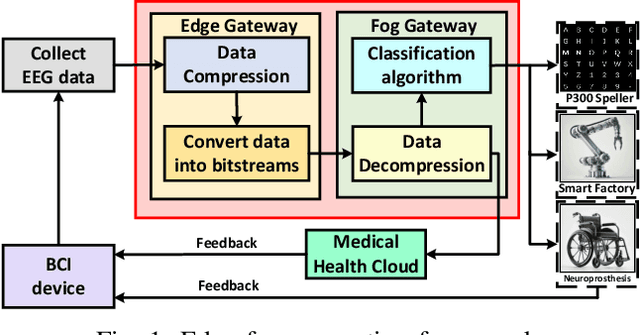
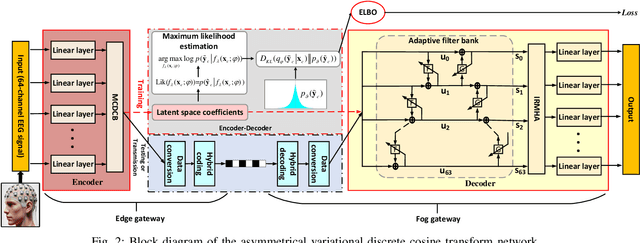
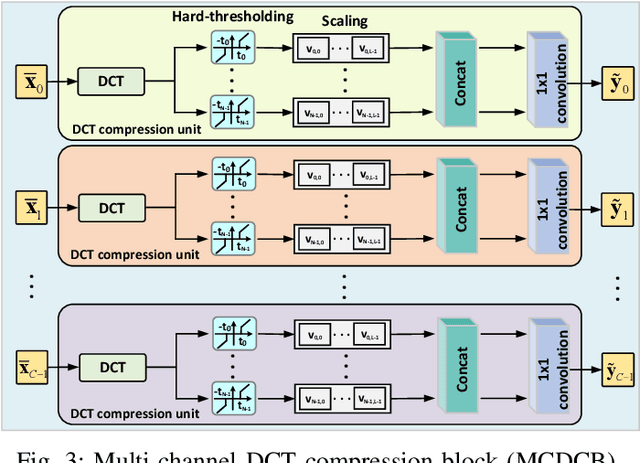
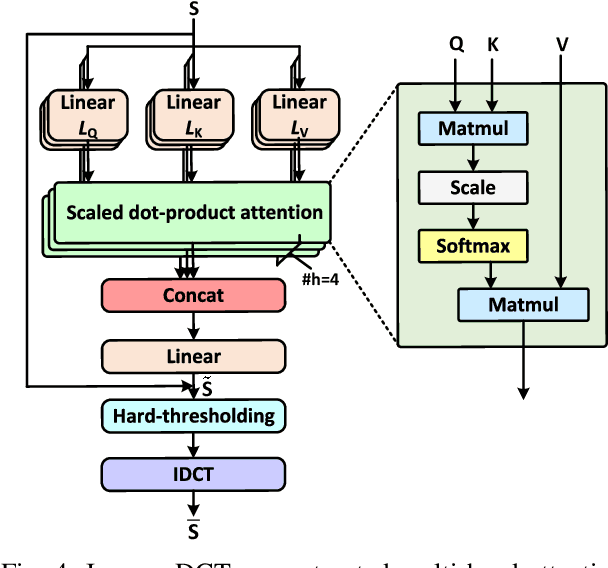
The large volume of electroencephalograph (EEG) data produced by brain-computer interface (BCI) systems presents challenges for rapid transmission over bandwidth-limited channels in Internet of Things (IoT) networks. To address the issue, we propose a novel multi-channel asymmetrical variational discrete cosine transform (DCT) network for EEG data compression within an edge-fog computing framework. At the edge level, low-complexity DCT compression units are designed using parallel trainable hard-thresholding and scaling operators to remove redundant data and extract the effective latent space representation. At the fog level, an adaptive filter bank is applied to merge important features from adjacent channels into each individual channel by leveraging inter-channel correlations. Then, the inverse DCT reconstructed multi-head attention is developed to capture both local and global dependencies and reconstruct the original signals. Furthermore, by applying the principles of variational inference, a new evidence lower bound is formulated as the loss function, driving the model to balance compression efficiency and reconstruction accuracy. Experimental results on two public datasets demonstrate that the proposed method achieves superior compression performance without sacrificing any useful information for BCI detection compared with state-of-the-art techniques, indicating a feasible solution for EEG data compression.
Efficient Bearing Sensor Data Compression via an Asymmetrical Autoencoder with a Lifting Wavelet Transform Layer
Jan 20, 2025Bearing data compression is vital to manage the large volumes of data generated during condition monitoring. In this paper, a novel asymmetrical autoencoder with a lifting wavelet transform (LWT) layer is developed to compress bearing sensor data. The encoder part of the network consists of a convolutional layer followed by a wavelet filterbank layer. Specifically, a dual-channel convolutional block with diverse convolutional kernel sizes and varying processing depths is integrated into the wavelet filterbank layer to enable comprehensive feature extraction from the wavelet domain. Additionally, the adaptive hard-thresholding nonlinearity is applied to remove redundant components while denoising the primary wavelet coefficients. On the decoder side, inverse LWT, along with multiple linear layers and activation functions, is employed to reconstruct the original signals. Furthermore, to enhance compression efficiency, a sparsity constraint is introduced during training to impose sparsity on the latent representations. The experimental results demonstrate that the proposed approach achieves superior data compression performance compared to state-of-the-art methods.
Towards Reliable Advertising Image Generation Using Human Feedback
Aug 01, 2024

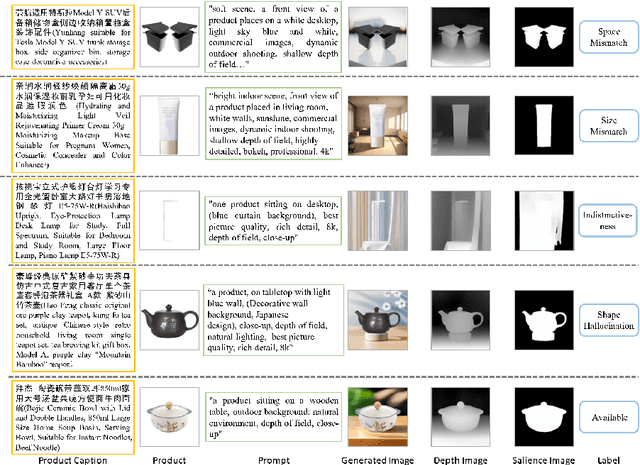

In the e-commerce realm, compelling advertising images are pivotal for attracting customer attention. While generative models automate image generation, they often produce substandard images that may mislead customers and require significant labor costs to inspect. This paper delves into increasing the rate of available generated images. We first introduce a multi-modal Reliable Feedback Network (RFNet) to automatically inspect the generated images. Combining the RFNet into a recurrent process, Recurrent Generation, results in a higher number of available advertising images. To further enhance production efficiency, we fine-tune diffusion models with an innovative Consistent Condition regularization utilizing the feedback from RFNet (RFFT). This results in a remarkable increase in the available rate of generated images, reducing the number of attempts in Recurrent Generation, and providing a highly efficient production process without sacrificing visual appeal. We also construct a Reliable Feedback 1 Million (RF1M) dataset which comprises over one million generated advertising images annotated by human, which helps to train RFNet to accurately assess the availability of generated images and faithfully reflect the human feedback. Generally speaking, our approach offers a reliable solution for advertising image generation.