 Add to Chrome
 Add to Firefox
 Add to Edge
CARE-LoRA: Compressed Activation REconstruction for Memory-Efficient LoRA
Jul 11, 2026
As the scale of large pre-trained models continues to grow, fine-tuning them under limited memory budgets has become increasingly challenging. Low-Rank Adaptation (LoRA), currently one of the most widely adopted parameter-efficient fine-tuning (PEFT) methods, mitigates this challenge by optimizing only low-rank adaptation matrices, thereby greatly reducing the number of trainable parameters. With the parameter overhead substantially reduced, the activations retained for backpropagation have emerged as the primary remaining memory bottleneck during LoRA fine-tuning. To address this, we propose CARE-LoRA, a data-aware Compressed Activation REconstruction framework. By exploiting the inherent projection structure of LoRA, CARE-LoRA replaces the full input activation with the low-rank compressed activation naturally produced by the LoRA branch. It further computes a lightweight reconstruction matrix during the forward pass with negligible additional computation cost, which is used during backpropagation to reconstruct the gradient signal, thereby keeping LoRA matrices fully trainable. Extensive experiments across diverse models and downstream tasks demonstrate that, while substantially reducing the overall memory footprint, CARE-LoRA achieves competitive or even superior performance compared with standard LoRA and representative LoRA variants. Our code is publicly available at https://github.com/fishandyu/CARE-LoRA .

VLA Knows Its Limits
Feb 24, 2026Action chunking has recently emerged as a standard practice in flow-based Vision-Language-Action (VLA) models. However, the effect and choice of the execution horizon - the number of actions to be executed from each predicted chunk - remains underexplored. In this work, we first show that varying the execution horizon leads to substantial performance deviations, with performance initially improving and then declining as the horizon increases. To uncover the reasons, we analyze the cross- and self-attention weights in flow-based VLAs and reveal two key phenomena: (i) intra-chunk actions attend invariantly to vision-language tokens, limiting adaptability to environmental changes; and (ii) the initial and terminal action tokens serve as stable anchors, forming latent centers around which intermediate actions are organized. Motivated by these insights, we interpret action self-attention weights as a proxy for the model's predictive limit and propose AutoHorizon, the first test-time method that dynamically estimates the execution horizon for each predicted action chunk to adapt to changing perceptual conditions. Across simulated and real-world robotic manipulation tasks, AutoHorizon is performant, incurs negligible computational overhead, and generalizes across diverse tasks and flow-based models.
Real-Time Robot Execution with Masked Action Chunking
Jan 27, 2026Real-time execution is essential for cyber-physical systems such as robots. These systems operate in dynamic real-world environments where even small delays can undermine responsiveness and compromise performance. Asynchronous inference has recently emerged as a system-level paradigm for real-time robot manipulation, enabling the next action chunk to be predicted while the current one is being executed. While this approach achieves real-time responsiveness, naive integration often results in execution failure. Previous methods attributed this failure to inter-chunk discontinuity and developed test-time algorithms to smooth chunk boundaries. In contrast, we identify another critical yet overlooked factor: intra-chunk inconsistency, where the robot's executed action chunk partially misaligns with its current perception. To address this, we propose REMAC, which learns corrective adjustments on the pretrained policy through masked action chunking, enabling the policy to remain resilient under mismatches between intended actions and actual execution during asynchronous inference. In addition, we introduce a prefix-preserved sampling procedure to reinforce inter-chunk continuity. Overall, our method delivers more reliable policies without incurring additional latency. Extensive experiments in both simulation and real-world settings demonstrate that our method enables faster task execution, maintains robustness across varying delays, and consistently achieves higher completion rates.
Consistent Instance Field for Dynamic Scene Understanding
Dec 16, 2025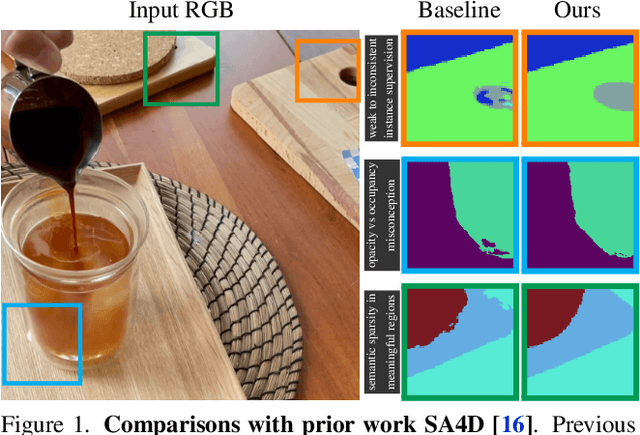
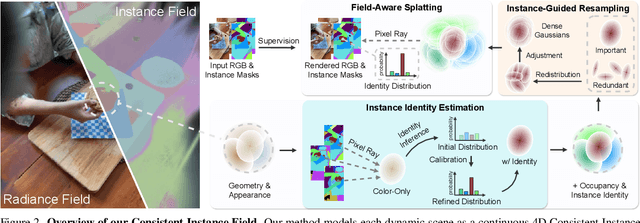
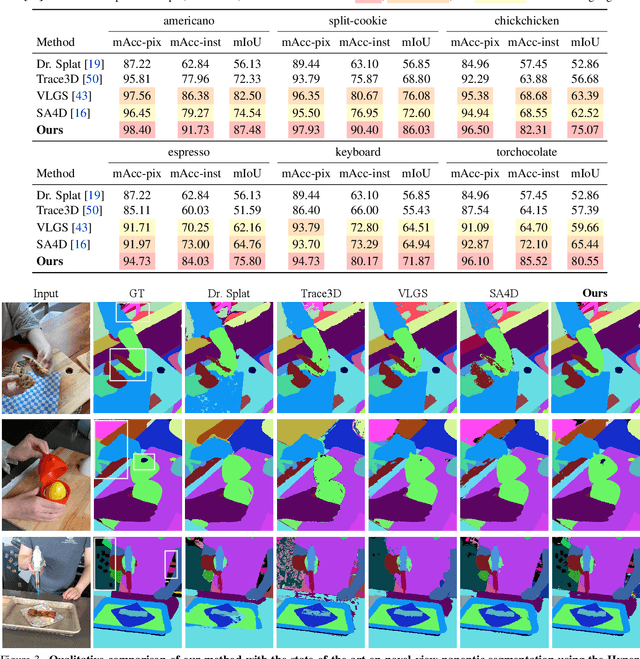
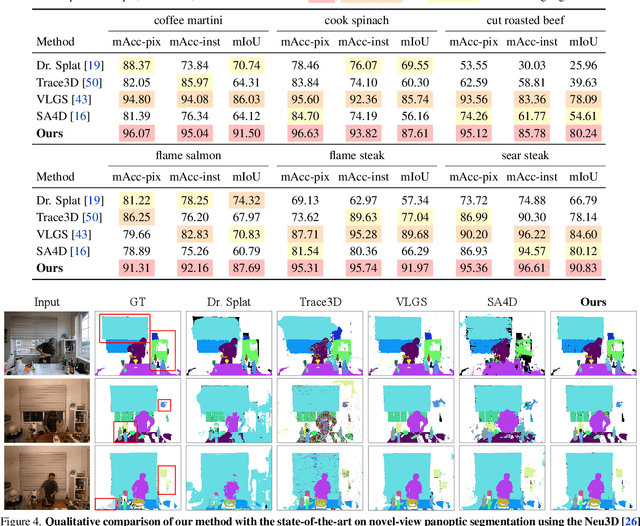
We introduce Consistent Instance Field, a continuous and probabilistic spatio-temporal representation for dynamic scene understanding. Unlike prior methods that rely on discrete tracking or view-dependent features, our approach disentangles visibility from persistent object identity by modeling each space-time point with an occupancy probability and a conditional instance distribution. To realize this, we introduce a novel instance-embedded representation based on deformable 3D Gaussians, which jointly encode radiance and semantic information and are learned directly from input RGB images and instance masks through differentiable rasterization. Furthermore, we introduce new mechanisms to calibrate per-Gaussian identities and resample Gaussians toward semantically active regions, ensuring consistent instance representations across space and time. Experiments on HyperNeRF and Neu3D datasets demonstrate that our method significantly outperforms state-of-the-art methods on novel-view panoptic segmentation and open-vocabulary 4D querying tasks.
From Particles to Fields: Reframing Photon Mapping with Continuous Gaussian Photon Fields
Dec 13, 2025Accurately modeling light transport is essential for realistic image synthesis. Photon mapping provides physically grounded estimates of complex global illumination effects such as caustics and specular-diffuse interactions, yet its per-view radiance estimation remains computationally inefficient when rendering multiple views of the same scene. The inefficiency arises from independent photon tracing and stochastic kernel estimation at each viewpoint, leading to inevitable redundant computation. To accelerate multi-view rendering, we reformulate photon mapping as a continuous and reusable radiance function. Specifically, we introduce the Gaussian Photon Field (GPF), a learnable representation that encodes photon distributions as anisotropic 3D Gaussian primitives parameterized by position, rotation, scale, and spectrum. GPF is initialized from physically traced photons in the first SPPM iteration and optimized using multi-view supervision of final radiance, distilling photon-based light transport into a continuous field. Once trained, the field enables differentiable radiance evaluation along camera rays without repeated photon tracing or iterative refinement. Extensive experiments on scenes with complex light transport, such as caustics and specular-diffuse interactions, demonstrate that GPF attains photon-level accuracy while reducing computation by orders of magnitude, unifying the physical rigor of photon-based rendering with the efficiency of neural scene representations.
Versatile Navigation under Partial Observability via Value-guided Diffusion Policy
Apr 01, 2024Route planning for navigation under partial observability plays a crucial role in modern robotics and autonomous driving. Existing route planning approaches can be categorized into two main classes: traditional autoregressive and diffusion-based methods. The former often fails due to its myopic nature, while the latter either assumes full observability or struggles to adapt to unfamiliar scenarios, due to strong couplings with behavior cloning from experts. To address these deficiencies, we propose a versatile diffusion-based approach for both 2D and 3D route planning under partial observability. Specifically, our value-guided diffusion policy first generates plans to predict actions across various timesteps, providing ample foresight to the planning. It then employs a differentiable planner with state estimations to derive a value function, directing the agent's exploration and goal-seeking behaviors without seeking experts while explicitly addressing partial observability. During inference, our policy is further enhanced by a best-plan-selection strategy, substantially boosting the planning success rate. Moreover, we propose projecting point clouds, derived from RGB-D inputs, onto 2D grid-based bird-eye-view maps via semantic segmentation, generalizing to 3D environments. This simple yet effective adaption enables zero-shot transfer from 2D-trained policy to 3D, cutting across the laborious training for 3D policy, and thus certifying our versatility. Experimental results demonstrate our superior performance, particularly in navigating situations beyond expert demonstrations, surpassing state-of-the-art autoregressive and diffusion-based baselines for both 2D and 3D scenarios.