 Add to Chrome
 Add to Firefox
 Add to Edge
FlowCIR: Semantic Transport via Flow Matching for Zero-Shot Composed Image Retrieval
Jul 02, 2026
Zero-shot composed image retrieval (ZS-CIR) aims to retrieve a target image by editing a reference image with a natural-language instruction, without relying on domain-specific annotated triplets. Most existing ZS-CIR methods rely on textual inversion to translate the reference image into pseudo-text tokens and then compose them with the instruction via simple concatenation in the text space, which can be lossy and brittle for fine-grained semantics. In this work, we propose a new paradigm, namely FlowCIR, that casts ZS-CIR as conditional semantic transport between reference and target embeddings. Leveraging \emph{conditional flow matching}, our model learns a lightweight transport field that maps the instruction representation toward a target-aligned query embedding conditioned on the reference image. Since FlowCIR operates on pre-extracted VLM embeddings and trains only a small transport module without updating the image or text encoder, it offers a computationally efficient training protocol compared with prior textual-inversion-based approaches. The resulting framework is training-efficient, requiring roughly $10\times$ fewer training resources than prior textual-inversion-based approaches. We further identify negation and removal as a major failure mode of VLM-based composition. To address this, we propose an inference-only Multi-Negative Steering strategy that steers a negation-containing relative instruction away from its negated semantics, mitigating the limited negation handling of VLMs and improving robustness on negation-heavy queries. Extensive experiments on standard CIR benchmarks demonstrate that FlowCIR achieves strong and competitive performance compared with recent ZS-CIR methods.

Direct Product Flow Matching: Decoupling Radial and Angular Dynamics for Few-Shot Adaptation
May 06, 2026Recent flow matching (FM) methods improve the few-shot adaptation of vision-language models, by modeling cross-modal alignment as a continuous multi-step flow. In this paper, we argue that existing FM methods are inherently constrained by incompatible geometric priors on pre-trained cross-modal features, resulting in suboptimal adaptation performance. We first analyze these methods from a polar decomposition perspective (i.e., radial and angular sub-manifolds). Under this new geometric view, we identify three overlooked limitations in them: 1) Angular dynamics distortion: The radial-angular coupling induces non-uniform speed on the angular sub-manifold, leading to regression training difficulty and extra truncation errors. 2) Radial dynamics neglect: Feature normalization discards modality confidence, failing to distinguish out-of-distribution and in-distribution data, and abandoning crucial radial dynamics. 3) Context-agnostic unconditional flow: Dataset-specific information loss during pre-trained cross-modal feature extraction remains unrecovered. To resolve these issues, we propose warped product flow matching (WP-FM), a unified Riemannian framework that reformulates alignment on a warped product manifold. Within this framework, we derive direct product flow matching (DP-FM) by introducing a constant-warping metric, which yields a decoupled cylindrical manifold (i.e., direct product manifold). DP-FM enables independent radial evolution and constant-speed angular geodesic transport, effectively eliminating angular dynamics distortion while preserving radial consistency. Meanwhile, we incorporate classifier-free guidance by conditioning the flow on the pre-trained VLMs' hidden states to inject missing dataset-specific information. Extensive results across 11 benchmarks have demonstrated that DP-FM achieves a new state-of-the-art for multi-step few-shot adaptation.
Coarse-Guided Visual Generation via Weighted h-Transform Sampling
Mar 12, 2026Coarse-guided visual generation, which synthesizes fine visual samples from degraded or low-fidelity coarse references, is essential for various real-world applications. While training-based approaches are effective, they are inherently limited by high training costs and restricted generalization due to paired data collection. Accordingly, recent training-free works propose to leverage pretrained diffusion models and incorporate guidance during the sampling process. However, these training-free methods either require knowing the forward (fine-to-coarse) transformation operator, e.g., bicubic downsampling, or are difficult to balance between guidance and synthetic quality. To address these challenges, we propose a novel guided method by using the h-transform, a tool that can constrain stochastic processes (e.g., sampling process) under desired conditions. Specifically, we modify the transition probability at each sampling timestep by adding to the original differential equation with a drift function, which approximately steers the generation toward the ideal fine sample. To address unavoidable approximation errors, we introduce a noise-level-aware schedule that gradually de-weights the term as the error increases, ensuring both guidance adherence and high-quality synthesis. Extensive experiments across diverse image and video generation tasks demonstrate the effectiveness and generalization of our method.
Path-Decoupled Hyperbolic Flow Matching for Few-Shot Adaptation
Feb 24, 2026Recent advances in cross-modal few-shot adaptation treat visual-semantic alignment as a continuous feature transport problem via Flow Matching (FM). However, we argue that Euclidean-based FM overlooks fundamental limitations of flat geometry, where polynomial volume growth fails to accommodate diverse feature distributions, leading to severe path entanglement. To this end, we propose path-decoupled Hyperbolic Flow Matching (HFM), leveraging the Lorentz manifold's exponential expansion for trajectory decoupling. HFM structures the transport via two key designs: 1) Centripetal hyperbolic alignment: It constructs a centripetal hierarchy by anchoring textual roots, which pushes visual leaves to the boundary to initialize orderly flows. 2) Path-decoupled objective: It acts as a ``semantic guardrail'' rigidly confining trajectories within isolated class-specific geodesic corridors via step-wise supervision. Furthermore, we devise an adaptive diameter-based stopping to prevent over-transportation into the crowded origin based on the intrinsic semantic scale. Extensive ablations on 11 benchmarks have shown that HFM establishes a new state-of-the-art, consistently outperforming its Euclidean counterparts. Our codes and models will be released.
Exploring Cross-Modal Flows for Few-Shot Learning
Oct 16, 2025Aligning features from different modalities, is one of the most fundamental challenges for cross-modal tasks. Although pre-trained vision-language models can achieve a general alignment between image and text, they often require parameter-efficient fine-tuning (PEFT) for further adjustment. Today's PEFT methods (e.g., prompt tuning, LoRA-based, or adapter-based) always selectively fine-tune a subset of parameters, which can slightly adjust either visual or textual features, and avoid overfitting. In this paper, we are the first to highlight that all existing PEFT methods perform one-step adjustment. It is insufficient for complex (or difficult) datasets, where features of different modalities are highly entangled. To this end, we propose the first model-agnostic multi-step adjustment approach by learning a cross-modal velocity field: Flow Matching Alignment (FMA). Specifically, to ensure the correspondence between categories during training, we first utilize a fixed coupling strategy. Then, we propose a noise augmentation strategy to alleviate the data scarcity issue. Finally, we design an early-stopping solver, which terminates the transformation process earlier, improving both efficiency and accuracy. Compared with one-step PEFT methods, FMA has the multi-step rectification ability to achieve more precise and robust alignment. Extensive results have demonstrated that FMA can consistently yield significant performance gains across various benchmarks and backbones, particularly on challenging datasets.
Combing Text-based and Drag-based Editing for Precise and Flexible Image Editing
Oct 04, 2024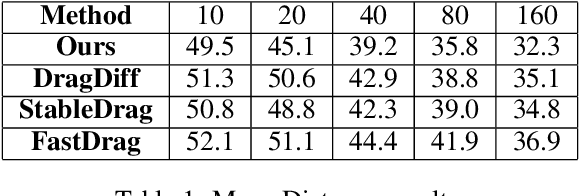
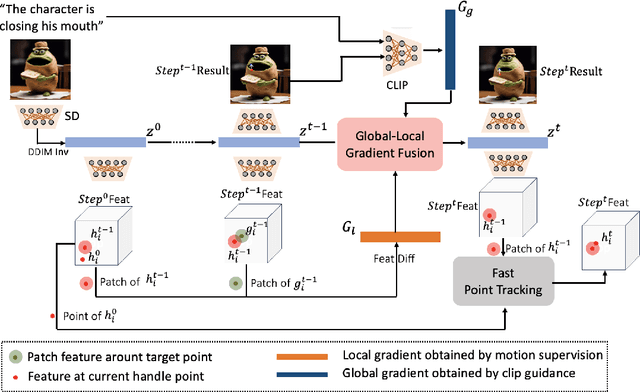
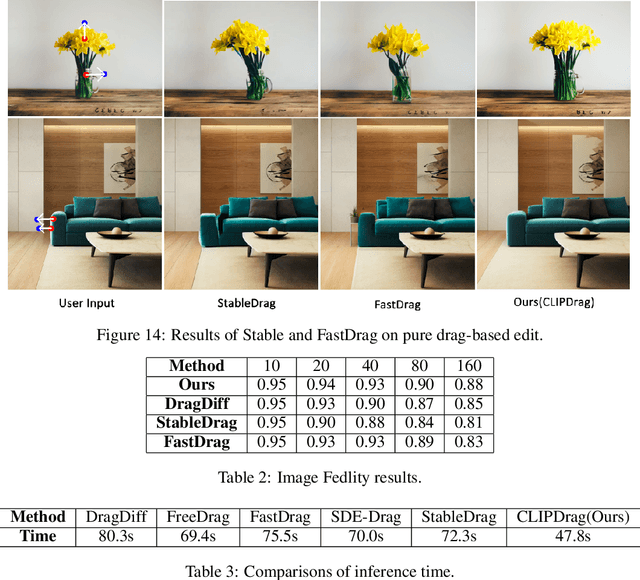
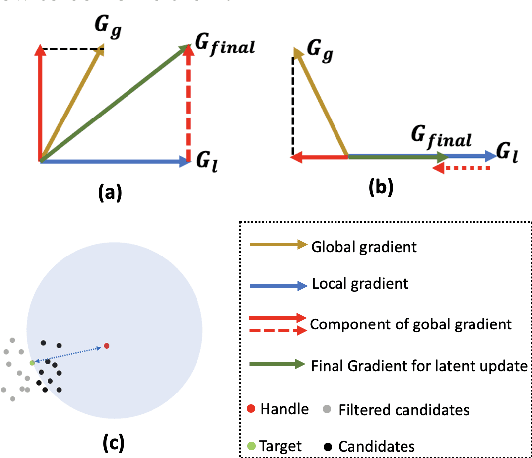
Precise and flexible image editing remains a fundamental challenge in computer vision. Based on the modified areas, most editing methods can be divided into two main types: global editing and local editing. In this paper, we choose the two most common editing approaches (ie text-based editing and drag-based editing) and analyze their drawbacks. Specifically, text-based methods often fail to describe the desired modifications precisely, while drag-based methods suffer from ambiguity. To address these issues, we proposed \textbf{CLIPDrag}, a novel image editing method that is the first to combine text and drag signals for precise and ambiguity-free manipulations on diffusion models. To fully leverage these two signals, we treat text signals as global guidance and drag points as local information. Then we introduce a novel global-local motion supervision method to integrate text signals into existing drag-based methods by adapting a pre-trained language-vision model like CLIP. Furthermore, we also address the problem of slow convergence in CLIPDrag by presenting a fast point-tracking method that enforces drag points moving toward correct directions. Extensive experiments demonstrate that CLIPDrag outperforms existing single drag-based methods or text-based methods.
Causal Distillation for Alleviating Performance Heterogeneity in Recommender Systems
May 31, 2024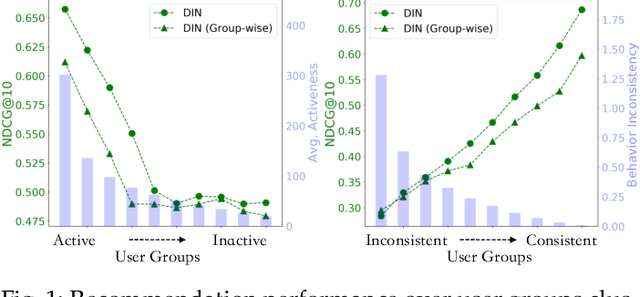
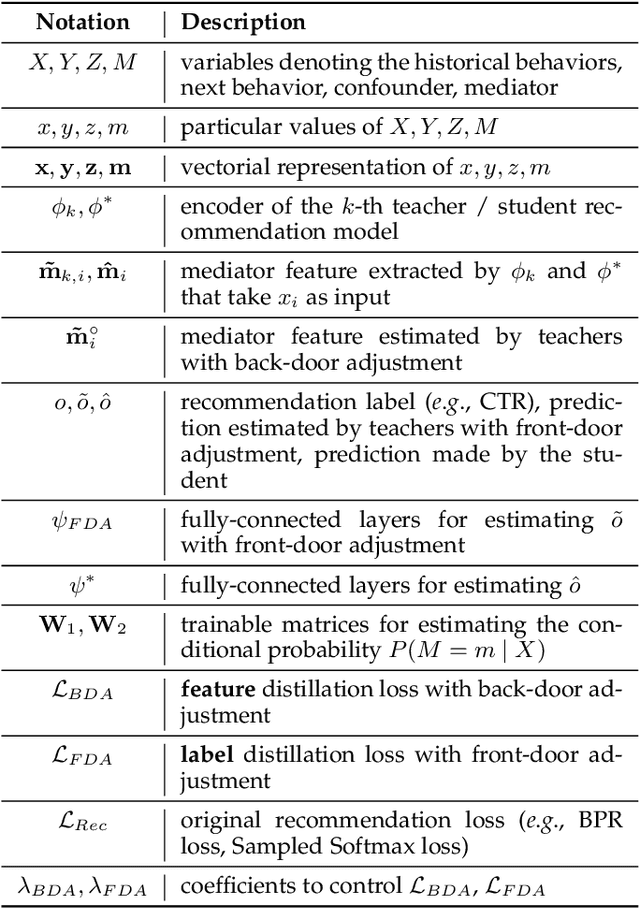
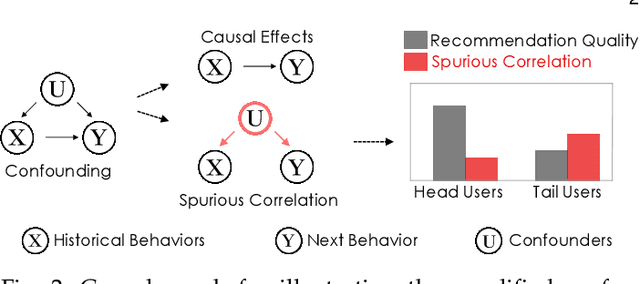
Recommendation performance usually exhibits a long-tail distribution over users -- a small portion of head users enjoy much more accurate recommendation services than the others. We reveal two sources of this performance heterogeneity problem: the uneven distribution of historical interactions (a natural source); and the biased training of recommender models (a model source). As addressing this problem cannot sacrifice the overall performance, a wise choice is to eliminate the model bias while maintaining the natural heterogeneity. The key to debiased training lies in eliminating the effect of confounders that influence both the user's historical behaviors and the next behavior. The emerging causal recommendation methods achieve this by modeling the causal effect between user behaviors, however potentially neglect unobserved confounders (\eg, friend suggestions) that are hard to measure in practice. To address unobserved confounders, we resort to the front-door adjustment (FDA) in causal theory and propose a causal multi-teacher distillation framework (CausalD). FDA requires proper mediators in order to estimate the causal effects of historical behaviors on the next behavior. To achieve this, we equip CausalD with multiple heterogeneous recommendation models to model the mediator distribution. Then, the causal effect estimated by FDA is the expectation of recommendation prediction over the mediator distribution and the prior distribution of historical behaviors, which is technically achieved by multi-teacher ensemble. To pursue efficient inference, CausalD further distills multiple teachers into one student model to directly infer the causal effect for making recommendations.