 Add to Chrome
 Add to Firefox
 Add to Edge
DIFFCZSL: Compositional Zero-Shot Learning Regularized by Diffusion Representations
Aug 20, 2026
Compositional Zero-Shot Learning (CZSL) aims to recognize unseen attribute-object compositions by leveraging knowledge of primitive concepts learned from seen compositions. Although recent works achieve impressive performance in CZSL by leveraging large vision-language models, they primarily rely on discriminative representations that may not explicitly preserve the structured relationships between primitive concepts and their compositions. Motivated by the recent success of diffusion-based classifiers and their competitive performance relative to discriminative models, we investigate whether intermediate diffusion representations can provide complementary cues for CZSL. To this end, we propose DIFFCZSL, a diffusion-augmented framework that injects generative priors from pre-trained diffusion models into CLIP-based CZSL pipelines. We extract intermediate diffusion representations and project them into the CLIP embedding space to provide auxiliary supervision on both image and text modalities. Through contrastive alignment between CLIP embeddings and diffusion features during training, our method encourages the embedding geometry toward richer composition-aware semantics, while introducing no additional cost at inference time. Extensive experiments on three public CZSL benchmarks demonstrate consistent improvements over strong CLIP-based baselines under both closed-world and open-world settings. Our results highlight the complementary strengths of generative diffusion representations and discriminative vision-language models for compositional generalization.

FlowCIR: Semantic Transport via Flow Matching for Zero-Shot Composed Image Retrieval
Jul 02, 2026Zero-shot composed image retrieval (ZS-CIR) aims to retrieve a target image by editing a reference image with a natural-language instruction, without relying on domain-specific annotated triplets. Most existing ZS-CIR methods rely on textual inversion to translate the reference image into pseudo-text tokens and then compose them with the instruction via simple concatenation in the text space, which can be lossy and brittle for fine-grained semantics. In this work, we propose a new paradigm, namely FlowCIR, that casts ZS-CIR as conditional semantic transport between reference and target embeddings. Leveraging \emph{conditional flow matching}, our model learns a lightweight transport field that maps the instruction representation toward a target-aligned query embedding conditioned on the reference image. Since FlowCIR operates on pre-extracted VLM embeddings and trains only a small transport module without updating the image or text encoder, it offers a computationally efficient training protocol compared with prior textual-inversion-based approaches. The resulting framework is training-efficient, requiring roughly $10\times$ fewer training resources than prior textual-inversion-based approaches. We further identify negation and removal as a major failure mode of VLM-based composition. To address this, we propose an inference-only Multi-Negative Steering strategy that steers a negation-containing relative instruction away from its negated semantics, mitigating the limited negation handling of VLMs and improving robustness on negation-heavy queries. Extensive experiments on standard CIR benchmarks demonstrate that FlowCIR achieves strong and competitive performance compared with recent ZS-CIR methods.
LISA: Likelihood Score Alignment for Visual-condition Controllable Generation
Jun 25, 2026The prevalent dual-branch paradigm, i.e., training a side network to encode visual conditions and fusing its intermediate-layer features to a frozen pretrained main network, has shown remarkable success in visual-condition controllable generation. Despite its widespread adoption, the role of the side branch and its training efficiency remain underexplored. In this paper, we first revisit this mainstream paradigm through the lens of score-based generative modeling: 1) The main network preserves visual perceptual quality by providing a prior unconditional score. 2) The side network steers conditional control by implicitly contributing a likelihood score. Guided by this perspective, we propose LIkelihood Score Alignment (LISA), an effective regularization method that explicitly aligns the intermediate feature of the side network with an approximated likelihood score. Specifically, we first hook features from a designated layer of the side network and project them into the score latent space by a lightweight decoder. Then, we construct an approximated likelihood score target and calculate the distance between the decoder's output and this target as an additional regularization loss. Finally, we jointly optimize the side network and decoder with both standard diffusion loss and our regularization loss. Experiments across various image/video tasks, architectures, and diffusion/flow models demonstrated that LISA can not only consistently accelerate the training convergence and improve final synthetic results, but also encourage the side network's features to be more disentangled for conditional modeling with negligible additional training cost and zero extra inference cost.
FlowComposer: Composable Flows for Compositional Zero-Shot Learning
Mar 17, 2026Compositional zero-shot learning (CZSL) aims to recognize unseen attribute-object compositions by recombining primitives learned from seen pairs. Recent CZSL methods built on vision-language models (VLMs) typically adopt parameter-efficient fine-tuning (PEFT). They apply visual disentanglers for decomposition and manipulate token-level prompts or prefixes to encode compositions. However, such PEFT-based designs suffer from two fundamental limitations: (1) Implicit Composition Construction, where composition is realized only via token concatenation or branch-wise prompt tuning rather than an explicit operation in the embedding space; (2) Remained Feature Entanglement, where imperfect disentanglement leaves attribute, object, and composition features mutually contaminated. Together, these issues limit the generalization ability of current CZSL models. In this paper, we are the first to systematically study flow matching for CZSL and introduce FlowComposer, a model-agnostic framework that learns two primitive flows to transport visual features toward attribute and object text embeddings, and a learnable Composer that explicitly fuses their velocity fields into a composition flow. To exploit the inevitable residual entanglement, we further devise a leakage-guided augmentation scheme that reuses leaked features as auxiliary signals. We thoroughly evaluate FlowComposer on three public CZSL benchmarks by integrating it as a plug-and-play component into various baselines, consistently achieving significant improvements.
Path-Decoupled Hyperbolic Flow Matching for Few-Shot Adaptation
Feb 24, 2026Recent advances in cross-modal few-shot adaptation treat visual-semantic alignment as a continuous feature transport problem via Flow Matching (FM). However, we argue that Euclidean-based FM overlooks fundamental limitations of flat geometry, where polynomial volume growth fails to accommodate diverse feature distributions, leading to severe path entanglement. To this end, we propose path-decoupled Hyperbolic Flow Matching (HFM), leveraging the Lorentz manifold's exponential expansion for trajectory decoupling. HFM structures the transport via two key designs: 1) Centripetal hyperbolic alignment: It constructs a centripetal hierarchy by anchoring textual roots, which pushes visual leaves to the boundary to initialize orderly flows. 2) Path-decoupled objective: It acts as a ``semantic guardrail'' rigidly confining trajectories within isolated class-specific geodesic corridors via step-wise supervision. Furthermore, we devise an adaptive diameter-based stopping to prevent over-transportation into the crowded origin based on the intrinsic semantic scale. Extensive ablations on 11 benchmarks have shown that HFM establishes a new state-of-the-art, consistently outperforming its Euclidean counterparts. Our codes and models will be released.
Category Discovery: An Open-World Perspective
Sep 26, 2025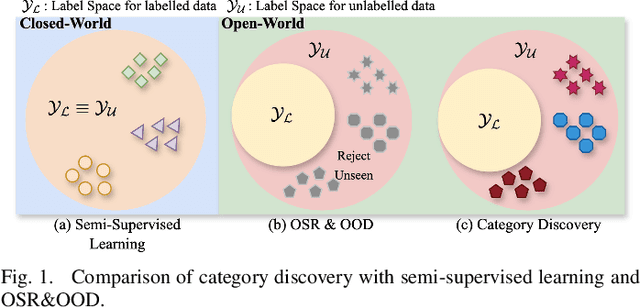
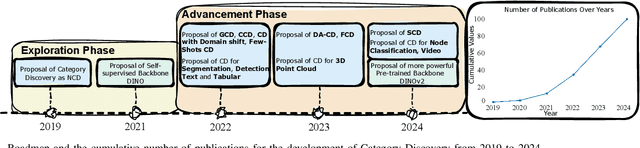
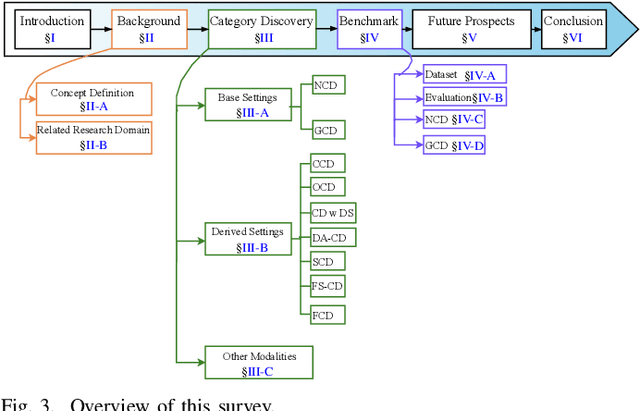
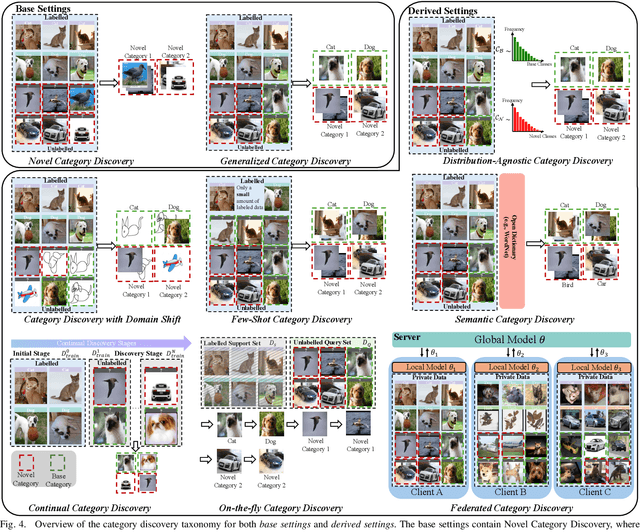
Category discovery (CD) is an emerging open-world learning task, which aims at automatically categorizing unlabelled data containing instances from unseen classes, given some labelled data from seen classes. This task has attracted significant attention over the years and leads to a rich body of literature trying to address the problem from different perspectives. In this survey, we provide a comprehensive review of the literature, and offer detailed analysis and in-depth discussion on different methods. Firstly, we introduce a taxonomy for the literature by considering two base settings, namely novel category discovery (NCD) and generalized category discovery (GCD), and several derived settings that are designed to address the extra challenges in different real-world application scenarios, including continual category discovery, skewed data distribution, federated category discovery, etc. Secondly, for each setting, we offer a detailed analysis of the methods encompassing three fundamental components, representation learning, label assignment, and estimation of class number. Thirdly, we benchmark all the methods and distill key insights showing that large-scale pretrained backbones, hierarchical and auxiliary cues, and curriculum-style training are all beneficial for category discovery, while challenges remain in the design of label assignment, the estimation of class numbers, and scaling to complex multi-object scenarios.Finally, we discuss the key insights from the literature so far and point out promising future research directions. We compile a living survey of the category discovery literature at \href{https://github.com/Visual-AI/Category-Discovery}{https://github.com/Visual-AI/Category-Discovery}.
Hyperbolic Category Discovery
Apr 08, 2025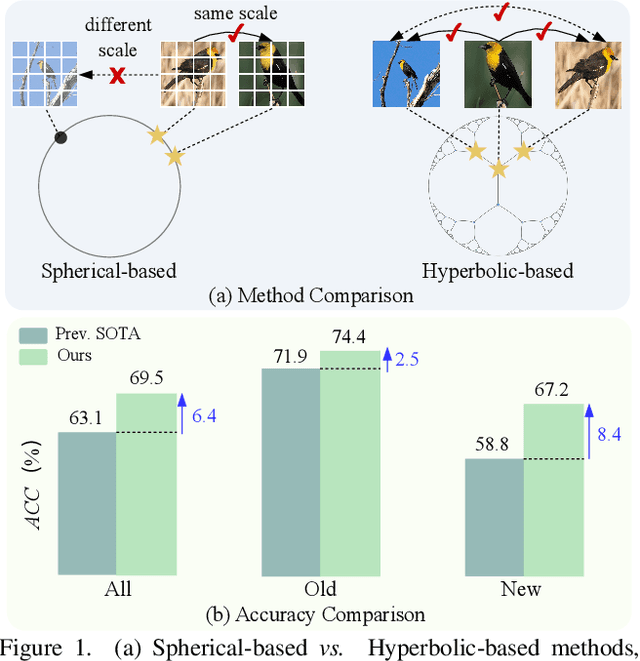
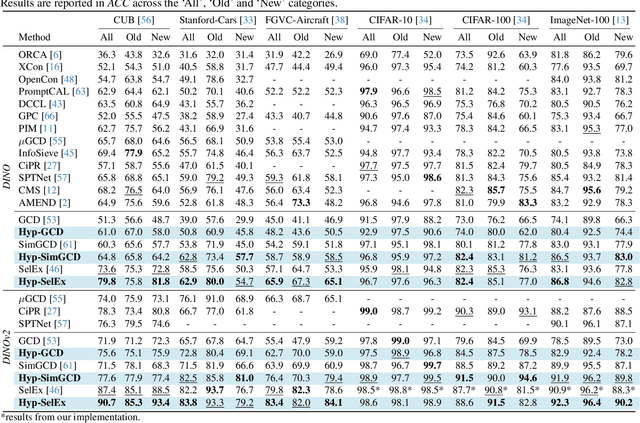
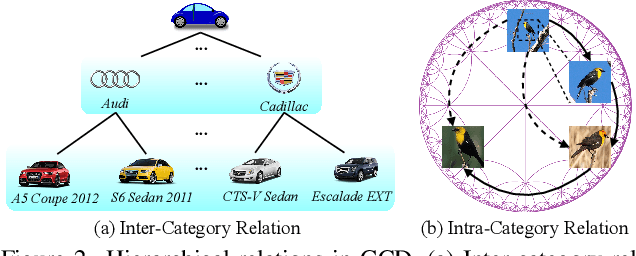
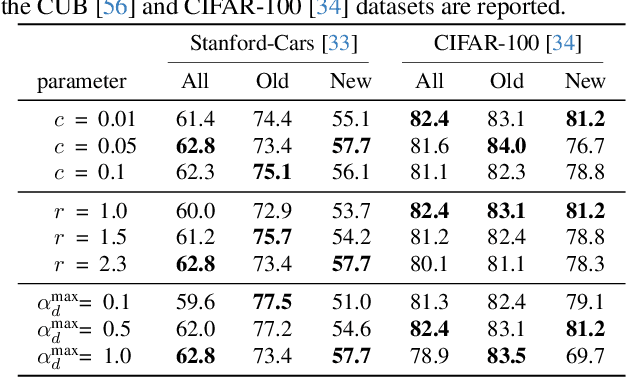
Generalized Category Discovery (GCD) is an intriguing open-world problem that has garnered increasing attention. Given a dataset that includes both labelled and unlabelled images, GCD aims to categorize all images in the unlabelled subset, regardless of whether they belong to known or unknown classes. In GCD, the common practice typically involves applying a spherical projection operator at the end of the self-supervised pretrained backbone, operating within Euclidean or spherical space. However, both of these spaces have been shown to be suboptimal for encoding samples that possesses hierarchical structures. In contrast, hyperbolic space exhibits exponential volume growth relative to radius, making it inherently strong at capturing the hierarchical structure of samples from both seen and unseen categories. Therefore, we propose to tackle the category discovery challenge in the hyperbolic space. We introduce HypCD, a simple \underline{Hyp}erbolic framework for learning hierarchy-aware representations and classifiers for generalized \underline{C}ategory \underline{D}iscovery. HypCD first transforms the Euclidean embedding space of the backbone network into hyperbolic space, facilitating subsequent representation and classification learning by considering both hyperbolic distance and the angle between samples. This approach is particularly helpful for knowledge transfer from known to unknown categories in GCD. We thoroughly evaluate HypCD on public GCD benchmarks, by applying it to various baseline and state-of-the-art methods, consistently achieving significant improvements.
Towards Hierarchical Multi-Step Reward Models for Enhanced Reasoning in Large Language Models
Mar 19, 2025
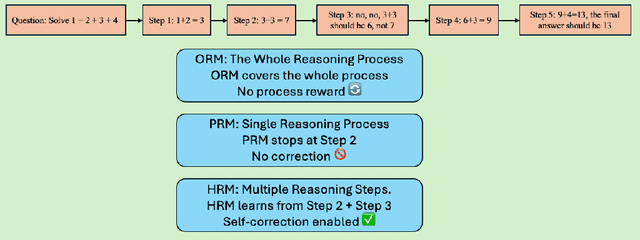
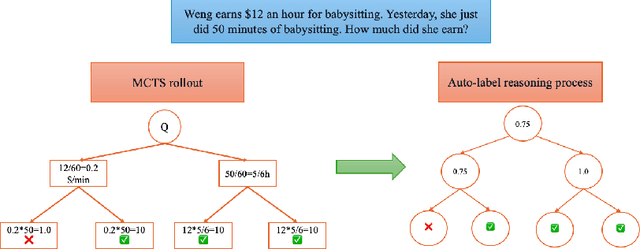
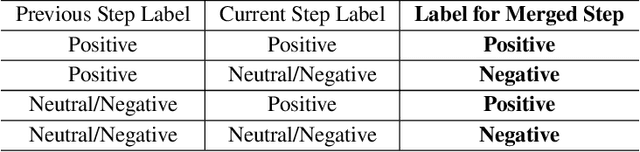
Recent studies show that Large Language Models (LLMs) achieve strong reasoning capabilities through supervised fine-tuning or reinforcement learning. However, a key approach, the Process Reward Model (PRM), suffers from reward hacking, making it unreliable in identifying the best intermediate steps. In this paper, we propose a novel reward model approach, Hierarchical Reward Model (HRM), which evaluates both individual and consecutive reasoning steps from fine-grained and coarse-grained level. HRM performs better in assessing reasoning coherence and self-reflection, particularly when the previous reasoning step is incorrect. Furthermore, to address the inefficiency of autonomous generating PRM training data via Monte Carlo Tree Search (MCTS), we introduce a lightweight and effective data augmentation strategy called Hierarchical Node Compression (HNC) based on node merging (combining two consecutive reasoning steps into one step) in the tree structure. This approach diversifies MCTS results for HRM with negligible computational overhead, enhancing label robustness by introducing noise. Empirical results on the PRM800K dataset demonstrate that HRM, in conjunction with HNC, achieves superior stability and reliability in evaluation compared to PRM. Furthermore, cross-domain evaluations on MATH500 and GSM8K confirm HRM's superior generalization and robustness across diverse reasoning tasks. The code for all experiments will be released at https: //github.com/tengwang0318/hierarchial_reward_model.
BPP-Search: Enhancing Tree of Thought Reasoning for Mathematical Modeling Problem Solving
Nov 26, 2024
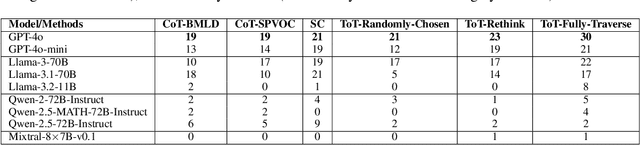
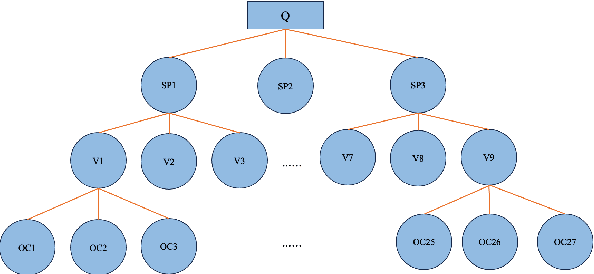
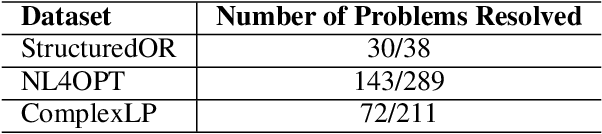
LLMs exhibit advanced reasoning capabilities, offering the potential to transform natural language questions into mathematical models. However, existing open-source operations research datasets lack detailed annotations of the modeling process, such as variable definitions, focusing solely on objective values, which hinders reinforcement learning applications. To address this, we release the StructuredOR dataset, annotated with comprehensive labels that capture the complete mathematical modeling process. We further propose BPP-Search, a algorithm that integrates reinforcement learning into a tree-of-thought structure using Beam search, a Process reward model, and a pairwise Preference algorithm. This approach enables efficient exploration of tree structures, avoiding exhaustive search while improving accuracy. Extensive experiments on StructuredOR, NL4OPT, and MAMO-ComplexLP datasets show that BPP-Search significantly outperforms state-of-the-art methods, including Chain-of-Thought, Self-Consistency, and Tree-of-Thought. In tree-based reasoning, BPP-Search also surpasses Process Reward Model combined with Greedy or Beam Search, demonstrating superior accuracy and efficiency, and enabling faster retrieval of correct solutions.
Large Language Models are Good Multi-lingual Learners : When LLMs Meet Cross-lingual Prompts
Sep 17, 2024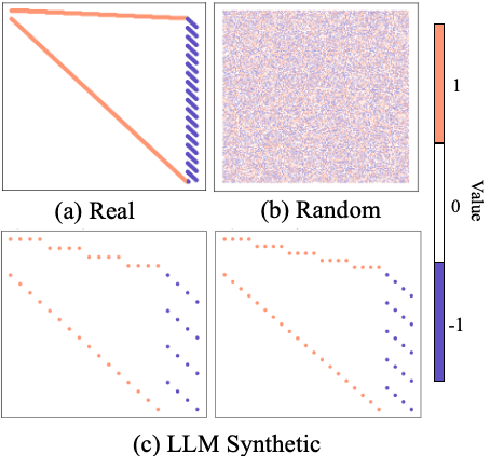

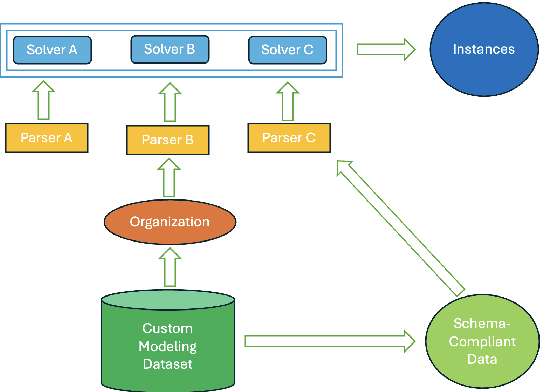

With the advent of Large Language Models (LLMs), generating rule-based data for real-world applications has become more accessible. Due to the inherent ambiguity of natural language and the complexity of rule sets, especially in long contexts, LLMs often struggle to follow all specified rules, frequently omitting at least one. To enhance the reasoning and understanding of LLMs on long and complex contexts, we propose a novel prompting strategy Multi-Lingual Prompt, namely MLPrompt, which automatically translates the error-prone rule that an LLM struggles to follow into another language, thus drawing greater attention to it. Experimental results on public datasets across various tasks have shown MLPrompt can outperform state-of-the-art prompting methods such as Chain of Thought, Tree of Thought, and Self-Consistency. Additionally, we introduce a framework integrating MLPrompt with an auto-checking mechanism for structured data generation, with a specific case study in text-to-MIP instances. Further, we extend the proposed framework for text-to-SQL to demonstrate its generation ability towards structured data synthesis.