 Add to Chrome
 Add to Firefox
 Add to Edge
G0.5: One Autoregressive Stream for Robot Reasoning and Action
Aug 12, 2026
The prevailing recipe for Vision-Language-Action (VLA) models couples a pretrained VLM with a separately trained flow-matching action expert. This makes the VLM a context encoder rather than a decision-maker. We introduce G0.5, a pretrained autoregressive VLA in which a single transformer decoder emits reasoning and action tokens under a single objective. Three components make this tractable at foundation-model scale: a learnable cross-embodiment action tokenizer that maps heterogeneous robot actions into a shared vocabulary; a native chain-of-thought stream interleaving task decomposition, object grounding, and action hints with action tokens; and a visual memory module that injects multi-second history through the vision encoder. Because reasoning and action share a single set of weights, the pretrained VLM's capabilities carry over to physical behavior: the model follows instructions closely, and prompts directly steer action granularity, task horizon, and out-of-distribution scene handling without further training. Pretrained on a large collection of robot datasets together with VQA samples, G0.5 surpasses state-of-the-art models across 7 independent regimes: real-world fine-tuning on R1lite and R1pro robots (76.7\% vs.\ 53.3\% for $π_{0.5}$ and 24.4\% for GR00T-N1.7), the 2025 BEHAVIOR Challenge on 50 long-horizon household mobile manipulation tasks using a generalist policy (31.4\% vs.\ 26.3\% for $π_{0.5}$ and 26.1\% for the challenge winner), DROID post-training followed by zero-shot transfer to an unseen environment and objects (82.5\%), a language-following Pick-and-Place benchmark, LIBERO (98.9\%), RoboTwin 2.0 (93.3\%), and SimplerEnv-Bridge (87.3\%).

FlagGAM: Rule-Based Generalized Additive Modeling for Explainable Tabular Prediction
May 29, 2026Tabular prediction in high-stakes domains requires models that are accurate, transparent, and robust to imperfect inputs. We propose FlagGAM, a rule-defined basis framework that separates feature-level rule construction from prediction. A Flag Core Module converts numerical and categorical variables into sparse, human-readable univariate bases, including threshold flags, category-level flags, tail-deviation bases, and categorical step functions; a default additive head then combines these bases as a restricted GAM-style predictor. Rather than reducing triggered rules to compact count summaries, FlagGAM retains a sparse rule-basis matrix that supports mixed-type classification and regression, feature-specific weighting, and optional flexible prediction heads. Across tabular benchmarks, default FlagGAM remains close to EBM in transparent additive mode, improves substantially over ridge regression on mixed-type regression, and shows smaller AUROC degradation than common baselines under missing and noisy perturbations. Flexible heads further improve accuracy and approach strong tree-based baselines, with the caveat that the resulting model should be interpreted as a rule-basis representation followed by a nonlinear predictor rather than as a fully additive GAM. Overall, FlagGAM provides a practical middle ground for tabular settings that require competitive accuracy, communicable rules, and robustness to imperfect inputs.
Learning Whom to Trust: Market-Feedback Adaptive Retrieval for Frozen LLMs in Event-Driven Financial RAG
May 29, 2026Financial retrieval-augmented generation (RAG) systems typically rank evidence by textual relevance, but in financial markets the useful evidence source depends on event type, forecast horizon, and market context. We study news-triggered event-impact prediction as a point-in-time financial RAG problem. For each company-news anchor, the system retrieves related financial news and SEC filing passages, appends a pre-decision market-context card, and predicts multi-horizon residual-return signals. Our method keeps the large language model (LLM) reader frozen and adapts the retrieval layer through an external Bayesian source memory updated from matured residual-return feedback. On a fixed 89-stock Nasdaq-oriented universe derived from the FinRL-DeepSeek/FNSPID task, using original FNSPID news and point-in-time EDGAR filing passages, Frozen Reader with Source Memory improves held-out macro-F1 from 0.438 to 0.471 and downstream portfolio Sharpe from 0.52 to 0.84 relative to Frozen Reader with No Memory. A supervised LoRA reader improves static RAG modestly, but does not improve over the frozen source-memory reader. These results suggest that, for financial RAG, learning where to retrieve from can be as important as learning how to read, offering a simple, modular route to market-feedback adaptation.
AnyPoC: Universal Proof-of-Concept Test Generation for Scalable LLM-Based Bug Detection
Apr 13, 2026While recent LLM-based agents can identify many candidate bugs in source code, their reports remain static hypotheses that require manual validation, limiting the practicality of automated bug detection. We frame this challenge as a test generation task: given a candidate report, synthesizing an executable proof-of-concept test, or simply a PoC - such as a script, command sequence, or crafted input - to trigger the suspected defect. Automated PoC generation can act as a scalable validation oracle, enabling end-to-end autonomous bug detection by providing concrete execution evidence. However, naive LLM agents are unreliable validators: they are biased toward "success" and may reward-hack by producing plausible but non-functional PoCs or even hallucinated traces. To address this, we present AnyPoC, a general multi-agent framework that (1) analyzes and fact-checks a candidate bug report, (2) iteratively synthesizes and executes a PoC while collecting execution traces, and (3) independently re-executes and scrutinizes the PoC to mitigate hallucination and reward hacking. In addition, AnyPoC also continuously extracts and evolves a PoC knowledge base to handle heterogeneous tasks. AnyPoC operates on candidate bug reports regardless of their source and can be paired with different bug reporters. To demonstrate practicality and generality, we apply AnyPoC, with a simple agentic bug reporter, on 12 critical software systems across diverse languages/domains (many with millions of lines of code) including Firefox, Chromium, LLVM, OpenSSL, SQLite, FFmpeg, and Redis. Compared to the state-of-the-art coding agents, e.g., Claude Code and Codex, AnyPoC produces 1.3x more valid PoCs for true-positive bug reports and rejects 9.8x more false-positive bug reports. To date, AnyPoC has discovered 122 new bugs (105 confirmed, 86 already fixed), with 45 generated PoCs adopted as official regression tests.
Piece of CAKE: Adaptive Execution Engines via Microsecond-Scale Learning
Feb 04, 2026Low-level database operators often admit multiple physical implementations ("kernels") that are semantically equivalent but have vastly different performance characteristics depending on the input data distribution. Existing database systems typically rely on static heuristics or worst-case optimal defaults to select these kernels, often missing significant performance opportunities. In this work, we propose CAKE (Counterfactual Adaptive Kernel Execution), a system that learns to select the optimal kernel for each data "morsel" using a microsecond-scale contextual multi-armed bandit. CAKE circumvents the high latency of traditional reinforcement learning by exploiting the cheapness of counterfactuals -- selectively running multiple kernels to obtain full feedback -- and compiling policies into low-latency regret trees. Experimentally, we show that CAKE can reduce end-to-end workload latency by up to 2x compared to state-of-the-art static heuristics.
Streaming Hallucination Detection in Long Chain-of-Thought Reasoning
Jan 05, 2026Long chain-of-thought (CoT) reasoning improves the performance of large language models, yet hallucinations in such settings often emerge subtly and propagate across reasoning steps. We suggest that hallucination in long CoT reasoning is better understood as an evolving latent state rather than a one-off erroneous event. Accordingly, we treat step-level hallucination judgments as local observations and introduce a cumulative prefix-level hallucination signal that tracks the global evolution of the reasoning state over the entire trajectory. Overall, our approach enables streaming hallucination detection in long CoT reasoning, providing real-time, interpretable evidence.
CriticSearch: Fine-Grained Credit Assignment for Search Agents via a Retrospective Critic
Nov 15, 2025Tool-Integrated Reasoning (TIR) with search engines enables large language models to iteratively retrieve up-to-date external knowledge, enhancing adaptability and generalization in complex question-answering tasks. However, existing search agent pipelines typically depend on reinforcement learning based optimization, which often suffers from sparse outcome rewards, leading to inefficient exploration and unstable training. We introduce CriticSearch, a fine-grained credit-assignment framework that supplies dense, turn-level feedback via a retrospective critic mechanism. During training, a frozen, asymmetric critique LLM retrospectively evaluates each turn using privileged information from the full trajectory and gold answers, converting these assessments into stable, dense rewards that guide policy improvement. Experimental results across diverse multi-hop reasoning benchmarks demonstrate that CriticSearch consistently outperforms existing baselines, achieving faster convergence, improved training stability, and higher performance.
Empowering Multi-Robot Cooperation via Sequential World Models
Sep 16, 2025Model-based reinforcement learning (MBRL) has shown significant potential in robotics due to its high sample efficiency and planning capability. However, extending MBRL to multi-robot cooperation remains challenging due to the complexity of joint dynamics. To address this, we propose the Sequential World Model (SeqWM), a novel framework that integrates the sequential paradigm into model-based multi-agent reinforcement learning. SeqWM employs independent, sequentially structured agent-wise world models to decompose complex joint dynamics. Latent rollouts and decision-making are performed through sequential communication, where each agent generates its future trajectory and plans its actions based on the predictions of its predecessors. This design enables explicit intention sharing, enhancing cooperative performance, and reduces communication overhead to linear complexity. Results in challenging simulated environments (Bi-DexHands and Multi-Quad) show that SeqWM outperforms existing state-of-the-art model-free and model-based baselines in both overall performance and sample efficiency, while exhibiting advanced cooperative behaviors such as predictive adaptation and role division. Furthermore, SeqWM has been success fully deployed on physical quadruped robots, demonstrating its effectiveness in real-world multi-robot systems. Demos and code are available at: https://github.com/zhaozijie2022/seqwm-marl
KNighter: Transforming Static Analysis with LLM-Synthesized Checkers
Mar 12, 2025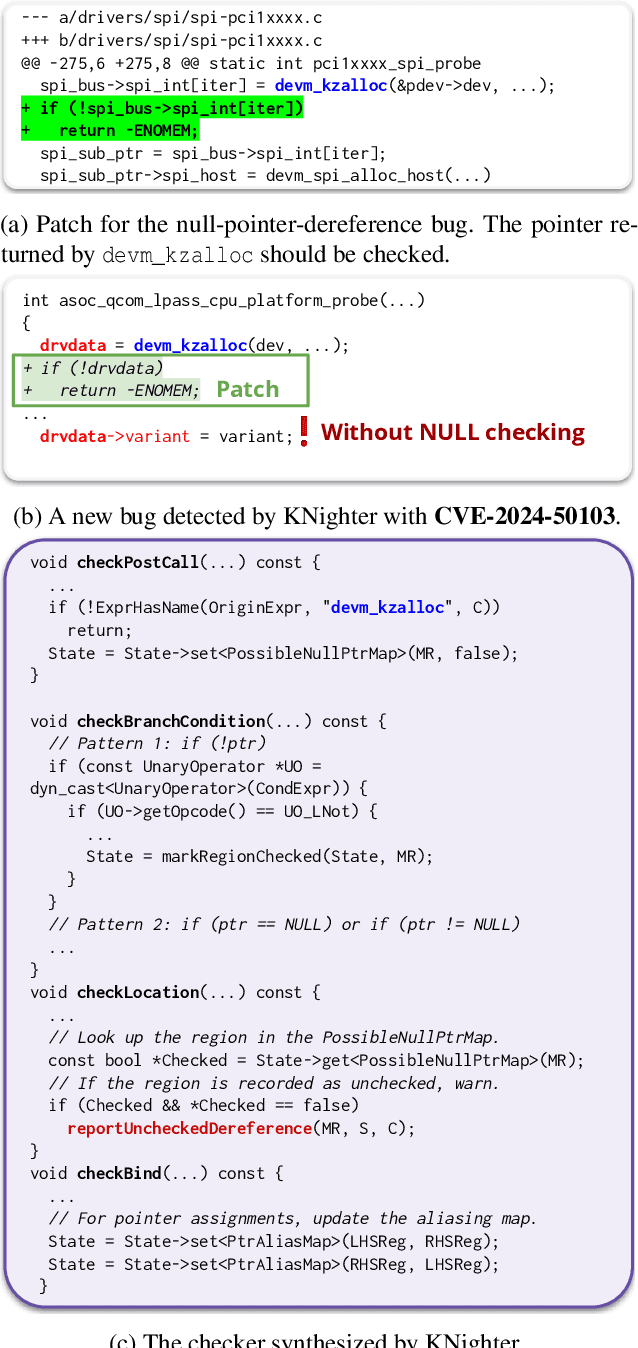
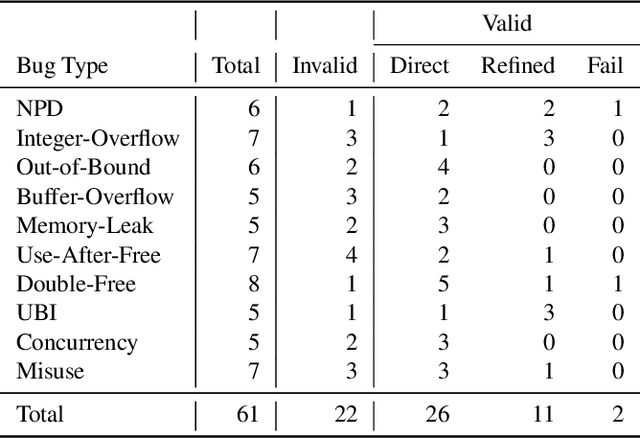
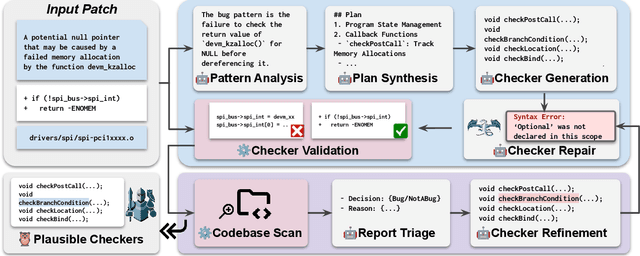

Static analysis is a powerful technique for bug detection in critical systems like operating system kernels. However, designing and implementing static analyzers is challenging, time-consuming, and typically limited to predefined bug patterns. While large language models (LLMs) have shown promise for static analysis, directly applying them to scan large codebases remains impractical due to computational constraints and contextual limitations. We present KNighter, the first approach that unlocks practical LLM-based static analysis by automatically synthesizing static analyzers from historical bug patterns. Rather than using LLMs to directly analyze massive codebases, our key insight is leveraging LLMs to generate specialized static analyzers guided by historical patch knowledge. KNighter implements this vision through a multi-stage synthesis pipeline that validates checker correctness against original patches and employs an automated refinement process to iteratively reduce false positives. Our evaluation on the Linux kernel demonstrates that KNighter generates high-precision checkers capable of detecting diverse bug patterns overlooked by existing human-written analyzers. To date, KNighter-synthesized checkers have discovered 70 new bugs/vulnerabilities in the Linux kernel, with 56 confirmed and 41 already fixed. 11 of these findings have been assigned CVE numbers. This work establishes an entirely new paradigm for scalable, reliable, and traceable LLM-based static analysis for real-world systems via checker synthesis.
Hierarchical Reinforced Trader (HRT): A Bi-Level Approach for Optimizing Stock Selection and Execution
Oct 19, 2024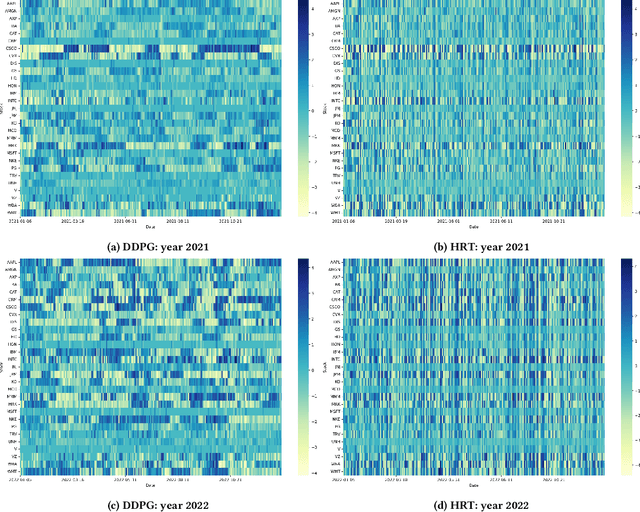

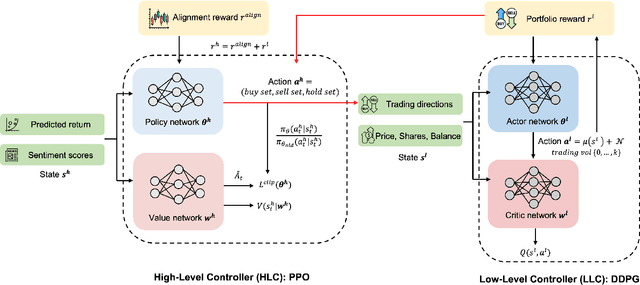
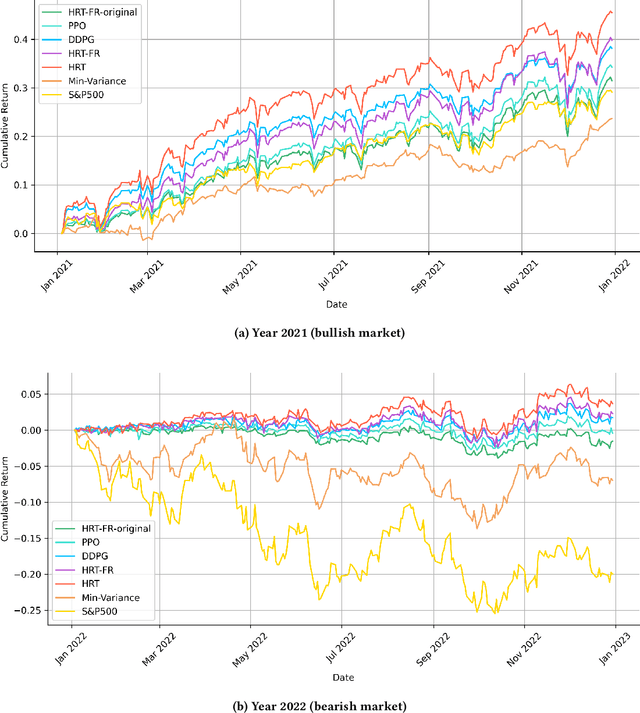
Leveraging Deep Reinforcement Learning (DRL) in automated stock trading has shown promising results, yet its application faces significant challenges, including the curse of dimensionality, inertia in trading actions, and insufficient portfolio diversification. Addressing these challenges, we introduce the Hierarchical Reinforced Trader (HRT), a novel trading strategy employing a bi-level Hierarchical Reinforcement Learning framework. The HRT integrates a Proximal Policy Optimization (PPO)-based High-Level Controller (HLC) for strategic stock selection with a Deep Deterministic Policy Gradient (DDPG)-based Low-Level Controller (LLC) tasked with optimizing trade executions to enhance portfolio value. In our empirical analysis, comparing the HRT agent with standalone DRL models and the S&P 500 benchmark during both bullish and bearish market conditions, we achieve a positive and higher Sharpe ratio. This advancement not only underscores the efficacy of incorporating hierarchical structures into DRL strategies but also mitigates the aforementioned challenges, paving the way for designing more profitable and robust trading algorithms in complex markets.