 Add to Chrome
 Add to Firefox
 Add to Edge
G0.5: One Autoregressive Stream for Robot Reasoning and Action
Aug 12, 2026
The prevailing recipe for Vision-Language-Action (VLA) models couples a pretrained VLM with a separately trained flow-matching action expert. This makes the VLM a context encoder rather than a decision-maker. We introduce G0.5, a pretrained autoregressive VLA in which a single transformer decoder emits reasoning and action tokens under a single objective. Three components make this tractable at foundation-model scale: a learnable cross-embodiment action tokenizer that maps heterogeneous robot actions into a shared vocabulary; a native chain-of-thought stream interleaving task decomposition, object grounding, and action hints with action tokens; and a visual memory module that injects multi-second history through the vision encoder. Because reasoning and action share a single set of weights, the pretrained VLM's capabilities carry over to physical behavior: the model follows instructions closely, and prompts directly steer action granularity, task horizon, and out-of-distribution scene handling without further training. Pretrained on a large collection of robot datasets together with VQA samples, G0.5 surpasses state-of-the-art models across 7 independent regimes: real-world fine-tuning on R1lite and R1pro robots (76.7\% vs.\ 53.3\% for $π_{0.5}$ and 24.4\% for GR00T-N1.7), the 2025 BEHAVIOR Challenge on 50 long-horizon household mobile manipulation tasks using a generalist policy (31.4\% vs.\ 26.3\% for $π_{0.5}$ and 26.1\% for the challenge winner), DROID post-training followed by zero-shot transfer to an unseen environment and objects (82.5\%), a language-following Pick-and-Place benchmark, LIBERO (98.9\%), RoboTwin 2.0 (93.3\%), and SimplerEnv-Bridge (87.3\%).

The Post-GCN Decade Revisited: Curvature-Stratified Evaluation of Relational Learning
Jun 04, 2026Current evaluation practices in relational learning rely heavily on flat leaderboards that average performance across heterogeneous datasets, implicitly assuming a uniform underlying structure. We show that this assumption introduces systematic bias: it obscures geometry-dependent performance variations and can lead to misleading conclusions about model generalization. In this work, we identify intrinsic geometry as a key latent factor governing model effectiveness. We demonstrate that conventional aggregated metrics mask critical performance trade-offs that only become visible when datasets are stratified by their geometric properties. To address this issue, we introduce a curvature-stratified evaluation framework that partitions datasets into positive, negative, and near-zero curvature regimes. Our benchmark evaluates 18 representative models including Graph Convolutional Networks (GCNs), Graph Foundation Models (GFMs), and tabular learning methods across 14 datasets. We find that model rankings are highly stable within each curvature regime but shift significantly across regimes, indicating that performance is fundamentally geometry-dependent rather than universally transferable. Notably, we identify regimes where GFMs offer diminishing returns compared to geometry-aligned GNNs. Based on these findings, we propose a geometry-aware evaluation protocol that yields more reliable and interpretable comparisons than standard aggregated benchmarks. We release all code, curvature-stratified dataset splits, and evaluation tools to support reproducible and rigorous assessment of future relational learning methods. Code and datasets are provided in our project homepage: https://sirbabbage.github.io/CurvBench_HOME/.
RoboMIND 2.0: A Multimodal, Bimanual Mobile Manipulation Dataset for Generalizable Embodied Intelligence
Dec 31, 2025While data-driven imitation learning has revolutionized robotic manipulation, current approaches remain constrained by the scarcity of large-scale, diverse real-world demonstrations. Consequently, the ability of existing models to generalize across long-horizon bimanual tasks and mobile manipulation in unstructured environments remains limited. To bridge this gap, we present RoboMIND 2.0, a comprehensive real-world dataset comprising over 310K dual-arm manipulation trajectories collected across six distinct robot embodiments and 739 complex tasks. Crucially, to support research in contact-rich and spatially extended tasks, the dataset incorporates 12K tactile-enhanced episodes and 20K mobile manipulation trajectories. Complementing this physical data, we construct high-fidelity digital twins of our real-world environments, releasing an additional 20K-trajectory simulated dataset to facilitate robust sim-to-real transfer. To fully exploit the potential of RoboMIND 2.0, we propose MIND-2 system, a hierarchical dual-system frame-work optimized via offline reinforcement learning. MIND-2 integrates a high-level semantic planner (MIND-2-VLM) to decompose abstract natural language instructions into grounded subgoals, coupled with a low-level Vision-Language-Action executor (MIND-2-VLA), which generates precise, proprioception-aware motor actions.
An interpretability framework for Similar case matching
Apr 04, 2023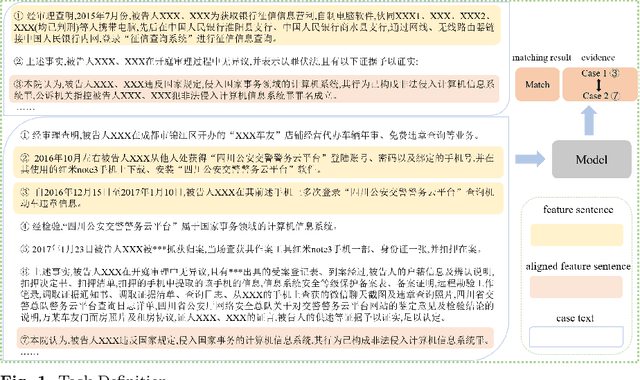
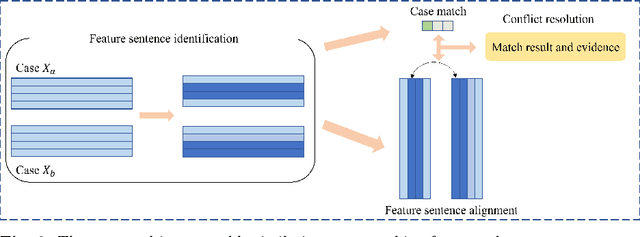
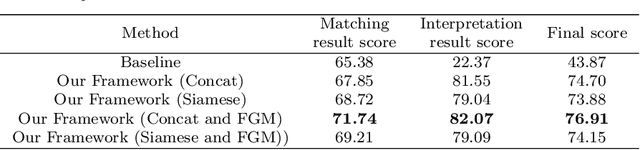
Similar Case Matching (SCM) is designed to determine whether two cases are similar. The task has an essential role in the legal system, helping legal professionals to find relevant cases quickly and thus deal with them more efficiently. Existing research has focused on improving the model's performance but not on its interpretability. Therefore, this paper proposes a pipeline framework for interpretable SCM, which consists of four modules: a judicial feature sentence identification module, a case matching module, a feature sentence alignment module, and a conflict disambiguation module. Unlike existing SCM methods, our framework will identify feature sentences in a case that contain essential information, perform similar case matching based on the extracted feature sentence results, and align the feature sentences in the two cases to provide evidence for the similarity of the cases. SCM results may conflict with feature sentence alignment results, and our framework further disambiguates against this inconsistency. The experimental results show the effectiveness of our framework, and our work provides a new benchmark for interpretable SCM.